|
T of C
Home |
My Work |
Hand- books |
Qin as Object |
Qin in Art |
Poetry / Song |
Hear, Watch |
Play Qin |
Analysis | History |
Ideo- logy |
Miscel- lanea |
More Info |
Personal | email me search me |
| Origins In Qinshu Cunmu Qin Biographies pdf of original | 中文(殘) 首頁 |
| Qin Shi (History of the Qin) | 琴史 1 |
| By Zhu Changwen (1041-1098) | 朱長文 2 |
| Now available in English translation 3 |
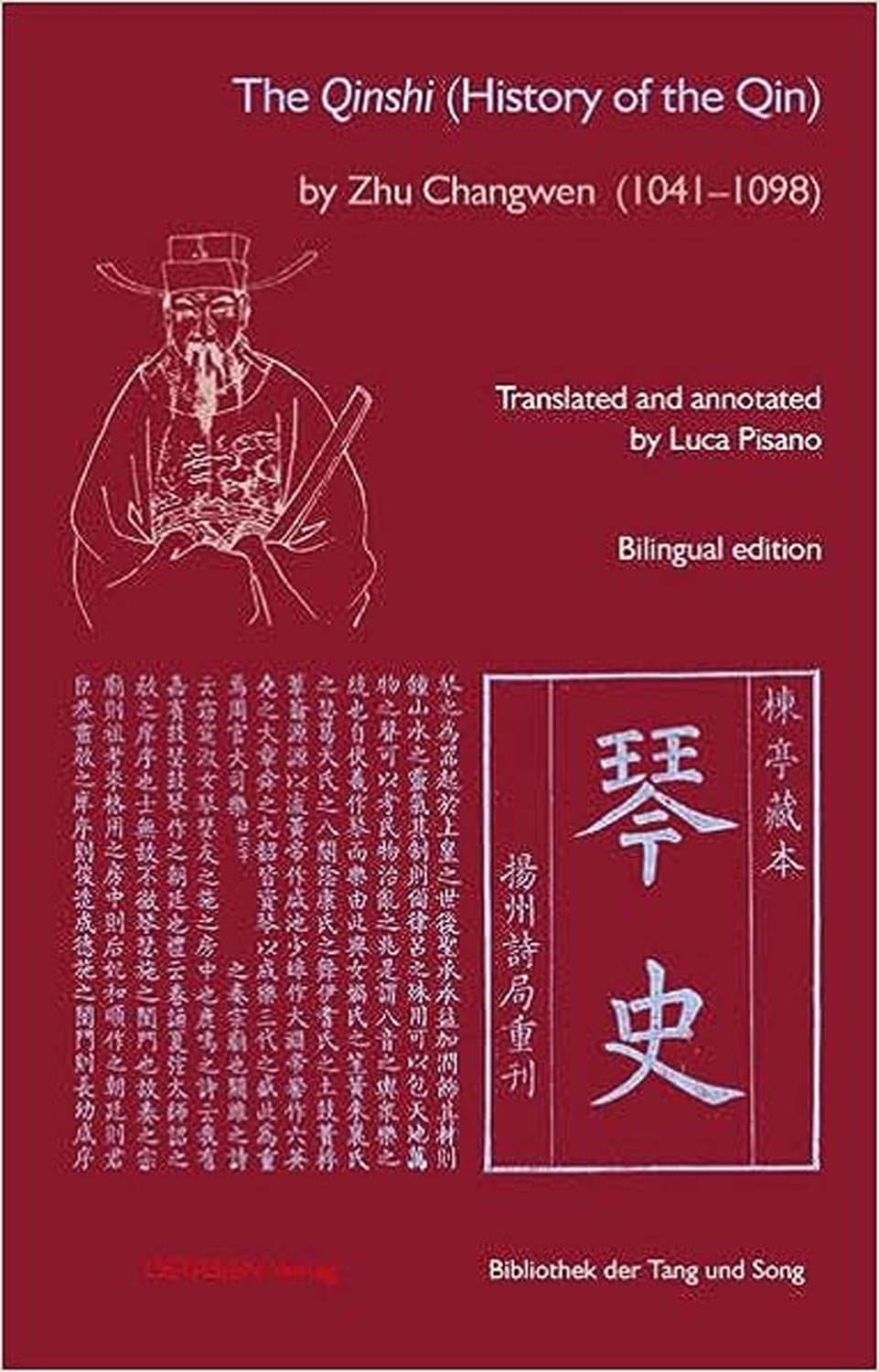 Qin Shi, by Zhu Changwen, has six folios (see contents outline below
4). The first five folios should have 146 biographical essays, but in the Lianting edition reprinted in Yangzhou originally available to me three entries were garbled into one. Eleven of the entries concern women.5 In addition, the final folio has 11 theoretical and practical treatises.6
Qin Shi, by Zhu Changwen, has six folios (see contents outline below
4). The first five folios should have 146 biographical essays, but in the Lianting edition reprinted in Yangzhou originally available to me three entries were garbled into one. Eleven of the entries concern women.5 In addition, the final folio has 11 theoretical and practical treatises.6
The biographical essays relate legends and biographies from the earliest days of the qin to the time of the author. They seem to be organized as much by source as by chronology. The standard format of the entries is that Zhu Changwen begins by quoting or paraphrasing existing written sources, then perhaps adds his own comments. He rarely indicates the source. Some of these quoted sources have also been translated elsewhere.
Until the 2023 translation by Luca Pisano shown at right, very little of this work had been translated anywhere, and most of my own translations here were done in rough form some years ago.7
Below is a list of all 146 Qin Shi biographical entries. There are links to separate entries for those which have extended commentary. Those below that that I have translated but for which I only have short commentary have two sections, an opening explanation then, indented, my translation of the original Qin Shi article.
- 帝堯 Emperor Yao (traditional dates 2356-2255)
中文. See separate entry; also "唐堯 Tang Yao"; he and "虞舜 Yu Shun" are referred to together as "唐虞 Tang Yu". - 帝舜 Emperor Shun (traditional dates 2317-2208)
中文. See separate entry - 大禹 Da Yu (Great Yu; traditional d. 2197 BCE)
中文. See separate entry - 成湯 Cheng Tang (ca. 18th c. BCE)
中文. See separate entry - 太王 Tai Wang, Supreme King (d. 12th c. BCE)
中文. See separate entry; Tai Wang was also called 古公亶父 Gugong (old duke) Danfu - 王季 King Ji (12th/11th c. BCE)
中文. See separate entry; given name Jili; son of #5 Tai Wang - 文王 Wen Wang (d. ca. 1073 BCE)
中文. See separate entry; original name 姬昌 Ji Chang. - 武王 Wu Wang, the Martial King (r. 1073 - 1068)
中文. See separate entry - 成王 Cheng Wang (r. 1115 - 1078)
中文. See separate entry'' - 周公 Zhou Gong (Duke of Zhou; also called 魯周公 Duke Zhou of Lu)
中文. See separate entry - 孔子 Confucius (551-479)
中文. See separate entry - 許由 Xu You (ca. 2000 BCE)
中文. See separate entry - 夷、齊 Yi Qi (伯夷、叔齊 Bo Yi and Shu Qi)
中文. See separate entry - 箕子 Jizi (Viscount of Ji)
中文. See separate entry - 微子 Weizi (Viscount of Wei)
中文. See separate entry - 伯奇 Bo Qi, i.e., 尹伯奇 Yin Boqi (9th c. BCE)
中文. 中文. Yin Boqi was the eldest son of 尹吉甫 Yin Jifu, a leading minister for 周宣王 King Xuan of Zhou, r. 827-782). When Boqi was slandered by the wife of the second son (other versions say it was Yin Jifu's second wife) he fled to the countryside. Here he wrote 履霜操 Lüshuang Cao (lyrics are from YFSJ, Folio 57, #21) to speak his misery after his father had been persuaded to send him away. He is also associated with a melody called Zi An zhi Cao - 介之推 Jiezhi Tui (also called 介子推 Jiezi Tui); 7th c. BCE
中文. See separate entry. - 史魚 Shi Yu (Historian Yu)
中文. As a minister of 衛靈公 Duke Ling of Wei (534-492 BCE), Shi Yu (3334.143) had a reputation for being outspoken and frank. He once criticized the duke for employing a bad official, 彌子瑕 Mi Zixia; when the advice was ignored Shi Yu died of grief, telling his son not to bury him preperly as he hand not been able to serve properly. Hearing this the duke understood and was respectful. However, Confucius said Shi Yu was too inflexible in his advice. Qin Cao, Hejian Zage, #15, is Shi Yu's Jian Bu Wei Ge (36549.xx Admonish without Waivering Song); see also Shi Yu Shang Jian Ge.(N.B. Shi Ji #67 [GSR VII p.63ff] discusses all of the following disciples of Confucius, but does not have the qin stories)
- 顏子 Yanzi, Master Yan (514 - 483)
中文. See separate entry; nickname of 顏回 Yan Hui. - 子張 Zizhang (503 - 447 BCE;
Wiki)
中文. Zizhang was a nickname of 顓孫師 Zhuansun Shi (7072.441). After his parents died Zizhang became a prominent disciple of Confucius. He played the qin together with Confucius (no melody named); when he played people became 俯 fu (obedient; compare #21 Zixia) - 子夏 Zixia (507-425).
中文. See separate entry; nickname of 卜商 Bu Shang - 閔子 Minzi (born 535 BCE)
中文. See separate entry; nickname of 閔損 Min Sun - 子路 Zilu (542-480)
中文. See separate entry; nickname of 仲由 Zhong You - 曾子 Zengzi (505-436)
中文. See separate entry; nickname of 曾參 Zeng Shen, style name 子輿 Ziyu (compare another Ziyu below) - 原思 Yuan Si (born 525 BCE)
中文. See separate entry; nickname (also 子思 Zisi) of 原憲 Yuan Xian. - 子賤 Zijian (宓子賤 Fu Zijian, born 521 BCE)
中文. See separate entry; nickname of 宓不齊 Fu Buqi
卷二 Folio 2 - 涓子 Juanzi (of 齊 Qi)
See separate entry.
中文. (Also compare Qinshi Bu #24 Liu Juanzi and Xie Juanzi) - 琴高 Qin Gao (21570.40)
中文. See separate entry. - 冠先 Guan Xian
(Lie Xian Zhuan has 寇先 Kou Xian)
中文. A man of 宋 Song who understood Daoist arts. Once when fishing 宋景公 Duke Jing of Song asked him about this. When Guan Xian did not answer he had him killed. Later he was seen squatting on the gates of the city playing the qin. Weeks later he left. A temple was built in his honor. The entry includes a poem from the biography of Kou Xian by Liu Xiang in Liexian Zhuan. (冠先 1610.xxx "Cap First"; 寇先 7350.8 "Plunder First") - 楚商梁 Chu Shang Liang
中文. Sometimes called 莊王 King Zhuang; see separate entry - 師曠 Shi Kuang (Master Kuang), style name 子野 Ziye, a man of 晉 Jin
中文. See separate entry - 師襄子 Shi Xiangzi (9129.189); qin teacher of Confucius
中文. See separate entry. - 瓠巴 Hu Ba (21890.5)
中文. A search in the Chinese Text Project for 瓠巴 Hu Ba in all "Pre-Qin and Han" sources gives four results, as follows:- 荀子勸學 Quan Xue 11 in Xunzi
(Knoblock I.7)
「昔者瓠巴鼓瑟,而流魚出聽;伯牙鼓琴,而六馬仰秣。故聲無小而不聞,行無隱而不形。」 - 韓詩外傳,卷六 Hanshi Waizhuan, Folio 6 #14
「夫子亦誠無善耳。昔者瓠巴鼓瑟,而潛魚出聽;伯牙鼓琴,而六馬仰秣;魚馬猶知善之為善,而況君人者也。」 - 大戴禮記,勸學 Dadai Li Ji, Quan Xue 11
昔者瓠巴鼓瑟,而沈魚出聽;伯牙鼓琴,而六馬仰秣, - 淮南子,說山訓 Huainanzi, Shuoshanxun 2
瓠巴鼓瑟,而淫魚出聽;伯牙鼓琴,駟馬仰秣;介子歌龍蛇,而文君垂泣。
All of these say that when Hu Ba played the se, fish came to the surface of the water to listen, and when Bo Ya played the qin horses looked up from eating. The earliest story about Hu Ba playing the qin is apparently the one in the chapter Tang Wen (Questions of Tang) in the book of Liezi, which actually calls him 匏巴 Pao Ba, of whom 2582.5 says "古善琴之人,與瓠巴同 a good qin player of ancient times, same as Hu Ba" (however, it then mistakenly gives as its source 韓詩外傳,六 Hanshi Waizhuan 6, with the same quote about the se as above). Other stories about Hu Ba all come from later sources.
The text in 列子,湯問 Liezi, Tang Wen 10 is:
匏巴鼓琴,而鳥舞魚躍,鄭師文聞之,棄家從師襄游。
When Pao Ba (or Hu Ba) played the qin birds would dance and fish skip about. Shi Wen of Zheng heard this, and so left home to follow Shi Xiang.The entry for Hu Ba in Qin Shi is as follows:
Hu Ba was a man of Chu who was so good at playing qin that 鳥舞魚躍 birds would dance and fish skip about. If harmony comes from the center and things are arranged on the outside, art reaches its highest level. It is also said that when Hu Ba played the 瑟 se zither hidden fish would emerge in order to listen. Perhaps he was equally good at playing the se. - 荀子勸學 Quan Xue 11 in Xunzi
(Knoblock I.7)
- 師文 Shi Wen (9129.20); music master discussed in Liezi
中文. See separate entry. - 鍾儀 Zhong Yi
中文. See separate entry (QSCB, p.2 describes Zhong Yi as the "first recorded qin specialist") - 師經 Shi Jing (5th c. CE)
中文. Shi Jing (9129.168xxx) was music master (court musician) for 魏文侯 Marquis Wen of Wei (46879.18; Bio/2573; r. ca. 446 - 396; see also Dou Gong! Van Gulik gives his dates as 426 - 387). Marquis Wen is said to have been a cultured and sincere ruler, but he is also quoted as having said that he fell asleep whenever he had to dress up and listen to 古樂 ancient music. Stories similar to the one here are told in 十二國史 (see Qinshu Daquan, Folio 16, #9) and in Van Gulik, Lore, p.155, where Shi Jing tries to strike Marquis Wen because he has started dancing as Shi Jing played. Qin illustration 21 in Taiyin Daquanji shows what it says was Shi Jing's Overturned Cup (覆杯 Fu Bei) qin.Shi Jing served Marquis Wen of Wei. Once he ordered Shi Jing to play the qin. (Shi) asked, "Order"? (Wen) said, When I speak no one dares to disagree. Isn't that joyful? Shi Jing then took his qin and tried to strike Marquis Wen, but he missed. Everyone around said, Execute him. Shi Jing said, I have heard that Yao and Shun were the sort of people who feared only that no one would contradict them. (On the other hand, the tyrants) 桀 Jie and 紂 Zhou were the sort of people who feared only that people would contradict them. I attacked someone like Jie and Zhou, not my own lord. Marquis Wen then released him and gave no further punishment. In the olden days skill in the arts could be used to admonish (a superior.) Although this was the Warring States period, perhaps the custom was still the same. Marquis Wen could be like that. What a sage!
- 榮啟期 Rong Qiqi (5th c. BCE)
中文. See separate entry - 伯牙 Bo Ya (full name 俞伯牙 Yu Boya)
中文. See separate entry - 鐘子期 Zhong Ziqi
中文. See separate entry - 鄒忌子 Master Zou Ji
中文. Master Zou Ji (40445.31 鄒忌 says Zou Ji was also called 田忌 Tian Ji, but there is confusion on this) is discussed in Shi Ji, Books 74 and 75 (see GSR VII, pp. 180 and 189). The story here, though, relates a story told in Shi Ji, Book 46. QSDQ has the same story, prefacing it by saying "In the 20th year of 威王 King Wei (336 BCE)", but saying that it is from 齊世家 Hereditary House of Qi. Shi Ji, p.1889, says 田敬仲完世家 Hereditary House of Tian Jingzhong Wan. Jingzhong was the posthumous name of 齊陳完 Chen Wan of Qi. I haven't figured out how 田 Tian becomes 齊 Qi.Zou Jizi was a minister of 齊威王 King Wei of Qi (r.356 - 320); his nickname was 成侯 Marquis Cheng. Zou Jizi at first used his qin playing to gain audience with the king, who enjoyed it and so installed him in the 右室 apartments to the right. A while later the king himself was playing qin when Zou, hearing it from the doorway, came into the room and said, Such good qin playing! The king angrily put away the qin, picked up his sword, and said, You just saw my form and didn't examine carefully. How can you know it was any good? Zou Jizi (then followed with a discourse on the relationship of qin and 志 will, which saved him.)
(The author, Zhu Changwen [?], comments:) .....
- 雍門周 Yongmen Zhou
中文. For Yongmen Zhou see separate entry; story concerns Lord Mengchang. The essay also discusses Han E; compare Sun Xi, who also made people cry). - 子桑 Zisang
中文. 7072.361 gives his full name as 子桑戶 Zisang Hu (or Zi Sanghu) and quotes Zhuangzi (大宗師 Da Zong Shi - Chapter 6/61) discussing Zisang Hu, 孟子反 Mengzi Fan (referring to 子輿 Ziyu, not 曾子 Zengzi #24 above) and 子琴張 Ziqin Zhang (Zi Qinzhang), all of whom were good friends. Zhuangzi tells of Zisang dying and someone playing qin at his funeral. The present story is quoted from later in the same chapter of Zhuangzi (6/94), but obviously before Zisang had died.As for Zisang, Zhuangzhou once praised him. Zisang and Ziyu were friends, and so after there had been continuous frost (and rain) for 10 days Ziyu said (to himself), "Zisang is dangerously ill." So he took food and went to feed friend. Arriving at Zisang's doorway he heard him singing and sighing as he played his qin and said/sang, "Father? Mother? Heaven? People?" There was lack of control over the sounds, and the lyrics were hurried. Ziyu went in and asked, "Your song and lyrics, what is the reason they are like this?" (Zisang) replied, "I was thinking about what brought me to this extreme, but could not decide. How could my parents have wanted me to be so poor? (Heaven covers all and earth sustains all.) Do heaven and earth want me to be poor? I was searching for the reasons, but was unable. So becoming like this must have been fate." (The essay closes with the writer adding that although Zhuangzi told many allegories, when he spoke of recluses they were often real people and he was commenting on their feelings.) - 屈原 Qu Yuan (ca. 340 - 278)
中文. See separate entry - 宋玉 Song Yu (ca. 290 - ca. 223)
中文. See separate entry - 卞和 Bian He (also "Bian Huo"; 2825.15 - .7)
中文. Bian He was a man of 楚 Chu who acquired a piece of uncut jade and gave it to the King of Chu, then was accused of trying to cheat him with a piece of ordinary stone; he thus had his feet cut off. Later it was discovered that it was true jade, and became known as Mr. He's 壁 bi disc. As a result there is the song "Uprighteousness Leading to Disgrace (信立追怨 Xin Li Chui Yuan) seen in Qin Cao (#12 of Cai Yong's Hejian Zage) telling of his honesty and loyalty to the prince. There was also a melody called Bian He Qi Yu. Someone once asked him why he didn't keep or sell the jade, and he discoursed on the necessity of loyalty. - 牧犢子 Mu Duzi
中文. Mu Duzi (20418.83 a man of 齊 during the Warring States period) was also called 犢牧子 Du Muzi. The melody here is called 朝飛 Zhao Fei (14705.127 朝飛操, Yuefu lyrics for qin melody), not Zhi Zhao Fei (also the title in YFSJ, Folio 57, #23.Mu Duzi, still a bachelor at age 70, went out into the wilds to collect firewood. Seeing a male and female ring-necked pheasant flying together his emotions were stirred and he wrote Zhao Fei zhi Qu, included in Qin Cao. There is also a Mu Duzi zhi Ge.... - 商陵牧子 Shangling Muzi (3834.xxx/ Bio/2204)
中文. The only reference quoted at Bio/2204 is an introduction to the melody 別鶴操 Bie He Cao (1955.175 -.177; Lament #9, also called .170 別鵠操 Bie Gu Cao), said to be from Qin Cao. A similar story introduces the Biehe Cao lyrics in YFSJ, Folio 58, #11 (pp. 844-7; see partial translation.) As here, these relate the story that after five years of marriage but no children Shangling Muzi was torn between the need to honor his parents, who wanted him to find a new wife in order to provide them with an heir, and his love for his wife. Observing her unhappiness over this led him to create Biegu Cao for the qin. The biography here ends by quoting the YFSJ lyrics on this theme by Han Yu.Shangling Muzi was married but had no children. His parents wanted him to send away his wife (and get a new one). After his wife heard this she arose in the middle of the night and sadly leant against the doorway, sighing. So Muzi took out his qin and played it, creating the melody Bie He Cao. In order to manage this affair morally - 霍里子高 Huoli Zigao (43291.32 Han dynasty)
中文. Huoli Zigao was a recluse who worked as a ferry operator at 朝鮮 Chao Xian (14705.355 a district in China; also: Korea). One morning some dissolute men came wanting a trip. The ferry operator's wife asked her husband not to go across, saying he they would drown. She even took up a 箜篌 harp and sang her warning. However, he went ahead and they drowned (or the others drowned, or he hadn't gone yet?). She then sang of her misery and jumped into the river, drowning herself. Zigao, observing this, was very sad so he played a 箜篌引 Konghou Yin on the qin. This is the same as 公無渡河曲 the song Husband Don't Cross the River, and is said to be an allegory for a person who "drowns" in a confused society because of not maintaining propriety, etc. (He called his wife 麗玉 Beautiful Jade [48631.14]. Konghou Yin is #7 of the Nine 引 Preludes in Cai Yong's Qin Cao.)* 屠門高 Tumen Gao (7927.28/2xx) appended
中文. Tumen Gao was a singer from 秦 Qin mentioned in Qin Cao. During the Qin period they took all the beautiful women and put them in the imperial household. There was great sadness so Tumen Gao wrote 琴引 Qin Yin (21570.12) as a protest against the situation. Although this is in Qin Cao (where it is #8 of the Nine 引 Preludes), it is not in Sima Qian's Shi Ji (#126) 滑稽傳 Biographies of Jesters, so it is not reliable. - 龍丘高 Longqiu Gao
中文. Yuefu Shiji, Folio 58, #15 is Prelude of Longqiu (龍丘引 49812.94), which it says is the same as Prelude of Chu (楚引 Chu Yin). The preface of Chu Yin in Qin Cao, where it is #9 of the Nine 引 Preludes, says it is by Longqiu Gao. Folio 58, #15 Chu Chao Yin is a poem by 吳邁遠 Wu Maiyuan, said to be on the same topic.Longqiu Gao, a man of Chu, spent a long time as a guest and became weary of wandering. He thought of returning to Chu. His heart sad and without joy he played the qin and created Chu Yin to describe his observations and express his aims. Someone who thought of going home but didn't might be drafted into the army and incarcerated. - 樗里牧恭 Chuli Mugong
中文. Chuli Mugong (15735.4 Chuli: place/double surname + 20418.xx "Reverent Shepherd") is credited with a melody, Zou Ma Yin (37885.42) that is #6 of the Nine 引 Preludes in Cai Yong's Qin Cao. It is also Folio 58, #13 in Yuefu Shiji.Chuli Mugong was a recluse looking for a chance to get revenge on his father's enemies. He fled into the mountain marshes. At night he heard a horse neigh and felt he was being followed by officials. The next day when he saw the horse's hoof prints he considered them to have been made by a celestial horse, and so he wrote 走馬引 Zou Ma Yin to capture the sounds he had heard. This has a fearful sound tinged with a righteous desire for revenge of which honorable men approve. (See also YFSJ p.847.) * 聶政 Nie Zheng (29829.20) appended
This is another revenge story connected to qin, Nie Zheng Stabs the Han King (聶政刺韓王 Nie Zheng Ci Hanwang. The title is Hejian Zage #19 in Qin Cao), a melody title that has also been connected to the famous extant melody Guangling San; see separate entry. - 三士 Three Gentlemen (其思革子 Qisi Gezi, 石文子 Shi Wenzi and 叔愆子 Shu Qianzi)
中文. See separate entry* 離須 Li Xu appended
中文. See separate entry* (楚)明光子組 Zu, son of (Chu) Mingguang also appended
中文. See separate entry - 衛女 Wei Nü (Woman of Wei)
中文. This "Wei" (CK) was a small state apparently centered in Henan. It is not to be confused with the larger 魏 Wei state (Wikipedia) that perhaps originated in what is now southern Shanxi province but at its height extended into Hebei, Henan and even Shandong. As for the "Woman of Wei" there are several related stories from both Wei, and it is not always clear when they are referring to the same or different women. Here are some references:- 34896.8 衛女 Wei Nü says only that Wei Nü is/means "衛國之少女 young woman of Wei"; it then quotes 文選,江淹,別賦 a fu poem by Jiang Yan in Wen Xuan saying, "桑中衛女,上宮陳娥 In the mulberries the young woman from Wei...." This does not shed any light on the present woman.
- 34896.xxx 衛女傅母 Wei Nü Chuanmu (Governess of the Woman of Wei). This woman, #31 in Qin Shi Bu , is presumably a completely different person from the one here in Qin Shi.
- 34896.78 衛宣夫人 Wei Xuan Furen (Wife of [Duke] Xuan of Wei). Her biography, #3 in Scroll 4 of the Lienü Zhuan of Liu Xiang, says that she was from 齊 Qi, and after her husband died she wanted to return home. The first part of the Qin Shi biography suggests that she could be the woman in the present entry. I do not yet know the source of the 邵國 Kingdom of Shao story also told there.
- 魏曲沃婦 Wei Quwo Fu (Old Woman of Quwo in Wei, but this is the other Wei). Her biography is #14 in Scroll 3 of the Lienü Zhuan.
The melody discussed here, Si Gui Yin, is #4 of the Nine 引 Preludes in Cai Yong's Qin Cao. The preface to the Si Gui Yin in YFSJ, Folio 58, #1, begins by saying it is also called Leave Detention Melody (離拘操 Li Ju Cao). It then quotes Qin Cao, which calls the woman 衛賢女 (34896.xxx) the Virtuous Woman of Wei. The YFSJ lyrics by Shi Chong (石崇), which are set to music in the Si Gui Yin included in Taigu Yiyin, are completely different from those here. Zhu Changwen himself seems to have been rather confused about this.
The Woman of Wei created Si Gui Yin (Longing to Return Prelude). As seen in (Cai Yong's) Qin Cao the lyrics are, "Bubbling waters from the spring flow into the 淇 Qi River; I cherish someone in Wei; there is not a day I don't think of him." Now Airs of the States includes (see poem #39 in the Shi Jing) a Spring Waters poem with almost the same lyrics. Its preface says the lyrics called 泉水 Quan Shui (Waters from a Spring) are about this. The preface (in Airs of the States) says Quan Shui is the story of the Woman of Wei longing to return home. Her husband was a feudal lord, but her parents died so she wished to return home but could not get permission, so she wrote these lyrics to express her feelings. This is exactly the story (as related with the lyrics the Shi Jing). That sagely teacher (Confucius) appreciated that, although she was married, she could still worry about her home country, and could also use the rites to control her emotions. Thus she was selected as a good example. (However, the introduction in) Qin Cao says 邵國 the Kingdom of Shao had forced her to be the wife of their king, and that when he died his son wanted to keep her as his own wife. She disagreed, dying instead.
(Zhu Changwen adds that the two versions are different, but he did not have enough free time to reconcile the differences.)
- 百里奚妻 Wife of Baili Xi
中文. The wife of Baili Xi (23193.190), perhaps knowing the stories of successful husbands having their poor country wives killed, approached him cautiously. The lyrics quoted here are the second of three lyrics on this theme in YFSJ, Folio 60, #20; compare Yan Yi Ge, which uses the first lyrics there.The wife of Baili Xi helped him in their distress, but then when he became prime minister of 秦 Qin he forgot about her. After he had left home in search of office she had found work as a washer woman. On hearing of her husband's elevation she was afraid to present herself to him. However, she found an occasion to play the qin in his presence. The lyrics are Baili Xi, when we first married you had five ramskins. There were three verses all like this, and so (Baili Xi) realized this was his old wife (and they lived together happily ever after).
When you were about to set off we ate the hen,
Now that you have fame and wealth have you forgotten me? - 伯姬保母 The Governess of Boji
中文. The governess of Boji was a daughter of 魯宣公 Duke Xuan of Lu. The song attributed to her, 伯姬引 Boji Yin (538.208), is #2 of the Nine 引 Preludes in Cai Yong's Qin Cao. A biography of Boji is in Lienü Zhuan.The Governess of Boji created Boji Yin, to be found in Qin Cao. Boji was a woman of Lu married to 宋共公 Duke Gong of Song. (After 10 years) she was widowed, but she hereafter maintained her purity. In the 30th year of 魯襄公 Duke Xiang of Lu there was a fire in the palace. She was inside. An officer asked her to come out. Boji said, "I cannot. I have heard that if a wife looks out at night and does not see her tutor and governess, she should not leave the building. The tutor has arrived but the governess has not." So she died in the fire. The Spring and Autumn Annals consider her consider her worthy. Her governess was sad and thus wrote this yin (prelude). Alas! Boji's virtue was greater than that of others. For hundreds of generations her story will remain known. It will cause beautiful wives to be pure and licentious women to calm down. Especially after listening to the sound of this. Even hearing of this centuries later it will inspire women to be good.) - 樊姬 Fan Ji (ca. 600 BCE)
A consort of King Zhuang of Chu; see separate entry- 魯女 Lu Nü (Woman of Lu)
中文. The Woman of Lu is also called 魯次室女 (47030.xxx; 16347.71/2 = 妾 handmaiden) Handmaiden of Lu. The melody quoted here, Upright Woman Prelude (正女引 Zheng Nü Yin) is #3 of the Nine Preludes in Cai Yong's Qin Cao, with the same story but a slightly different title (貞女引 Zhen Nü Yin. YFSJ has Zhennü Yin as Folio 58, #9, but with later lyrics. It has the lyrics below as Folio 58, #8, calling them 處女吟 Chaste Woman's Intonation.The Woman of Lu, also called Handmaiden of Lu, had not married. She would lean against pillars and sigh. Her soul grieved for her country and she was distressed for its people. People nearby suspected that her desire was to marry, so she then felt distressed for herself. They still were suspicious so she ran off into the mountain forest. There she saw "the uprighteousness of women" (女之正: epitomized by evergreen trees?). Sighing heavily from emotion she created a 正女引 Correct Woman Prelude. The lyrics are, 菁菁茂木,隱獨榮兮。 Luxuriant are the trees, hiding solitary glory. (懷忠見疑,何貪生兮。 Harboring loyalty brought suspicion, so why cling to life?)
變化垂枝,含蕤英兮。 With shifting growth their branches bend, bearing clustered blossoms.
修身養志,建令名兮。 Self-cultivation and nurturing the will, lead to noble recognition.
厥道不同,善惡並兮。 But ways there differ - good and evil stand side by side.
屈身身獨,去微清兮。 Bending the body in solitude, departing into a faint purity.(The original was [4+4] x 6 but here the last line was omitted.)
Zhu Changwen adds some commentary, including that Qin Cao says she committed suicide; he then adds that this seems unlikely given her character: was the last line omitted because of its suggestion of suicide?.
- 毛女 Mao Nü (Hairy Lady)
中文. See separate entry
卷三 Folio 3- 漢高祖 Han Gaozu (劉邦 Liu Bang 247-194; r.206-194)
中文. Gaozu, the first Han emperor, born in Jiangsu as 劉季 but better known as 劉邦 Liu Bang, was at first a minor civil servant. Around 209 BCE he became involved in a local rebellion against Qin Shi Huang, the tyrannical Qin emperor, then continued his opposition by joining with Xiang Yu. When Qin collapsed in 207 Liu Bang declared himself emperor, but Xiang Yu did not accept this and the two then spent the next four years struggling for power; in this Liu Bang was aided by his advisor Zhang Liang. After defeating Xiang Yu in 202 BCE Liu Bang still had to engage in military campaigns against local and foreign powers. The biography of Qin Shihuang mentions a 13 string qin Liu Bang found in Xiangyang Palace.Zhu Changwen's biography basically quotes a story set in 195 BCE, shortly before Liu Bang's death, taking it directly from Shi Ji Chapter #8 (see RGH I, p.81ff). The account of Liu Bang's drinking led to one of his nicknames, 高陽酒徒 the Drunkard from Gaoyang. It then comments briefly on several points, mentioning first the 筑 zhu, a 5-string zither plucked with a stick. (It is no longer played. See also another story about the zhu/qin.) The two melodies mentioned are The Great Wind Arises (大風起 Dafeng Qi; 5960.xxx, but it is in 僧 Seng's list of qin melodies, and 5960.786 大風歌 Dafeng Ge references the Shi Ji story) and The Great Sound Reaches the World (號令及天下 Haoling Ji Tianxia 33525.9xx).
Han Gaozu, 13 years years after having finished off the wicked Qin emperor, was traveling through Pei but stayed a while. He served up wine in the Pei Palace, calling in old friends and their fathers, sons and brothers and 佐 serving them wine. He brought forth the children of Pei, getting 120 of them, and taught them to sing. When everyone was feeling mellow from the wine the emperor began to play the zhu 5-string zither, and he sang a song he had written whose lyrics went, A great wind has arisen and clouds are fly by overhead.
My strength covers everything all the way to the sea, but I have returned home.
From where will I get brave men, who will guard us in all directions.He told the children all to practice this with him. The emperor then got up and began to dance. He was overcome with emotions, both sad and nostalgic, and his tears came flowing down. He then said to the 父兄 fathers and brothers of Pei, "Travellers think sadly of their old homes. Although I have made my capital on this side of the mountain pass, after my long life is over my spirit with happily think of Pei.
(End of quote from Shi Ji) The zhu resembles a qin, so later people transmitted it. The silk-string melody called A Great Wind Arises, is the same as The Great Sound Reaches the World. "Clouds flying by overhead" means "enriching the lives of the people." "Where will I get brave men to guard us in all directions" means that he was mourning the fact that all within the seas was not yet peaceful.
Wang Tong said, The Great Wind suggests that he was not going to forget about danger.
- 漢元帝 Han emperor Yuandi (劉奭 Liu Shi, 75-32; r.48-32)
Han Yuandi succeeded his father 劉詢 Liu Xun (宣帝 Emperor Xuandi, r.73 - 48), who was canonized as 孝宣 Xiao Xuan. The account here suggests that Yuandi favored as his successor his son by 傅昭儀 Fu Zhaoyi, 劉康 Liu Kang, referred to here as 定陶王 Prince of Dingtao (see 7256.125 定陶共王). However, he is thwarted by his consort Empress Yuan (see next) through the arguments of his Palace Attendant 史丹 Shi Dan who, among other things, speaks sarcastically of two skilled musicians, 陳惠 Chen Hui and 李微 Li Wei. As a result his son by Empress Yuan, 劉驁 Liu Ao, became emperor Chengdi; this led to the catastrophe with Zhao Feiyan.Yuandi succeeded Xiao Xuan. Virtuous, learned and talented, he was skilled in history, played the qin and se zithers and the dongxiao flute....
- 元后 Empress Yuan (Wiki; 71 BCE-13CE)
Empress Yuan (1356.158/3) was consort of Emperor Yuandi, mother of Emperor Chengdi, and aunt of "The Usurper" 王莽 Wang Mang. She was also called 王正君 Wang Zhengjun (see Xu Jian, Chapter 2.A. [p.13]).Empress Yuan had the family name Wang. Her father was 王禁 Wang Jin, her mother was from the family of prefect 李 Li of 趙 Zhao. When she was young an auspicious oracle predicted for her great wealth. This led her parents to have her study writing and qin. During the period 57 - 53 she was offered to 宣帝 emperor Xuandi (劉詢 Liu Xun, ca.90-49; r.79-49). Then 18, she instead married 劉奭 Liu Shi, who became emperor Yuandi, and was mother of 成帝 emperor Chengdi. Perhaps she was able to rise to such heights because of her artistry. * 趙后 Empress Zhao (Zhao Feiyan; 1st c. BCE) appended
Empress Zhao, better known as 趙飛燕 Zhao Feiyan (Xu Jian discusses her together with Wang Zhengjun in Chapter 2.A. [p.13]), became the favorite consort of Han emperor Chengdi (r. 32 - 6 BCE, son of Yuandi and also called 孝成 Xiao Cheng), supplanting Ban Jieyu. The article in Qin Shi compares Zhao with two earlier concubines said to have brought disaster to their countries, 褒妲 Bao Da (35241.16, Giles: the efforts of 周幽王 King You of Zhou [r.781-770] to make her smile brought disaster) and 妲己 Da Ji (as concubine of 紂辛 Zhou Xin, the last Shang ruler, she encouraged his debauchery.) Zhao Feiyan is also discussed in Xu Jian, Chapter 2.A. (pp. 13-4), and she has an entry in the Lienü Zhuan. She is said to have had a qin named Feng Huang.Xiao Cheng's Empress Zhao was (daughter of a musician named 馮萬金 Feng) Wanjin. She was trained to sing and dance. Summoned to the palace she had the good fortune of becoming empress. She was also good at playing the qin, in particular 歸風送遠之操 the melodies Gui Feng Song Yuan (16714.124; Returning Wind Sending One Afar; perhaps this was two melodies [#]). She had a valuable qin called 鳳凰 Fenghuang (Phoenixes) with gold and jade.... In the end she was the Han dynasty's counterpart to Bao and Da, so it is said. - 四皓 Si Hao (Four Hoaryheads, 3rd c. BCE)
See separate entry.- 竇公 Dou Gong (26273.8)
If Dou Gong was really music master for 魏文侯 Marquis Wen of Wei (ca. 446 - 396, see Shi Jing!) as well as for Han emperor Wendi (r.141-87), he lived to the age of 280, not 180 as stated here. He is connected here to melody called 臣導引 Chen Dao Yin (30739.xxx).Dou Gong served Marquis Wen of Wei as music master, so that by the time of Han emperor Wendi he had lived 180 years. When Wendi asked him about this (Dou Gong) answered, "When I was 13 years old I lost my sight. My parents were sad. I couldn't learn an ordinary talent so they taught be to play the qin.... - 周太賓 Zhou Taibin
Zhou Taibin (3597.xxx) is said to have taught 孫登 Sun Deng (teacher of Xi Kang), then returned to 蓬萊 Penglai. Juqu (Gouqu?) Mountain, in Jiangsu province, was later called 茅山 Mao Shan; it was famous as an abode of immortals.周太賓於秦時學道,與巴陵侯姜叔茂居句曲山下,多才藝,尤精於琴,以教麋長生、 孫廣田。廣田即登也,登能彈獨絃而成八音,本太賓教之也。太賓復為蓬萊左卿。
Zhou Taibin studied Dao during Qin dynasty from Jiang Shumao, lord of Baling, and lived at Gouqu Mountain (i.e., Maoshan). He was skilled at many arts, but especially at qin, using it to teach Mi Changsheng (Deer of Long Life?) and Sun Guangtian - Guantian is actually Deng (Sun Deng). Deng could play on just one string but produce all the sounds. Taibin then returned to Penglai as Minister of the Left (zuoqing?).*** 馬明生 Ma Mingsheng (compare 馬鳴生 Maming Sheng, Mr. Horse-neigh [Wikipedia])
Ma Mingsheng (not 45550.308 馬明王 Maming Wang? Ma Mingwang? Ma Ming Wang? Name of a silkworm deity 蠶神). This story has more detail in Qinshu Cunmu.又傳馬明生,隨神女入石室,金床玉几,彈琴有一絃五音並奏. ,此仙家之異也。
Ma Mingsheng followed a Divine Woman into a stone room with a golden bed and jade bench. He played a one string qin, producing all five sounds, expressing the strange nature of this immortal's home.The one string qin (一絃琴 1.2507) is also discussed with Liu Bing and Shi Yan. And QSDQ Folio 17 has several more accounts, including this one. Qin illustration 31 in Taiyin Daquanji shows a qin named Four Peaks (四峰 Si Feng), saying it was made by Maming Sheng.
- 稷丘君 Master Jiqiu
See separate entry- 淮南王安 Prince An of Huai Nan; proper name 劉安 Liu An (d. 122 BCE)
See separate entry- 司馬相如 Sima Xiangru (179 - 117)
See separate entry- 張安世 Zhang Anshi (d. 62 BCE)
; 43067.297 quotes Xijing Zaji saying Shuang Feng Li Luan is/are qin melodies by 慶安世 Qing Anshi, who at 15 became an 侍郎 Attendant Gentleman under Chengdi [r.32 - 8]) and Departing Luan Birds (離鸞 Li Luan; 43079.196, as above but mentions 瑟 se). They are also sometimes written as one title, and Shuangfeng Liluan became a metaphor for a lost lover.
Zhang Anshi (Bio/1276; 10026.258; should be 慶安世 Qing Anshi 11407.xxx ?), style name 子孺 Ziru, served several Han emperors. His only qin connection seems to be the attribution to him of the two melodies listed as #2 and #3 of the Hejian Yage in Qin Cao. The two melodies were called Pair of Phoenixes (雙鳳 Shuang FengZhang Anshi, style name Ziru, was a son of the Chief Censor 張湯 Zhang Tang. When 15 years old, (Zhang Anshi) became an 侍中 Palace Attendant (in the court of Wudi, r. 140 - 86). An excellent qin player, he could play the melodies Shuang Feng and Li Luan. (In 115) he was enfeoffed as 富平侯 Marquis Fuping, (then later) became 衛將軍 General of Wei. - 師中 Shi Zhong (3rd/2nd c. BCE)
Shi Zhong (Bio/xxx; Xu Jian, p.12) was a qin player at the court of Emperor Wudi (r.140 - 86) in Chang'an. He then returned home to Pi in northern Jiangsu province. Over 100 years later Liu Xiang wrote in a Bie Lu that there were still many qin players in that area. His qin book 師氏八篇 Shi Family, 8 Volumes, is #5 in QSCM (雅琴師氏八篇 Elegant Qin of the Shi Family).Shi Zhong was 東海下邳人 from Pi, below Donghai. He carried on the (qin) tradition of 師曠 Shi Kuang after him. He played the elegant qin very well. The 漢志 Han Annals have a (book called) Shi Family, 8 Volumes, written by him. It is also said that Shi Zhong played for Han emperor Wudi, using the qin to send up memorials. He then returned to Pi. Because of him many people liked the qin. - 趙定 Zhao Ding (1st c. BCE)
Zhao Ding from 渤海 Bo Hai was a qin player in the court of Han emperor Xuandi (r. 73 - 48). He wrote 雅琴趙氏十篇 Elegant Qin of the Zhao Family, 10 Volumes (QSCM #4 says 7 volumes).(His biographical sketch is combined with that of Long De; see next.) * 龍德 Long De (Qin Shi title was "趙定龍德")
Long De, from 梁國 the Liang kingdom, wrote 雅琴龍氏九十九篇 Elegant Qin of the Long Family, 99 Volumes (QSCM #6). Qin Shi quotes a comment about him from Liu Xiang without naming the source.Zhao Ding was from Bohai and Long De was from the Liang Kingdom. During the period 61 - 57 BCE .... - 劉向 Liu Xiang (77-6 BCE)
See separate entry*** 揚雄 Yang Xiong (53 BCE-18 CE)
See his separate entry in Qin Shi Bu. He is mentioned only briefly in Qin Shi.- 王昭君 Wang Zhaojun (1st c. BCE)
Nickname of 王嬙 Wang Qiang; see separate entry- 宋勝之 Song Shengzhi (7230.288); d.45 BCE
Orphaned young, Song Shengzhi went from 南陽安眾 Nanyang to 太原 Tai Yuan then wandered the country herding sheep. He entertained himself by doing calligraphy and playing the qin. Hearing of his great virtue various people tried to get him into their government, but he preferred herding sheep. (See Berkowitz, Patterns of Disengagement. Qin illustration 33 in Taiyin Daquanji shows his 蟬翼 Cicada Wings Qin.)- 桓譚 Huan Tan (ca.43 BCE - 28 CE)
See separate entry- 劉昆 Liu Kun, d.57 CE (compare #90)
Liu Kun (compare #90), was from 陳留東昏 Donghun in Chenliu (near Kaifeng in Henan) and a descendent of 劉武 Liu Wu (a brother of Han Jingdi, he was 梁孝王 Prince Xiao of Liang from 168 to 144). His 清角之操 Qingjue melody was also played by Shi Kuang. Loewe: He was a skilled musician who taught many students during the inter-regnum of Wang Mang. He had such a following that Wang Mang arrested him. After Wang Mang's defeat he was for a while a recluse, later serving Emperor Guangwu.Liu Kun, style name 桓公 Huan Gong, was from Donghun in Chenliu and a descendent of Prince Xiao of Liang. At an early age he was used to the demeanor of propriety and could play the elegant qin, knowing the Qingjue melody. During the time of the Han Guangwu emperor Laozi and Confucius were honored and people were loyal to the state. No one had heard a Qingjue melody since Shi Kuang. There were those who knew it, but (Liu) Kun understood it. It was the most eminent of all music. Since Kun those who know it are very rare. This is unfortunate. - 梁鴻 Liang Hong, style name 伯鸞 Boluan (1st c. CE; 15135.295)
Liang Hong, from 平陵扶風 Pingling in Fufeng district (across the river and west from Chang An), was a gentleman who enjoyed solitude. With his wife 孟光 Mengguang (biography in Lienü Zhuan) he went into 霸陵山 Baling Mountain where for a living he farmed and she weaved. They 誦書詩彈琴 chanted poetry and played the qin to amuse themselves. As a result their whole lives were peaceful. To be employed and not 屑祿仕者 perhaps increased their enjoyment. (Giles: Liang Hong was a poor scholar who supported himself by raising pigs. His honesty earned him many offers of marriage but he selected a fat and ugly girl who was unmarried at 30 because she had been waiting for a man like him. She was strong but deferential. Later on when passing through the capital Liang Hong wrote a poem Song of Five Belches (五噫歌 Wuyi Ge 262.1049 has the lyrics). This so enraged 肅宗 (Han) emperor Suzong (r.76-89) that Liang Hong had to flee with his wife to Shangdong, where they lived with a wealthy family.)- 馬融 Ma Rong (79-166)
Ma Rong (45550.818; see also Giles, ICTCL, and Knechtges Wen Xuan III) was a scholar-official from a powerful family. Well-known for his commentaries on ancient texts, he was also an unconventional but upright official under several emperors. His critical comments once led him to be suspended for 10 years but he was eventually made governor of the Hubei region. His chief pupils were 盧植 Lu Zhi (ca. 159 - 192; Bio/386; he tutored Liu Bei) and 鄭玄 Zheng Xuan. He was important in the development of 古文 ancient text commentary, and introduced the system of putting such commentary in double columns. He wrote a 長笛賦 Rhapsody on the Long Flute, and is said to have written a 忠經 Classic of Loyalty. 21570.76 琴歌 (qin song) gives as its earliest reference the biography of Ma Rong in the 後漢書 Hou Han Shu.Ma Rong, style name 季長 Jichang, was from 扶風茂陵 Maoling in Fufeng district. Great in talent, 博洽 (amiable?), known in his day as the 通儒 Universal Scholar. He taught many students, often having thousands. He was especially good at playing qin, enjoyed playing di flute.... Wrote a 琴賦 Qin Fu (see Qinshu Daquan, Folio 18 #2 [very short]) and perhaps a 琴歌 Qin Ge, now lost. - 蔡邕 Cai Yong (133-192), style name 伯喈 Bojie
See separate entry.- 蔡琰 Cai Yan, daughter of #77 Cai Yong
See separate entry.* 陳脩明 Chen Xiuming (42618.xxx) appended; compare Chen Xiu
See separate details added after Cao Wenji.- 杜夔 Du Kui (<188 - after 220)
Du Kui (14796.381 quotes 三國志 San Guo Zhi #29), style name 公良 Gong Liang, was from Henan. He was familiar with 聲律 the rules governing sound and was more intelligent than others. As for 絲竹八音 all sorts of music, there was nothing he was unable to do. During the Three Kingdoms period he served as 太樂令 Music Director for the Wei court (in Luoyang); his ancestors had already held this rank. 古樂 Old music began with Du Kui. The emperor was once accompanying his guests and wanted the sheng mouth organ blown and the qin played. Du Kui expressed reluctance. The emperor was very angry and used another matter to dismiss Du Kui. It is also said that Du Kui was an expert on Guangling San and so Xi Kang studied it from Du Kui's son 杜孟 Du Meng. (杜猛? See Xu Jian, QSCB Chapter 3.A. (p.25.)- 孫登 Sun Deng (no certain dates)
Style name 公和 Gonghe (see separate entry)- 阮瑀 Ruan Yu (d. 212)
See separate entry- 阮籍 Ruan Ji (210 - 263)
See separate entry阮咸 Ruan Xian (3rd c.)
See separate entry; nephew of Ruan Ji.阮瞻 Ruan Zhan (ca. 281 - ca. 310)
See separate entry; son of Ruan Xian.- 季流子 Ji Liuzi (7115.xxx)
This biography is extracted from an essay #81 Ruan Ji wrote in his Yue Lun (full version is in Qinshu Daquan, Folio 16, #56As for Ji Liuzi, it isn't known when he lived. Ruan Ji discussed him (as follows). He would play the qin facing the wind. Listeners would cry until their clothing was damp. Students said he was good, but he said the best music was not that which made people 哀傷 very sad. The most important role of music is to 和 help people get along....
- 嵇康 Xi Kang (or Ji Kang), style name 叔夜 (223-262)
See separate entry- 嵇紹 Xi Shao (253-304 CE)
Xi Shao (or Ji Shao, 8500.13; Bio/2307), style name 延祖 Yanzu, was a son of 魏中散大夫嵇康 Xi Kang. Orphaned when he was 10, he died defending 晉惠帝 Emperor Huidi (r. 290 - 307) of the Eastern Jin dynasty (265 - 317; capital in Luoyang). The essay tells of 董艾 Dong Ai (32204.xxx) and 齊王冏 Prince Jiong of Qi (49553.26, same as 司馬冏 3306.178 Sima Jiong [Bio/480; d. 303], one of the five princes of 晉 Jin) trying to order Xi Shao to play the qin. He declines, saying one cannot order such things....- 顧雍 Gu Yong (168 - 243)
Gu Yong (44649.247; Bio/1888), style name 元歎 Yuantan, lived in Nanjing when it was the capital of 吳 Wu, during the Three Kingdoms period (孫權 Sun Quan was reigning emperor of Wu). #77 Cai Yong was also there, having come from 朔方 Shuo when the fall of 董卓 Dong Zhuo put him in trouble. Gu studied the qin and calligraphy with 蔡邕 Cai Yong. Concentrating on this he learned so quickly that Cai honored him by giving him his own name (邕 and 雍 are both pronounced "Yong"). And Gu Yong's style name came from the praise Cai Yan gave him. Cai predicted great success for Gu Yong, and sure enough he became an important figure in the government of Sun Quan.- 顧榮 Gu Rong (270-322 CE)
Gu Rong (44649.269), style name 彥先 Yanxian, was from Wu. He was a grandson of #86 Gu Yong. Because of his skills 晉元帝 the Jin emperor Yuandi (r.317-322) gave him a military position. (He rose to a high rank.) He became a good friend of #88 Zhang Han. He once told Han that when he enjoyed wine he could forget his troubles, but that this didn't work because he would get sick. He had been a good qin player, and when he died family members extended a qin across the death tablet. Zhang Han cried in this sadness, then played several melodies on the qin by his bed. As he played he sighed, saying, Gu may or may not be able to appreciate this. So he grieved some more.- 張翰 Zhang Han (c. 258 - 319)
秋風 25505.223) in the handbook Xilutang Qintong (1525 CE) says Zhang Han created this melody after hearing an autumn wind rising; some related poetry is included there in a footnote. See also He Xun.
Zhang Han (10026.1374), from 吳郡 the area around Suzhou, was (see Giles:) "a poet under the 晉 Jin dynasty (capital Luoyang), who took office with Prince 冏 Jiong of Qi (in Shandong; see #85) but resigned because he could not do without the salad and fish of 松江 Songjiang (a river south of Suzhou) in Jiangsu.... He professed to despise all worldly honours and said that he would rather have one cup of wine during life than any amount of fame after it. He was however a model of filial piety, and found time to write essays and poems that were highly esteemed in his day (but for the most part have not survived)." (Shishuo Xinyu wrote of him playing qin on spirit bed of Gu Rong (#87.)Zhang's own entry here has no direct reference to his playing the qin, but biography #87, Gu Rong, does. In addition the present biography, after quoting an exchange between Zhang and Gu Rong (see again #87), mentions the inspiration Zhang Han once took from autumn winds. The afterword to the melody Autumn Wind (Qiu Feng
Zhang Han, style name 季鷹 Jiying, was (wild in youth, and thus) nicknamed by his contemporaries 江東步兵 the Wandering Soldier from East of the River. Prince Jiong of Qi made him a military officer of 東曹掾 East Cao. When Jiong ordered him into government, Zhang Han then said to Gu Rong, "The world is unceasingly disorderly and disastrous. Whatever famous people there are do not want to be officials. I am also a recluse. I have no desires from these times. You had clear vision and got out...." Gu Rong sorrowfully said, "Like you I have also decided to live in 南山 South Mountain eating and drinking from the three rivers." Because Zhang Han saw an autumn wind arising he thought of the 菰菜 gu plant and the 鱸魚 sea perch, and so told (the messenger?) to ride off. He did whatever he wished. If one isn't appropriate to the times, one will be sad until death.
卷四 Folio 4- 謝安石 Xie Anshi; style name of 謝安 Xie An (320-385; 36661.57/2)
See separate entry.- 劉琨 Liu Kun (d. 317 CE; compare #74)
Liu Kun (2270.830) is discussed in QSCM, Chapter 3.A. (p.29). From northeast China, he had high military rank under several 晉 Jin emperors. He once defended 晉陽 Jinyang against the "Tartars" by playing on the Tartar pipes from a tower in the moonlight. They became homesick and left. Some say he wrote 胡笳五弄 Five Playings of Nomad Reed Pipe (compare Xiao Hujia and Da Hujia) as well as five melodies whose titles can be found in the qin melody list included with the You Lan manuscript. The five are 登隴 Deng Long, 望(秦) Wang (Qin), 竹吟風 Zhu Yin Feng, 哀松露 Ai Song Lu, and 悲漢月 Bei Han Yue. Zhao Yeli later revised these melodies for posterity. Some say that Liu Kun was the first to introduce Central Asian musical elements into guqin music, but no evidence has been provided for this other than melody titles such as the above.Liu Kun, style name 越石 Yueshi, was a native of 魏昌 Weichang in 中山 Zhongshan. During the discorders of the Yongjia period (307 - 313) had high military rank....(7 lines) - 袁準 Yuan Zhun (3rd c. CE)
Bio/1835; 34953.185 Yuan Zhun, style name 孝尼 Xiaoni, was from 陽夏 Yangxia (modern 太康 Taikang) in 陳郡 Chenjun (eastern Henan province). The -ni 尼 in early sources became -si 巳 in SQMP and later sources; Zha Fuxi's index changes it to yi 已 . Xiaoni was a noted author and Confucianist who rose to the position of Palace Steward. He was a son of 袁渙 Yuan Huan, who had served under Cao Cao, and a relative of Xi Kang. SQMP's preface to Guangling San quotes Qin Shu as saying Xiaoni was Xi Kang's 甥 nephew. Van Gulik (Hsi Kang, p.36) says they were brothers-in-law. Qin Shu in QYYL does not specify the relationship, nor does the account here in Qin Shi.Yuan Zhun, style name Xiaoni, was from Chenjun. He enjoyed playing the qin when young, constantly visiting (his relative) Xi Kang in order to learn Guangling San. (When Xi Kang refused to teach him he listend secretly when Xi Kang was playing it in the middle of the night. In this way he learned part of it, particular 廣陵止息 Guangling Zhixi.) - 王徽之 Wang Huizhi (d.388 CE; 21295.1950)
Style name 王子猷 Wang Ziyou; see separate entry.- 三戴 San Dai: The three Dai (four?): 戴逵 Dai Kui, 戴述 Dai Shu, 戴勃 Dai Bo and 戴顒 Dai Yong
See separate entry.- 陶淵明 Tao Yuanming
Style name of 陶潛 Tao Qian (365-427); see separate entry.- 賀韜 He Tao (37569.xxx)
He Tao, 橫陽令 a commander at Heng Yang (near the southern Zhejiang coast), was a good qin player. At one time there was a 防風鬼 "wind-guard"(?) ghost frequently seen in the city. Often it would tiptoe on the Thunder Gate with its feet hanging down to the ground. When it heard qin sounds from He Tao's courtyard it would suddenly start dancing, 亦異事也 also a strange matter.- 公孫鳳 Gongsun Feng (1480.447)
Gongsun Feng, style name 子鸞 Ziluan, was from 上谷 Shanggu (in Hebei on the northwest side of today's Beijing); his dwelling place in the 九城山 Jiucheng Mountains of 昌黎 Changli (modern 義州 Yizhou) would be in Liaoning province to the east. This region was then under the rule of the Eastern Yan dynasty (see next); 慕容暐 Murong Wei (350-385) was one of its rulers.Gongsun Feng, style name Ziluan, was a man from Shanggu who secluded himself in the Jiucheng Mountains of Changli during the Former Yan dynasty. He played the qin, chanted and sang happily. No one could fathom it. Murong Wei sent the sort of chariot used to honor statesmen to summon him, but Gongsun would not come out. He died of illness at an advanced age. (3 lines) - 段豐妻 Wife of Duan Feng (16987.xxx; Bio. xxx)
Bio/2438 refers to the wife of Duan Feng as 慕容氏 Murong Shi ("maiden name Murong"), a daughter of 慕容德 Murong De (336 - 405, Bio/2439). 慕容 Murong was a royal family name within the Turkic 鮮卑族 Xianbei clan. In 352 慕容雋 Murong Jun (319-360), then prince of Yan, proclaimed himself emperor of what became known as the 前燕 Former Yan dynasty; its capital was at 鄴 Ye (today's 安陽 Anyang, southern Hebei). Murong Jun's third son 慕容暐 Murong Wei (350-385, see previous), is said to have been from 昌黎棘城 Jicheng in Changli (modern 義州 Yizhou in Liaoning). He succeeded his father in 360. In 400 Murong De, a brother of Murong Jun, proclaimed himself emperor of Southern Yan (now in Shandong province). His daughter, also said to be from 昌黎棘城 Jicheng in Changli, was married to Duan Feng in "年14" (the 14th year). The story told here seems to be an abridgement from 晉史列女 Virtuous Women in the Jin Annals.The wife of Duan Feng was Miss Murong, daughter of Murong De. She was a woman of many talents, being 善書史 good in classical literature and able to play the qin. She married young. The person she married was slandered and killed. Her father ordered her to get married again, but instead she killed herself. She is one of the Virtuous Women in the Jin Annals. (2 lines) - 王微 Wang Wei, style name 景玄 Jingxuan (415 - 453; 21295.1548/1)
(From 琅邪臨沂 Linyi in Langye [Shandong; compare Langya]), Wang Wei was great grandson of the 晉 Jin chief minister 王導 Wang Dao (276 - 339). As a youth he was a good student and understood music, but he was not willing to be an official. He was especially good at the qin and wrote prefaces to qin tablature that are unfortunately lost.* also 王僧祐 Wang Sengyou, style name 嗣宗 Sizong (21295.1654)
Wang Sengyou, Wang Wei's 姪 nephew, (was a high ranking military official) during the 南齊 Nan Qi period (479 - 502). He was good at Zhuangzi and Laozi and an excellent qin player. His cousin (the scholar-official) 王儉 Wang Jian (452 - 489) greatly respected him. Once Qi emperor Gaodi (r.479-483) ask Wang Jian why his cousin seemed to be a recluse from the government. Wang Jian replied that his cousin was not a braggart who said he was better than other people, but simply enjoyed relaxation; in addition he had many illnesses. Wang Ziliang (i.e., 竟陵[文宣]王蕭子良 Xiao Ziliang, Prince Wenxuan of Jingling in southern Hubei, 460 - 494; see also #109 below) heard he was a great qin player and tried to induce him into office, but he refused. (Yet) he died as 黃門侍郎 Huangmen Shilang (Gentleman Attendant at the Palace Gate).- 王僧虔 Wang Sengqian (425-485; 21295.1655)
Wang Sengqian 以文情學解見重江表 used essays and sentiments study explain, with emphasis south of the Yangzi River (?). (Gaodi), the first (Qi) emperor (r.479-482) once held a tricky sort of banquet (at the Hualin Pavilion in Nanjing 華林園?) where all the attendants had to exhibit their artistic skills. (Wang Sengqian's nephew) 王儉 Wang Jian (420-489) recited from the 封禪書 Feng Shan Shu (Chapter 28 of the Shi Ji, The Feng and Shan Sacrifices). 褚淵 Chu Yuan (35259.34) played the pipa lute. 沈文季 Shen Wenji (17529.17) sang. 張恭兒 Zhang Gong'er (10026.791xx) danced. Only Wang Sengqian played the qin.... (Wang Sengqian was also an expert on music theory and practice, discussing this in his 古今技錄 Gujin Jilu.)- 謝莊 Xie Zhuang (421-466)
See separate entry; style name 謝希逸 Xie Xiyi- 沈道虔 Shen Daoqian (368 - 449; 17528.xxx)
Shen Daoqian was from 吳興武康 Wukang in Wuxing (north of Hangzhou). He secluded himself at 石山 Rocky Mountain in the north of his district with all of his orphaned brothers. Together they prepared all their own food. They couldn't find a solution to their difficulties. They received a qin from Dai Kui (#93 above). Ten times the local commander order them out (to take office), but they refused. When Shen Daoqian was old he often did not have more than one day's supply of food on hand, but he was happy with just his qin and calligraphy, and worked at them energetically. He died age 92.- 宗炳 Zong Bing (375-443)
Style name 宗少文 Zong Shaowen; see separate entry- 蕭思話 Xiao Sihua (406-455; 32667.218)
Xiao Sihua was from 南蘭陵 South Lanling (2798.776 in Jiangsu, NW of Taihu). The account of him playing qin on a rock by a clear spring seems to have been quoted from 宋書 History of the Liu Song Dynasty (420-479). In Nanjing on 鍾山北嶺 the northern cliff of Zhongshan Mountain here is a statue of Xiao playing qin on a rock (see under Shishang Liu Quan).A man of South Lanling, as a youth he occupied himself (博誕 boasting of?) wandering in many places, but he also a good student and worked at qin and calligraphy. He advanced into powerful positions, becoming 侍中大衛將軍 a general in the imperial guard. He once accompanied 太祖 the first ruler of the Liu Song dynasty as he climbed the northern cliff of Zhongshan Mountain. Along the road there was a big boulder by a clear spring. Told to play the qin on top of the boulder, he gave him a silver wine cup and said, It makes me think of elevated thoughts I have had of pines and rocks. (Xiao) was killed while guarding 西郢州 Western Yingzhou (Wuhan?). Sihua was related through marriage (to the royal family) and was a loyal official, but he didn't stop studying elegant sounds. This was wonderful. - 二柳 The two Lius: 柳世隆 Liu Shilong (442 - 491) and his son 柳惲 Liu Yun (465 - 517)
Also mentions another son, 柳惔 Liu Yan (462 - 507); see separate entry- 柳遠 Liu Yuan (509 - 539)
And his younger brother 柳諧 Liu Xie (503 - 528); see separate entry- 鄭述祖 Zheng Shuzu, style name 恭文 Gongwen (485 - 565; 40513.232)
Zheng Shuzu was man of 滎陽開封 Kaifeng who served the 北齊 Northern Qi (550 - 577, capital city in northeast Henan). His virtuous and elevated thoughts were respected. During a time at the beginning of the 天寶 (天保 550 - 560) Tianbao period he advanced from the 少師 Shaoshi (7834.152 type of official tutor?) to the heir apparent, to (儀同三司 Yitong Sansi [a military rank]), then to governor of 兗州 Yanzhou (western Shandong area, a position his father once held). He could play the qin and himself created (a set of melodies called) 10 Sets of Dragon Intonations (龍吟十弄 Long Yin Shinong 49812.163/2). He said that once he had dreamed of a man playing the qin; when he awoke he wrote down (the melody). People at the time thought it was most beautiful. He died (as governor of 光州 Guangzhou) in northeast Henan.- Chu Yanhui (435 - 483)
褚彥回 Chu Yanhui (style name of 褚淵 Chu Yuan, 435 - 483; 35259.34, from 陽翟 Yangdi in Henan) was the son of the Liu Song dynasty's 丹陽尹 Danyang ruler (褚)堪之 Chu Kanzhi. (Giles: Son of a Song dynasty princess, as one of the 四貴 Four Regents he helped the chief regent 蕭道成 Xiao Daocheng make himself emperor of the new 齊 Qi dynasty [479 - 502], at which point Chu Yanhui became Minister of Works). 少有履操美儀貌 When young he acted with beautifully correct manners, and the good demeanor in his manner and deportment was obvious. People at that time 方之 imitated him(?). 何平叔 He Pingshu (? 489.xxx) once assembled 袁粲 Yuan Can (420 - 477) (人over吉?) on a cool evening at the beginning of autumn. The wind and moon were very beautiful. Chu Yanhui took his qin and played Bie Gu Cao. As he played the notes their deportment became joyful. (#100) Xie Zhuang as he sat beat out the rhythm and said, Using a carefree spirit I accompany the instrument of the 道 Dao. The notes suddenly leave and cannot be obtained. Also, Chu Yanhui and Yuan Can had the responsibility of raising the orphaned son of the Song Mingdi emperor (r.465 - 473), but they sided with (Xiao Daocheng, who became the) Qi Gaodi emperor and 害 killed (the child). Yuan Can 義士非之 (remained loyal and wouldn't do it.) (35259.35 has a story about Chu Yanhui seeing off #99 Wang Sengqian, then governor of 湘州 Xiangzhou.)- 沈麟士 Shen Linshi, style name 雲禎 Yunzhen (419 - 503; 17529.656)
Shen Linshi (also 驎士) was from 吳興武康 Wukang in Wuxing (as was #101 above). During the Liu Song (420 - 479) and Qi (479 - 501) periods Shen was summoned to the court but he wouldn't respond. Instead he lived in hiding in the 餘干吳差山中 (corrected from "餘不缺缺山中" in original) Wucha Mountains of Yugan (district in Jiangxi). He discussed the Classics and imparted teachings. His students numbered in the thousands (elsewhere says "hundreds"). He often leaned on his common bench playing his 素琴 unadorned qin. He did not play new sounds. He died age 85. (He also wrote some poems and books. Giles: He was so poor he had to spend most of his youth repairing door screens. He managed to educate himself, though he was still called 織簾先生 Mr. Screenweaver. Eventually he retired to a mountain in Jiangxi where he had hundreds of students but still gathered his own fuel and drew his own water.)- 杜棲 Du Qi, style name 孟山 Mengshan (464 - 499)
Du Qi, from 錢塘 Hangzhou, was the son of the lofty gentleman 杜京產字景齊 Du Jingchan (436 - 499; 14796.93 [杜景產 is apparently a mistake], a recluse who taught Daoism in the Kuaiji Mountains and refused Southern Qi summons to 員外散騎侍郎 office). Du Qi was good at clear talk, able to play the qin (and liked to drink). Wang Ziliang (i.e., 竟陵[文宣]王蕭子良 Xiao Zilang, Prince Wenxuan) of Jingling (see also #98 above) often met him to 致禮 debate ceremonies. (When Du) Jingchan (became old Du Qi returned to take care of him, and when his father) died he destroyed himself (by not eating or drinking and crying all the time and soon) died.- 陶弘景 Tao Hongjing (452 or 456 - 536)
See separate entry- 王彥 Wang Yan (21295.780xxx; Bio/116xxx; 彥 10209.xxx)
It is strange that I have not found other references to Wang Yan. (No apparent connection to 王彥伯 Wang Yanbo.)Wang Yan, the great grandfather of (#112) Wen Zhongzi, was once the governor of 同州 Tongzhou (in Shaanxi, north of Chang An). When young he studied the Chun Qiu and Yi Jing from his teacher 關子明 Guan Ziming Together they were recluses in 臨汾山 the mountains of Linfen district (Shanxi). In 景明四年 503 CE Wang Yan 服闋 set aside mourning and 授 transmitted a qin (melody). It was urgent, with thoughts of the melancholy time. Hearing this Ziming asked, What sad sound is this? Yan said, Sincere sadness for my late father 與先生有志不就也. Ziming said, (....my translation is incomplete, it ends:) Yan was the father of 安康獻公 (Duke Xian of Ankang, in Shaanxi). Duke Xian was the father of 銅川 Tongchuan, and Tongchuan was the father of Wen Zhongzi. - 文中子 Wen Zhongzi (583 - 616)
Nickname of 王通 Wang Tong; see separate entry- 王績 Wang Ji (585 - 644)
Listed by his nickname, 東皋子 Donggaozi; see separate entry- 呂方 Lü Fang (3474.xxx)
Lü Fang was a government official during the reign of Tang Emperor Wenhuang (Taizong, r.627 - 650).- 趙耶利 Zhao Yeli (563 - 639)
See separate entry.- 司馬子微 Sima Ziwei, i.e., 司馬承正 Sima Chengzheng (647 - 735)
See separate entry; his name is also written as 司馬承禎 Chengzhen- 盧藏用 Lu Cangyong (ca. 660 - ca. 714)
See separate entry- 趙元 Zhao Yuan, style name Zigu 子固 (38015.72/2?)
Zhao Yuan was from 汲 Ji (汲郡 northern Henan)Zhao Yuan, style name 子固 Zigu, was from Ji. He was a good friend of Chen Zi'ang....Spent time in secret, not speaking, only picking herbs, playing qin, and intoning praise to emperors Yao and Shun. He died age 39. - 元紫芝 Yuan Zizhi, style name of 元德秀 Yuan Dexiu (696 - 754)
Yuan Dexiu, from Henan, was a Tang gentleman of lofty actions.... (Giles: As ruler of 魯山 Lushan in Henan he was much loved, lived simply, in famine would go without eating a long time, comforting himself by playing the qin.- 房公 Fang Gong ("Duke Fang"), nickname of 房琯 Fang Guan (697 - 763)
中文. Folio 15, #17 of Qinshu Daquan has his complete biography (V.328). It says he was a learned high official who played qin with/for guests, and often heard Dong Tinglang play.
The Lianting edition of Qin Shi has a missing section several words into his entry. This was corrected here by using the edition copied into Qinshu Daquan.- 張鎬 Zhang Gao (died 764 CE; ToC calls him 張丞相鎬 Prime Minister Zhang Gao)
中文. Folio 15, #20 of Qinshu Daquan has his complete biography (V.328). It says he was a high official who liked drinking and playing the qin he often carried with him.
The Lianting edition of Qin Shi has his name in the ToC, but the biography is completely missing.- 李勉 Li Mian (717 - 788; ToC calls him 李丞相勉 Prime Minister Li Mian)
中文. See separate entry, which is mostly from Folio 15, #18 of Qinshu Daquan (V/328)
The Lianting edition of Qin Shi is missing the beginning of his entry, so here that part has been added from Qinshu Daquan- 韓滉 Han Huang, style name 太沖 Taichong (723 - 787)
中文. See separate entry. The latter parts mostly concern Xi Kang and Guangling San* 韓皋 Han Gao, style name 仲聞 Zhongwen (746 - 824), his son
中文. See separate entry- 獨孤及 Dugu Ji (725 - 777)
See separate entry- 白居易 Bai Juyi (772 - 846)
See separate entry; style name 樂天 Letian; name also written Bo Juyi, Po Chü-I.- 崔晦叔 Cui Huishu, style name of 崔玄亮 Cui Xuanliang, 崔玄亮 Cui Xuanliang, style name 晦叔 Huishu (768 - 833)
From 磁州博陵 Cizhou (northern Henan) he had official positions in various places (including 歙二州). He enjoyed himself with countryside, qin and wine....He had a qin named 玉磬 Yu Qing- 衛次公 Wei Cigong, style name 從周 Congzhou (752 - 818)
Wei Cigong (從周 Congzhou is same style name as #121) was from 河東 Hedong. During the 正元 (貞元?) period 785 - 805 he was in the Hanlin academy; during 806 - 821) he 度淮南次公 was an official in Huainan. A good qin player. There is a story concerning 尹季齊 Yin Jiqi (? nfi).- 郭虛舟 Guo Xuzhou
"Empty Boat Guo"; (NFI)When Bai Juyi was an official in 江州 Jiangzhou, Guo Xuzhou travelled with him. There is a farewell poem that says, 師年三十餘,白晰好容儀。
專心在船永,餘力工琴棋。
靜彈弦歌聲,閑飲酒一卮。Gu Xuzhou was called the 江南道士 Jiangnan Daoist.
- 蕭祐 Xiao You (also Xiao Hu 蕭祜; d. 828)
Xiao You (Bio/2099) is mentioned in a poem by Li Yijian. And Qin illustration 7 in Taiyin Daquanji as well as this 此製有三 claims to show his Cloud Gathering (雲和 Yun He) qin; it also mentions two other qins said to have belonged to him, 空桑 Kong Sang and 龍門 Long Men.Xiao You was a good calligrapher and painter, and also could distinguish musical tones. During 806 - 821 he wrote a Wuyi Shang Jiudiaopu. His finger techniques were especially marvelous. The preface to the handbook.... (mentions some qin melodies).... Xiao You was once governor of 彭州 Pengzhou. - 董庭蘭 Dong Tinglan (695 - ca. 765)
中文. See separate entry- 李氏、王氏女 Women of the Li and Wang families
李氏女 The woman of the Li Family was from 潁陽 Yingyang (Henan or Anhui). When she was 15 she suddenly became ill. For seven days she didn't eat. Her spirit then flew off as though it was ascending into the atmosphere. In the clouds and fog some female immortals with qin played 50 melodies of a type similar to 清風弄 Clear Breeze Melody (18003.275xx). During the period 742 - 756, Tang Emperor Minghuang (Xuanzong) 度 decided that she was a 女道士 Female Daoist master.** 王氏女 Woman of the Wang family (see main entry title)
The woman of the Wang family was an 兄女 older sister of 王淹 Wang Ye of 琅邪 Langye (Shandong?). When not yet 15 years old she was suddenly able to play Guangling San. It hadn't come out of the ground or come down from the heavens. It was as if it had been preserved by a spiritual master. 顧況為之記且曰 Seeing the circumstances it was written down. It was also said, All the music loving officials welcomed it. Guangling San is a model melody. Its meaning was that in the empty silence there is a spiritual investigating official. 其妙有以授王女 Its beauty was given to the Wang lady. Don't you think that this is really the case?- 薛易簡 Xue Yijian (ca. 725 - ca.800; 329.29xxx)
中文. Xue Yijian was one of the leading qin players and writers of the Tang dynasty, noted for his playing skill and writings such as Qin Rules (琴訣一卷 Qin Jue)- 陳康士 Chen Kangshi, style name 安道 Andao (874 - 888)
中文. Chen Kangshi was one of the leading qin players and writers. The writer connects him with some famous melodies and seems to claim that he wrote poetic prefaces ("小序" so perhaps not musical) for several of them.- 宋霽 Song Ji
Song Ji was good at qin. During the Wenzong reign (827 - 841) he privately studied at the 學士院 Student Academy. The text relates a story about pleasing the emperor by playing with his feet.* 賀祐存 He Youcun (?; also called 夷 Yi) appended
He Youcun was good at qin. During the 宣宗 Xuanzong period (847 - 860) he played the qin for the emperor. The account concerns this.- 甘讜 Gan Dang, style name 正詞 Zhengci (xxx)
Gan Dang was from Chengdu. His mother liked the qin. When he was 9 he began studying from 羅興宗名達四遠多所傳授性好山水晚無定居長安人張巒 in Chang An Zhang Luan learned qin from Gan Dang. He was especially good.- 孫希裕 Sun Xiyu, style name 偉卿 Weiqing (?)
Sun Xiyu's father Guo (or "certainly") was a Daoist master. He was good at qin. He once asked 鄭瀚 Zheng Han (civil official and writer; 776 - 839) to write a preface for his 陰符經 Yinfu Jing and 柳公權 Liu Gongquan (see Giles; beautiful writing; 778 - 865) to copy it. The entry also mentions his playing Guangling San.- 陳拙 Chen Zhuo (late Tang)
中文. Chen Zhuo was one of the leading qin players and writers. See the separate entry.
卷五 Folio 5- (宋)太宗 Song Taizong (趙匡儀 Zhao Kuangyi, 939 - 997; 38015.209)
中文. Zhao Kuangyi, the second emperor of the Song dynasty, was of considerable importance to qin history. See separate entry.- 竇儼 Dou Yan, style name 望之 Wang Zhi (919 - 960)
Dou Yan, younger brother of 竇儀 Dou Yi, was a music official of the Latter Zhou dynasty. The entry mentions the instruments he studied, including qin from 茅 Mr. Mao of 圃田 Putian. It has a rather extensive discussion of musical matters.- 崔遵度 Cui Zundu
See separate entry; also 崔論德 Cui Lunde (a rank? compare 諭德 Yude)- (朱億 Zhu Yi, style name 延年 Yannian)
先祖尚書公 My Late Grandfather (see 朱長文 Zhu Changwen) the Esteemed Minister (this is the original Qin Shi title; xianzu can mean simply "ancestor" as well as "late grandfather"; shangshu was a high official position; gong is an honorific) avoided using his given name, 億 Yi; his style name was 延年 Yannian. He was from 越州剡縣 Shan (or Yan) district of Yuezhou (south of 紹興 Shaoxing in Zhejiang). When young he had elegant interests, especially deep regarding the qin.... (Details.) He had a qin named 玉磬 Yu Qing from #126 Cui Xuanliang....
- 朱文濟、趙裔 Zhu Wenji and Zhao Yi
For Zhu Wenji see separate entry** 趙裔 Zhao Yi (see main entry title)
Most information on Zhao Yi is related together with that of Zhu Wenji. Compare Bio/1642, a noted painter of the Later Liang dynasty (907 - 923).- 唐異 Tang Yi (ca. 1100?)
中文. Tang Yi, style name 子正 Zizheng (3714.xxx; Bio/2029) was a good calligrapher and qin player in retirement (perhaps Zhu Changwen knew him?). He is said to have studied qin with Cui Zundu (here called 崔諭德 Cui Yude, though Cui's own biography calls him 崔論德 Cui Lunde). The narrative also mentions 林逋 Lin Bu (967 - 1028, famous for his cranes) and #144 Fan Zhongyan. Other references include a letter from Fan Zhongyan, a preface perhaps by Fan Zhongyan, and a poem by Shi Yanping.Recluse Tang Yi, style name Zizheng, had high artistic skills, living happily without having to leave home. At the time Li Xitai (Li of the Censorate?), i.e., Li Jianzhong (14819.778: became Erudite of the Chamberlain for Ceremonials) was said to be a good calligrapher; Zisheng's brushwork was similar. Lin Bu (commented on this; he played qin with Cui Zundu and taught it to Fan Zhongyan.... 5 lines) - 范仲淹 Fan Zhongyan (989 - 1052)
中文. See separate entry- 歐陽修 Ouyang Xiu, style name 永叔 Yongshu (1007 - 1072)
See separate entry- 趙抃 Zhao Bian, style name 閱道 Yuedao (1008 - 1084)
Zhao Bian (Bio/1628), from 衢州西安 Xi'an in Quzhou [southwest Zhejiang], would have been a near contemporary of Zhu Changwen (1041 - 1100). Zhu is said to have completed Qin Shi in 1085: Zhao had died one year earlier, but it still seems appropriate to translate his biography mostly in the present tense. including translating his "今 jin" according to its normal meaning of "now" (instead of "well now", as might be possible). Zhao attained his jinshi during 1034-8, served in the court and then held other positions. He was celebrated for his integrity and benevolence, and opposed 王安石 Wang Anshi. Some time during 1064-8 he was sent as governor to Sichuan. Giles, who gives his dates as 994 - 1070, says he took nothing but a qin and a crane. Here he served well; it was said that every night he put on robes, burned incense and submitted to Heaven his acts of the day: he tried never to do something which could not be so submitted. Qinshu Daquan, Folio 18, #38, has qin inscriptions attributed to him. His biography here has 4 lines.Zhao Bian, style name Yuedao, is held in high regard because of his incorruptibility and reasonable statements. From the end of the reign of (Song emperor) Renzong (r. 1023 - 64) until the beginning of the Xianning period (1068 - 78) he had the experience of participating in the national government. Now he has left his position as Junior Guardian of the heir apparent. This esteemed man is fond of the qin, (but) his fate was to travel in the four directions. Although his family members have not been able to follow him, his qin and a 龜鶴 tortoise and crane" have not left him. When he has a break from princely affairs, he plays old melodies to calm himself. As a result his spirit from beginning to end has been completely clean and without blemish, and he will be a model teacher these generations, so to speak.
卷六 Folio 6 (Theory; this section is included in Luca Pisano's translation) - 魯女 Lu Nü (Woman of Lu)
卷一 Folio 1

- 瑩律 Ying Lü: Sonorous Tubes
- 釋絃 Shi Xian: Explaining the silk strings
- 明度 Ming Du: Clarifying Measurements
- 擬象 Ni Xiang: Determining the Form
- 論音 Lun Yin: Discussing the Tones
- 審調 Shen Diao: Investigating the Modes
- 聲歌 Sheng Ge: The Sound of Songs
Includes this statement about playing (qin) while singing:
"蓋古人歌則必絃之,絃則必歌之 For the ancients if you sing then you must play it, if you play then you must sing it."- 廣制 Guang Zhi: Construction
- 盡美 Jin Mei: Exhausting the Beauty (this is also included in QSDQ, Folio 1, #13)
- 志言 Zhi Yan: Words about Significance
Translated in Van Gulik, Lore, pp. 55-6 (and fn. pp. 56-7)- 敘史 Xu Shi: Chatting about History
- 釋絃 Shi Xian: Explaining the silk strings
Footnotes (Shorthand references are explained on a separate page)
1.
Qin History (Qin Shi 琴史; 6 folios)
21570.17/2. Rao Zongyi's Historical Account of the Qin begins by saying Zhu Changwen's Qin Shi was completed in 1085 but not published until 1233. According to the extensive introduction in the 2023 bi-lingual translation by Luca Pisano (p. L.I ff) discussed further below, the earliest surviving edition of this work is the Lianting edition dating from 1706. Pisano then gives details of at least six known classical editions and several modern ones. The ones to which I have had access are:
- The 欄亭藏本 Lianting Collection edition reprinted by a 揚州詩局重刊 Yangzhou Poetry Group, photocopied from The Chinese Library, Taipei (pdf copy).
- An edition in Siku Quanshu, Vol. 839 (seen briefly but not studied).
- A corrected edition by Wang Mengshu published in Valued Writings of Qin Studies by Mr. Wang Mengshu of Old Wu.
I did most of my work (starting in 1974) with the Lianting edition, a copy of which I was able to buy in Taiwan (see front page). It was probably the first classical text I worked on there with my classical Chinese tutor. Details, originally in a notebook, the margins of my edition, and flashcards, were expanded somewhat when I put it on the earlier version of this website in the 1990s. Since then I have added details from time to time, usually when I encounter a name connected to a melody I am working on.
As for online versions of the original text (other than what is on this website), this seems mostly to be material scanned with a not very good optical scanner as there are many mistakes and no punctuation. These include the following. Apparently the first three are based on the Siku Quanshu edition; I am not sure of the edition being used by Wikisource.
- Ctext, Folios 1 to 3
- Ctext, Folios 4 to 6 (and more?)
- Ctext (e.g.); several biographies copied into Qinshu Daquan Folio 13 and Folio 14
- Chinese Wikisource; fewer mistakes and punctuated, but as of September 2022 it had only a few entries; hopefully more will be added later.
There is also this copy of《琴史》卷一筆記, with a lot of added commentary, but it is only Folio 1.
In addition individual biographies can be found scattered in a number of sites. Some of these seem simply to copy other badly scanned ones, but some of them are actually correct versions.
The Chinese text I have here was mostly downloaded from the first Ctext version, to which I have made corrections and added punctuation usually based on the Wang Mengshu edition.
(Return)
2.
Zhu Changwen 朱長文 (1041 - 1100)
In addition to his Qinshi Xu biography there is also a discussion of Qin Shi in QSCB,
Chapter 6c1. More detailed is the biographical essay included in Pisano (next).
(Return)
3.
English translation of Qin Shi by Luca Pisano (for original Chinese edition see above)
Publication details:
Translated and annotated by Luca Pisano
Bibliothek der Tang und Song 6
OSTASIEN Verlag, 2023, paperback; 285 pages (€39.80)
In September 2023 I received a copy of this work. Ostasien-verlag, the publishing company in Gossenberg, Germany, of Sinologists Martin Hanke and Dorothee Schaab-Hanke, released it in July 2023 (web page; pdf). It can be ordered from Amazon Germany (details), but as of August 2023 the amazon.de website said that delivery to the US would take six months or more, so from outside Europe it is probably best to order directly through the publisher (martinhanke@t-online.de). In September 2023 he said shipping one or two volumes to the US by registered package would cost €15.99; discounts are available for larger orders.
This translation is now an essential work for studying the early history of the qin, though it suffers somewhat from its lack of an index. It being bilingual and punctuated is also extremely useful. I have some online searchable punctuated Chinese entries here, but most online versions, in particular the nearly complete ones in ctext, seem to have been done with a not very good optical scanner (see further above. Hopefully one day there will be an online searchable complete punctuated Chinese edition.
(Return)
4.
Contents Outline for Qin Shi
Qin Shi has no general Table of Contents, instead having one for each folio. Here there are a total of 146 biographical entries followed by 11 essays on musical theory, as follows:
Folio 2: 31 entries (27 - 57)
Folio 3: 31 entries (58 - 88)
Folio 4: 49 entries (88 - 137; see comment)
Folio 5: 9 entries (138-146)
Folio 6: 11 essays on musical theory.
In addition, the titles of some entries indicate they concern two (in one case three) people. Most of these are indicated by appending a name, as in the following nine entries (marked here by *): 48, 50, 51 (two names appended), 60, 69, 78, 98, 123 and 134. These are presumably the "nine in attachments" mentioned in the Qinshi Xu entry for Zhu Changwen (q.v.).
In addition, two entries have two names in the actual title itself (marked here by **): 131 and 142. And at least three more could have appended one or two names but for some reason did not (marked here by ***): 41, 63, 70, and 82 (two additional).
As for the original Chinese text of the Lian edition, the edition originally available to me and still the most common version, there is some missing material in Folio 4, entries #120 - 122, cutting off the end of 120 (Fang Gong), all of 121 (Zhang Gao) and the beginning of 122 (Li Mian), resulting in only 47 entries for that folio. I have here re-separated them, providing the missing material from the same entries in
Qinshu Daquan, Folio 15, Entry 17,
Entry 20, then
Entry 18. Thus the 146 numbered biographical essays here correspond with the listing in the Qin Shi Table of Contents.
(Return)
5.
The following are about women qin players (also: mother of #135).
#52-57,
#60 A & B,
#71,
#78 A & B,
#97,
#131 A & B.
(Return)
6.
These I have not carefully examined.
(Return)
7.
My comments on this are in Qin History, Footnote 1.
(Return)
Return to the Top or to the
Guqin ToC