|
T of C
Home |
My Work |
Hand- books |
Qin as Object |
Qin in Art |
Poetry / Song |
Hear, Watch |
Play Qin |
Analysis | History |
Ideo- logy |
Miscel- lanea |
More Info |
Personal | email me search me |
| Handbook List Intro Typed Fingering Analysis Melody list Xu Jian Recordings and transcriptions Guqin and Orchids | 五線譜、錄音 / 首頁 |
|
Towering Rock Melody Secluded Orchid
1
- Jieshi Diao2; tuning: 1 2 4 5 6 1 2 |
碣石調幽蘭 1
Jieshi Diao Youlan |
| My transcription3 (compare original scroll) |
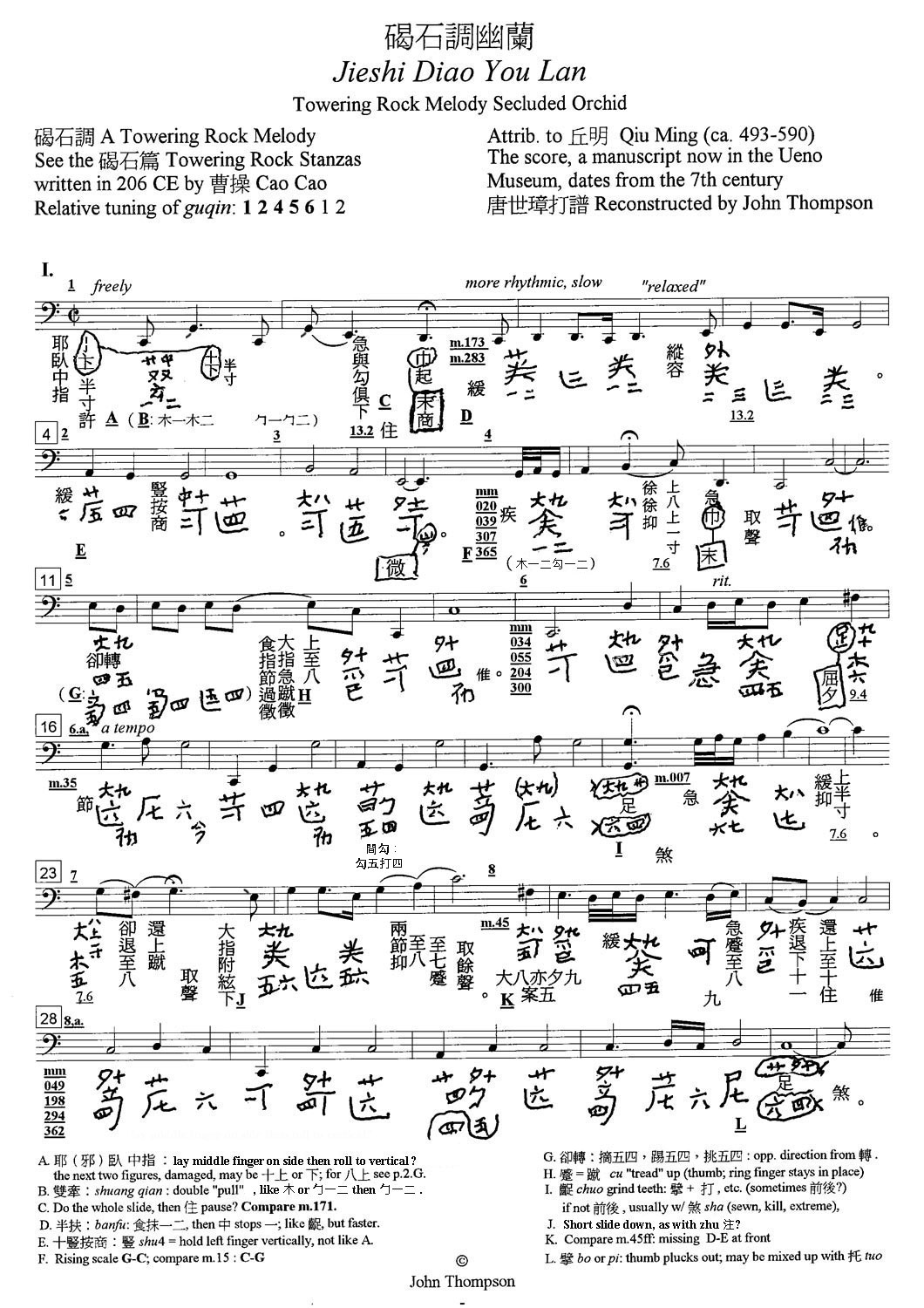 This melody, over 8 minutes long, is the world's oldest surviving substantial written melody:4 its preface suggests that it dates from at least the 6th century CE.5 That combined with its exceptional sophistication and beauty make it worthy of especial attention.
At present this website has You Lan commentary on the separate pages that have or concern:
- includes a translation of the original preface,
references and
comments on the title.
- by 查阜西 Zha Fuxi
- old version also on YouTube and BiliBili. Phrase numbers in the transcription correspond with phrase numbers in:
- compare with the original manuscript, now in the Japanese National Museum, Ueno.
- 汪孟舒:烏絲闌指法釋 the Explanation of Wusilan Finger Techiques by Wang Mengshu (plus the Yang edition)
- with transliterations; appended to this is Qin Li, another list of melodies, also dated to the Sui or Tang dynasty.
- Does this "diao", translated here as "melody", still have distinctive modality or structure?
- includes discussion of Bao Zhao and Cao Rou; translated from his Introductory History of the Qin
Because, other than this You Lan, the only other surviving tablatures before the first qin handbook was printed in 1425 are for the short song Gu Yuan and for another short song and two sets of short modal preludes dating only from the 13th century (in Shilin Guangji and in Taiyin Daquanji), it is tempting to see this You Lan as an oddity. However, the attached list of melodies and the surviving descriptions of finger techniques show conclusively that this melody gives us but a glimpse of a strong and sophisticated music tradition that must have been centuries in developing. Unfortunately, at that time the music was only hand-copied, not printed, and we are left wondering how the music developed, and what role writing the music down played in this development.
The original manuscript copy of You Lan was preserved in Japan and is now in the collection of the Tokyo National Museum.6 Meanwhile it had been uncovered in the 18th century and then copied by the well-known Japanese Confucianist Ogyu Sorai (1666-1728).7 The original is a scroll over 4 meters long with the tablature written out in longhand; it has been authenticated as dating from at least the 7th century CE.8
In the fourth century Xi Kang wrote a poem praising the beauty of qin. The sophistication and complexity of the present You Lan melody provide strong evidence supporting the common belief that Xi Kang was describing music that already had a strong tradition.9 However, it is very difficult to say how far back that tradition would be recognizable in the surviving You Lan melody. By Xi Kang's time it seems likely that the qin had achieved its current physical shape, but earlier surviving instruments suggest that the left hand finger techniques in particular would have been very limited.
The "you" of You Lan suggests a flower of such beauty that it stands alone; this has led to various translations of that part of the title, including Lonely Orchid, Solitary Orchid, Reclusive Orchid, Hidden Orchid, Elegant Orchid and so forth as well as Secluded Orchid.10 As for "lan", though today always translated as "orchid", it may in ancient times have referred to a different flower; this is emphasized by references that suggest its beauty lies more in its fragrance than in its appearance.11 In any case, this You lan is the earliest of a number of surviving qin melodies connected to the theme of orchids.12 Its tablature gives as an alternative title an Yi Lan meaning "Self-Reliant Orchid",13 while the earliest surviving melody with "orchid" in its title is an Yi Lan meaning Flourishing Orchid.14 At least one later surviving melody has the same title as here, You Lan (Secluded Orchid),15 but because the most famous orchid story is connected to Confucius, the same connection to Confucius may be made to any melody with orchids in the title. However, most properly the connection to Confucius is with the version called Flourishing Orchid. There the the story in the preface tells of Confucius, on his way home from having failed to find a worthy ruler who could appreciate his advice, finds a solitary orchid flourishing in a common field; he then compares himself to that orchid.
The "Jieshi" ("Towering Rock"16) of "Jieshi Diao", on the other hand, brings up another intriguing possibility: that Jieshi refers not to a musical mode but rather to the Towering Rock climbed by the famous warlord and erstwhile emperor Cao Cao after his conquest of the northeast. Does this part of the title suggest that "Jieshi Diao You Lan" deliberately contrasts Confucius' reaction to seeing a solitary orchid to Cao Cao's reaction on encountering a towering rock and seeing the vast sea to the east? The four jieshi stanzas that Cao Cao wrote survive, and he is said sometimes to have commissioned music for such occasions. Could the mood of the four poems correspond to the varying moods of Cao Cao' four poems?17
A purely musical analysis can help us know what makes this piece work musically, but how much can it tell us of what the the music may have been intended to convey? For example, if the opening two notes are interpreted as an octave leap does that suggest viewing the world from a mountaintop, while if those two notes are interpreted as a dissonant fifth does that suggest thoughts of an unsuccessful quest?
The accumulation and investigation of historical and literary references will give us a variety of ideas about what the music should convey but fails to tell us which if any is "correct". Fortunately, though, the beauty of the music and the various ideas from the literature are both sufficiently enticing that the task of getting answers, though perhaps impossible, is nevertheless both enjoyable and rewarding.18
1.
You Lan references (for 碣石 Jieshi references see next)
Other pages from this section of the website, as linked above, also have further references.
2.
碣石調 Jieshi Diao (Towering Rock Melody) references
3.
My Jieshi Diao You Lan transcriptions and recordings
Transcriptions and recordings by others
(actual copies here)
All play the second note as "G" (sol, 5). Of them all, only the recordings of You Lan by Guan Pinghu can easily be found on the internet. In addition, almost all other modern recordings of You Lan are by people who either follow the version of Guan Pinghu, or who re-interpret the melody based not so much on the original as on Guan's interpretation. Two prominent later recordings are:
Also of note are these two transcriptions:
There are many other recordings on the internet but most seem either simply to follow or somewhat modify pre-existing reconstructions (without credit).
4.
You Lan: The world's oldest surviving substantial written melody
The word "melody" is deliberately used here instead of "composition". In discussing early music I have tried to make a distinction between
"composing" and "creating". That distinction suggests that "composing" implies conscious ordering of musical structures; "created" music might be just as structured as composed music but the structuring is more instinctive. Based on that distinction, the
structures of Jieshi Diao You Lan suggest that it more resembles a written composition than any other surviving piece of written music prior to at least the late Western medieval period. At the same time, it is not clear that the structures in Jieshi Diao You lan were put there consciously by a "composer": they could just as well have been felt instinctively by the first person whose version was written down. underlining this spontaneity, the music was not then written down by the player for others to follow, almost certainly it was written down by someone who listened to it being played (see stories such as this). Later editors, then, could have modified the structures in various ways.
The word "substantial" is also used carefully here. It does not mean "important", or suggest it is "more worthy of study", or "more representative of a distinctive tradition" than other early surviving tablature or notation. There are in fact some very important but still minimal texts that seem to document music from earlier periods. However, attempts to make music from those documents are extremely speculative if only because of the documents' brevity and simplicity. By contrast, this You Lan is a complete work by itself. Its length and complexity as well as the detail of the You Lan manuscript, plus the fact that there are surviving playable instruments dating from around the same time, make it unique. The tablature also provides specific evidence for an instrumental tradition of long standing: one can argue about such specifics as the length of notes, but musical structures can clearly be heard, and it was writen down in detail that is certainly comparable to that available for medieval Western notation.
In fact, the closest real competitor for a documentable antique repertoire is probably some of the music from China being reconstructed from documents connected to the original gagaku repertoire.
Other claims to the title "world's earliest music" include, for example:
Even more ancient claims have been made for some oral traditions, but there is no way really to verify them. It is thus unlikely that they could be used to revive a music tradition in the way that scholars and musicians have been able to revive medieval Western music.
5.
Date of the You Lan scroll
6. Museum copies of the 碣石調幽蘭 Jieshi Diao You Lan manuscript scroll
The later copy of the scroll, made by Ogyu Sorai or under his supervision (see next), is apparently in the 彦根 Hikone Musuem together with the finger techniques scroll (plus its original copy by Sorai?
7.
Ogyu Sorai (Ogyū Sorai; 1666-1728;
Wikipedia)
Modern commentary on the You Lan scroll seems to begin shortly after 荻生徂徠 Ogyu Sorai (1666-1728) discovered it shortly before the year 1720. Sorai also discovered and edited some related manuscripts, leading to confusion about their actual origin. Furthermore his helped keep commentary on the melody focused on Confucius rather han any alternative possibilities.
Of Sorai's You Lan manuscript and its
discovery Van Gulik, op.cit., wrote as follows,
Van Gulik's skepticism, along with the problem of the first two notes, are the main reasons I did not work on this melody for a long time. As it turns out, though, it seems that in fact Ogyu Sorai's copy was remarkably identical to the original and what he edited (re-wrote or simply re-arranged) was commentary on the manuscript and its finger techniques.
8.
Date
9.
Dating the You Lan style
10.
蘭 lan
11.
Fragrance over appearance
12.
Later versions of You Lan
Another melody connected to orchids is Xiuxi Yin in Xilutang Qintong (1525)
13.
Self-reliant Orchid (倚蘭 Yi Lan)
14.
Flourishing Orchid (猗蘭 Yi Lan
15.
Secluded Orchid dated 1525 (西麓堂琴統幽蘭
You Lan in Xilutang Qintong)
16.
Translating the "碣石調 Jieshi Diao" of "碣石調幽蘭 Jieshi Diao You Lan"
17.
Cao Cao's Four jieshi stanzas
18.
The Challenge of Jieshi Diao You Lan
This latter work is still ongoing, details of its current progress perhaps best linked from here
Return to the annotated handbook list
or to the Guqin ToC.
Footnotes (Shorthand references are explained on a
separate page)
"You Lan" is often translated "Elegant Orchid" and the mode title "Stone Tablet Mode", making the full title "Elegant Orchid in the Stone Tablet Mode".
(Return)
Perhaps more commonly titled "Stone Tablet Mode". See this detailed account.
(Return)
Linked here are my original recordings and transcriptions (2005), my revised ones (2020), and some transcriptions and recordings by other players, as listed below.
This melody was much studied in the 1950s, presumably as a part of the project led by Zha Fuxi; this resulted in recordings by at least five separate players. Four of these have transcriptions, all included at the beginning of Volume 1 of Guqin Quji (古琴曲集第一集). The seven known recordings by these five masters are included in 國鵬
(Guo Peng), 絕響-國鵬輯近世琴人音像遺珍); he says they are for public, non-commerical use, so people may similarly copy them from here as well. They are as follows:
The first of the three recordings tunes the open first string to C; the other two tune it to B).
The transcription of his play is the only one to document changes, but it shows only some of them.
In the recording the open first string = C#.
The transcription is quite close to his performance, but changes unmarked.
In the recording the open first string = sharper C#.
Xu interprets the tuning as 1 2 3 5 6 1 2 (based on
comments by Yang Zongji?).
The recording has the open first string = A#.
Regarding the time difference between his transcription and recording, the transcription is very similar to his play on the recording, so for the transcription he must just have played quite a bit faster. As for his style, the original tablature has relatively few slides, so those added here may seem to some quite out of place (further comment).
In the recording the open first string = A.
There is transcription; seems to play all separated notes (e.g. "前後 qianhou") as unisons.
The transcription, dated 2001, has the open first string = C but the pitch on the recording is B; Wu transcribes the opening as C-Ab, i.e. G#. In the recording (but not in the transcription) he seems to interpret the opening 耶臥 yewo as a major ornament on the repetition of the Ab. The basis for this is not clear. Professor Wu wrote that in doing his version he became impatient with many of the details; he felt that paying too much attention to these details had made all the versions he had heard unmusical, and so in the end he ignored inconvenient detils and just played it in a way that sounded coherent to him. He also added many zhu slides.
This recording, made for Radio France, is from the CD Chine: L'Art du Qin, Li Xiangting (Ocora C560001 HM 83, 1990)
Includes melographic analysis and other details. However, there is no recording and he does not include the tablature.
Published in 陳應時,中國民族音樂大系:古代音樂卷。上海音樂出版社, 1989 (Chen Yingshi's volume on Ancient Music in the Compendium of Chinese Folk Music. Chapter 1, 幽蘭 You Lan (pp.l20-127), mostly consists of a transcription worked out together with Dai Xiaolian; she also made a recording, but it was apparently incomplete.
(pdf copy.)
(Return)
This melody, surviving from a document authenticated as having been
written down in around the year 600 C.E., also documents the world's oldest surviving written instrumental tradition: one can play this same music today on essentially the same instrument (or course, there are still issues involved in the actual interpretation).
The "world's oldest religious text in continued use", but there is minimal information about what the "melody" might actually have been.
Written in cuneiform on clay tablets, with lyrics, but the apparent notation is brief (apparently fragmentary and with much disagreement about interpretation; e.g., it remains unclear what is the longest sequence of notes actually written down).
Written on stone, this "oldest musical composition to have survived in its entirety" is again short (40 to 50 named notes, with few details about how they were to be performed). Even shorter are some other early Greek fragments such as the "Delphic hymns" and "Hymns of Mesomedes"
(Return)
There are actually two surviving early scroll versions of this melody, as listed in the next footnote. One is from around 600 CE, the other is a copy of it from around 1700. These are discussed in detail in
several articles by Yang Yuanzheng. See in particular this one but also "Japonifying, p.111ff.
As of 2025 the original manuscript scroll is online here, on the emuseum site of the Tokyo National Museum in Ueno, which houses the original copy; it is also shown in segments here.Unfortunately, the museum seems quite often to change this address. To find the new address try searching for "Ueno Museum" or "東京國立博物館", and "Elegant Orchid in the Stone Tablet Mode" or "碣石調幽蘭第五". (Yang Yuanzheng refers to this as the "Tokyo Manuscript".)
(Return)
Ogyu Sorai (荻生徂徠 Disheng Culai, also known as Mononobe Noke (物部茂卿 Wubu Maoqing), was a well known Japanese Confucianist. He apparently believed that the true ancient Chinese music was preserved in Japan, especially but not exclusively in its gagaku tradition. The You Lan manuscript was also a part of this argument: Sorai argued strongly that this melody was actually created by Confucius himself.
(Return)
The paper and ink have been carbon dated.
(Return)
Claims have been made that a possible creator of the melody was the 4th century poet Bao Zhao, who may also have written related lyrics ({[5+5]x2} x 5). However, there is no real evidence to support this claim.
(Return)
Though "lan" is almost always translated simply as "orchid", it is not certain how strictly one can define what this character meant in ancient literature as it may not have referred to flowers we know of today as orchids.
For more on this see this footnote under Guqin and Orchids.
(Return)
See under Orchids.
For a list of the later versions of You Lan see
Zha Fuxi's index 19/181/--. At present only some preliminary comments are available for the first of these, the version in Xilutang Qintong (1525).
(Return)
This alternate title for You Lan is not attached to any other known melodies. See further comment on "self-reliant".
(Return)
Survives in 36 handbooks from 1425 to about 1900, but there is nothing to connect it to any earliest melody.
(Return)
Survives in about six handbooks from 1515 to 1876, but there is no evidence connecting this melody to an earlier one.
(Return)
During the Ming dynasty guqin melodies were always identified by their mode (調 diao). Each diao had its own general modal characteristics, as discussed here; and the actual modal characteristics of Jieshi Diao You Lan are analyzed to some extent here. But these analyses are based purely on personal observation - there is little to no such information in the traditional literature. In addition, few Chinese commentaries on this melody mention the Cao Cao story or "Towering Rock Mountains (碣石山 Jieshi Shan)", a range of mountqains by the coast in what is today Hebei province.
(Return)
Chinese research on You Lan always emphasizes the You Lan story over any Jieshi connection. However,
Xu Jian's study of You Lan does make reference to Cao Cao and Jie Shi, in particular making a connection with Longxi Ballads. Also see further comment here as well and in Yuefu Shiji.
(Return)
My personal connection with this tablature has gone through several phases. Almost from the time I began study in 1974 I found its antiquity intriguing. My relationship with it has then gone through several phases.
(Return)