|
T of C
Home |
My Work |
Hand- books |
Qin as Object |
Qin in Art |
Poetry / Song |
Hear, Watch |
Play Qin |
Analysis | History |
Ideo- logy |
Miscel- lanea |
More Info |
Personal | email me search me |
| Qin and Togaku | 首頁 |
|
Gagaku
|
雅樂 1
Zheng4 notation as found in a gagaku score: Music from the Tang Court, Vol. 1, pp. 30-31 |
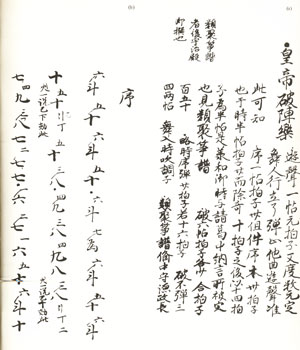 The word "gagaku" is the Japanese pronunciation of the Chinese characters whose modern pronunciation is "ya yue", literally "elegant music". During the Han dynasty (206 BCE - 220 CE) the term yayue came to be used for court ceremonial music. During the Japanese Heian period (794-1185) the Japanese obtained a substantial body of music from China (and Korea), much of it music as written down for play in the Chinese court during the Tang dynasty (618 - 906).5 The written scores indicated the melodies by writing the notes6 and the phrasing7; in this way they may also have given some indication of note values8 and ornamentation9, though interpreting these latter is quite problematic. In Japan this imported music joined with some indigenous music, also preserved in the court, eventually forming a distinctive style of music generally referred to as gagaku.10
During the Tang dynasty, at the court in Chang'an one could hear music from many parts of Asia. In the Japanese court the music thought to be specifically of Chinese origin came to be called Togaku (Tang music). Ensembles in the Japanese court have played Togaku since at least the end of the Heian period. Most Japanese scholars insist that the Togaku as played by Japanese gagaku ensembles today preserves Tang dynasty court music. However, the music they play sounds nothing like any known Chinese music from any period. Their performances also differ greatly from the written scores acquired earlier in the Heian period.11 Japanese tradition says that the written scores consist of only the skeletal outlines of the music,12 but this explains the discrepancies in only a very superficial way.
In the 1950s, Dr. Lawrence Picken (L.E.R. Picken, 1909 - 2007) of Cambridge University in England formed the Tang Dynasty Music Research Project to re-evaluate the original scores.13 According to their research, the written scores, in fact, contain the original music, though perhaps only hints at the ornamentation and rhythms. This music was played by the Japanese aristocracy throughout most of the Heian period, consciously preserving the Chinese tradition. During this period the music slowed down, but did not become unrecognizable. The repertoire apparently became smaller, and sections were omitted from some melodies. But because they played the music largely as written, melodies could still be revived.
The radical change came at the end of the Heian period, when the court musicians changed from being literate aristocrats, who could read the original scores, to being professionals (mostly commoners), who could not. The ornamentations for various types of gagaku were elaborated and standardized, eventually becoming the actual melodies. The repertoire became fixed, with the main melodies played by just two of the instruments, the hichiriki and ryuteki.
The Tang Dynasty Music Research Project, by stripping away all the music not in the ancient written scores, has revealed melodies which not only sound more Chinese than does gagaku, they share potentially noteworthy modal characteristics with early qin music, some of which on a completely different basis has claims to preserving Tang dynasty music. Some of the music in both repertoires may even pre-date the Tang dynasty.
However, reconstruction of the way the Togaku melodies might have been played in China remains problematic. Comparing the parts for the different instruments in the gagaku ensemble suggests that the music was heterophonic, as has long been typical in Chinese music.14 And whether played in ensemble or solo, such music generally was not played exactly as written, but was embellished by performers according to their feelings, skills, and/or the occasion.15
It is an odd fact that the earliest Chinese music has been preserved in Japan.17 This is true whether one is referring to the music preserved in the Togaku manuscripts, or to music for the qin. Notation/tablature and instruments for both genres were brought to Japan during the Tang dynasty. In the case of the qin one can point specifically to the melody
You Lan and to at least two Tang dynasty qin preserved there.18
However, whereas music in the Togaku repertoire was played for centuries by aristocrats (before becoming the ritualistic music heard in the Japanese court today), there is little evidence of similar interest in the music for the qin. One can only speculate as to the reasons for this. One reason might have been that the Japanese did not realize that the zheng was a different instrument from the qin: the character qin was often used in Japan for the koto (zheng).19 Alternatively, those who were aware of the difference perhaps felt that the zheng was an acceptable substitute for the qin. One can also point to the relative complexity of qin tablature, or suggest that Chinese scholars were less willing (if not forbidden) to teach this music to non-Chinese. Of course, it might simply have been that Japanese aristocrats' enjoyment of the music in the Togaku repertoire made this sufficient for any need they may have felt to show respect for Chinese culture.
A major difference between these repertoires seems to be that, whereas qin tablature presents basically complete versions of the music as actually played, gagaku notatation and tablature present only the basic melodies. On the other hand, whereas the qin tablatures that arguably date from the Tang dynasty are few in number, there is a great amount of Tang material surviving in Togaku scores.
As for which is the earliest, the earliest surviving
qin tablature was apparently written down in the 7th century CE (see again
You Lan), but the music must have been quite a bit older. In addition, a number of examples of tablature surviving from 15th century publications (most famously Shen Qi Mi Pu, 1425) may have their origins in the Tang dynasty as well (see, e.g., the Wang Shixiang's article on Guangling San), but it will be extremely difficult to prove which parts of which melodies actually date from the Tang dynasty.
The Togaku scores may date from the 9th to the 12th centuries, but some are clearly based on much earlier materials. It is quite possible that some of these may be pre-Tang, but again, exactly which parts of which melodies will also be very difficult to prove.
Making music from the original qin scores is called
dapu. Often such scores are quite freely interpreted, but the tablature itself contains sufficient information that one can make a good case that proper work with scores such as the You Lan manuscript and the earlier music from Shen Qi Mi Pu will eventually allow one to do historically informed performances of qin music dating from at least the 7th century CE.20
At present, although Togaku scores as interpreted by the Tang Dynasty Music Research Project have formed the basis for a number of modern re-creations, to my knowledge there is not yet sufficient information about Tang dynasty performance practice to enable one to evaluate how closely even the most historically informed reconstructions resemble what one might have heard in China at that time.21
The qin was not included in the Togaku repertoire, and the music from these two repertoires is said to come from two entirely different sources: literati tradition in the case of qin, mostly court but also popular tradition in the case of Togaku. Nevertheless, it is important that there be research comparing these two traditions, whether to improve our understanding of the modality of music from that time, or to understand better the relationship between the music as written down and the music as actually played.
1.
雅樂 Ya Yue (Japanese: gagaku)
2.
唐樂 Tang yue (Japanese: Togaku)
3.
Music from the Tang Court
Each volume has a descriptive subtitle, the most complete version of which seems to be, "a primary study of the original unpublished, Sino-Japanese manuscripts, together with a survey of relevant historical sources, both Chinese and Japanese, with full critical commentary and detailed structural analysis of all items transcribed".
Seven of 25 projected volumes have been published, all but the first by Cambridge University Press. Most are out of print, and little information about them is available online. Published volumes (also called fascicles) include:
This information may now be out of date.
4.
箏 Zheng (in Japanese: koto or so)
According to current gagaku practice the ryuteki and hichiriki play the main melodies, while the other instruments provide simple accompaniment. The Tang Dynasty Music Research Project has shown that these ryuteki and hichiriki melodies were added later, and that in fact all instruments played the melodies.
5.
Music imported into Japan
6.
Written notes
7.
Phrasing
8.
Note values
9.
Ornamentation
10.
Gagaku: Many forms
Footnotes (Shorthand references are explained on a
separate page)
"Ya yue" literatally means "elegant music". 42903.172 says 雅樂正樂也 "Ya yue is correct music", with mostly Han dynasty references; it makes no mention of Japan.
(Return)
3714.374 "Chinese music" (no reference to Japan).
(Return)
This is the title for a series of books with transcriptions of Chinese music (togaku) in the Japanese court music repertoire (gagaku) as re-interpreted by the Cambridge Tang Dynasty Music Project; published by Cambridge University Press. The main editor/author was Lawrence Picken. Others include Rembrandt Wolpert, Elizabeth Markham, Allan Marett, Noel Nickson, Yoko Mitani and Jonathan Condit.
(Return)
The Chinese zheng zither, generally called koto in Japan, is correctly written with the same Chinese character as for zheng, 箏 (in modern times it is sometimes incorrectly written with the character for qin, 琴). It was called so (or 樂箏 gaku so) in the gagaku ensemble. There is surviving notation or tablature for five melody instruments in the gagaku ensemble, and also percussion indications. The five melody instruments are:
(Return)
This seems generally to refer to written sources, and most of it apparently came either from or through China (which is where it would have been written down), most notably during a mission from Japan to China in the mid ninth century. I don't know to what extent instruments may have been imported, or to what extent the people who brought the music to Japan had actually studied it in China.
(Return)
The written system mostly names the notes but there is also some tablature. It all seems to indicate relative pitch, though there are indications that absolute pitch may have sometimes been intended (this being difficult to prove without surviving fixed-pitch instruments). The written systems were different for different instruments.
(Return)
Most of this is clearly marked in the original.
(Return)
Many transcriptions into staff notation indicate most notes a quarter notes, with the occasional eighth note and the last note of a phrase being a half note or whole note. In this way it is very different from Chinese music that has survived in the oral tradition, not to mention music for the guqin.
(Return)
There may have been some indication of ornamentation in the original scores; some hints at ornamentation also come from comparing the versions indicated in the scores for different instruments playing the same piece. It is quite likely there was much further ornamentation never written down and that, as in the known surviving oral traditions, there was considerable flexibility allowed or intended from performance to performance.
(Return)
In Japan this music has a very distinctive style, but quite likely the original music had great variety. Perhaps the standardization of this variety took place in the Chinese court; unfortunately not enough documentation has survived in China to tell us how this music sounded there. In any case, almost all of the music that has survived was preserved in Japan, to which it came in the form of written sources originating in China. In addition, there is also surviving gagaku that was added in Japan. Some of it attempted to imitate the style of the music from China, some was intentionally more local. Imported types included the following:
| 1. | 唐樂 Togaku: | Music from the Tang dynasty, i.e., China |
| 2. | 高麗樂 Komagaku: | Music from Korea |
| 3. | 渤海樂 Bokkaigaku: | Bokkai (Bohai; also Balhae) was a kingdom based in what is today northern Korea, northeast China and southeast maritime Russia (Wiki / 中文); some sources suggest that here Bokkaigaku generally refers to music from Manchuria and/or Mongolia. |
| 4. | 度羅樂 Toragaku: | Tora (Duluo) literally refers the island of 濟州 Jeju (Cheju) off the south coast of Korea, but other sources have suggested that Toragaku was also in some way connected to music from Dvaravati (陀羅缽地、墮羅缽底; roughly the area that is today Thailand). |
| 5. | 林邑樂 Rinyugaku: | Rinyu (Linyi) was later named Champa (Wiki) but here Rinyugaku may broadly refer to music from Southeast Asia, some perhaps originating in India. |
| 6. | 舞樂 bugaku: | "Wu yue", literally "dance music"; this can also fall into one of the above forms. |
| 7. | 伎樂 gigaku: | Also called 吳樂 Kuregaku, this was apparently a dance or theater form said to originate in the 吳 Wu region of China (modern Zhejiang) |
There are apparently some other musical terms from Japan suggesting music from other places, such as 天竺樂 Tenjikugaku (music from India). However, it is my understanding these would all have come to Japan through China. And to my knowledge no one has been able to point out any specific characteristics of the musics that might lead to a better understanding of music from those places at that time.
(Return)
11.
Earlier Hei'an sources
These have been preserved basically in two great manuscript collections, one belonging to Minamoto no Hiromasa (918-980), the other to Fujiwara no Moronaga (1138–92).
(Return)
12.
They probably have less than 10 per cent of the notes as played today.
(Return)
13.
Original Tang dynasty music project
The original group consisted of Lawrence Picken, Rembrandt Wolpert, Elizabeth Markham, Allan Marett, Jonathan Condit and Yoko Mitani. They were later joined by Noel Nickson and some others. At present the project is directed by Wolpert and Markham from the Center for the Study of Early Asian and Middle Eastern Musics at the University of Arkansas.
(Return)
14.
Heterophony?
(Wiki)
In heterophonic music each performer is playing essentially the same melody, probably from the same written source, but each is interpreting it in his/her own way. Sometimes they are in unison; at other times one or the other instrument may be doing its own variation. Much of traditional jazz is thus heterophonic.
(Return)
15.
Original performance method
The Togaku repertoire includes a number of modal preludes. Perhaps these were played in China much as written: such modal preludes in the qin tradition tend to be short and relatively straightforward.
(Return)
| 16. Qin and Togaku | Tablature from Kingaku Hakki (complete pdf 3.9 MB) |
 Although "Togaku" literally means "Tang music", and the term seems specifically intended to refer to a certain part of the gagaku repertoire preserved in Japan, it could perhaps more generally refer to ancient Chinese music either as preserved in Japan, or as perhaps could be reconstructed through re-examination of the gagaku repertoire (example). To what extent the qin could be part of this effort is not at present clear. Although for ritual or symbolic reasons the qin was often included in ritual ensembles, it apparently was not included in general court (or any other) ensembles. It is also commonly said that there is no connection between the qin repertoire and the court repertoire.
In this context it could be particularly interesting to examine the qin tablature published in the Qin Study Report (琴學發揮 Kingaku Hakki) by 山縣大弐 Yamagata Daini (1725 - 1767). Van Gulik seems to have no mention of this book or of Yamagata Daini, but an apparently modern edition published in 1914 is available in the 国会図書館蔵 National Diet Library Tokyo.
The copy I have seen (a pdf copy courtesy of Muka Fushimi) has pages numbered 4 to 30. I don't know what comes before; directly after there is another essay, 發音略 Outline of Pronunciation, this one "compiled by Yamagata Shozo".
Kingaku Hakki itself has the following overall content:
- p. 4: Review the Old (溫故 Wen Gu), an essay by 山縣昌貞 Yamagata Shozo (Daini)
- p.14: Learn the New (知新 Zhi Xin), by Yamagata Shozo
- p.19: untitled explanation of finger techniques (part of previous?)
- p.23: According to the Rules (倣則 Fang Ze)
- p.25: Old Tablature (古譜 Gu Pu)
The "old tablature", from pp. 25 to 30, consists of one title with no music, then 10 melodies, all connected in some way to the gagaku repertoire (none is in the old Japanese qin handbooks). They are all categorized by mode and mode type.
- Modes (gong [宮 kyu̅], shang [商 sho̅], jue [角 kaku], zhi [徴 chi], yu [羽 u̅]): I don't know how these modes are defined. Specifically, I don't know whether anyone has ever studied them in terms of such modal characteristics as tonal centers or changed notes.
- Mode types (呂 ryo̅ or 律 ritsu): some have compared these types to the early Western Lydian and Dorian scales respectively, and/or say the important difference is in the note kaku (3): in the ryo̅ scales kaku is half a step lower.
Details of the included melodies are as follows:
古譜 Old Tablature
The 11 titles in Kingaku Hakki are as follows:
| |
幽蘭操 |
Yûran Sou |
(You Lan Cao); "徴音律調 chi mode, ritsu type", but no tablature
Brief comment, includes: "old tablature (q.v.) was in Kessekichô (Jieshi mode).... Not seen." |
| 1. | 越天樂 | Etenraku | 商音律調 sho̅ mode, ritsu type |
| |
A comment between #1 and #2 says, 擬製譜九首 9 Melodies Made in Imitation | ||
| 2. | 五常樂急 | Gosho̅raku (kyu̅) | 商音律調 sho̅ mode, ritsu type |
| 3. | 千秋樂 | Senshuraku | 商音律調 sho̅ mode, ritsu type |
| 4. | 拾翠樂 | Jyusuiraku | 商音呂調 sho̅ mode, ryo̅ type |
| 5. | 合歡鹽 | Gakkaen | 商音呂調 sho̅ mode, ryo̅ type |
| 6. | 喜春樂 | Kishenraku | 宮音律調 kyu̅ mode, ritsu type |
| 7. | 新羅陵王急 | Shin Raryo̅-o̅ (kyu̅) | 宮音呂調 kyu̅ mode, ryo̅ type |
| 8. | 武德樂 | Butokuraku | 徴音呂調 chi mode, ryo̅ type |
| 9. | 胡飲酒破 | Koinju (ha) | 宮音呂調 kyu̅ mode, ryo̅ type |
| 10. | 拔頭 | Bato̅ | 徴音律調 chi mode, ritsu type |
Three of these titles are further mentioned
here. My preliminary examination of the tablature suggests there are so many mistakes and vague instructions that it would be difficult to make melodies from these pieces without referring to actual gagaku notation or practice for the same melodies. Note, however, that Yamagata lived in 18th century and it is not exactly clear to me to what extent this 1914 copy in modern type, with tablature hand copied, is a replica of the original.
(Return)
17.
Oldest Chinese music scores
The closest competitor to the manuscripts preserved in Japan is the set of 25 pipa lute scores copied down in the 10th century CE and discovered at 敦煌 Dunhuang in western China. It is my understanding that reconstructing the way these short melodies actually might have been played could only come from learning the idiom preserved in the Togaku repertoire.
(Return)
18.
Two Tang qin preserved in Japan
One of these is at the 正倉院 Shoso-In in Nara, the other is at the 法隆寺 Horyuji Temple in Ueno. See Van Gulik, Lore, pp. 200-209 (photos between pp. 196/7 are discussed further here under Buddhism and the Qin) and pp. 223, 236 (photo between pp.192/3).
The Shoso-In qin was put on display during an exhibition in the 1990s, together with some strings. The strings are said to be original, but I have not seen an analysis of them. Such an analysis might shed light on issues brought up in surviving early composition on the making of qin strings (e.g., in
Taiyin Daquanji, Chapter 1.B. on
gauges and
potions).
(Return)
19.
Knowledge of the qin in Japan
Van Gulik discusses this issue in some detail in his appendix The Chinese
Lute in Japan (Lore, pp. 217 - 224). He points to the fact that although the You Lan tablature and the two Tang qin were brought to Japan, they were unknown to most people. He adds that most Chinese music came to Japan via Korea (or Koreans), and concludes that the qin was never really played in Japan until the monk
Shin-Etsu arrived there in 1677.
(Return)
20.
Historically Informed Performance of Tang dynasty music
What would be most significant in establishing credibility for such performance would be finding connections between the two independent sources dating from that period, Togaku and guqin. If one musical phrase could be found in common between the two repertoires that would be most significant. More likely the evidence would have to be more circumstantial, especially from modal comparisons.
(Return)
21.
Using Togaku to recreate Tang dynasty Chinese music practice
Not being a specialist in this area, I do not know to what extent it will be possible in future to make cases for historically informed performance of Tang dynasty music, or even to evaluate claims that currently may be made (other than on such straightforward matters as choice or style of musical instruments). One possible avenue to explore, presumably, is further comparative analysis of differing versions of the same melodies in surviving Heian scores. If a number of these show both plain and ornamented versions, and if one can make a good argument that the ornamentation is of the sort that one might have heard in Tang dynasty China, then one might use this ornamentation together with the surviving Heian scores to re-create the sort of heterophonic improvisation which presumbably went on in China during performances of these melodies.
(Return)
Return to the Guqin ToC or to miscellanea.