|
T of C
Home |
My Work |
Hand- books |
Qin as Object |
Qin in Art |
Poetry / Song |
Hear, Watch |
Play Qin |
Analysis | History |
Ideo- logy |
Miscel- lanea |
More Info |
Personal | email me search me |
| Taiyin Daquanji ToC / Previous - Next / Silk Strings | 首頁 |
|
Taiyin Daquanji
1
Folio 1B : Information about making qin strings (I/47a-48a) 2 3 |
太音大全集
卷一,乙﹕琴絃 |
| Method of Discerning (Proper) Silk 4 | Image continues I/47a |
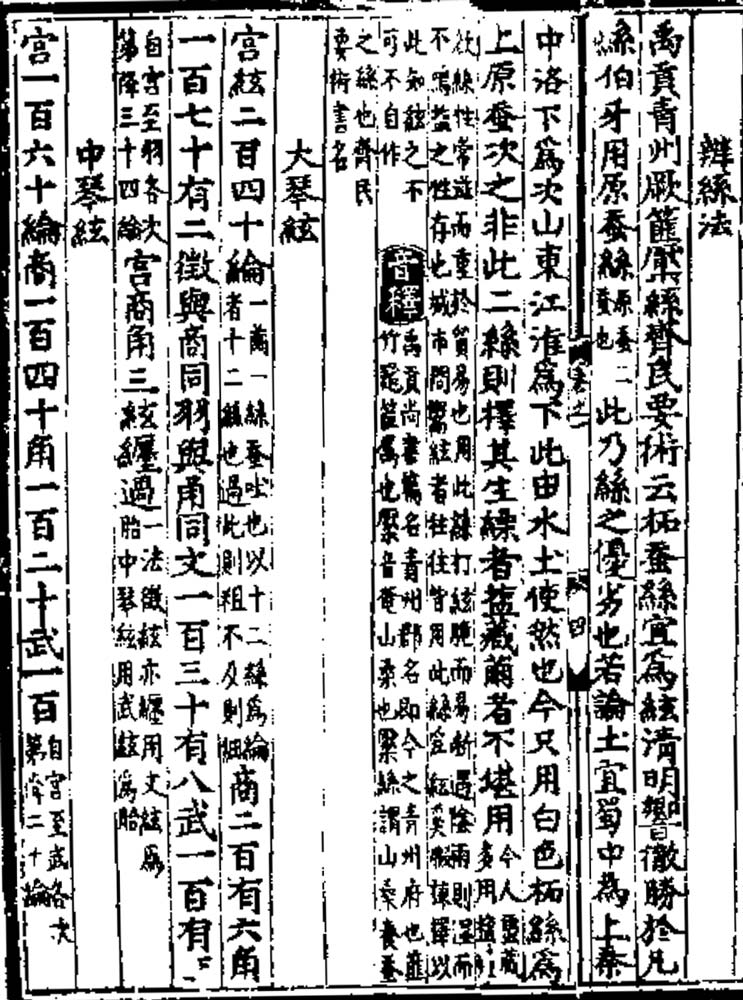
[Main text:] "Yu Geng" (a section of the Classic of History [Shu Jing], dealing with Emperor Yu, 23rd c. BC), in a part concerning Qingzhou, (a district in Shandong province, says), "His wicker basket had silk made from a yan (mountain mulberry) tree".
Summary Narrative of the People of Qi (Qi Min Yao Shu, written during the Northern Wei [386-535]) says, "Silk from silkworms (fed on the leaves of the) zhe tree (cudriana5) is suitable for (qin) strings; (the sound is) light, clear, resonant and penetrating. It is better than any (other) kind of silk string.
Bo Ya (a famous qin player of the Chun Qiu period 770-476) used "basic silkworm silk".
[Main text:] This is what is meant by "the good and the bad" strings.
If you talk about appropriate soil, that in Sichuan is best. Next best is in Shaanxi and the lower Luo river (in Henan province). That from Shandong and the region of the Yangzi and Huai Rivers is worst. This is all because of the influence of the water and soil.
Nowadays one only uses white silk from the cudriana as the best source (and) "basic silkworm silk" (from the same source) as next best.7 If you don't use one of these two types, then select "raw crimson silk".8 One cannot use the cocoons with salt mixed in.9
[Yin Shi:] Yu Geng is the name of a chapter from Shang Shu (another name for the Shu Jing, said to date from the Zhou dynasty, 1122-255). Qingzhou Jun (one of the nine commanderies into which Yu is said to have divided China) is today called Qingzhou Fu. The wicker basket (fei) is a bamboo product like a kuang (an open basket). Yan is pronounced the same as yan (remain), and means "mountain mulberry". "Yan silk" is the name given to silk raised/grown from cocoons of the mountain mulberry. "Summary Narrative of the People of Qi" is the name of a book.
(String Sizes: background information11 and measurements12)
Big (i.e., thick) Qin Strings13
[Main text:] The first (gong) string has 240 strands (lun).
[Main text:] The second string has 206 (strands). The third string has 172. The fourth is the same as the second. The fifth is the same as the third.
The sixth has 138. The seventh has 104.
[Main text:] Three strings, the first, second and third, are wrapped (i.e., they have an inner "core" [tai, lit., "womb"];14 see "Wrapping Gauze" below).
Medium (in thickness) Qin Strings
16
[Main text:] The first string has 160 strands, the second string has 140 strands, the third string has 120 strands, and the seventh string has 100 strands.
| Small (i.e., thin) Qin Strings 18 | Original text, beginning with 小琴絃 (I/47b) |
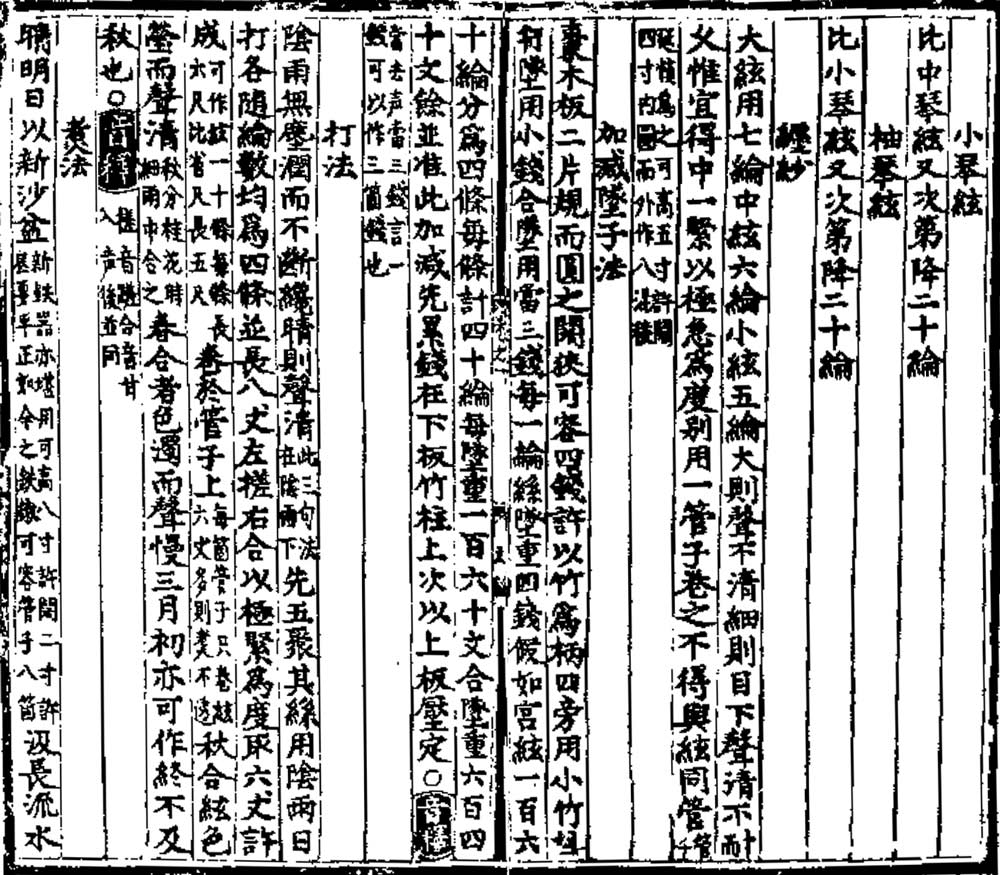
[Main text:] Each string has 20 strands fewer than each of the corresponding medium qin strings.
Fine (i.e., very thin) Qin Strings 19
[Main text:] Each string has 20 strands fewer than each of the corresponding thin qin strings.
[Main text:] The thick strings use seven strands (around the outside of each of the strings?). The medium strings use six strands. The thin strings use five strands. If the wrapping is too thick, then the sound will not be clear. If it is too fine then the present sound's clarity will not last. Best is for it to be medium in size. When drawing it tight (around the core) the tighter the better. If in another way you use (or: If you don't use?) a "tube" (guanzi to wrap them, then you must (will?) not have the strings together with the tube (?).21
Method for Correcting Size with the Zhuizi23
[Main text:] Take two boards of jujube tree wood (zao mu), measure them and make them round (like round platters?). The size (broad/narrow, i.e., thickness?) should be about that of four coins. With bamboo make a handle (and) on four sides use small bamboo pegs (i.e., both sides of the two round boards?).
When operating this zhui, use small coins (?). Combine () the zhui to take the place of three*. Each silk-strand zhui (lun si zhui) should have the weight of four coins. If the first string (being medium) has 160 strands, then dividing this into four strips (tiao, i.e., zhui?) means each strip will have 40 strands; each zhui will weigh 160 "cash" (wen) and the (four) zhui (together) will weigh 640 cash. (The weight of the) remaining (zhui) should be calculated on this basis.... First place the coins on the lower board. The bamboo pegs (go on) top (of this). Then with the upper board press this down together.
Method of Operating (the Zhuizi)
(If done on) a cloudy and rainy day with no dust around, (when the silk is) wet and not easily breakable, (but the weather is) about to clear up (cai qing), then the sound (and/or appearance of the strings) will be clear
[Main text:] The first five (times you?) combine this silk, do it on a rainy day. According to the number of strands (i.e., different for each string) make them all into four (? see above) equal strips, and with a length of eight "zhang" (8 x 141" = 1128" = 94' -- see above). If you wrapped (zuo, lit., rub palms together) (the strands) to the left, then you should combine (ho/gan) the (strips) to the right. The tighter these are twisted the better. (The original length of eight zhang) becomes (a string) about six zhang in length (70.5').
[Main text:] Wrap this (string) around the tube.
[Main text:] If you make the strings in fall, their color will be clear and their sound will be pure.
[Main text:] If the strings are made in spring, their color will be muddy and the sound will be slow (?). By the beginning of the third lunar month (when the spring is almost over) one can make strings, but the result will still not be as good as if you make them in the autumn.
Method of Boiling (the Strings)
[Main text:] On a bright and clear day use a new pan made of earthenware.
[Main text:] Pour running fresh water (chang liu shui) so that it is two cun higher than the top of the tubes.
[Main text:] Use an alternating high and low fire to boil the strings. Stop when the wheat (see ingredients below) is smashed (well-done?).
[Main text:] If the strings are too "raw" then they will have a wooden sound, and soon they will have no sound at all. If they are cooked too long, then the sound will not be clear and the strings will break easily. At these times according to your own ideas make calculations (i.e., learn by doing). Take them out and dunk them in cold water, taking them out quickly. Quickly stretch them out to dry.
| Using Potions (during Boiling; compare translation by Binkley from Yuguzhai Qinpu) | At left from line 5 用藥 (I/48a) |
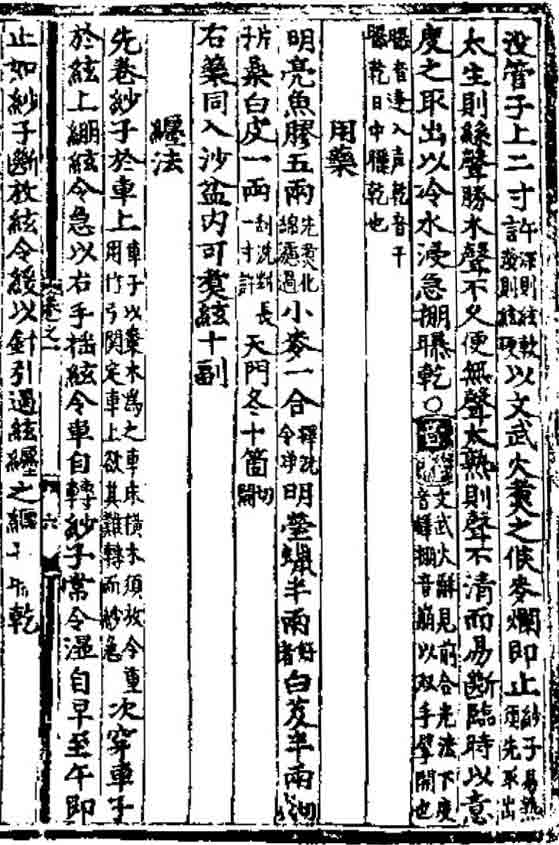
[Main text:] (1). 明亮魚膠五兩 Five liang of mingliang yujiao ("clear fish gelatin")25
[Main text:] (2). 小麥一合 A handful of xiaomai ("wheat")
[Main text:] (3). 明瑩蠟半亮 Half a liang of ming yingla ("gem wax")
[Main text:] (4). 白芨半兩 Half a liang of baiji ("white bletilla": tuber of a type of orchid?).
[Main text:] (5). 桑白皮五兩 One liang of sang bai pi ("white mulberry bark")
[Main text:] (6). 天門冬十箇 Ten tianmen dong ("heavenly gates of winter": "lucid asparagus")
[Main text:] Take these potions and put them together in an earthenware pan. This amount can be used to boil ten sets.
[Main text:] First wind the gauze (shazi) on a cart-device chezi
[Main text:] Then thread the chezi using a length of (unwound) qin string. Tie up this string (e.g., affix one end to a pillar) so that it is tight. Then use the right hand to twirl the string, causing the chezi to rotate by itself (around the string). Moisten the (thread) often. Do this from morning until noon, then stop. If gauze breaks, loosen ???string cause slowly/delay cause a needle/notch to draw out the thread and wrap it/tie up the broken ends together????. After the wrapping is finished, put it out in the sun to dry.
Return to Taiyin Daquanji index page,
to the annotated handbook list
or to the Guqin ToC.
Footnotes (Shorthand references are explained on a
separate page)
1.
Taiyin Daquanji
Although apparently written down during the Song dynasty, the date of the information is not clear. This is emphasized by the structure of main text followed by explanations (see Structure of the original text). Two examples of this from the present section concern filaments made into strands and wrapping for the lower strings. Thus, under "Big strings" it is stated that there are 12 filaments per strand, then figures are given on the various number of strands per string: was it always like this or did they originally go directly from filament to string, or experiment with the number of filaments per strand (further)? As for the number of lower strings that are wrapped, mention is made that it could be only the lower three or it could be the lower four: was it originally three the later four, or did this go back and forth?
(Return)
2.
Information about qin string manufacture
This section of Taiyin Daquanji has much valuable information but it is often incomplete and/or confusing. As a result the present translation has several long footnotes. For further information from old sources see in particular,
- Notes on the translation (next footnote)
- Background information on string sizes (strands and gauges)
- Problems in silk string manufacture
There is also useful/essential information in such later handbooks as,
| Tianwenge Qinpu includes the image at right (see QQJC XXV/108-9). | String Making Method (造絃法 zao xian fa) |

Although the illustration at right is called "string making method" (造絃法 zao xian fa), shows only part of the whole process (see also some further diagrams near the bottom of this page). Copied here from Tianwenge Qinpu (1876; QQJC XXV/108-9), it has also been reproduced on page 65 of Cecilia Lindquist, Qin (in Swedish). She says it is from 琴書大全 Qinshu Daquan (1585); that is apparently a mistake, but she may be correct that it was based on an earlier diagram.
Most detailed is the handbook (and compendium) Qinshu Daquan (1590), Chapter 7, expands considerably on (and sometimes contradicts) the information here. With 32 entries in all, what its Chapter 7 has from the present page is mainly the text in entries 19-28. This begins with 楊祖雲辯絲法 Yang Zuyun's Method of Discerning Silk (QQJC V/146ff; compare above), presumably so named because Yang Zuyun edited, wrote and/or compiled Qinyuan Xuzhi, an early version of Taiyin Daquanji. Section 28 in 1590 is "Wrapping Method" (纏法 Chan Fa, illustrated below).
Some of what is in sections 1 to 18 is outlined here. As for what is in sections 29 to 32 of Qinshu Daquan, Chapter 7, these last four sections are as follows:
- 僧居月造絃法 Seng Juyue Zao Xian Fa (String Making Method of Seng Juyue; V/150)
- 煮絃法 Zhu xian fa (Method of Boiling the Strings)
- 又一法 You yi fa (One more method)
- 纏絃法 Chan si fa (Method of wrapping strings)
The original text of these four is generally as follows (copied mostly from this blog, which added some comments):
- 造絃法 Zao Xian Fa
細白好絲,不以多少,擇州土好者。先須揀擇明、精、白、均、淨、溫、潤、細者,並須擇麄礧絡這,五絲爲綜。欲打時先用清白淨水浸之令透然後分絲打之,並須左搓右合。第一弦用一百二十絲,分爲四股秦子四個,重五兩,省秤黑錫爲之鐵作莖。合鎚一枚,二十兩,亦用物分定,左搓,切頻頻行水酒潤見股緊,便合之。堅硬舊竹一片,如人手掌於竹兩邊共開四稜用架絲之四股也。使人持墊徐徐行之。恐其合股之不勻,此謂仙人掌也。如合絃了欲收時,以舊竹筒捲之,則和筒煮也。乃用木截長四寸,徑三寸,令圓一頭大。此又用如人手指大竹六片,釘在木上頭四周圍,小頭不須釘,此謂之捲絃軸。合絃了,用此捲之。隨時即便脫取絃下,候煮日煞了,用紗子纏之以應其宮。第一絃不纏者即爲第四絃,應徵也。第二絃,一百絲分爲四股,秦子四個,每個重四兩,合搓一個十六兩秦子,磋、打、合、並如前法,用紗子纏之,以應其商。第二絃不纏者,爲第五絃應羽也。第三絃八十絲,爲四股,秦子四個,重三兩,合搓一個十二兩,秦子,磋打,合、並如前法,以紗子纏之,以應角。第三絃不纏者,即爲第六絃也。第七絃六十絲,秦子合磋即用第三絃法度打之已絃並須看絲麄第一絃減二十絲。漸至四十絲。作七絃。一絃減二十絲。(此二句疑衍)紗子用絲,(絲上疑有脫文)秦子重一兩,打時足保絃搓,即左搓也。如緊即用竹筒捲收。其竹筒,刮去竹青煮數沸方可用也。- 煮弦法 Zhu Xian Fa
凡欲煮絃須候天氣晴明方可煮。先須擇清水,鍋子不得肥膩水須過其絃,用小麥少許同煮,如見麥綻,絲即熟也。如太過則無聲,稍生則,貴得其中。紗子先摝出,不可與絃同時。絃摝出後,須用大魚膠一片,煮熟爛搥,以湯浸之,取其薄薄清膠水,度其絃過,猛日中抨日煞之。抨,須令急不可浙尺須長六尺六寸。又雲以白芨一錢皂子白一個明膠一錢,小麥半盞以河水煮之。
香白芷 玄日石 桑白皮- 又一法 You Yi Fa
打法如前。先用魚膠浸夏三日,洗淨,搜細,除其血膜,用篛包緊,煮爛用石器練。練時須加巴豆,則不粘手。候極細,攤於竹筒上,曬半幹,切開剝下,再曬待煮絃用。先以 南星、 白芨、 明礬、 碙砂(少許) 黃蠟、 小麥、 巴豆、 用小瓦瓶煮濃汁,另放。別用瓦瓶煮前膠水,以一滴滴於刀鐵上,試之略略粘手爲度不可太濃,濃則硬折。次以前藥汁放這,候滾起,以竹筒捲絃,以大者居下,次第逐節捲之,溺於膠內,候略透,便提起;又候滾,再溺。凡三次,提起膠水,放地上,候略冷,仍線浸於中。令透,取起,繃緊曬乾。臨纏時,又用小瓶煮熱膠水,頻頻潤於纏絲上。- 纏絃法 Chan Si Fa
其紗子,用車子旋捲之。纏絃當,取天敢陰潤纏之方妙。抨其絃當取一頭定就一處,一頭以椅子架之。令一頭昂抨定其絃,穿過車子,用石墜之。第一絃用六斤許石。二絃四斤,三絃二斤,仍須二手停勻,不可令有踈漏及有重疊。唯緊爲妙,用針纏之倒穿過緊纏日煞之。 - 煮弦法 Zhu Xian Fa
These sections all have somewhat different information from what is in Taiyin Daquanji. For example, the Seng Juyue paragraph (beginning line 3) gives extended details about string counts. The numbers seem to be as follows, suggesting that the figures for the first, second and third strings do not include the wrapping:
Compare the figures in the chart below.
The sections on boiling the strings focus on potions to use; the section on wrapping discusses how to use equipment such as the chezi.
3.
Folio 1B: Notes on the translation
(see also Silk Strings)
In translating this section I referred to Joseph Needham, ed., Science and Civilization in China (SCC), Vol. V. #9 (#32, The Silk Industry, by Dr. Dieter Kuhn, Würzburg). This book includes in its bibliography a 臞仙神隱
Qu Xian Shen Yin, a book by 朱權 Zhu Quan apparently on a variety of topics, with a brief mention of qin.
Reference has also been made to Jim Binkley's translation of the chapter on
silk strings in the
Yuguzhai Qinpu (1855). Binkley borrowed an abridged handwritten copy of the original from Sun Yuqin
(Sun Yü-ch'in), who was my teacher in Taiwan from 1974 to 1976, then later obtained a microfilm of the original from the Library of Congress.
There is further information in Qinshu Daquan (1590),
Chapter 7.
When I had discussed this information with Sun Yuqin he said that the methods described here in Taiyin Daquanji were different from the ones with which he was familiar.
After arriving in Taiwan from north China after 1949 Mr. Sun had no qins, so he taught himself how to make them, his most important reference being the Yuguzhai Qinpu. He also studied string-making, though he never actually tried making them himself and certainly did not consider himself a specialist on strings.
Mr. Sun said that at the turn of the century the best strings were being made by a family in Hangzhou. One branch stopped making them around 1911, the other stopped during the Cultural Revolution and so the high quality strings were no longer being made. He had two sets of Hang(zhou) strings, which were very good. However, the fourth string of one of the sets was not a normal Hangzhou string but an ice string (冰絃 bingxian), which was even better. Apparently the more translucent a string the better.
Regarding string measurements (see chart below) Mr. Sun said that each strand today has only nine filaments. "Thick strings" refers to a type used on a big old-fashioned qin such as is no longer in existence. He added that variations in thickness among medium qin strings occur not as a result of variations in the filament count, but because of the variations in thickness of the filament. The highest quality strings are no longer made.
Mr. Sun said that the 5th, 6th and 7th strings wear out the fastest. Regular replacements not being then available, he sometimes removed the wrapping gauze from the 3rd and used its inner part as a 7th string; likewise the 2nd for the 6th and the 1st for the 5th.
For further detail on the arrangement of this translation see the translator's comments concerning the structure of the original text.
4.
Method of discerning proper silk
5.
The 柘 zhe tree (cudriana triloba, cudriana tricuspidata) is a thorny tree about 15 feet high whose bark contains a yellow dye. For the yan (厭 over 木) tree neither 4/1352 nor 16126 gives a genus; descriptions include 山桑 mountain mulberry. Both trees are mentioned in Shi Jing #241, verse 2, line 7,
translated by Waley as "The wild mulberries, the cudrianas".
6.
"原蚕(蠶)二蚕也。 Basic silkworm silk is the same as second silkworm silk". Second silkworm silk apparently is silk obtained from silkworms after they have already spun one cocoon; this latter product is considered poor for making silk cloth, but apparently was valued in the making of silk strings.
7.
白色柘絲為上,原蚕此之。 23191 白 has no 白色; 23191.440 白柘 seems unrelated (bai zhe is another name for 棫 [yu] a kind of oak tree). It is thus not clear from this whether 白色柘絲 simply means "white color zhe silk".
8.
非二絲則擇其生繰者 . 28573 繰 sao: "crimson silk" or "reel silk from cocoons"; sheng sao 22165.xxx. So instead of "raw crimson silk" perhaps it suggests "self-made silk".
9.
"鹽藏繭者不堪用 Salt-stored cocoons: not worthy of use". 鹽藏 48554.162: "鹽漬以藏之也 salt-soaked to hide/hoard it". Elsewhere there is apparently comment about not using leaves from trees grown in saline soil.
10.
常滋 chang zi (9138.xx; 3/741xx); perhaps the implication is cheaper but stronger?
Seng Juyue
1st
120
2nd
100
3rd
80
4th
120
5th
100
6th
80
7th
60
(Return)
In the 1970s I made a rough translation of this passage on qin strings from the Taigu Yiyin in Qin Fu, pp.33-34, identical to but more clearly printed than the same passage from Taiyin Daquanji in QQJC Vol. I, pp.37-38 (30 Volume edition Vol. I, pp. 47-48). When putting it online I tried to make corrections, but a number of passages still elude me.
(Return)
Compare another version, mentioned above.
(Return)
(Return)
(Return)
(Return)
(Return)
(Return)
(Return)
| 11. Silk string manufacture: background information on filaments and strands | Brettl: Cross section w/49 strands |
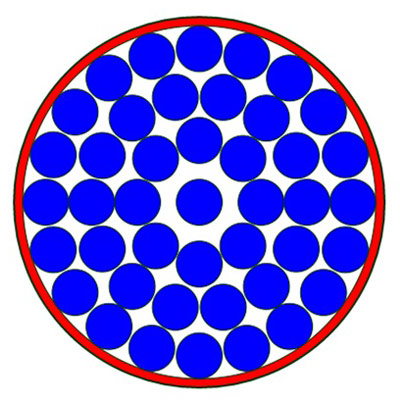 This information is intended to help understand the descriptions given in this section of Taiyin Daquanji; at the same time is shows inconsistencies in the data from various sources. A much longer essay would be required to try either to bring all the data into a coherent whole.
As I understand it, what comes from the silkworm is called a "brin": one of these emerges at the same time from each of the two silkworm glands; right at the glandular opening (spinneret) they fuse to make a "bave" (rhymes with "have"). This bave is what seems generally to be referred to either as a "fiber" or as a "filament". Since "bave" has sometimes been defined as "the fluid silk as it is spun by caterpillars", perhaps this means the term "fiber" (or as used here, "filament") refers to the bave after it has dried? In any case, since its two parts are fused together the smallest unit referred to here is "filament".
This filament is more triangular (or pentagonal) than round. As it twists into a cocoon the filament can be 300 to 1500 meters long but only 1.8 to 3.0 "deniers" in thickness. "Denier" is actually a unit of weight, and it is weight that determines the musical pitch rather than thickness. But available string measurements only seem to be done in terms of thickness (gauge or numbers of strands); and apparently 1.8 to 3.0 deniers suggests that such a filament would typically have a thickness of just over 10 μm (.01mm; μm [sometimes written "um"] is the symbol for microns/micrometers; it is equal to .001mm).
The blue circles in the image at right show the cross section of a string (or a piece of thread?) with 49 strands. Since a filament .01mm in diameter is too fine by itself, a number of filaments are always bundled together to make strands; strands are in turn wrapped together to make a silk string. Sources suggest that 12 silk filaments will typically be wrapped together to make a single strand of silk. Since often it may be more or fewer filaments in a strand perhaps that is related to the actual thickness of the filament (in any case I am not sure what the variablity is in terms of the strand gauges, much less how this may have changed over time). Furthermore, if the .01mm thick filaments were perfectly round the resulting strand would have a diameter of approximately 54μm (.054mm); however, the filaments' actual somewhat trianguler or pentagonal shape means the round strands will have somewhat smaller diameter.
All this together suggests that to make unwrapped strings with the diameters required for the three "standard" gauge strings in the chart below (see also this string gauge chart) you would need approximately the following number of strands (estimating the diameter of each single strand at .04cm):
1.00 cm : ~ 172 strands
1.20 cm : 256 strands
These figures are summarized (and rounded off) from some personally sent by Michael Brettl, who added numerous caveats regarding the flexibility of these figures (e.g., related to the production process, whether the silk is de-gummed and so forth); in sum, "it is the nature of silk strings that consistency may be difficult to achieve and control - even a minute change in the quality and diameter of the silk alone can result in massively different strings". For greater understanding see his on-going website, especially Estimating Guqin String Diameters for Multifilament Core Guqin Strings.
Compare this with the strand counts given in the the following footnote. The actual number of strands will of course vary depending on the thickness of the filaments (it is not clear what range of thicknesses might compare to "1.8 to 3.0 deniers").
In addition to getting clarification for the varying diameters of the filaments it would also be interesting to have some further information as to why they were made first into strands instead of directly twisting them together to make strings. How is this done for silk thread?
As an aside, silk thread gauges can be given in either weight or size; I have seen diameters ranging from .70cm to almost 2cm but I am sure there are many more.
(Return)
12.
Silk string manufacture: gauges and problems with the Taiyin Daquanji data
Issues include the following:
- This section discusses relative string sizes only in terms of the number of strands used to make them. However, silk filaments can vary considerably from silkworm to silkworm. Perhaps related to this, my teacher Sun Yuqin said that each strand should have 9 filaments, whereas Yuguzhai Qinpu and Taiyin Daquanji both say there should be 12 filaments per strand.
- No clear distinction is made between the twisted strands and the strands used for wrapping the lower strings, with details of the wrapping strands being particularly unclear. Related to this, today the lower four strings are wrapped, but evidence here seems largely based on an assumption that only the first three strings were wrapped. This may suggest either that originally only the first three were wrapped, or that in early times both methods existed side by side. (See under gagaku for the possibility that strings survive from the Tang dynasty.)
- The strand numbers do not always seem to add up. For example, data given here for thick strings have the first string with 240 strands, the second 206, the third 172, and the fourth the same as the second. The passage goes on to say, "From the first to the fifth string each succeeding string has 34 strands fewer than the preceding one" and "(thick strings) use the sixth string as the core". Given that they consider only the first three strings to be wrapped, for all this to be correct the core, instead of the 138 strands given in this section, would have have 68 strands (thus the third big string figures would be 172 + 68, which = 206 + 34).
- These figures also seem to be at odds with the figures under "wrapping gauze" that it consists of seven, six or five strands.
- The figures given here concerning the number of strands per string are at variance with what is in the 19th century Yuguzhai Qinpu and with what can be observed in surviving qin strings.
Here is a chart summarizing the calculations of Sun Yuqin, Yuguzhai Qinpu (YGZ), and Taiyin Daquanji (TYDQJ):
Silk string measurements by strands
| Sun Yuqin (9 fil. each) |
YGZ 加重 heavy |
YGZ 太古 ancient |
YGZ 中清 medium |
TYDQJ 大 big |
TYDQJ 中 medium |
TYDQJ 小 small |
TYDQJ 細 fine |
|
| 1st | 126 | 162 | 130 | 108 | 240 + 138 | 160 + 100 | each one | each one |
| 2nd | 108 | 144 | 115 | 96 | 206 + 138 | 140 + 100 | 20 fewer | 20 fewer |
| 3rd | 90 | 126 | 100 | 84 (81?) | 172 + 138 | 120 + 100 | than | than |
| 4th | 81 | 108 | 86 | 72 | 206 | 160 | medium | thin |
| 5th | 72 | 96 | 77 | 64 | 172 | 140 | ||
| 6th | 63 | 84 | 67 | 56 (54?) | 138 | 120 | ||
| 7th | 54 | 72 | 58 | 48 | 104 | 100 |
Compare the numbers from Seng Juyue, above. Also given above are some speculative modern calculations, but as yet I have not seen figures based on physical examination of the number of filaments or strands in modern qin strings. It is thus difficult to correlate the information concerning strands in the previous chart and the text above, as well as the speculative details in the previous footnote, with information about gauges given in the following chart, which only gives their relative thicknesses/gauges in cm, based on the ranges available for strings today.
To make the following chart (expanded in 2012 to include some new "thickest" strings) I used a micrometer to measure good strings made ca. 1980, ordinary strings from the mid 1990s, and some excellent new ones first made available in early 2000 in two gauges, then in 2004 produced in three different gauges (trial version, February 2004) using the brand name Taigu. The three gauges for Taigu strings, called "加重 jiazhong", "太古 taigu" and "中清 zhongqing" respectively, resemble most closely the gauges of the "thick", "standard" and "medium" strings in the chart below. However, it should be noted that no actual sets have these precise measurements: the figures below are averaged from measuring all the above. In addition, any particular string (particularly a wrapped one) tends to be uneven, its gauge varying by as much as .05cm depending on place of measurement. Today strings 1 to 4 are always wrapped; this process is also called "overspinning".
Sample modern silk string gauges (mm)
| thickest | thick | standard | medium | thin | |
| 1st | 1.88 | 1.75 | 1.64 | 1.52 | 1.40 |
| 2nd | 1.78 | 1.60 | 1.49 | 1.38 | 1.27 |
| 3rd | 1.60 | 1.45 | 1.35 | 1.24 | 1.14 |
| 4th | 1.40 | 1.30 | 1.20 | 1.10 | 1.00 |
| 5th | 1.20 | 1.15 | 1.10 | 1.00 | 0.90 |
| 6th | 1.10 | 1.03 | 1.02 | 0.90 | 0.80 |
| 7th | 1.00 | 0.90 | 0.85 | 0.80 | 0.75 |
13.
Big (i.e., thick) Qin Strings (大琴絃)
The basic data on strands seems consistent; the original explanation is:
One cocoon provides one filament spit out by the silkworm. Use 12 filaments to make a strand (and it is called) "12 filaments". More than (12) then (the strand/string) is (too) thick; just under then it is (too) thin.
Cocoon (繭 jian); silk filament (絲 si); silkworn (蠶 can); strand (綸 lun).
On the other hand, the numbers given for string count are confusing mainly because, although the data makes it clear its string counts do not include mesh wrapping, it doesn't make it clear which strings actually have the wrapping. This makes it difficult to line up the string counts here with the data in the above chart
(also here).
(Return)
14.
Core (胎 tai, lit. "womb")
See the figures +138 and +100 from columns "TYDQJ (big)" and "TYDQJ (medium)" in the chart above.
(Return)
15.
Statistics involving the "core" (see also "Problems to consider")
As mentioned in the previous footnote (for Thick Strings), the text states that in addition to the core the first three or four strings have a wrapping. However, the statements that for thick strings this core should be the sixth string and that for middle sized strings this should be the seventh string lead to some complications in the statistics as given.
In addition, note that the "explanation" of each string having 20 strands less than the previous will only add up if the 4th to 7th have as many strands as noted here, and the core for the 1st to 3rd strings had 60 each
(e.g., a "Fine" 7th Qin String -- see below).
(Return)
16.
See previous comments about the inconsistency of the calculations.
(Return)
17.
Medium (in thickness) Qin Strings (中琴絃)
See chart.
(Return)
18.
Small (i.e., thin) Qin Strings (小琴絃)
See chart.
(Return)
19.
Fine (i.e., very thin) Qin Strings (細琴絃)
See chart.
(Return)
20.
Wrapping Gauze (纏紗/纒紗 Chan Sha)
Strings with this wrapping gauze (or "mesh") could also be called "wrapped strings" (纏絃 chanxian), "wrapped silk strings" (纏絲絃 chansixian) or just 纏 alone. This section might more logically have been followed by the section called Method for Wrapping Gauze (纏紗法 chansha fa).
(Return)
21.
This last sentence in the original is: 別用一管子卷之,不得與絃同管。 Note that the tube used to keep the strings separate and tight while they are being boiled is also called a guanzi.
(Return)
22.
One zhang = 10 chi = 100 cun = officially 141 inches according to Matthews dictionary, but this varies with time and place. By this reckoning 5 x 4 cun = 7" x 5.6".
23.
墜子 zhuizi literally means "earrings". The illustration at right shows Mr. Sun's idea of what one might look like.
As for the devices for storing the string, or twisting it, or stretching it, Mr. Sun had never heard of the fore-mentioned "tube", or the device for twisting strings, mentioned under Method for Wrapping Gauze, below.
To make strings, first the filaments (si) must be twisted to make strands (lun), then the lun must be twisted to make strings (xian). The zhuizi seems to be for the latter, but it is not completely clear to me.
24.
Pan or pot size
(Return)

(Return)
Here footnote 26 by Tong Kin-Woon says,
(Return)
25.
Clear fish gelatin (明亮魚膠 mingliang yujiao)
One 兩 liang (about an ounce?). Sun Yuqin said this kind of gelatinouw substance, which comes from the stomach of a fish, was no longer available. He was either mistaken (it is readily available), or I misunderstood, or he had information that "fish gelatin" refers to a special kind of (treated?) fish gelatin that in the past was different from the pure fish gelatin ("isinglass") of today.
(Return)
 26.
Wrapping Method (纏法 Chan Fa)
26.
Wrapping Method (纏法 Chan Fa)
"Wrapping method" might also be translated as "method for making the mesh", as the wrapping forms a sort of mesh around the string. This section might more logically have been placed together with the one called wrapping gauze.
The cart-device (車子 chezi, illustrated at right) seems to be the "cart-bed" (車床 che chuang) shown in Figure 1 of the passage on silk strings in Yuguzhai Qinpu. Instead of this device, Mr. Sun said he had wanted to use bicycle wheels to twist the strings, with fixed distances.
See also String Making Method (造絃法 zao xian fa), above.
(Return)
Return to the top,
to the Taiyin Daquanji index page,
or to the Guqin ToC.