|
T of C
Home |
My Work |
Hand- books |
Qin as Object |
Qin in Art |
Poetry
/ Song |
Hear / Watch |
Play Qin |
Analysis | History |
Ideo- logy |
Miscel- lanea |
More Info |
Personal | email me search me |
| Playing at exhibitions: Fantastic Mountains and In Pursuit of Mists and Clouds | 中文 目錄 |
|
Guqin in Art
Especially, guqin and Chinese painting |
古琴與書畫
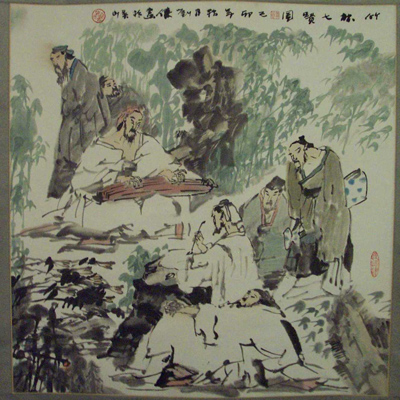
The Seven Sages, with Xi Kang playing qin 1 |
 This section has three categories:
The division between categories 2 and 3 is similar to that with qin poetry and song, with qin poetry (poems that mention qin) corresponding to qin in art, and qin songs (lyrics that accompany qin melodies) corresponding to art which can be used to illustrate a specific qin melody. The qin is a very common motif in traditional landscapes, but the latter category is also quite considerable, and it is the latter which this website emphasizes.
Deriving inspiration from looking at artists' impressions of the themes of melodies can be related to the ancient idea of taking this inspiration from nature itself. Perhaps the earliest narration of this concept is the famous story (told with the melody Shui Xian) in which Cheng Lian teaches Boya to play qin by leaving him alone on a deserted island.5
Art with themes shared by qin melodies can bring similar inspiration.
If no indication is given (usually by a link) of the current location of the original of an image on this site, then it is probably in my personal collection.
Footnotes (Shorthand references are explained on a
separate page)
1.
The Seven Sages, with Xi Kang playing qin
Painting by Liu Jian, Vice President,
China Academy of Art, Hangzhou
劉健教授,中國美術學院副院長,杭州
(Return)
2.
Artists with the Guqin
Added 2007. Not yet developed: suggestions welcomed.
(Return)
3.
Guqins in art and illustrations
See also graphic illustrations. And other websites have numerous examples of illustrations that can be used to accompany guqin melodies. In the past I have had some links here to them, but the links keep changing.
(Return)
4.
Illustrations of guqin melodies
Some of the examples of these on this website reveal close associations between a painting and a melody. The spirit behind this is an aim to evoke the sort of reaction an artist might have had on hearing the qin at a gathering such as the one depicted on the page The Four Arts of the Chinese Scholar: someone would recite a poem and this would inspire a qin melody; someone would play a qin melody and this would inspire a painting.
(Return)
5.
Learning from nature
A personal experience that might be connected to this concept is presented in connection with Silk Zither Dreams.
(Return)
Return to the Guqin ToC