|
T of C
Home |
My Work |
Hand- books |
Qin as Object |
Qin in Art |
Poetry / Song |
Hear, Watch |
Play Qin |
Analysis | History |
Ideo- logy |
Miscel- lanea |
More Info |
Personal | email me search me |
| With Zhong Ziqi (in nature; other images: High Mountains On a boat Another boat Playing for Ziqi Mourning Ziqi) | 首頁 |
|
Bo Ya
- Qin Shi #38; other qin bios |
伯牙 1
琴史 #38 2 |
| Boya at the Wuhan Guqin Terrace3 (compare painting) |
 Bo Ya is the most famous Chinese musician from antiquity, but about him we have no facts, only legend.4 Early accounts tell of his ability to express himself on the qin, and about never playing again after the death of
Ziqi, the only person who ever understood his music; but none of these sources gives any specifics about his life, at most identifying him as having lived during the Spring and Autumn Period (777 - 476 BCE), with no mention of where he was from. He is not mentioned in the Book of History (Shi Ji) and the other classical texts add few specifics other than that when he played horses looked up to listen, that only Ziqi was able to understand when Boya described in his music mountains or streams, and that this is why after Ziqi died Boya broke his strings. All other stories seem to be later additions except for the one that he he had a qin named dizhong.5
Bo Ya is the most famous Chinese musician from antiquity, but about him we have no facts, only legend.4 Early accounts tell of his ability to express himself on the qin, and about never playing again after the death of
Ziqi, the only person who ever understood his music; but none of these sources gives any specifics about his life, at most identifying him as having lived during the Spring and Autumn Period (777 - 476 BCE), with no mention of where he was from. He is not mentioned in the Book of History (Shi Ji) and the other classical texts add few specifics other than that when he played horses looked up to listen, that only Ziqi was able to understand when Boya described in his music mountains or streams, and that this is why after Ziqi died Boya broke his strings. All other stories seem to be later additions except for the one that he he had a qin named dizhong.5
Regarding his name, all the ancient sources seem to give "Bo Ya" as the complete name. Later sources, however, often say his surname was Yu, making his full name Yu Boya. In addition, some qin references also call him Yu Duan or Yu Rui. However, the attribution to him of these names seems to have originated in the Song or Ming dynasties.6
Likewise with stories that he was from the ancient state of Chu.7 Although it seems common today to state this as a fact, the source of this story is unclear - perhaps of the same origin as that his surname was Yu. On the other hand, the qin pavilion associated with him in Hanyang (part of the modern city of Wuhan) are said to be just the latest in a series of such pavilions that have been there since at least the Song dynasty. Perhaps this suggests an association of Bo Ya with Chu dating earlier, but did other places also claim a connection with him?
The many stories that grew up about Bo Ya make studies of him both interesting and worthwhile for what they say about traditional Chinese attitude towards art and music. They also call for more research into the connection between literati culture and folk culture.8
Bo Ya and the Guqin9 is the tentative title of a program drawing on the many surviving qin melodies associated with Bo Ya. The following are the relevant melodies I play, all as published in Ming dynasty handbooks; the first two are among the most famous titles in the Chinese music repertoire:
- Gao Shan (High Mountains; listen); my recording is of the earliest version
- Liu Shui (Flowing Streams; listen); my recording is of the earliest version
- Feng Ru Song Ge (listen); oblique reference in lyrics
- Jiang Yue Bai (listen, with Qing Ye Yin); shares lyrics/story with #8 below, Ting Qin Fu
- Shishang Liu Quan (listen); sometimes connected to Boya
- Boya Diao Ziqi (listen); Boya Mourns Ziqi, a song
- Shuixian Qu (listen); see below and Shuixian Cao; Boya studies the qin
- Ting Qin Fu (listen); a song telling the Boya/Ziqi story; requires an extra singer
Some years ago, after playing qin at a meeting with several senior qin players, I asked them for advice on how to improve my technique. One said, "Visit all the relevant beauty spots in China." The others seemed to nod their heads in agreement.10
The origins of this concept, learning music from nature rather than from a human teacher,11 could well be the story related here below: Boya learns his qin playing skills from Cheng Lian12 (sometimes Tian Lian?13) but his playing art from nature. This story is also told in several prefaces to the melody Shuixian Qu, also called Shuixian Cao. The title Shuixian Cao is mentioned in many early lists of melodies, but the earliest surviving tablature using the word "shuixian" is the Shuixian Qu found in Wuyin Qinpu (1579).14
The Qin Shi biography includes a quote from the book of Xunzi,15 and also mentions the name Fang Zichun, whom Cheng Lian claims as a "teacher".16 I have not found mention of Fang Zichun elsewhere.
The most famous story for Boya, telling of his meeting with Zhong Ziqi, usually but not always described as a woodcutter, is told not in the present entry but in Zhong Ziqi's own entry. It is also related in the introduction to the melody Gao Shan. The friendship of Boya and Ziqi is the focus of the qin song Boya Diao Ziqi.
Boya is associated with a famous qin called Hao Zhong (Proclaiming Affection). There are images of Hao Zhong in a number of books. See, for example, Taiyin Daquanji, Chapter 2, image 10 (also compare image 3, Di Zhong).
Stories of Boya are also to be found in the countries near China,17 especially Japan, where he was called Hakuga.18
The entry for Boya in Qin Shi is as follows,19
The famous "High Mountains Flowing Streams" story is told under Zhong Ziqi.
Footnotes (Shorthand references are explained on a
separate page)
1.
Bo Ya references
Perhaps only "Bo Ya" should be used for the original name and "Boya" with
Yu Boya; instead they are used pretty much interchangeably. A search in the Chinese Text Project for "伯牙" in all "Pre-Qin and Han" sources gives 28 results in 21 paragraphs of 14 texts, as follows:
- 荀子,勸學
Xunzi Quan Xue 11
(translation; see also
Knoblock I.7)
『昔者瓠巴鼓瑟,而流魚出聽;伯牙鼓琴,而六馬仰秣。故聲無小而不聞,行無隱而不形。」 - 說苑,尊賢、談叢
Shuo Yuan, Zun Xian 7 and Tan Cong, 61
『伯牙子鼓琴,鍾子期聽之,方鼓而志在太山,鍾子期曰:「善哉乎鼓琴!巍巍乎若太山。」少選之間,而志在流水,鍾子期復曰:「善哉乎鼓琴!湯湯乎若流水。」鍾子期死,伯牙破琴絕絃,終身不復鼓琴,以為世無足為鼓琴者。非獨鼓琴若此也,賢者亦然,雖有賢者而無以接之,賢者奚由盡忠哉!』
『鍾子期死而伯牙絕絃破琴,知世莫可為鼓也;惠施卒而莊子深暝不言,見世莫可與語也。』 - 韓詩外傳,卷六、卷九 Hanshi Waizhuan, Folio 6 #14 and Folio 9 #5
『夫子亦誠無善耳。昔者瓠巴鼓瑟,而潛魚出聽;伯牙鼓琴,而六馬仰秣;魚馬猶知善之為善,而況君人者也。』
『伯牙鼓琴,鍾子期聽之,方鼓琴,志在山,鍾子期曰:「善哉!鼓琴!巍巍乎如太山。」志在流水,鍾子期曰:「善哉!鼓琴!洋洋乎若江河。」鍾子期死,伯牙僻琴絕絃,終身不復鼓琴,以為世無足與鼓琴也。非獨琴如此,賢者亦有之,苟非其時,則賢者將奚由得遂其功哉!』 - 大戴禮記,勸學 Da Dai Li Ji, Quan Xue 11
『昔者瓠巴鼓瑟,而沈魚出聽;伯牙鼓琴,而六馬仰秣,』 - 論衡,累害 Lunheng, Lei Hai 7
『絃者思折伯牙之指,御者願摧王良之手。』 - 風俗通義,聲音,琴 Fengsu Tongyi, Shengyin, Qin (only one of these also to use " 伯子牙 Boziya")
『伯子牙方鼓琴,鍾子期聽之,而意在高山,子期曰:「善哉乎!巍巍若太山。」頃之間而意在流水,鍾子又曰:「善哉乎!湯湯若江、河。」子期死,伯牙破琴絕絃,終身不復鼓,以為世無足為音者也。今琴長四尺五寸,法四時五行也。七絃者、法七星也。』 - 列子,湯問
Liezi, Tang Wen 12
(translation; see also
Graham pp. 109/110)
『伯牙善鼓琴,鍾子期善聽。伯牙鼓琴,志在登高山。鍾子期曰:「善哉!峨峨兮若泰山!」志在流水。鍾子期曰:「善哉!洋洋兮若江河!」伯牙所念,鍾子期必得之。伯牙游於泰山之陰,卒逢暴雨,止於巖下;心悲,乃援琴而鼓之。初為霖雨之操,更造崩山之音,曲每奏,鍾子期輒窮其趣。伯牙乃舍琴而歎曰:「善哉善哉!子之聽夫志,想象猶吾心也。吾於何逃聲哉?』 - 淮南子,說山訓、脩務訓 Huainanzi, Shuoshanxun 2 and Xiuwuxun 11 (Major et al, 16.4a and 19.7)
『瓠巴鼓瑟,而淫魚出聽;伯牙鼓琴,駟馬仰秣;介子歌龍蛇,而文君垂泣。』
『是故鍾子期死而伯牙絕弦破琴,知世莫賞也;』 - 呂氏春秋(呂覽),本味 Lüshi Chun Qiu (Lu Lan), Ben Wei 3
(see Knoblock and Riegel)
『伯牙鼓琴,鍾子期聽之,方鼓琴而志在太山,鍾子期曰:「善哉乎鼓琴,巍巍乎若太山。」少選之間,而志在流水,鍾子期又曰:「善哉乎鼓琴,湯湯乎若流水。」鍾子期死,伯牙破琴絕弦,終身不復鼓琴,以為世無足復為鼓琴者。非獨琴若此也,賢者亦然。雖有賢者,而無禮以接之,賢奚由盡忠?猶御之不善,驥不自千里也。』 - 漢書,傳,司馬遷傳、嚴朱吾丘主父徐嚴終王賈傳下、揚雄
Han Shu, Biographies, Biography of Sima Qian 21; of Yan, Zhu, Wuqiu (etc) 22; and of Liu Xiang (part 2) 20
『蓋鍾子期死,伯牙終身不復鼓琴。何則?』
『雖伯牙操遞鍾,逢門子彎烏號,猶未足以喻其意也。』
『是故鍾期死,伯牙絕弦破琴而不肯與眾鼓;』 - 《東觀漢記,傳十三,尹敏 Dong Guan Han Ji (chinaknowledge.de), Annal 13, Yin Min 2
『然鍾子期死,伯牙破琴,曷為陶陶哉!』 - 後漢書,列傳,鄭、范、陳、賈、張列傳、儒林列傳上 Hou Han Shu, Annals of (陳元 Chen Yuan) 25, and of Confucian Scholars 49
『夫至音不合眾聽,故伯牙絕弦;』
『自以為鍾期伯牙、莊周惠施之相得也。』 - 楚辭,七諫,謬諫、九歎,愍命, Chu Ci. Qi Jian, Miujian, 25th couplet; and Jiu Jian, Min Ming, 6th couplet (see Hawkes)
『伯牙之絕弦兮,無鍾子期而聽之。』
『破伯牙之號鍾兮,挾人箏而彈緯。』 - 說文解字,卷十二,魚部
Shuo Wen Jiezi, Folio 12, Fish section, 7579
『鱏:魚名。从魚覃聲。傳曰:「伯牙鼓琴,鱏魚出聽。」』
Boya and Ziqi as 知音 zhiyin: bosom friends
Given the popularity of the Boya story it is somewhat surprising that, although a search of the China Text Project turns up 32 occurrences of 知音 zhiyin, none directly connects it to the Bo Ya - Ziqi story. In addition, although it is an account in Liezi, translated here as part of the preface to the melodies High Mountains and Flowing Streams, that has the most detailed account telling of Bo Ya playing the qin for Ziqi, the standard Liezi text does not seem to mention Ziqi dying, instead having Boya traveling and Ziqi continuing to understand his music. The story of Ziqi dying seems to come from Lüshi Chunqiu. Nevertheless, 24483.114 知音 zhiyin quotes the same Liezi passage as having the following:
子期死,伯牙絕絃,以無知音者。
The Lüshi Chunqiu
Concepts about zhiyin are discussed in more detail
here. Broadly speaking, references seem to suggest that although "zhi yin" could simply refer to a technical knowledge of music, at the same time it implies that a high level of such knowledge (or awareness) might be needed to appreciate a subtle type of music, such as that of guqin; zhi yin" as "bosom friends" naturally follows on from this.
When Ziqi died, Bo Ya broke his strings, figuring that there would be no one else who could understand his music.
When Zhong Ziqi died, Bo Ya smashed the qin and cut its strings. To the end of his life, he never played the qin again because he felt that there was no one in the world worth playing for. This applies not only to the qin, but to worthiness as well. Although a man is worthy, if he is not received by a ruler with due courtsy, why should he devote his full loyalty to him? It is like the fleet-footed horse that will not go a thousand li by itself when the driver is not skilled.
The other early accounts mostly tell shorter versions of the same story. The only additional detail is the one in Han Shu about Bo Ya playing a qin called 遞鍾 Di Zhong.
Other references
538.18 伯牙 and
Bio/1097 伯牙 Boya both give only "Spring and Autumn period" for his dates and nothing about his place of origin. The former cites five sources, all of which are included among the references above.
None of these references connects Bo Ya to any geographical region, nor do they mention his supposed surname 俞 Yu (as in 俞伯牙 Yu Boya or 俞端 Yu Duan). The preface to Ting Qin Fu uses this surname, as does the story below connecting Boya to the state of Chu. But the surname Yu is rarely found elsewhere. Xu Jian does not mention it in his Outline History discussion of Bo Ya, Chapter 1. A. (中文 pp. 4-5).
The entry 538.21 伯牙絕絃 Boya Breaks his Strings tells the story related under
Zhong Ziqi and depicted under Boya Mourns Ziqi. And in opera one can find Boya Smashes his Qin (伯牙碎琴 Bo Ya Sui Qin, e.g., in Jing Ju), also called 撫琴訪友 Playing the qin while visiting a friend, 聽琴 Listening to a qin, and 知音會 Meeting of intimates through music. The operas seem often to connect the story to a "Saddle Mountain" (馬鞍山 Ma'an Shan; 45550.771/2 lists 24 such mountains).
(Return)
2.
Folio 2, #12; 9 lines.
(Return)
| 3. Bo Ya Qin Terrace 伯牙琴臺 (old riverside image?) | An old photo of the Boya Qin Terrace, then on a Hanyang hilltop |
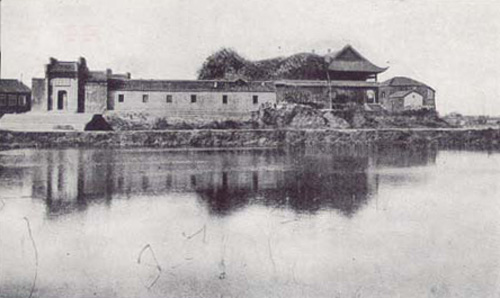
 There are a number of Qin Terraces (琴臺 Qin Tai) in China, but the best known one, also called the 古琴台/古琴臺 Guqin Terrace, or translated as Heptachord Terrace (external site) or Ancient Lute Terrace, etc., is by Moon Lake in the Hanyang district of Wuhan (14658.207 月湖 Moon Lake says Hanyang has an East Moon Lake and a West Moon Lake). Hanyang was once part of the ancient state of Chu and Boya is often said to have been from Chu. Other than this, Boya's connection to Wuhan is discussed below. (See also the
commentary in
Ting Qin Fu, which seems to suggest this event took place along a 清江 clear river near 常州 Changzhou (presumably not the one 500 miles downriver in Jiangsu province).
There are a number of Qin Terraces (琴臺 Qin Tai) in China, but the best known one, also called the 古琴台/古琴臺 Guqin Terrace, or translated as Heptachord Terrace (external site) or Ancient Lute Terrace, etc., is by Moon Lake in the Hanyang district of Wuhan (14658.207 月湖 Moon Lake says Hanyang has an East Moon Lake and a West Moon Lake). Hanyang was once part of the ancient state of Chu and Boya is often said to have been from Chu. Other than this, Boya's connection to Wuhan is discussed below. (See also the
commentary in
Ting Qin Fu, which seems to suggest this event took place along a 清江 clear river near 常州 Changzhou (presumably not the one 500 miles downriver in Jiangsu province).
533.23 伯牙臺 Boya Terrace gives two locations, one 浙江海鹽縣東門外 Outside East Gate in Haiyan District, on the north side of Hangzhou bay east of Hangzhou; the other is the one in Hanyang mentioned above. Both are said "by tradition" to have been associated with the Boya and Ziqi story, but no dates are given for the origins of these traditions. I have found no evidence that Haiyan still claims this connection.
In addition, 21570.78/2 Qin Terrace has four references. One says it is the same as Boya's Qin Terrace, as above. However, at least two of the other three are associated with other people: the one in 山東省單縣東南一里舊城北 the north part of the old town one li southeast of Dan district of Shandong province is said to be where 子賤 Zijian (Fu Buqi) played; the one in 河南省魯山縣城北 the north of the Lushan District city of Henan province is said to have been built by 唐元德秀 Yuan Dexiu; the third, in 浙江省杭縣慧日峰西 east of Huirifeng in Hangzhou district of Zhejiang province, gives no association. And Magnificent China has a picture of at least one other Qin Terrace, on 靈岩山 Lingyan Mountain, by Taihu Lake near Suzhou; it is said to have been used by Xi Shi.
楊剛編,中國名勝詩詞大辭典 Yang Gang's Poetry Dictionary of China's Scenic Places, pp. 627-8, has seven poems associated with this terrace. The earliest ones it has are as follows:
- 伯牙 Bo Ya, by 王安石 Wang Anshi (1021-1086)
千載朱弦無此悲,
欲彈孤絕鬼神疑。
故人舍我閉黃壤,
流水高山深相知。
(Regarding the last line Su Shi ended his own poem 和蔡景繁海州石室 with the similar line "流水高山心自知". - 放言 Fang Yan by 黃庭堅 Huang Tingjian (1045-1105)
匣中綠綺琴,欲撫已絕絃。
問絃何時絕,鍾期謝世年。
正聲不可聞,千載寂寞間。
未有顏叔子,安知柳下賢。
Not yet translated. Here is a tentative translation of a more recent description than the one linked above. It is from Chinese Wikipedia (also see this map).

According to the "Lüshi Chun Qiu" and the "Book of Liezi", when Yu Boya encountered Zhongzi Qi he played a piece called "High Mountains and Flowing Streams." Boya then found Ziqi to be someone who understood (his) music. They agreed to meet the following year but when Boya returned Ziqi unexpectedly had passed away from illness. Boya was so grief stricken that he never again played qin.
The Guqintai building complex covers an area ofabout 15 mou (acres?). In addition to a temple there are courtyards, forest gardens, flower beds, tea rooms, etc. The scale may not be large, but the layout is delicate and the levels are clear. In front of the temple is the "qintai, a terrace in the form of a square stone platform made of white marble. Its size is about 20 square meters.
The Wuhan Qintai Concert Hall and Wuhan Qintai Grand Theater are on the north side of Qintai Park. Since 2011, the Wuhan Municipal Party Committee and Municipal Government have held an annual Qintai Music Festival in the Qintai Concert Hall.
The complex seems to have changed quite a bit since the photographs here, which date to before 1949.
(Return)
4.
Historical Boya?
It has proven difficult finding the sources of all the later stories about Bo Ya.
(Return)
5.
A qin named Transmitting Affection
(遞鍾 Di Zhong)
Also written Dizhong, this is mentioned several times in the texts above, e.g., in Han Shu. It is not clear whether a distinction was made between Di Zhong and Hao Zhong (號鍾 Hao Zhong: Proclaim Affection), a qin mentioned in 淮南子,脩務訓
Huainanzi, Xiuwuxun, 13
(Major et al, Cultivating Effort, 19.7 translates this: "The qin player hopes for a pure, lingering and clear sound; he does not hope for (the perfection of) Lanxie or
Hao Zhong.
(Return)
6.
Yu Boya (俞伯牙) and Yu Duan (俞端, also 俞瑞 Yu Rui)
1462.xxx for all three; 1462.106 俞端 is someone else. 1462.0 says the character 俞 when pronounced "Shu" was the name of an ancient kingdom northwest of Mount Tai in Shandong (modern 平原縣 Pingyuan County), as well as a personal name. I cannot find this listed as Boya's home, but some stories speak of him traveling in the area north of Mount Tai.
The occasional references in qin melody commentaries to Yu as a surname for Boya may reflect influence from popular literature. In these examples usually his full name is given as 俞伯牙 Yu Boya but he may also sometimes be referred to as 俞端 Yu Duan (here see in Boya Diao Ziqi [QQJC III/189] and in Jiang Yue Bai [QQJC III/112]; both 1525), or as 俞瑞 Yu Rui (1462.xxx; as in Ting Qin Fu; 1511).
The only prefaces to Gao Shan or Liu Shui that mention the surname Yu are those in Shuangqin Shuwu Qinpu Jicheng (1884) (see Zha Fuxi Guide, pp. 22 [266] and 26 [270]).
A qin friend in Wuhan, 王冠卉 Wang Guanhui, has told me that according to one of her teachers the earliest surviving reference to Yu as Boya's surname is in a story told (or re-told) by the famous late Ming literatus 馮夢龍 Feng Menglong (1574-1645). The first story of his Comprehensive Words to Admonish the World (警世通言 Jingshi Tongyan) is 俞伯牙摔琴謝知音 Yu Boya Shuai Qin Xie Zhiyin, translated as Yu Boya Smashes His Zither in Gratitude to an Appreciative Friend by Shuhui Yang & Yunqin Yang in their Stories to Caution the World: A Ming Dynasty Collection (Seattle; London: University of Washington Press, 2005). The original Chinese can easily be found online.
Other stories by Feng also concern or mention qin. I am not sure about his operas and novels (including 平妖傳 Pingyao Zhuan, expanded from an earlier version by 羅貫中 Luo Guanzhong and available online), but a number of stories he recounted in several collections concern or mention qin. For example the story of Baili Xi was recounted in his Romance of the Eastern Zhou Kingdoms (東周列國志 Dong Zhou Lie Guo Zhi). And his "三言 San Yan" series of 120 old 話本 huaben (story outlines beginning from the Song dynasty, re-told in three publications whose titles all end with the word "yan") contain other such stories.
(Return)
7.
Yu Boya of Chu 俞伯牙 (see also previous)
The following biography of Boya, as well as the photo above, is adapted from pp. 288/9 of
Magnificent China
(see original text), a book with numerous pre-1949 photographs (Land of Splendours pp. 123/5). The text and layout of the biography in both books, together with three related photographs, are identical; the Chinese text is longer than the English. The book does not quote its sources, so I do not know where this story originated. The original text begins by saying Boya was in the service of 晉平公 Duke Ping
(Wiki; ruled 557 - 532 BCE) of Jin (Wiki, including its map). Jin was in what is today southern Shanxi province (near modern 晉城 Jincheng?). But Ping did not understand Boya's music and was always asking him to play for guests at banquets, so he left and returned to his home state of Chu, living in the Chu capital, 郢 Ying, upriver from Hanyang (Wuhan), near modern 荆州 Jingzhou (Wiki).

Yu Boya lived in the time of Duke Ping of Jin. Boya himself came from the Chu Kingdom to the south. There he had studied the qin with the great master Cheng Lianzi (Cheng Lian; see more about this under Shui Xian). In order for Boya to better understand the connection between qin music and the sounds of nature, Cheng Lian had sent Boya to play in the hills. Boya then went to 泰山 Mount Tai (in Shandong) and listened to the sounds of nature in water and wind. He mastered all these sounds completely. Then he left Chu and took service again under Duke Ping, who gave him high rank. After an absence of 20 years from Chu, Boya desired to return home. 楚靈王 King Ling of Chu (r. 538 - 526) was just then completing construction of a palace at 郢 Ying, and so Duke Ping made Boya his ambassador to a commemorative event. Here Boya discovered that Cheng Lianzi had died, leaving him his qin. Boya then travelled along rivers and streams, eventually coming to Hanyang. Here he anchored his boat in the nearby gorges and began to play on the qin given to him by Cheng Lianzi. As he played he thought sadly of his teacher. Suddenly he heard a sigh coming from the river bank. It came from a woodcutter. Boya invited the woodcutter on board, learning that his name was Zhong Ziqi. Boya, though assuming that Ziqi knew little about music, played several melodies then asked Ziqi if he knew what they signified. The first melody he played was Shuixian Cao. Ziqi said that for him the melody described wind and thunder, birds soaring, fish dancing, all the while water continuing to flow. Boya was astonished that Ziqi understood the music so well. Boya then played Heavenly Wind Melody (Tianfeng Cao). This time Ziqi described in detail how the melody concerned the nearby high mountains. Boya was so pleased with Ziqi they that became close friends. They arranged to meet at the same spot on the same day of the following year. Boya duly arrived at the meeting place, but there was no sign of his friend. He struck his qin and the notes were so mournful that he knew something bad had happened to his friend. He landed and went to Ziqi's village. On the way he saw an old man tending a new grave. The old man told Boya that the grave was that of Ziqi, who had died of a sudden illness. After playing a lament at the tomb (see Huailing Cao), Boya broke his beautiful instrument and never played again. It was mid-autumn.There has been a qin terrace at Hanyang since the Song dynasty, and a district of old Hanyang was called 鐘家村 Zhong Family Village (41566.xxx). Here there is also a Qin Breaking Port (Qin Duan Kou 琴斷口 21570.99xxx). For this reason the famous story is connected to Hanyang.
The following is a similar account, but now I cannot find its source:
中國古代最著名音樂家俞伯牙和鍾子期的故事,是「知音」和「知己」的典範,這兩個藝術家的友誼,被人傳誦至今。俞伯牙名瑞,是戰國時楚國郢都荊門人(湖北江陵)。他在音樂上的稟賦很高,擅於彈奏古琴。他最初拜當時有名的古琴家成連子為師,苦學三年....
Some accounts say the above story explains a Chinese expression for "brain drain": 楚材晉用 (Chu talent used in Jin). However, 4/1152 connects this expression with a story from the Zuo Zhuan, 26th year of Duke Xiang (546 BCE; see Legge, V., pp. 521 and 526), that has no connection to Boya (there are also several other unrelated references). Note also that in addition to the specifics about the time and location of this story, it has Boya going into the mountains to learn about nature, instead of to the legendary island of
Penglai in the eastern sea.
(Return)
8.
Bo Ya in folk culture
Research not yet done.
(Return)
9.
Boya and the Guqin: Further program comments
The first seven melodies on the list above have about 40 minutes of music that I myself have reconstructed and perform; a separate singer would be needed for #8, Ting Qin Fu. From this the program could be expanded in several ways. One would be to include melodies from
Boya Xinfa (Shared Teachings of Boya), the only qin handbook named after a famous player of antiquity. Another would be to include other melodies with tangential references to Boya or to this story. For example, the preface to the melody
Lingxu Yin says it must have been "written by...a friend like Zhong (Ziqi)."
(Return)
10.
Inspiration from art and nature
A personal experience that might be connected to this concept is presented in connection with
Silk Zither Dreams.
(Return)
11.
Learning without a teacher 無師自通
The Qin Shi biography says only "無師 without a teacher". For the expression "無師自通 without a teacher oneself succeeds" 7/127 gives several examples, but none involves learning from nature.
(Return)
12.
Cheng Lian 成連 (sometimes romanized Chenglian; also 成連子 Cheng Lianzi)
There is little information available about Cheng Lian other than that he was the teacher of Bo Ya. 11820.165 Cheng Lian (quoting 太平御覽,樂,琴 one of the three chapters about qin in the music section of the Song dynasty work Taiping Yulan) tells only the story of him sending Bo Ya to Penglai (more under
Shui Xian). Giles, Po Ya, also has this story. Van Gulik (Hsi Kang, p.88) writes that the 田連 Tian Lian (see next footnote) in Xi Kang's Qin Fu was said to be Cheng Lian.
(Return)
13.
Tian Lian 田連
22219.xxx, but 7/1276 Tian Lian says he was a qin master, quoting Han Feizi (外儲), which also mentions another qin master, 成竅 Cheng Qiao (11820.xxx). The story also compares them to two famous charioteers, 王良 Wang Liang (21295.461) and 造父 Zao Fu (39772.4).
(Return)
14.
Melody of the Water Immortals (Shui Xian zhi Cao 水仙之操)
The Chinese titles for melodies on this theme usually omit the "of" (zhi) used here, thus
Shuixian Qu as well as Shuixian Cao and simply Shui Xian. These titles are actually applied to a variety of melodies, occurrences of which are traced in
a footnote to Shuixian Qu. None of the commentaries there discusses any specific connection between Boya and water immortals.
(Return)
15.
Xunzi 荀子
Xunzi (ca. 310–238 BCE) is credited with "a thorough and cohesive revision of Confucianism, which was crucial to the philosophy's ability to flourish in the Han dynasty and throughout the later history of East Asia"
(Wikipedia). Xunzi's philosophy is outlined in the book called "Xunzi". The book has been translated by John Knoblock.
David Tod Roy has written of the novel Jin Ping Mei that "the implied author adheres to an uncompromising version of Xunzi's particular brand of orthodox Confucianism."
Passages from Xunzi that mention qin are listed here. Two of these relevant to Boya are as follows:
- Xunzi, Chapter 28 宥坐 You Zuo, is discussed and translated under Liu Shui.
- Xunzi, Chapter 1, 勸學 Quan Xue (Encouraging Study; original text above), can be translated as follows:
| 昔者 | In former times, | |
| 瓠巴鼓瑟而潛魚出聽 | When Hu Ba played the se, fish came out of the water to listen; | |
| 伯牙鼓琴而六馬仰秣。 | When Boya played the qin, six (imperial) horses looked up from eating. |
Xunzi uses this to illustrate how even the smallest actions have significance, concluding that worthy actions must likewise bring renown.
A passage from Xunzi that does not specifically mention qin but that might be considered relevant to guqin learning is mentioned here.
(Return)
16.
Fang Zichun 方子春
No further information (13936.xxx, Bio/xxx) on this teacher of Cheng Lian
(Return)
17.
Bo Ya stories in China's neighboring countries (for Japan see next footnote)
In Korea the fact that a net search showed that a Korean singer/rapper named Gil Seong-joon has made an album with a title that translates as "Boya Breaks his Strings" (伯牙絶絃: 백아절현 Baek-ah-jeul-hyun) suggests its currency there.
In Vietnam a melody called Lưu Thủy (Liu Shui) has a long history, and is still popular today. The melody is unrelated to the Chinese one and it is not clear to what extent people connect it to the Boya story, but one can read there about its connection to Bá Nha (Boya) and Tử Kỳ (Ziqi).
(Return)
18.
Bo Ya stories in Japan
In Japan Bo Ya is usually called Hakuga. Most online information about Hakuga comes from commentary on Kyoto's 祇園祭 Gion Matsuri. In connection with the melody Bo Ya Mourns Ziqi this site has an image from that festival and some comments.
In addition, there is the following story from Kakuzo Okakura (岡倉覚三; also 岡倉天心 Okakura Tenshin, 1862 - 1913), The Book of Tea, 1906. The complete English book is included on the website of the World Wide School (see Chapter 5). Here Bo Ya is called Peiwoh.
Okakura apparently wrote only in English. The story was translated into Japanese (see below) shortly after the publication of The Book of Tea, with what he called a harp being written "琴 qin". As for this story, it is pretty clear that Okakura was not translating it from an original Chinese source. It reads something like one of the many free adaptations Japanese have long made of Chinese stories, but Okakura may have adapted or made up a lot of the details himself (further comment). Kiri is Japanese for the 桐 tong tree, from which qin were commonly made, but I do not know of any stories connecting Bo Ya to a place called Lungmen (龍門 Longmen).
Have you heard the Taoist tale of the Taming of the Harp?
Once in the hoary ages in the Ravine of Lungmen stood a Kiri tree, a veritable king of the forest. It reared its head to talk to the stars; its roots struck deep into the earth, mingling their bronzed coils with those of the silver dragon that slept beneath. And it came to pass that a mighty wizard made of this tree a wondrous harp, whose stubborn spirit should be tamed but by the greatest of musicians. For long the instrument was treasured by the Emperor of China, but all in vain were the efforts of those who in turn tried to draw melody from its strings. In response to their utmost strivings there came from the harp but harsh notes of disdain, ill-according with the songs they fain would sing. The harp refused to recognise a master.
At last came Peiwoh, the prince of harpists. With tender hand he caressed the harp as one might seek to soothe an unruly horse, and softly touched the chords. He sang of nature and the seasons, of high mountains and flowing waters, and all the memories of the tree awoke! Once more the sweet breath of spring played amidst its branches. The young cataracts, as they danced down the ravine, laughed to the budding flowers. Anon were heard the dreamy voices of summer with its myriad insects, the gentle pattering of rain, the wail of the cuckoo. Hark! a tiger roars,--the valley answers again. It is autumn; in the desert night, sharp like a sword gleams the moon upon the frosted grass. Now winter reigns, and through the snow-filled air swirl flocks of swans and rattling hailstones beat upon the boughs with fierce delight.
Then Peiwoh changed the key and sang of love. The forest swayed like an ardent swain deep lost in thought. On high, like a haughty maiden, swept a cloud bright and fair; but passing, trailed long shadows on the ground, black like despair. Again the mode was changed; Peiwoh sang of war, of clashing steel and trampling steeds. And in the harp arose the tempest of Lungmen, the dragon rode the lightning, the thundering avalanche crashed through the hills. In ecstasy the Celestial monarch asked Peiwoh wherein lay the secret of his victory. "Sire," he replied, "others have failed because they sang but of themselves. I left the harp to choose its theme, and knew not truly whether the harp had been Peiwoh or Peiwoh were the harp...."
The Japanese translation by 村岡博 Muraoka Hiroshi 1895-1946) can be found online in several places, as follows (this one from here):
諸君は「琴ならし」という道教徒の物語を聞いたことがありますか。
大昔、竜門の峡谷に、これぞ真の森の王と思われる古桐があった。頭はもたげて星と語り、根は深く地中におろして、その青銅色のとぐろ巻きは、地下に眠る銀竜がそれとからまっていた。ところが、ある偉大な妖術者がこの木を切って不思議な琴をこしらえた。そしてその頑固な精を和らげるには、ただ楽聖の手にまつよりほかはなかった。長い間その楽器は皇帝に秘蔵せられていたが、その弦から妙なる音をひき出そうと名手がかわるがわる努力してもそのかいは全くなかった。彼らのあらん限りの努力に答えるものはただ軽侮の音、彼らのよろこんで歌おうとする歌とは不調和な琴の音ばかりであった。
ついに伯牙という琴の名手が現われた。御しがたい馬をしずめようとする人のごとく、彼はやさしく琴を撫し、静かに弦をたたいた。自然と四季を歌い、高山を歌い、流水を歌えば、その古桐の追憶はすべて呼び起こされた。再び和らかい春風はその枝の間に戯れた。峡谷をおどりながら下ってゆく若い奔流は、つぼみの花に向かって笑った。たちまち聞こえるのは夢のごとき、数知れぬ夏の虫の声、雨のばらばらと和らかに落ちる音、悲しげな郭公の声。聞け!虎うそぶいて、谷これにこたえている。秋の曲を奏すれば、物さびしき夜に、剣のごとき鋭い月は、霜のおく草葉に輝いている。冬の曲となれば、雪空に白鳥の群れ渦巻き、霰はぱらぱらと、嬉々として杖を打つ。
次に伯牙は調べを変えて恋を歌った。森は深く思案にくれている熱烈な恋人のようにゆらいだ。空にはつんとした乙女のような冴えた美しい雲が飛んだ。しかし失望のような黒い長い影を地上にひいて過ぎて行った。さらに調べを変えて戦いを歌い、剣戟の響きや駒の蹄の音を歌った。すると、琴中に竜門の暴風雨起こり、竜は電光に乗じ、轟々たる雪崩は山々に鳴り渡った。帝王は狂喜して、伯牙に彼の成功の秘訣の存するところを尋ねた。彼は答えて言った、「陛下、他の人々は自己の事ばかり歌ったから失敗したのであります。私は琴にその楽想を選ぶことを任せて、琴が伯牙か伯牙が琴か、ほんとうに自分にもわかりませんでした。」と。
Regarding the source of Okakura's version of the story, Jing Ke (UCLA doctoral dissertation: China in Okakura Kakuzo with special reference to his first Chinese trip in 1893) wrote to me the following,
19.
Boya entry in Qin Shi (琴史,卷二,十二號)
The original Chinese for this biography is as follows (compare the
introductions to other early Shuixian Cao),
(Return)
It is interesting to compare this story with the one told in the 1988 film "Feeling from Mountain and Water" (山水情 Shan Shui Qing) by 特偉 Te Wei (1915-2010; see further).
| 20. Penglai 蓬萊 (Wikipedia) | 蓬萊山圖 Mt. Penglai |
 The image at right is from 32596.83 蓬萊, which says the source is 山川典 Shanchuan Dian (8043.xxx). Although generally referred to as a mountain (蓬萊山), the mountain was said to have been on an island in the Eastern Sea, and so Penglai may also refer to the island (蓬萊仙島). On the north coast of Shandong province there is a Penglai City
(Wiki) which claims that the Eight Immortals set off from here and that several emperors came here searching for an elixer of immortality. The melody that some sources say Boya created here, Melody of the Water Immortals (水仙之操 Shui Xian zhi Cao), concerns learning music from nature. Other stories have him creating this melody at Mount Tai and then playing it for Ziqi while moored on a boat near Hanyang (see above and under Shuixian Qu).
The image at right is from 32596.83 蓬萊, which says the source is 山川典 Shanchuan Dian (8043.xxx). Although generally referred to as a mountain (蓬萊山), the mountain was said to have been on an island in the Eastern Sea, and so Penglai may also refer to the island (蓬萊仙島). On the north coast of Shandong province there is a Penglai City
(Wiki) which claims that the Eight Immortals set off from here and that several emperors came here searching for an elixer of immortality. The melody that some sources say Boya created here, Melody of the Water Immortals (水仙之操 Shui Xian zhi Cao), concerns learning music from nature. Other stories have him creating this melody at Mount Tai and then playing it for Ziqi while moored on a boat near Hanyang (see above and under Shuixian Qu).
(Return)
Return to QSCB, or to the Guqin ToC.