|
T of C
Home |
My Work |
Hand- books |
Qin as Object |
Qin in Art |
Poetry / Song |
Hear, Watch |
Play Qin |
Analysis | History |
Ideo- logy |
Miscel- lanea |
More Info |
Personal | email me search me |
| Qinshi Chubian Qin biographies Five-string Qin Melodies One origin? Qins from Qin and Han to the Wei and Jin Periods | 中文 首頁 |
| Origins of the Qin 1 |
古琴之來源1
Ancestors of the classical qin? 2 (enlarge; see others) |
 The study of qin can be divided into three periods. There is the early period, which extends from the legends of its creation until the introduction some time before the 7th century CE of what might be called its "classical form"
(see below). The classical form then extends to the present. However, starting some time in the mid-twentieth century there is the beginning of a third period, one which could be categorized as bringing the qin into the modern world: replacing the silk strings with nylon-metal ones to make it more of a performance instrument along modern standards, at the same time making corresponding changes in the instrument's inner structure.3
The study of qin can be divided into three periods. There is the early period, which extends from the legends of its creation until the introduction some time before the 7th century CE of what might be called its "classical form"
(see below). The classical form then extends to the present. However, starting some time in the mid-twentieth century there is the beginning of a third period, one which could be categorized as bringing the qin into the modern world: replacing the silk strings with nylon-metal ones to make it more of a performance instrument along modern standards, at the same time making corresponding changes in the instrument's inner structure.3
At present the classical form can be interpreted either as beginning when the qin became a true zither, with a sound box that extended the full length of the instrument, which could then include instruments such as these. Or it could begin with the introduction of instruments that can clearly be identified and played like instrument in the classical form. But when did that begin?
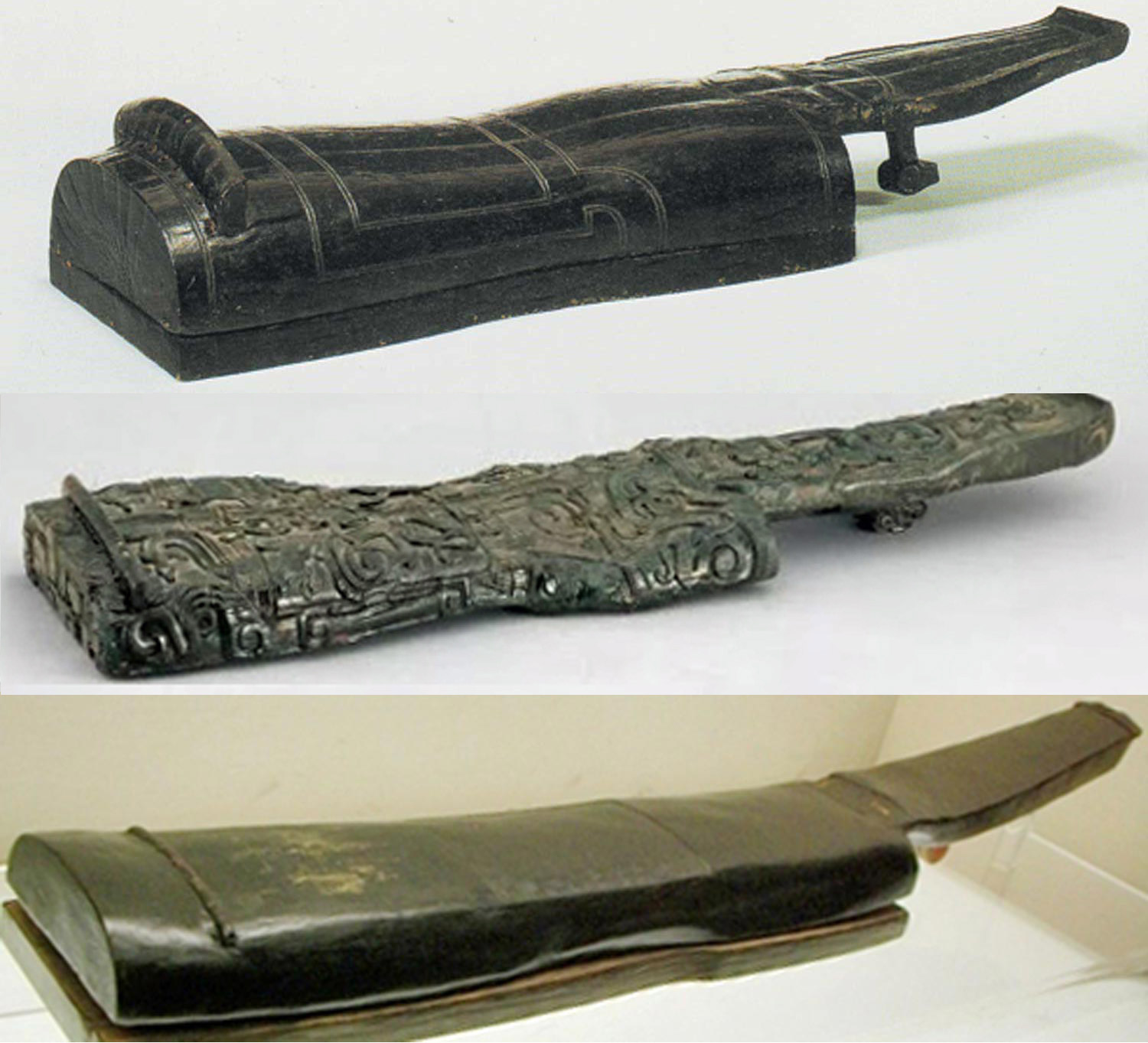
The earliest surviving ancient forms of instruments that are called "qin" (though some prefer "qin-type"), such as those shown at right, have a solid piece of wood for the neck; if this area was used as a fingerboard this would make them lutes; if the neck's curvature meant it could not be used as a fingerboard, this would make the organology of the instruments more resemble that of harps (see Qin: Lute or Zither?).
In any case, the fact that no one has as yet figured out how to make music from the instruments found in the Chu region, other than by simply playing the open strings, has led to speculation that the surviving examples were purely ritual instruments, leaving open the question of what was the exact shape of playable instruments they had at that time that might be identified as qin or ancestors of the qin. What, for example, was the shape of the instrument played by "the first historically named qin player", Zhong Yi? Probably not one shaped like one of those to the right, hence the possibility that those were only ritual instruments.4
That there is no clear indication of when the qin became a true zither suggests that, at least in terms of organology, one can refer to the first two periods as pre-historical and historical. The third period is then the modern period. On details of this many will disagree, but this period has seen changes in qin construction largely but not only to accommodate the nylon-metal strings introduced during China's Cultural Revolution (1966-76) but also for such new inventions as electronic qin.
That the classical form began substantially before the period from which the first true zither-qins survive is perhaps best proven with two examples.
- The survival of the world's oldest surviving substantial written melody, as outlined here.
This is the guqin melody Jieshi Diao You Lan (Towering Rock Melody Secluded Orchid, perhaps more commonly called "Elegant Orchid in Stone Tablet Mode"). Written down in a long scroll dating from at least the 7th century CE, it requires eight or more minutes to play in full (examples), and the sophisticated nature of the melody is strong evidence that it already represented a long tradition. But how long? - Its description in the third century Rhapsody on the Qin
(Qin Fu) by Xi Kang (Ji Kang, 223 - 262)
As further described below, a version of the classical form certainly existed at that time.
In sum, although it is from about the 7th century CE that the earliest qin in their classical form seem to have survived, their sophisticated construction as well as its repertoire provide evidence of a much more ancient tradition. But how ancient?
Legends say the qin was invented over 4,000 years ago.5 There have also been a number of stories of people playing the qin during the following two millennia, and arguments about the type of people who first played it (philosophers; royalty; commoners). But all of this involves much speculation.6 There is conclusive evidence of there having been an instrument (or a class of instruments) called "qin" from as early as the 16th century BCE, but this evidence is not so much physical as pictographic, found primarily in the earliest Chinese written characters, found in archaeology sites: oracle bone graphs from the Shang dynasty (16th-11th C. BCE) and gu wen script from the Shang and early Zhou (11th C - 256 BCE) dynasties (all discussed further below). None of these gives any indication of what the "qin" may have looked like at that time. And from the later Zhou dynasty there are figurines showing people playing what might well represent zithers, but none of these has enough detail to show their actual structure.7
Today it is commonly stated as though it were fact that the qin has 3,000 (or more) years of history.8 The historicity of this claim is reinforced by the depictions of "historical qin images" (歷代琴圖 lidai qintu) dating back to the legendary early emperors: see, e.g., these qin images from a handbook said to date from the Song dynasty. It may thus be said that the Chinese tradition has long traced the qin back to earliest antiquity.
On the other hand, the earliest known mentions of the word "qin" in any literary documents do not come until around the 6th century BCE: in the Book of Songs (Shi Jing) and perhaps the Book of Documents (Shang Shu).9 And the first surviving instruments commonly referred to as "qin", three of them depicted at right, were all excavated from tombs in the old Chu region of south China dated from the fifth to the first centuries BCE.
| Bamboo slip in tomb: |
 Superficially, these instruments from Chu resemble the classical qin; and in at least one tomb there is a bamboo slip identifying the instrument in it as a 琴 qin (see at right [from Yang p.151], copied from the lower of the three instruments at top, identified below). However, as discussed further below, there are very distinct organological differences between these instruments from Chu and the classical forms that have survived, and pictorial evidence suggests that at that time there were a number of instruments that could have been considered as "qin". As a result there is some controversy as to whether Chu instruments are direct ancestors of the classical qin or are one of several styles of instruments that eventually developed into the classical qin.
In the absence of any archeological finds from the north and considering the organological differences, one must consider the possibility that the classical qin may have derived from multiple sources. Some of these sources may have had an influence on or been influenced by northern instruments, but in the end were there others that were a dead end and not ancestors of our classical instrument? Here it might also be pointed out that Chinese characters do not directly indicate pronunciation, and so a variety of zither-like instruments could have been referred to in writing by the character "琴" while in actual practice they were referred to by different names.
Thus, in trying to trace the early "history" of the qin, there are a number of important but not completely resolved issues. What were the earliest Chinese stringed instruments? What are the origins of the character "qin"? When mentioned in so many of China's oldest surviving written records, why is the character for qin generally paired with the character for that of another instrument, the 瑟 se? What are the origins of the physical instrument we know as a qin? What are the origins of the qin philosophy? Or of its use for self-cultivation?
Kenneth DeWoskin has written the following concerning traditional stories about the origins of the qin,11
Today the disagreement amongst modern historians and archaeologists is even greater as they have to consider the contribution of instruments from Chu. Much of this has to do with terminology: to what sorts of musical instruments did characters such as qin and se originally refer? And when considering a possible Chu origin, does this mean considering the possibility that there was foreign influence on its development?
Musicologists have arranged all traditional music instruments into four categories, membranophones, idiophones, aerophones and chordophones), further subdividing chordophones into five types, zithers, lutes, harps, lyres and musical bows (see Music Instrument Categories and their Chinese translation). And from sites dating to the Shang dynasty archaeologists have found examples for three of these categories:14 membranophones (in particular, skin-head drums), idiophones (chimes and bells) and aerophones (ocarinas and flutes). As for the fourth category, chordophones, although no instruments have been found, evidence from the oracle bones and gu wen suggest that they did exist.
Chordophones15 have been sub-divided into five types, zithers, lutes, harps, lyres and musical bows. Of these there is no evidence in pre-modern China for lyres or musical bows. As for indigenous harps16 or lutes,17 unless one accepts the Chu instruments as lutes instead of zithers (see argument) there is no evidence for them in China prior to their introduction there beginning in the Han dynasty. But as for zithers,18 although no physical examples have yet been found that can be dated to before about the 5th c. BCE, evidence from oracle bone and gu wen graphs is sufficient to show they did exist in China at least as early as the Shang dynasty.
Two seemingly specific zither names are known from the earliest Zhou classics: qin and se.19 Unfortunately, the exact details of the instrument or instruments to which each term referred are not clear. This suggests that "qin" and "se" should be considered more as generic words than as specific instruments. This an especially important point, since it seems likely that by the middle Zhou period there were, or had been, many more types of zithers in existence than what we have names for.20 Most writings suggest that the se refers to instruments with movable bridges and qin refers to those without them. However, it is not clear that these two characters always had this meaning, nor is it possible to determine which style came first.21
Concerning the earliest evidence for ancient Chinese zithers, Dr. Tong Kin-Woon has written the following,22
Two other zithers, the zheng (箏),25 similar to the se but with fewer strings, and the zhu (筑),26 the strings of which were struck with a bamboo stick, were popular in the second half of the Zhou period; these instruments are generally believed to be later developments than the qin or the se. However, archaeology shows that there were more styles of zithers in Zhou times than are mentioned in the classics. It is possible that some unrecorded prototypes of Zhou zithers might have existed in Shang times.
Dr. Tong goes on to say that, since no one has yet found oracle bones with characters specifically for stringed instruments, the earliest known written evidence for them is examples in gu wen script, from inscriptions on ancient bronzes; these date from the early Zhou dynasty.27 Thus, the strongest evidence for zithers during the Shang dynasty is the fact that the earliest oracle bone graphs for music (樂 yue) seem to show two pieces of twisted string (幺, probably silk) over wood (木).28
Although, as mentioned above, there were many different styles of zithers during the Zhou dynasty, the only known characters from that period describing them are qin and se, plus zheng and zhu for the late Zhou. Since the actual shapes of the qin and se of that time may have been quite different from what they later became, when discussing that period it is probably best to use the terms "qin-style" and "se-style" rather than "qin" and "se". In addition, the earliest sources generally refer to qin and se as a pair. This might suggest that the term qin se refers to these without distinction, and further that "qinse" might have been a generic term best translated simply as "zithers".
However, the way early literature very often pairs the qin and the se suggests that "qinse" was quite often used simply as a figurative expression. This might be true for any of the qin references in the Book of Songs, said to contain some of China's oldest writing. Its lyrics, which almost always refer to qin and se together, are the source of the phrase, "The qin and se resonate together". This then became a popular expression for "marital harmony".30
Legendary origins of the qin
The earliest Chinese music instruments
The earliest Chinese zithers
Qinse and Qin Se 29
(compare Qin-style and Se-style)
| The earliest physical evidence for the origins of the qin | Two early qin: from the 法隆寺 Horyuji Temple, and the 正倉院 Shoso-In 31 |

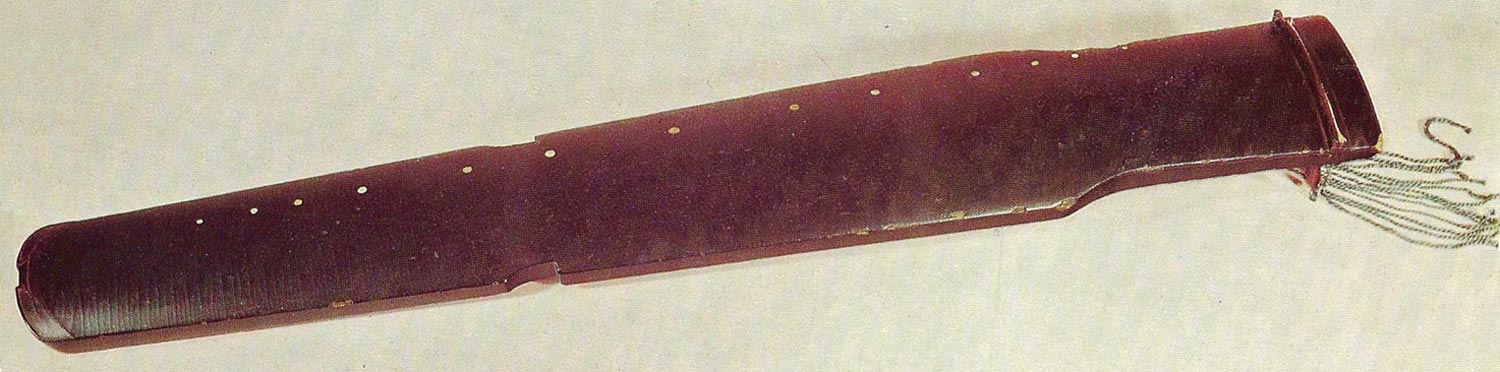 The earliest stringed instruments so far found in China are several qin-styles and se-styles found in late Zhou dynasty tombs in southern China, as in the illustration above. These are quite different from what are said to be the earliest surviving classical style qin, shown at right. The one far right (see also below), dated 735 CE, was stored in the 正倉院 Shoso-In in Nara; the one near right (also see below), tentatively dated 745 CE, was originally kept at the 法隆寺 Horyuji Temple, also in Nara, then was apparently donated to the Imperial Household in Tokyo in 1878; it is now at the Horyuji Gallery of the National Museum in Tokyo. These two instruments are thought to have been taken to Japan some time during the Tang dynasty (618-907 CE) then put into storage for protection or ceremonial reasons, largely unused.
As can been seen, these are quite different from the classical qin. In China quite a few surviving qin have been dated from the Tang dynasty but very few of these dates have been scientifically verified and none prior to 750 CE.32 The sophistication of their construction suggests instruments in this styles already had a long history even then. And this also is supported by the existence of seventh century qin tablature for the melody Jieshidiao You Lan, showing it to be a long and complex melody specifically designed for this instrument. However, it is still not yet possible to say just how long there has been an instrument in this classical form.
The earliest detailed desciption strongly suggestive of a qin in its classical form seems to be the one in the aforementioned third century poem Rhapsody on the Qin. Its descriptions of the physical details of a qin suggest not only that its form in the 3rd century CE was already rather similar to that of qin surviving from the Tang dynasty and later, but also that it had had this shape for some time already.
Unfortunately, the descriptions of qin in still earlier writings are much less detailed, making it impossible to say for certain just when the qin achieved its classical shape. As already noted, surviving instruments from the Han dynasty and earlier have somewhat different shapes (see at top). The earliest written records often depict the qin played in distinctly non-scholarly or non-contemplative settings (see, for example, the story of Zhang Ge and Fu Li). Such evidence, combined with the fact that these records generally do not mention the qin by itself, only qin se together, as though this was a generic term, leaves many questions. It thus remains uncertain what exactly the shape was of the instrument said to have been played by, for example, Confucius and his contemporaries.
Should the excavated qin-style instruments from Chu, with their gradually reduced numbers of strings, be considered not just predecessors of the classical qin, but its ancestors?33 Today it is common to write that the Chu instruments show that part of the evolution from the ancient qin-styles to the classical qin can be seen in the increasing length34 and decreasing number of strings of the Chu instruments.35
However, this theory contradicts the most common legends,36 which generally (but not always37) say that the qin began with five strings then increased in number to seven. In addition, the instruments surviving from Warring States tombs are all from places in the south. The earth in the north, where the five-string qin is said to have had its origins, was apparently harsher on wooden objects left in the ground.38
So another possible theory goes as follows. During the Shang and Zhou dynasties China had a variety of zithers, most without specific names, or with names that have not survived. (There could also have been similar variety later.39) These can be divided into two types: those without movable bridges were called "qin", but this should more precisely be understood as "qin-style"; those with movable bridges were called "se", but this should more precisely be understood as "se-style". Amongst the qin-styles was a five-string zither played in the north, no examples of which have survived because of the prevailing soil conditions. The seven-string descendant of this instrument gained status through accounts in the early classics, thereby becoming the true ancestor of our "classical" qin. Meanwhile, the qin-styles that have been found in the south were perhaps evolving in the direction of this northern instrument, perhaps because of its status, but they could also have been relatively new instruments, with influences from elsewhere (see further comment).
According to some modern research these instruments from Chu did not just exist in isolation, and they could have also had an influence on the development of the classical qin (see Yang, especially here), in which case one must consider the possibility of foreign influence on the development of the classical qin (see further). But in any case, eventually these instruments from Chu went out of use.
Proper testing of this theory may require discovering wooden instruments in the northern part of the Chinese heartland, something is to be unlikely because of the soil conditions there. On other hand the instruments found since 2015 in the tomb of 劉賀 Liu He (92-59 BCE), a Han dynasty prince, give hope for further discoveries. Although this tomb was in 海昬 Haihun, just north of what is today Nanchang in Jiangxi province, the prince himself had grown up in 昌邑 Changyi in Shandong and in 74 BCE even served briefly as emperor in Chang'an (Xi'an) before being exiled to the wilderness of Jiangxi. His tomb had at least five qin, all of the Chu-type. An inscription on a se-stand in the tomb indicates it was probably made in Changyi and so one might assume some or all of the music instruments also were brought there.
Although, or because, Haihun geographically could have been part of the ancient Chu region, the contents of this tomb make the strongest case yet that the qin-type instruments found there were once prevalent in the rest of China. However, as Yang Yuanzheng states, surely more tombs are there to be found.40
In the centuries before the Han dynasty was established the zheng, now also "old zheng" (古箏 guzheng) developed alongside the se. By the Tang dynasty the zheng was one of the most popular instruments in China and the se had almost disappeared. Here one might ask why something similar did not happen with the qin. Comparing the qin ("protoqin"?) that have been found in tombs of the Chu region with the classical form of the qin (guqin) one can see the connections but it seems clear that our guqin is much more playable than were the instruments found in Chu. If people thought that the Chu instrument was the instrument played by Confucius, why did that not survive as is, with the more playable newer version then developing under a different name?
The main difference between the qin and the other long zither now commonly compared to it, the zheng, is that the movable bridges on the latter seem to have made it much more accessible - hence its popularity in China as well as its spread all over East Asia. It would seem that the reason the same thing did not happen with the qin was related to the philosophy that was becoming attached to the qin. But what was (and is) this philosophy?
The 3rd century Rhapsody on the Qin by Xi Kang marks a defining point in the development of both the physical qin and the attitudes towards it. Although the earliest surviving qins in classical form date only from the 7th century, the description by Xi Kang shows that in the third century it had already arrived at its classical form. And although there are passages in earlier writings that reveal aspects of the philosophical ideas that came to be connected to the qin, this is the first full statement of it. Clearly Xi Kang is not describing a new object or proclaiming a new philosophy. But just how old the physical qin and the Way of the Qin were at that time is a question that has no firm answers.41
Qin and se: the development of attitudes towards them
The Way of the Qin
| Summation: Can we determine "an origin" of the qin? | Were these also "qin"? 42 |

Two basic scenarios have been considered: single origin and multiple origin.
- Single origin: for this archaeological evidence seems to suggest this should be the Chu region; if based on textual evidence this should be one of the places claimed as the homeland of the legendary emperors said to have first created it (Henan province for the Shang era?).
- Multiple origin: here the claims are much more complex. One can find ancient drawings that suggest different (regional?) versions of zithers that might have together evolved into the classical qin. But how many of these contributed to the classical form of the qin and how many were simply dead end competitors?
If "multiple origins" includes both the Chu instruments and ones from elsewhere it should be emphasized that, whereas there are recognizable similarities between the Chu instruments and what today are considered the standard instruments, there are also fundamental differences, in particular that only the Chu instruments are known to have had areas that seem to function only as fingerboards. Another very fundamental difference would also come if there is truth to ideas about the early origin of harmonic markers found on the classical qin.
Looking at other instruments for comparison one can find examples such as those at right from archaeological sites in 山東 Shandong and 越國 Yueguo (Zhejiang; enlarge and see also below). Are this instruments that perhaps never had a written name but would have been considered types of qin? And what of the different forms of 筑 zhu (see below).
In sum, whether or not Confucius himself ever played a musical instrument, it still remains unclear what forms of zithers would have been available at that time.
Footnotes (Shorthand references are explained on a
separate page)
1.
Origins of the 琴 qin, beginning with an analysis of the meanings of the character itself
The variety of uses of the character "qin" can cause confusion
(and see more on the role of language). As a result this page often uses the term "qin-style". Here are some of the issues involved.
- In pre-Han writing it is not at all clear what sort of music instrument the character "琴 qin" describes.
- It could have been a generic name for unspecified zithers with neither frets nor movable bridges (here simply called "fretless"); likewise, "瑟 se" could have been a generic name for zithers with movable bridges and/or frets (here simply called "fretted").
- "Qin" could have been the name used in different parts of China to refer to specific local qin-style instruments.
- After the Han dynasty the word "qin" in classical Chinese literature by itself almost always refers to our fretless zither with seven silk strings. However, over time many other stringed instruments came to be called qin: 胡琴 huqin for the two-string fiddle brought to China by the Hu of Central Asia, 月琴 yueqin for the plucked lute with a face like a full moon, and so forth. Eventually, perhaps in the 20th century, the term 古琴 guqin ("old qin") was coined to refer to our seven-string zither.
- In modern times, with many foreign instruments defined as types of qin, many people understand the word to refer to the piano (鋼琴 gangqin), an instrument much more commonly played in China today than is the guqin.
To make a comparison with Western music history, the common saying that "the qin has a 3,000 year old history" is rather comparable to saying "guitars (or indeed pipas) have a history of over 4000 years" because they can be traced back through lutes to the 'ud, which in turn must have descended from stringed instruments found in Western Asia dating back to more than 4000 years ago.
(Return)
| 2. Image: Zhou/Han dynasty qin-style instruments from Chu (enlarge; were they "qin"?) | "Historical qin?" |
 The images above show instruments generally considered today to be direct ancestors of the classical qin. Another hypothesis suggests that the classical qin developed from a variety of earlier local zithers, but that perhaps because of soil conditions no examples of these other local zithers have survived. Although all surviving instruments have clear relationships, there are also significant differences. So how do these theories fit in with the tradition of qin-styles such as those depicted at right, from here? These images are thought to have originated during the Song dynasty (see also the images in the writings of Chen Yang). Earlier writings do not seem to discuss different qin shapes, nor can one find statements saying, for example, that the instruments from the Chu region were different in some way.
Since this page was originally written, several more instruments have been found in the Chu region and, more importantly, information about all of them has become more clear, in English in particular through publications by 楊元錚 Yang Yuanzheng. This footnote has now been revised based largely on information from the following two sources.
Yang Yuanzheng: Dragon's Roar, Chinese Literati Musical Instruments in the Freer and Sackler Collections. Hirmer Publishers/Freer Gallery, 2020.
In particular, Chapter 2 (Archaeology: Truths Gradually Revealed) of Dragon's Roar updates information from the earlier article.
| Comparing a qin from Chu to a Tang dynasty qin |
 For his analysis, Yang divides instruments from Chu into five "registers" (see p.159). At right is, first, the top side and bottom side of a Chu-style qin. The first three of the five registers form the sound box, with the first and third wider than the second. The fourth register connects this to the fifth register, a solid piece that in a zither would be empty and thus part of the sound box but here looks like it should be a fingerboard, though its uneven surface brings that into question.
Dividing the Chu instruments in this way allows Yang to make correlations with the classical qin. For example, on p.35, referring to Figure 2.10, he discusses how the third register has phoenix (and snake) motifs while the second register is dominated by dragon motifs; this then corresponds on the classical qin to the positions of the sound holes called the "dragon's pool" and the "phoenix pond".
The dotted vertical line in this image is there to demonstrate Yang's opinion that the inspiration for the "shoulders" of the classical qin (see "body parts" was the sudden change here in width on the old instruments, not because the instrument was from the start designed with the human frame in mind (see also the reference in the top image here" to the 仙人肩 xianren jian: immortal's shoulders").
At the time of Yang's writing, 2020, eleven "qin-style instruments" (my term) had been discovered in six archaeological sites dating from the 5th to the 1st centuries BCE. Of these eleven instruments, however, only five are complete (#1 to #5 below). Excavation dates for these six sites (listed here in the chronological order of the apparent original burial dates) are reported as, respectively, 1977-81, 2002, 1993, 1980, 1973 and 2015. In the chronological order of the burial dates themselves these eleven (which include the three depicted above) are as follows:
- (The upper instrument above;
larger image) From the 曾侯乙墓
tomb of Marquis Yi of Zeng (433 BCE; 隨縣擂鼓墩 Leigudun, Suixian, Hubei, about 150 km northwest of Wuhan); 10 strings, length 67cm (ca. 26")
As the first one unearthed it is the one most commonly depicted; see, for example, in the film Hero - (The middle instrument;
larger image) From 湖北棗陽九連墩2號墓 Jiuliandun, Zaoyang, Hubei (about 220 km northwest of Wuhan), Tomb #2 (4th c. BCE); 10 strings, length 72 cm (ca.29").
This heavily ornamented instrument was unearthed in 2002 at Jiuliandun ("Nine Mounds in a Row"), an archeological site south of Zaoyang city in Hubei near its border with Henan. Today it is in the Hubei museum. Height 7.5 cm, width 25 cm. Yang Yuanzheng, pp.33-41, has an extensive description of the ornaments; perhaps most interesting is his description of the phoenix and dragon motifs on the top, suggesting a possible connection to the phoenix and dragon sound holes on the bottom of the classical qin (I have not seen any image of the bottom of the Jiuliandun instrument). - * A second Jiuliandun instrument (no image), but fragmentary, from the same source as previous, apparently also designed for 10 strings.
- (Larger image) From 郭店 Guodian, tomb #3 (3rd C. BCE; near 荊門市郭店 Jingmen, Hubei, about 200 km west of Wuhan); 7 strings, length 82.1cm (ca. 32")
The Guodian link concerns Guodian bamboo slips; these apparently include one that mentions a "周公之琴舞 Zhou Gong zhi Qin Wu (Qin Dance of Zhou Gong); if so it is one of the rare mentions of qin in any Chu document.- (Larger image) From "袁家岭墓1195五里牌墓群 Tomb 1195 in the Yuanjialing cluster within the Wulipai Tomb Group" (Wulipai is an eastern suburb of Changsha, Hunan, but the tombs are actually in 芙蓉 Furong distric. This is separate part of a larger tomb group that includes Mawangdui; see next): 7-9 strings, length 79.5 cm (31")
A description published in 1985 (now also in Google books) says:"今年(1982?)長沙五里牌戰國木椁墓出土木琴,長79厘米,從凹槽內絃道勒痕觀察,應為十絃,尾部有一軫。和曾侯乙中的十絃琴很相思,但形製則近於馬王堆三號墓中的七絃琴,琴身有極絢美的圖繪,表現楚琴的特色。 Another description says that there are two Warring States qin-type instruments from around Changsha, the one from 五里牌 Wulipai having nine strings, and another from 袁家岭 Yuanjialing having seven strings, so that presumably it is the one resembling the Mawangdui instrument. As yet I have not yet been able to find any images or further details, including a more clearly identifying gravesite name - there seem to be several tombs categorized simply as "Wulipai" (perhaps adding a number). The description of adornments suggests it may resemble the Jiuliandun instrument shown just below.
This year (1982?) a wooden qin was unearthed from Changsha Wulipai Warring States period wooden outer coffin gravesite; length 79cm (elsewhere says 79.5cm; ca. 31"); from looking at grooves worn into the body, it apparently had 10 strings (elsewhere says 9); the tail section has (underneath it?) a peg. It closely resembles the 10 string qin of Marquis Yi, but its construction method was like that of the seven string Mawangdui tomb #3 qin. The qin body is very beautifully adorned with designs, expressing the particular characteristic of the Chu qin."- (The lower instrument at top) From 馬王堆漢墓 Mawangdui Han Tombs, Tomb #3 (2nd C. BCE; another part of the tomb group just mentioned above, Changsha, Hunan); 7 strings, length 82.4cm (ca. 32"). This tomb has the bamboo slip shown here, apparently identifying its instrument as a qin.
- - 11. Five fragmentary instruments discovered at 海昏侯劉賀墓 the tomb of Liu He, Marquis of Haihun (92-59 BCE; Wiki) north of Nanchang. Although the instruments are all apparently fragmentary, one is complete enough that its length can be estimated at 82 cm (32"). As for Liu He, although known to have had a rather unrestrained life style, he apparently considered himself a Confucian. Is this why he had so many of these instruments? And what instruments might he have brought to Haihun from elsewhere?
- (Larger image) From 郭店 Guodian, tomb #3 (3rd C. BCE; near 荊門市郭店 Jingmen, Hubei, about 200 km west of Wuhan); 7 strings, length 82.1cm (ca. 32")


For all these instruments, the part of the instrument played with the left hand (note that the pictures all have the left hand area on the right, as though the player is facing us) apparently is always solid. This means that these instruments, unlike the classical qin, do not in fact belong to the zither family, instead being types of lutes or even modified harps (further below).
Note also that these instruments all range in length from about 26" to 32" (67 - 83cm) compared to 46" to 48" (ca. 120cm) for most qin since the Tang dynasty. In addition, although today all the above instruments are usually referred to as "qin", it is not certain by what name they were called in Chu. (See, however, the comment above under Guodian. In addition, one tomb, at Mawangdui, apparently had inside a list of the tomb objects, and this is said to mention "qin", but the shape of the instrument referred to is not clear, nor is it clear who wrote the list, or when.) Finally, the area where the left hand would play appears to be solid, meaning that technically within the chordophone family these seem to be more like harps or lutes than like zithers.
It should here be emphasized that the apparent reason such qin-styles survived only in the south had to do with the climate; they might also have existed elsewhere. In addition, no one has explained their uneven top surfaces, which make it very difficult to play stopped sounds.
An opening scene in the film
"Hero" shows a blind man apparently playing a replica of one of these Zhou dynasty instruments. However, the music is a modern composition by Tan Dun played by Liu Li on a modern guqin with nylon-metal strings. In addition to such music being unplayable on an instrument of the shape actually shown, early instruments would all have had silk strings, since metal qin strings were introduced only during China's Cultural Revolution. As for the man being blind, although there does not seem to have been a standing tradition of qin being played by blind people, note this story about Shi Kuang and this reference in the Huainanzi: perhaps there were blind qin players, but the evidence is only from a time when it is not certain what the form or function was of that instrument.
(Return)
3.
"Modern qin"
This is a tentative and certainly controversial categorization. To start with, what I refer to as the "modern" qin generally is not always immediately obvious to the observer and not all new qin have a "modern" style, which originally centered almost entirely on changing the internal structure of the instrument to accommodate the modern nylon-metal strings (see this comment on their development). These changes can range from using heavier and/or thicker wood to make the metallic sound mellower, to altering shape of the sound box (the famous qin maker Wang Peng makes the top board of the sound box thicker beneath the lower strings). Then there are also devises put under the instrument to make it easier to tune the very high tension nylon-metal strings.
Today most people are happy to hear Bach played on a piano, and this is certainly appropriate when the performance is in a large concert hall. But for "historically informed performance", one that features an attempt to capture Bach's sonic world as he created the pieces, one really needs to play them on a harpsichord or other early instrument.
Compromises such as the new composite strings bridge the gap, just as they do when they replace gut strings on early Western instruments. As yet, though, these are not capable of producing the subte overtones that help define the historic sound of the qin.
Modern changes are generally beyond the scope of this website, which probably the only one dedicated to historically informed performance on the qin. This is not intendeded as a criticism of the new, but it does suggest it might be appropriate to have a new name or new names for the modernized instruments, just as when the viols (Wikiedia) were modernised they became violins, violas and so forth.
(Return)
4.
Ritual instruments?
The uneven surface of the Chu instruments prevents controlling the pitches to be played when striking the strings. Harmonics can be played, but there are no harmonic markers. There apparently are notches on the bridge where strings cross: extended ritual play, or were the notches cut in so the strings wouldn't slide out of place?
The instruments that have been found were all buried in tombs. Does this suggest that these instruments stood in for stringed instruments that were actually played?
For an article on ritual use see, for example, this one by Professor Yao Kenan of Huazhong Agricultural University, Wuhan, China:
(Yao Kenan, Research on the Chinese Ten-Stringed Guqin of Marquis Yi: Design Ideas and Origin of Its Shape (2018)
Dr. Yao discusses possible ritual connections to the mythical 夔龍 kuilong but doesn't seem to discuss whether the instrument was ever actually played, or represented instruments that were played.
However, I have not yet been able to find his original article.
(Return)
5.
Legendary origins of the qin
Legends have the qin invented variously by
Fu Xi, Shennong and Huang Di (the Yellow Emperor). It was thus several centuries earlier than Shun (traditional dates 2317-2208) and his five-string qin.
In addition, the 3rd century CE Shan Hai Jing seems to credit a deity named 晏龍 Yan Long (Mild Dragon), a son of 帝俊 Di Jun (great god "Foremost"
(see Birrell, p.195.)
(Return)
6.
Speculation about who originally played the qin
In mainland China during the 1950s writers insisted that the qin was originally played by common people. There has also been speculation that it was developed by 巫師 wushi (encompassing wizards, geomancers, etc.) An internet search for 巫師琴 will give further detail, though it also turns up a lot of pop culture references.
(Return)
7.
Early figurines with...."qin"?
A number of examples are shown here. These figurines, which never have labels, are usually seated on the floor as they play. It is perhaps for this reason that the qin is sometimes referred to as a "floor zither", though for as long as we have had surviving music for the qin it has commonly been played seated at a table.
(Return)
8.
Historical origins of the qin: "3,000 year history"? "5,000 years"?
Statements such as this, especially when backed up by the fact that we actually have playable instruments and complex music from at least the 6th or 7th century CE, are much more impressive than what we hear in the "fake history" often spread today.
Today, specifically, it is commonplace to claim that that the qin actually has "3,000 years of history", or even "5,000 years of history". For this, unfortunately, there is a complete lack of evidence from archeological remains and only questionable support from surviving historical records: the fact that a 2,000 year-old history relates a legend as though it is history does not by itself make the details of that legend into historical fact.
The Oxford online dictionary defines "history"
(q.v.) as, "The study of past events, particularly in human affairs," and, "The whole series of past events connected with a particular person or thing." In other words, the "history" of something (in this case the qin) begins either when someone starts writing about it or when we have facts that support a series of events about it or that support its existence. With "qin", however, one must decide whether the simple mention of that word means the author was writing about what we would identify as a qin. According to my own understanding if we have no description of what a word means then it is difficult to know of what that word is historical evidence. Legendary origins of the qin mentions several early Chinese historical records that ascribe ancient origins to the qin. But even when it is mentioned in Sima Qian's Annals of History it is not clear the nature of the instrument he mentions. This is why, although one might say there is an over-2,000 year old history of claims that the qin goes back 5,000 years, this does not give the qin itself a 5,000 year-old history.
Strictly speaking, the earliest mentions of qin that clearly refer to something that looks like the classical instrument and might have produced sounds we recognize as qin sounds seem to be in the aforementioned
Rhapsody on the Qin. From this 3rd c. CE description of qin music at that time (and emphasized by the complexity of the melody You Lan surviving in a
7th century manuscript) it is clear that the music was then already highly developed. Thus, to my mind, the history of the qin begins either then, or some time during the Han dynasty, if you can argue that a specific Han dynasty description suggests the music might be of the nature described by Xi Kang.
9.
Earliest mention of "qin" in literature
Here are two accurate statements one can make about the history of the qin:
(Return)
For the specific references to qin (and se) in the Book of Songs (詩經 Shi Jing) and the Book of Documents (尚書 Shang Shu) see Qinshu Daquan
(Return)
11.
Traditional stories for origins of qin
See Kenneth DeWoskin, A Song for One or Two, Music and the Concept of Art in Early China, Michigan Papers in Chinese Studies, #4; Ann Arbor, Center for Chinese Studies, the University of Michigan, 1982. p.57. Romanization has been converted here from Wade-Giles. His account does not mention the Shan Hai Jing account mentioned above.
(Return)
12.
Shuo Wen: Shuowen Jiezi
36404.9 說文 Shuo Wen = .16 說文解字 Shuowen Jiezi, by 許慎 Xu Shen (30 - 124; ICTCL). See in Wikipedia. The original text can be found in the China Text Project,
(Return)
13.
Shun played a 5-stringed qin
The earliest known occurrence of this statement, "故舜彈五絃之琴,歌南風之詩,而天下治 In ancient times Shun invented the
five-string qin, in order to sing 'Southern Airs'" (later also called
Nan Xun Ge) is in 《禮記,樂記》 the Book of Music (or Records of Music) secton of the
Book of Rites (Li Ji). Other quotes from Li Ji are included in Qinshu Daquan,
Folio 16 (Written Records). This one was often quoted later. See, for example, Qinshu Daquan,
Folio 1 (quoting Fengsu Tong).
(Return)
14.
Shang dynasty musical instruments
"Shang Music Instruments" is the subject of the Ph.D. dissertation by Tong Kin-Woon at Wesleyan University, 1983 (Shang Musical Instruments; see publication details). Dr. Tong's work primarily concerns oracle bones (see Wikipedia) and gu wen
(again Wikipedia). As mentioned above, in oracle bones there is specific mention of instruments we categorize today as membranophones, idiophone and aerophones, but in surviving oracle bones there is no occurrence of the character 琴 qin, indeed, no mention of any specific chordophone. Nevertheless, evidence from the oracle bones and gu wen suggest that at that time chordophones did exist.
| 甲骨文 |
 In Chapter Seven (op. cit., XV-2, p.73;
.pdf copy) Dr. Tong points out that the three main characters now associated with sound all have their origin in oracle bones, and that each seems to have depicted a different type of music: string, chime and wind. The three graphs (as shown at right) are,
In Chapter Seven (op. cit., XV-2, p.73;
.pdf copy) Dr. Tong points out that the three main characters now associated with sound all have their origin in oracle bones, and that each seems to have depicted a different type of music: string, chime and wind. The three graphs (as shown at right) are,
- The original graph of the character now meaning music, 樂 yue. This early graph was once thought to show two drums mounted on a stand; Dr. Tong shows that it more likely depicted two twisted strings, with wood at the bottom.
- The original graph of the character now meaning sound, 聲 sheng. The early graph suggests a chime (磬 qing) over an ear (耳 er).
- The original graph of the character now meaning musical note, 音 yin. The early graph suggests a flute (made from an early form of 言 yan, now meaning "speech" but then referring to a vertical flute) over a mouth (曰 yue, here meaning the same as 口 kou).
Instruments known to have existed during the Shang dynasty include idiophones such as the 磬 qing and aerophones such as 塤 xun and "言 yan" (as just mentioned above; the Classics specifically mention the 簫 xiao,笛/篴 di and 箎 chi). For others there is also early historical mention after the oracle bones (e.g., 5465 塤 says xun is mentioned as early as the 後漢書 History of the Latter Han Dynasty). Some, such as the xun disappeared from mention, only to be revived in modern times.
As for the "history" of these Shang instruments in general, although there may be mention of them in historical records at least as early as those for the qin and se, there are no descriptions. And as for the qin in particular, in greater antiquity there do not seem to have been any records or legends either describing its appearance or suggesting it had greater antiquity than other instruments.
(Return)
15.
Chordophones
For more information on the categories of stringed instruments, see the
footnote under Qin: Lute or Zither?
(Return)
| 16. Harp-types (豎琴類 shuqin-lei) | Sancai Tuhui: konghou |
 Shuqin (37121.xxx; 9/1348), literally "vertical qin", is the modern word for harp. It was apparently derived from shukonghou, "vertical konghou".
The Feng Su Tong passage just quoted was intended to explain what seems to have been the earliest reference to a konghou, in Shi Ji, Chapter 12 (孝武 Emperor Wu; repeated in 28, 封禪書 Feng and Shan Sacrifices). Here it says, according to Watson's translation (RGH II, p. 40),
The two original versions of this are slightly different and both rather confusing due to at least one apparently missing character and no punctuation in the original:
益召歌兒,作二十五弦(瑟?)及空侯琴瑟自此起。 (Chapter 28, p. 1396)
From this it is not clear what is said to have begun from here. The first seems literally to say someone made "a 25-string (se?) and a konghou (and?) se". The second has him making "a 25-string (se?) and konghou (and?) qinse." Both then add, "(These) began from here." I don't know where Watson's "for religious ceremonies" comes from.
Unfortunately, there are no depictions of the physical shape of any type of konghou until several centuries after Emperor Wu. The Sancai Tuhui illustration, presumably if an undated reclining konghou, doesn't seem much to resemble a harp. Images called konghou that resemble vertical harps entered China during the Latter Han Dynasty; they tend to be Buddhist images, often showing harps played by 天女 heavenly maidens. Both styles of harps were apparently popular during the Tang dynasty, but disappeared shortly afterwards.
In sum, neither these literary examples nor the earliest illustrations can be used to establish when true harp-type instruments were first developed or introduced into China.
As for archaeological evidencen of harp-type instruments in China, Prof. Bo Lawergren has written about tuning keys dating from as early as the 5th C. BCE being unearthed in various places where Chinese would have been the local language. Prof. Lawergren writes that these tuning keys are similar to those used on West Asian harps (compare steppe-harps such as the one depicted below; I have not yet found references to any actual harps from that time being found in Han China regions.) Lawergren also writes that, because the tuning pegs on many instruments were too close together to be easily turned by hand, keys (often quite large and elaborate) were used to turn the tuning pegs. He specifically associates these tuning keys with local qin-style instruments (as at top). However,
Wu Yuehua argues that, while the tuning keys were often placed together with the se-type instruments, they are never placed directly with the qin-type instruments. (More about Prof. Lawergren's arguments
below.)
17.
Lute-types (see also: were the Chu instruments actually lutes?)
Many types of lutes arrived in China from around the end of the Han dynasty. This corresponds with the general introduction of Buddhism in China. Perhaps the assocation of lutes with Buddhism was one factor leading Daoists and Confucians to put such emphasis on the qin.
18.
Zither-types 箏類樂器 (zheng-lei yueqi, though this account would have preferred 琴瑟類 qinse-lei)
19.
Qin and Se (琴與瑟) or
Qin-styles and Se-styles (琴式與瑟式)
Common usage of the characters "琴 qin" and "瑟 se" is to apply them to a variety of instruments from archeological sites that did not actually name them; likewise, where these characters appear in written texts there is no description of their appearance. This common usage makes it difficult, for people trying to be more precise in writing about Han times and earlier, to use the words "qin" and "se" either as technical terms (as may also be implied by "qin-type" or "se-type") or as the names of specific instruments. As a result of this uncertainty they are in these cases here (somewhat arbitrarily) called "qin-styles" and "se-styles" rather than "qin-types" and "se-types". In general I use these terms as follows:
Furthermore, as will be discussed further below, it is not at all clear that the so-called qin-style instruments found in early tombs were in fact zithers. The left end was solid, giving the appearance of a fingerboard; this would make them generically lutes. However, it is also not clear that the left end was actually used, with the result that Prof. Lawergren (see below) suggests they are modified harps.
20.
How many styles of zithers were there in ancient China?
The possibility of there having been a variety of zithers in different parts of China, as well as over time, is an important factor to consider in determining the origin of the classical qin. For further on this see below.
21.
Which came first, the qin or the se?
22.
Tong Kin-Woon, op. cit., XV-2, p.68.
23.
Dr. Tong uses "zither" here as a generic term; by "fretless" he probably means it has no movable bridges.
(Return)
It is generally agreed that lutes arrived in China later than harps. The basic definition of a lute is that it has a fingerboard separate from the sound box. To this it might be added that zithers, Chinese ones in particular, tend to be made from rather thick wood. Lutes, on the other hand, usually have very thin wood: fingerboards are necessary because pressing directly onto the wood of the sound box would damage the wood as well as dampen the sound.
(Return)
"Zither" here is a technical term intended to describe
one category of
chordophones (compare
"lute"). Each of the two most ancient Chinese names for these zithers, qin and se, may have actually been used for a variety of instruments rather than being names of specific ones. The classic definition of a zither says that it is any instrument that has a soundbox running the length of the whole instrument, with no separate fingerboard. For this reason it may often be best to translate qin se not as the names of two specific instruments but as "zithers" or "zither-types". This issue is further discussed elsewhere on this site, such as below and
here. Note, however, that the Hornbostel-Sachs system does sometimes seem to break down, and here the problem is with instruments in which the sound box does not extend the length of the instrument, but neither is there a separate fingerboard. Such instruments include "stick zithers". From my understanding of the Chu instruments, their solid upper bodies (opposite end from the plucking area) means they are not true zithers; on the other hand, these upper bodies do not seem to be fingerboards: does this make them a type of hybrid stick zither? (See further.)
(Return)
In Shang Musical Instruments, Chapter Seven (op. cit., p.68ff.), Dr. Tong describes how the oracle bone graph for music, yue, actually depicts a stringed instrument. He then goes on to give further examples suggesting the existence of stringed instruments at that time. However, the first known use of specific names for stringed instruments does not come until the Book of Songs, which mentions the qin and se numerous times, almost always as a pair (see qinse). Other zithers are not mentioned until Sima Qian's Annals of History (2nd C. BCE), which mentions a zheng and a zhu.
Those referred to here as "se-style" have movable bridges usually one under each string. The best known of these instruments are the ancient se and the modern zheng.
Those referred to here as "qin-style" tend to have a fixed bridge at one end and perhaps a nub at the other, to raise the strings off the bridge, but they have no movable bridges. These all tend to be called simply "qin", as though this is a generic word rather than a specific one (the Penn Museum has two more modern examples).
(Return)
Several factors suggest that ancient China had many more zithers than can accurately be described by two characters. The reasons include:
(Return)
See Van Gulik, Lore, Chapter 1, for a further discussion of this. On p. 14 Van Gulik suggests that the characters qin and se both evolved from a single prototype related to the top part, which is the same for both characters (see image below). Further, one can speculate that the original instrument was simply a box with a string or strings across it. Making from this a playable instrument without bridges (or frets) would require good skills in designing and making the top very smooth. Making such an instrument by adding bridges might have been easier. Based on this small amount of information, however, it is not possible to say which style of instrument came first.
(Return)
(Return)
(Return)
| 24. Se 瑟 (19th c. image) | Image: a Warring States period se from Mawangdui |

 The two most ancient Chinese stringed instruments are the qin and se zithers, but by the Tang dynasty the se was largely extinct except as a ritual instrument, having largely been replaced by the zheng. As for the earliest surviving mention of the se, Dr. Tong, op. cit., p. 80, says that this is its mention together with the qin in the Shi Jing. Some sources say the se originally had 50 strings, but that the Yellow Emperor (other sources say Fu Xi) reduced this to 25. Dr. Tong adds that more than 30 se from the late Zhou dynasty have been unearthed; none had more than 25 strings. For more on its origins see a footnote below.
(Return)
| 25. Zheng 箏 (also called 古箏 guzheng) | Image: a Warring States period zheng from near Suzhou: is this the bottom side? |
 The zheng, as a zither with movable bridges, is considered to be a small form of the
se. Its earliest mention can be found in the Annals of the Historian (Shi Ji), Annal, Biography of Li Si (?280 - 208; 史記,李斯列傳, 2543). The translation from GSR, VII, p.339, followed by the original, is as follow:
The zheng, as a zither with movable bridges, is considered to be a small form of the
se. Its earliest mention can be found in the Annals of the Historian (Shi Ji), Annal, Biography of Li Si (?280 - 208; 史記,李斯列傳, 2543). The translation from GSR, VII, p.339, followed by the original, is as follow:
夫擊甕叩缶彈箏傅髀,而歌呼嗚嗚快耳(目)者,真秦之聲也。
However, the paragraph goes on to say that now people of Qin have abandoned their own instruments, such as the zheng, in favor of instruments from other states. Since Qin was centered in the area around modern Xi'an, and zheng-style instruments have been unearthed far to the east, in 吳縣長橋 Changqiao, Wu county (area around Suzhou, but as yet I have been unable to find out exactly where), and dated to at least the 5th c. BCE, it is difficult to know what to make of this. Note also that the popular story saying that the zheng was made by splitting a se in half must date from much later than this.
The movable bridges on the zheng have always made it more accessible than the qin, leading the zheng to be adopted and adapted by all countries in East Asia. There is some comment above regarding speculation as to why the Chinese literati focused on the qin rather than the zheng. It should be emphasized, though, that many zheng players have often aspired to what might be called a qin aesthetic, and so it is not accurate to say that qin music is necessarily going to be more elegant (雅 ya) than zheng music. This is especially true of the modern qin, whose
nylon-metal strings might be seen as resulting from an effort beginning during the Cultural Revolution to release it from the restrictions literati may have imposed on the qin almost two millennia earlier.
(Return)
| 26. Zhu 筑 (Wikipedia and poetic references) | Images: zhus from Mawangdui and Leigudun |
 A restored 馬王堆 Mawangdui zhu apparently looks like
this, while the 擂鼓墩 Leigudun zhu lower right seems already to have been restored (see strings but also
this image: notes accompanying online images do not always make it clear what sort of restoration has been done). The zhu is sometimes said to have been fretted but not so in these images. It was apparently played with a bamboo stick.
A restored 馬王堆 Mawangdui zhu apparently looks like
this, while the 擂鼓墩 Leigudun zhu lower right seems already to have been restored (see strings but also
this image: notes accompanying online images do not always make it clear what sort of restoration has been done). The zhu is sometimes said to have been fretted but not so in these images. It was apparently played with a bamboo stick.


As for historical references, the zhu is mentioned in the Shi Ji biography of Han Gaozu. However, Dr. Tong, op. cit., p. 81, writes that the earliest known mention of the zhu is in the Zhou text Zhan Guo Ce (section 'Qi Ce' 戰國策,齊策). Thus the zhu was first popular not later than the 4th century B.C. Its exact number of strings is not clear. Although some zhu were made in later generations, the Zhou style zhu became extinct soon after the Zhou period. (Return)
27.
Dr. Tong, op. cit., p. 76, points out that only a small percentage of the total number of the estimated number of oracle bones have been uncovered; he thinks quite likely an example showing specifically a stringed instrument will one day be found.
(Return)
| 28. Tracing the source of the characters for qin and se | Top: Dr. Tong; Bottom: gu wen |
 Dr. Tong, op. cit., p. 81, speculates that the characters 琴 qin and 瑟 se have a common origin, as indicated by the similar figures at the top (which in modern terms look like two pieces of 玉 jade). He theorizes that "the upper part of (both) words perhaps shows the cross-section of a zither looking from the end" (see at right). Regarding Zhou dynasty characters, Van Gulik in his discussion the origin of the character 琴 for qin, Lore, pp. 10 - 16 (see also above), gives some examples such as the two gu wen figures below Dr. Tong's example at right. The bottom element is a phonetic; the top parts show that the two 王 at top "have nothing to do with jade".
Dr. Tong, op. cit., p. 80, relates that, although some stories say the se originally had 50 strings, the Lüshi Chunqiu gives a different and more reasonable story concerning the evolution of the se, though it may not be historically accurate either. It says that originally the se had five strings, and the father of the legendary pre-Xia emperor Shun (舜) changed it to 15 strings. Emperor Shun in turn ordered his subjects to make it a zither with 23 strings (Lüshi Chunqiu, Juan 5, ch. "Ancient Music")." The story is translated in Knoblock and Riegel, p. 149, as follows,
The "Great Emblem" (大章 da zhang) was apparently used as the title of a melody connected to Emperor Yao.
(Return)
29.
琴瑟 Qin se
This expression perhaps originally referred to zither-type instruments
(see glossary and
Shi Jing references). In general literature it often referred to marital harmony (again alluding to the
Shi Jing), though it seems later also to suggest flirtation (e.g., in Jingshi Tongyan #9.)
21570.72 琴瑟 quotes from the following sources (the links go to more complete quotations):
- 詩,周南,關雎 Shi, Zhou Nan, Guan Ju
- 書,益稯 Shu, Yi Ji
- 周禮,春官,大司樂 Zhou Li, Chun Guan, Da Si Yue
- 禮記,曲禮上 Li Ji, Qulishang
- 左氏,昭,元 Zuo Shi, Zhao, Yuan (i.e., Zuo Zhuan, Duke Zhao, 1st year)
- 荀子,非相 Xunzi, Fei Xiang, 5.13
- 淮南子,俶真訓 Huainanzi, Chu Zhen Xun, 2
- 庾信,擬連珠 Yu Xin, Ni Lian Zhu, "忠信為琴瑟,仁義為庖廚"
"Loyalty and honesty for qin se; benevolence and righteousness for the kitchen".
In constrast to the Shi Jing, with its many references to qinse, the Chu Ci only mentions them separately (it mentions se seven times but qin
only once.
(Return)
30.
Qin and se resonate together (琴瑟和鳴 qin se he ming)
For qin se see previous. An example of qin se he ming is the calligraphy (done for a wedding invitation) at the top of the Guqin Table of Contents. 21570.73 is 琴瑟調和 qin se tiaohe (qin and se play in harmony), and 4/587 has 琴瑟不調 qin se butiao (qin and out of harmony); both allude to the marital state, but neither has qin se he ming. Shi Jing has a number of references to qin se, the closest to this being in poem 153, 常棣 Cherry Tree, where it says, "妻子好合,如鼓瑟琴 husband and wife are in harmony, as if playing se and qin". However, the exact expression qin se he ming seems to have come into use much later. (Compare the he of He Ming Jiugao.)
Likewise "breaking a string" can represent death of a spouse (or a very close friend).
13929.98 斷絃....喪妻也) "Broken strings" means death of a spouse.
28026.53 絕弦、斷弦也 "severed strings" means broken strings, referring to death of a close friend.
"Close friend" (知音) of course refers to the story of
Boya and Ziqi.
(Return)
| 31. Earliest surviving guqins | Two early qin: from the 法隆寺 Horyuji Temple, and at the 正倉院 Shoso-In |
The craftsmanship that goes into making high quality guqins makes them art objects as well as musical instruments and, indeed,
spiritual objects. This is true whether the instrument is playable, as with the one originally in the 法隆寺 Horyuji Temple in Nara (expand) but now in the Horyuji Gallery of the National Museum, Ueno (online here as of 2025), or whether it is not, as with the one from the 正倉院 Shoso-in (expand), also preserved in Nara.
With the Shoso-in instrument the elaborate artwork on what would normally have been the playing surface on top made the instrument unsuitable for normal qin play.
As for the qin from the 法隆寺 Horyuji Temple in Nara
(Wiki), the image just above was copied from Van Gulik, Lore, facing p. 192. In the 1970s this image was used as the basis for some modern copies such as this one by Ye Shiqiang.
Meanwhile this later online image suggests a darker color.
It is extremely rare to find prized antique instruments, whether or not they have flaws or ornaments that make them unplayable. The stratospheric prices ancient qins have commanded in recent times can be credited much more to a combination of the beauty of the lacquer cracks as well as the inscriptions on the back. (In December 2010 a Song dynasty qin called "松石間意
Song Shi Jian Yi", with inscriptions connecting it to the Song emperor Huizong, sold for US$22 million, a world record for musical instruments.) Unfortunately, there are no recordings available for many of these antique treasures (see further under
Qins in Captivity?).
Some Tang dynasty instruments, such as the one called 九霄環佩 Jiuxiao Huanpei now in the National Palace Museum, Beijing, are said to be admired for the elegant simplicity of their style. Rarely can they be heard.
However, in 1977, as recounted here, I had the good fortune to play several antique qin then in the collection of
Lo Ka-ping, including one named 九霄環珮 Jiu Xiao Huan Pei (compare 九霄環佩). His qin are shown in
Qin Fu page 1983
[pdf] with commentary on pp. 1657-1672 [pdf]). Another occasion for playing an antique qin is mentioned here.
32.
Dating ancient qin
33.
Are the Zhou dynasty qin-styles actually "qin"?
One intriguing aspect of his argument points to the structure of the Zhou dynasty qin-styles, as seen in the instruments shown in the illustration at top and described in the related
footnote. He says the narrow left-hand end of the pre-Han qin-styles (the pictures show the instruments as though the player is on the other side, facing us) evokes not so much a zither-type instrument as some known harps from Central Asia. Archaeological sites in regions west of China have yielded stringed instruments (most or all apparently had strings made of sinew) belonging to three of the four main types: a variety of lutes, lyres and harps, but no zithers. China, on the other hand, apparently had a variety of zithers (all apparently had silk strings) but none of the other types of chordophones (though see
the comments in the next paragraph on the ambivalence of "qin types"). Prof. Lawergren then argues that these pre-Han qin-styles might form an intermediary instrument between Central Asian harps and our classical qin.

(Return)
Yang Yuanzheng, Dragon's Roar, who dated qin in the Smithsonian, wrote (p.82) that only three surviving qin have been scientifically dated to the period 750-1000.
(Return)
Prof. Bo Lawergren has written several articles discussing connections between both the classical qin and the excavated instruments that I refer to here as "qin-style" (or "zither-type") instruments, and between these qin-styles and what in earlier publications he identified as "steppe harps". Although for convenience I use the terms "qin-styles" and "zither-types", as will be seen from my discussion, I am not sure either expression is accurate. Prof. Lawergren, on the other hand, refers to the excavated qin-styles as "ancient qin zithers". This is in line with the common belief that these unearthed qin-styles are predecessors - perhaps "the predecessors" - of the classical qin. He also argues that they can be shown to have foreign influence, or even a foreign origin. His writings on this include,
| "Chu qin": zither, lute or harp? |
 The solid area at the left hand end of the ancient qin-style instruments (the right end in the image at right) such as those described above seems at first glance to make them organologically lutes, not harps or zithers: being solid, that area should be used primarily as a fingerboard. However, its uneven surface makes its use as a fingerboard problematic and perhaps this is another reason Prof. Lawergren believes these early qin-styles may have developed from harps, several examples of which have been found in the steppe regions of Central Asia. The illustration at right, showing a steppe harp dating to 400-200 BCE from 扎滾魯克 Zaghunluq in Xinjiang over the qin-style from Leigudun (above and described here as the first of the 11 qin-style instruments), shows the possible relationship. Imagine the right end of the Leigudun instrument curving upward somewhat more, so that the left hand can no longer stop the strings, and you can see a possible connection between this harp and the surviving ancient qin-styles.
In addition, some West Asian harps were tuned using tuning-keys (軫鑰 zhenyao), and Prof. Lawergren has argued that some of the excavated qin-styles were also tuned in this way. (The tuning keys turned tuning pegs, which in turn had intermediary cords [now called rongkou] running through them; twisting the cords tightened or loosed the strings.) However, Wu Yuehua argues that such keys have never been found together with the qin-type instruments, only the se-type (classical qin are never known to have used tuning keys). Building on his own argument Prof. Lawergren has cited instances of tuning keys found in various parts of China, especially the north, as well as in Central Asia. He considers this as evidence that the excavated qin-styles were also used in the north, the region from which our classical qin is said to have originated.
However, all this information together can lead one to an understanding of the excavated qin-styles that is quite different from that outlined here. Since at that time China is not known to have had indigenous harps or lutes, but did have zithers, it may be that these early qin-style instruments from Chu more likely resulted either from someone taking a local zither and imitating the structure of a steppe harp (in this regard see the earliest story of the konghou, above), or taking a steppe harp and making it look more like a local zither. Either of these could have resulted in an instrument having what looks like a lute-type fingerboard, but which actually allowed only harp-type plucking, the top surface being so uneven.
Prof. Lawergren has suggested that "mention of Boya's expressive playing probably implies the use of glissandi by the mid-3rd century (BCE)", but speaking as a qin player, such mention of Boya suggests to me that he must have been able to play ornaments that can only be done when stopping strings with his left hand; that these could not be done on the Chu instruments is one of the major factors suggesting they could at best be considered "qin-style" rather than "qin".
Perhaps, then, the Chu instruments were a dead end, and the fact that they did not continue in use is due to the failed attempt to adapt an original Chinese instrument to a foreign one, or to adapt a foreign instrument to an existing indigenous Chinese one.
In this regard, though, it is interesting to consider the possibility that Chinese qin- and se-style instruments (i.e., not two specific instruments but two instrument types: zithers without frets or movable bridges, and zithers with one or the other; further) were descended from board zithers (which have no soundbox). In this case the sound box of the Chu instruments could be considered as possibly an intermediate step, or at least as instruments that did have an influence on the development of the qin. Once again, though, the lack of archaeological information from northern China makes this entirely speculative.
In addition, although tuning keys have been found in various parts of Han-speaking China, it is not at all clear for what instruments they were intended. Were some brought from Central Asia because someone liked their appearance? If they were intended for music instruments, what is to say it was a zither rather than a harp? If on a zither, could it have been a local one modified to have properties of a steppe harp (see again the konghou story)? If on a harp, could it have been a steppe harp modified to have properties of a local music instrument? To establish a further connection between the qin-styles and the classical qin Prof. Lawergren compares a perceived circle and square in the shape of the qin-styles with the round and square sound pegs of our qin; this seems very unlikely.
With the limited number of examples of these excavated qin-styles, all from the same region and none having known names, it is difficult to speak definitively about their connections with the Central Asian harp or with the classical qin. Presumably, though, one can conclude that similarities between the harp and the qin-styles, if not coincidental, resulted either from taking a harp and making it flatter, or from taking an existing local Chinese instrument and modifying it to be more like a harp.
In his argument that the excavated qin-styles are ancestors of the classical qin, Prof. Lawergren does not discuss the possibility of an indigenous Chinese qin-style or se-style being modified under influence from a steppe harp. His argument thus apparently is based on the scenario in which a flattened version of the steppe harp continued to evolve until it became our qin. Since no earlier qin-styles have yet been found, nor has anyone argued that the excavated se-styles are ancestors of the excavated qin-styles, this circumstance cannot be ruled out.
On the other hand, while we know that the people of Chu had the character "se", the character "qin" has not been found in pre-Han Chu writings (it is thus perhaps puzzling that it does appear on at least one archaeological object, a bamboo slip found next to a qin in tomb 2 at Mawang Dui). The variety that developed later within the zither family suggests there could well have been more types of local zithers than the limited types that have been found in the small region of southern Hubei and northern Hunan. Within this context, several factors favor the scenario in which the excavated qin-styles resulted from the modification of an already existing local qin-style, one which archaeologists have not yet been able to find. One such factor is the antiquity of the character "qin" and the long tradition that it is different from the se; this difference is generally considered to be its lack of frets or movable bridges. Another factor is the tradition that says the qin originally had five strings, eventually expanding to seven: in contrast, the number of strings on the unearthed qin-styles was decreasing.
If the Chinese tradition is correct, there was an ancient local zither that evolved into our qin. Given this, it is not difficult to imagine people in Chu or elsewhere, having heard and enjoyed the sound of their local harp, and imagining a connection between their instrument and the instrument connected to sages such as Confucius, deciding to modify their a local instrument to be more like that zither. qin are not mentioned in early southern literature, such as the Songs of Chu. Or, if people there knew of and respected the qin because of its philosophical connotations, but did not like its sound, perhaps they might have modified it, hoping to make it sound like a harp.
Again, though, it must be emphasized that, given the lack of hard evidence currently available, all of this is very speculative, and this must compete with the hard evidence produced by Yang Yuanzheng in Dragon's Roar.
(Return)
34.
Traditional qin length
As can be seen from the footnote to the picture at top, the length of the longest pre-Han "qin" is still about 25% shorter than the shortest surviving qin in classical form (the form they have had at least since the 7th c. CE).
Chinese tradition (see, e.g., Taiyin Daquanji, Folio 1) says the length of the qin should be 三尺六寸六分 3 chi, 6 cun, 6 fen, i.e., 3.66 chi, representing the 366 (or so) days of the year. Most qin are between 120 - 125 cm (47 - 49"). For 120.8 cm to equal 3.66 chi requires a chi 33 cm in length to have a length of about 33 cm (about 13"). Modern chi approach that length but historical records generally generally suggest the earlier the date the shorter the chi, starting with 16.95 cm during the Shang dynasty (see online chart). This, of course, might be considered as evidence that the qin was originally much shorter than it is at present.
However, there is also a tradition saying there once were small, medium and large qin (see image and its commentary).
(Return)
35.
Traditional number of qin strings
The tradition that the number of strings was decreasing is discussed in the following footnote.
(Return)
36.
Legendary origin of the qin: standard version
The most common early references have Shun playing a five string qin. The story that Wen Wang and Wu Wang each added one string, making our seven string qin, seems to appear later. Thus 禮記,樂記 the Records of Music in the Book of Rites mentions only the five string qin of Shun, with a 疏 commentary (undated (?)) adding that it did not have the two strings named after Wen Wang and Wu Wang.
(Return)
37.
Legendary origin of the qin: variations from the standard version
A Song dynasty account called Six Classes of Qin mentions a 27-string qin as well as ones with 5, 7, 9 and 13 strings.
The legend of a 27-string "big qin" called a "離 li" is discussed further under Fu Xi. According to Anne Birrell, Chinese Mythology, pp. 44-45, mention of Fu Xi is both rather late (Han dynasty), and Tai Hao was a deity associated with Sichuan. Perhaps this might support archaeological claims of there being long zithers in southern China with more than seven strings.
(Return)
38.
Northern earth not conducive to preserving wooden objects?
The earth around the Chu tombs is said to have been very wet, allowing the preservation of the wood; in earth in the north is mostly very dry. I do not know the scientific basis for this claim, or what statistical details back it up.
(Return)
39.
Varying types of qin and se without specific names?
This possibility of there having been many varieties of qin and se type zithers that did not survive - either in archeological or written records - is increased by the fact of Chinese lacking an alphabet, as this hinders the development of new written words, specifically, individual names for differing types of long zithers. This in turn complicates an effort to trace the history of the qin - or even to say what is meant by "history of the qin" (see related comment above).
This profusion of instruments in some way related to the qin seems to have continued later during certain periods of Chinese history. For example, the Song dynasty Music Book (樂書 Yue Shu) of Chen Yang includes a description of various types of "qin". Whether or not this list was descriptive of instruments Chen Yang (whose emphasis was on ritual instruments) had seen, or ones about which he had only read, the lack of substantial corroborating evidence for these combined with their disappearance suggests not only that some may have had limited and temporary use, and that others may not actually have existed at all other than in theory, but also that there may have been many others that disappeared without a trace. There may have been regional folk instruments, for example, for which a written name was never developed and of which no examples survive. Does this mean they never existed?
(Return)
40.
Was the Chu Qin once prevalent all over China?
If this were the case, would one not expect to find some writers bemoaning the fact that Confucius' instrument was being replaced by a "modern" version?
(Return)
41.
Qin as not easily accessible
Once I read in an essay (unfortunately I cannot recall the title or author) that asked, Why is it that the literati took (or created) as their chosen music instrument one whose physical shape has a design that produces so delicate a sound that it is almost impossible to perform for a general audience? And why does it have an ideology that so strongly claims that it is an instrument that can only be appreciated by refined sensibilities? The author suggests that the development of the classical physical qin and its ideology both took place in the period from the Han to the early Tang dynasties. This was a period when foreign things were becoming quite popular in China, Buddhism in particular. So perhaps traditional Confucians and Daoists thought that by emphasizing the qin but at the same time making it less accessible they could protect it from such "impure" influences.
I am still trying to find the quote, but according to my recollection it suggested that the classic design of the qin came about as part of this effort by literati, starting during the latter Han dynasty, to make the qin less accessible; the development of the qin went with this side-by-side. Related to this, see the comment above about the arrival in China of lutes, as well as the footnote regarding the zheng.
All this speculation is very interesting. However, I have not yet found a study that does establish just how and why the Way of the Qin came about.
(Return)
| 42. Origin: were these also "qin"? | Han figure from Sichuan |
 As yet I have never found anywhere else images of qin that look like the instruments unearthed from the Chu tombs. Examples of early "qin" images include the instruments above and at right, all copied from 中國音樂史圖鑑 Illustrated History of Chinese Music, 中國藝術研究院音樂研究所,人民音樂出版社,北京 1988.
From above, the upper image (p.7) is 浙江紹興三〇六號戰國墓模型 a rubbing from a 5th century BCE grave in Shaoxing, Zhejiang. The lower (p.36) is 山東隋家庄圖鑑漢畫像石中 a drawing made from a Han dynasty stone relief illustration found at Suijiazhuang in Shandong.
Meanwhile, the image at right (ibid, p.57) seems to be typical of a Western and Eastern Han figurines from Sichuan (it cannot be a "qin" player from 馬王堆三號漢墓 Mawangdui Site 3).
An interesting illustrated article by 丁承運 Ding Chengyun called "赫赫金鑰|早期琴史:介紹唐以前古琴的發展線索" (introducing the development of the qin before the Tang dynsty) is currently online at qin.kqh.me.
(Return)
Return to the top or to the
Guqin ToC