|
T of C
Home |
My Work |
Hand- books |
Qin as Object |
Qin in Art |
Poetry / Song |
Hear, Watch |
Play Qin |
Analysis | History |
Ideo- logy |
Miscel- lanea |
More Info |
Personal | email me search me |
| XLTQT ToC / spring melodies | Listen to my recording 首頁 |
|
23. Spring River
- shang mode:2 standard tuning played as 1 2 4 5 6 1 2 |
春江
1
Chun Jiang Fan Li 3 |
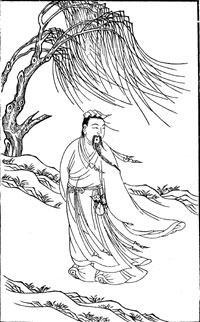 This melody title can be found in a Song dynasty
Melody List, and it has been attributed to Guo Chuwang (see
comment). However, the present melody survives only in Xilutang Qintong. It has no musical or thematic relationship to any of the Chun Jiang melodies first published as Chunjiang Qu in Taigu Yiyin (1511).4 The earlier one, surviving in at least eight handbooks, is connected to poems in the old Yuefu Shiji. The one in Xilutang Qintong relates a story about Fan Li,5 a minister to King Goujian of Yue6 during the Warring States period. Perhaps it is not a coincidence that at about the time Xilutang Qintong was published (1525), there were several very popular operas (discussed below) telling the story of a love affair between Fan Li, fabled for his wealth as well as power, and Xi Shi, one of China's most famous beauties.7
This melody title can be found in a Song dynasty
Melody List, and it has been attributed to Guo Chuwang (see
comment). However, the present melody survives only in Xilutang Qintong. It has no musical or thematic relationship to any of the Chun Jiang melodies first published as Chunjiang Qu in Taigu Yiyin (1511).4 The earlier one, surviving in at least eight handbooks, is connected to poems in the old Yuefu Shiji. The one in Xilutang Qintong relates a story about Fan Li,5 a minister to King Goujian of Yue6 during the Warring States period. Perhaps it is not a coincidence that at about the time Xilutang Qintong was published (1525), there were several very popular operas (discussed below) telling the story of a love affair between Fan Li, fabled for his wealth as well as power, and Xi Shi, one of China's most famous beauties.7
In his Annals of the Historian, Sima Qian tells of Fan Li as minister to Gou Jian, who ruled as King of Yue from 496 to 465 BCE. After helping Gou Jian defeat King Fuchai of Wu,8 Fan Li retired from office. His subsequent riches made his nickname Tao Zhu Gong into a phrase suggesting great wealth.9
The stories of a romance between Fan Li and Xi Shi, quite likely legends, are also apparently quite ancient. In the stories Fan Li usually meets Xi Shi washing silk by a river.10 This being a romance, one can almost assume that in the story this takes place in spring; on the other hand, if it is indeed a romance one might hope that at this point in the story Fan Li was not yet smitten, for after Gou Jian loses a battle to King Fuchai of Wu one of Fan Li's strategies to help Gou Jian reconquer his kingdom is to have him send Xi Shi to King Fuchai,11 thus distracting him from affairs of state. King Fuchai ignores warnings about this from his advisor, Wu Zi Xu.12 After Gou Jian's inevitable victory, according to some versions of the story, Fan Li and Xi Shi run off together.
The afterword to Chun Jiang here in Xilutang Qintong does not mention Xi Shi, saying only that after Yue defeated Wu, Fan Li retired from office and relaxed on a boat in the Five Lakes,13 an apparent reference to Lake Taihu, west of Suzhou;14 the city of Wuxi, on Taihu north of Suzhou, has an off-shoot of the lake called Lihu - Li Lake, supposedly in honor of Fan Li.15 The afterword gives no indication of the origins of this story, but the connection of Five Lakes to the titles and stories of several operas seems more than coincidental.
For example, the opera Wandering on the Five Lakes by Wang Daokun (1525-1593)16 relates the story of Fan Li and Xi Shi, after Gou Jian defeats Yue, traveling together as lovers on the Five Lakes. Here they meet two fishermen who sing a Fisherman's Song. By the singing Fan Li realizes the men are recluses, not ordinary fishermen.
Perhaps more important is another opera on this theme, Washing Silk Tale, by Liang Chenyu (ca. 1521 - ca. 1594).17 The popularity of this opera helped the new Kunqu opera singing style become widely popular.
As yet it is unclear how the name Chun Jiang is connected to this theme.18 The title probably suggests a river in springtime, not the actual name of a river. Also, the word "spring" (like the season) is often associated with romance.
Fan Li, having had control over Yue and (in this capacity) having pacified Wu, (was able to) excuse himself (from office and) relax on the Five Lakes; watching clouds while enjoying a boat, he paddled in the waves at springtime (?). Binding himself (already?) in his "retirement after meritorious service", having shrewdly observed the situation, he thus gave himself over to the qin in order to achieve his aims.
Music of Chun Jiang20
10 sections, untitled (timings follow my recording:
聽錄音 listen)
1. 00.00
2. 00.53
3. 01.55
4. 03.09
5. 04.00
6. 05.01 (波浪聲 sounds of paddling in the waves; in harmonics)
7. 05.52
8. 06.57
9. 07.37
10. 08.31
09.23 (Closing harmonics)
09.35 (end)
Footnotes (Shorthand references are explained on a
separate page)
1.
Chun Jiang references
14146.67 and 5/642 春江 chun jiang refer only to a river in spring; it does not seem to be the name of any river (although Chun Jiang is also short for 富春江 Fuchun Jiang, a river near Hangzhou). They do not mention the poems used with Chunjiang Qu.
Also, this title seems to have no connection to 春江花月夜 Chun Jiang Hua Yue, for which Yuefu Shiji has several sets of lyrics (pp.678-680), most famously by 張若虛 Zhang Ruoxu (c.660-c.720).
There are potentially relevant stories in the Spring and Autumn Annals of Wu and Yue (吳越春秋
Wu Yue Chun Qiu).
(Return)
2.
Shang mode (商調 shang diao)
For further information on shang mode see
Shenpin Shang Yi and
Modality in Early Ming Qin Tablature.
(Return)
3.
Image
This picture is from an illustrated Ming dynasty Liexian Quanzhuan, which developed out of the Han dynasty Liexian Zhuan.
(Return)
4.
Tracing Chun Jiang
Zha's Guide 14/150/267 incorrectly groups Chun Jiang with Chun Jiang Qu.
(Return)
5.
Fan Li (范蠡; 5th c. BCE; see image;
Wiki)
For early sources on Fan Li (31472.285 范蠡) see Shi Ji, Book 41 (Gou Jian) and Book 129 (Money Makers); his biography in
Liexian Zhuan; and the 夫差內傳 Inner Chronicle of the 14th Year of King Fuchai in the Spring and Autumn Annals of Wu and Yue
(Chinese Text Project). Fan Li, from Yue (an ancient region extending south from the area around modern Hangzhou), became (with 文種 Wen Zhong as chief advisor on civil matters) the chief advisor on military matters to 句踐 Gou Jian, who became King of Yue in 496 BCE; the capital city was Kuaiji (near modern Shaoxing). At the time Yue was at war with 吳 Wu (capital near modern Suzhou). The Shi Ji account of Gou Jian relates that the advice of Wen Zhong and Fan Li was basically to be prudent. As a result of their advice Yue finally defeated Wu 22 years later. At this point Fan Li told Wen Zhong that although Gou Jian was good to them in times of trouble, he would not be so in times of peace. Fan Li then left Yue. His subsequent activies are recorded in Shi Ji, Book 129. Here it says (see also 31472.286 范蠡泛湖 Fan Li Floats on a Lake, as well as the Shi Ji reference about Three Rivers Five Lakes) that Fan Li sailed away a boat, going to 齊 Qi (northern Shandong), where he became known as 鴟夷子皮 Zhiyi Zipi (Accommodating Old Wine-Skin). After this he went to 陶 Tao (Dingtao in western Shandong), where he was called 朱公 Zhu Gong (Lord Zhu). Here he amassed a great fortune, which he passed on to his childen; "Tao Zhu Gong" thus came to mean "millionaire".
See further under 蠡湖 Li Lake below.
(Return)
6.
King Gou Jian of Yue 越王勾踐
At present the Wikipedia entry does not mention the story of giving Xi Shi as a gift to Fuchai; instead it focuses on his capable advisors, at the same time relating stories of his brutal treatment of enemies. There is today a Goujian Temple in Shaoxing (see also the comment under the Shaoxing
Lanting Pavilion). For the vagaries of historical reputation as well as their significance see Paul A. Cohen, Speaking to history: the story of King Goujian in twentieth-century China.
(Return)
| 7. Xi Shi 西施 | Xi Shi washing silk |
 The painting at right is by 潘振鏞 Pan Zhenrong (1852-1921). The inscription says: "西施浣沙 雅聲潘振鏞寫 Xi Shi washing silk. Written by Pan Zhenrong, nicknamed Yashang (Elegant Sounds)." (Thanks for this to 孫小青Sun Xiaoqing.) Pan, from 浙江嘉興 Jiaxing in Zhejiang, also called himself 冰壺琴主 the Cold Pot Qin Master. Although Xi Shi is one of the "Four Famous Beauties" of China, one finds very few traditional images of her online; the one at right, for example, is by far the most traditional in style among many modern impressions
on that page.
The painting at right is by 潘振鏞 Pan Zhenrong (1852-1921). The inscription says: "西施浣沙 雅聲潘振鏞寫 Xi Shi washing silk. Written by Pan Zhenrong, nicknamed Yashang (Elegant Sounds)." (Thanks for this to 孫小青Sun Xiaoqing.) Pan, from 浙江嘉興 Jiaxing in Zhejiang, also called himself 冰壺琴主 the Cold Pot Qin Master. Although Xi Shi is one of the "Four Famous Beauties" of China, one finds very few traditional images of her online; the one at right, for example, is by far the most traditional in style among many modern impressions
on that page.
For Xi Shi 35587.308 西施 gives as a reference the 12th year in 吳越春秋,句踐陰謀外傳 Gou Jian Hidden Plans in Wu Yue Chun Qiu (as in China Text Project: 十二年,越王謂大夫種曰....), which tells of Fan Li having Xi Shi sent to 王夫差 King Fuchai of Wu in order to distract him. She succeeded, with the result that Fuchai eventually lost his kingdom.
At the supposed birthplace of Xi Shi, 諸暨 Zhuji, about 50 km southwest of Shaoxing, there is a temple and other constructions built in her honor. And by Lake Tai (Taihu) there are several memorials/sites. For example, near Suzhou is a 琴臺 qin terrace she is said to have used; and near Wuxi there is a 西施莊 Xi Shi Villa associated with her and Fan Li: see further under 蠡湖 Li Lake below. These both seem to be related to the story of her relaxing in a boat on Taihu with Fan Li. However, although "river in spring" may suggest romance, the afterword here makes no mention of her, nor does it connect the river with Taihu.
Operas relating a love affair between Xi Shi and Fan Li are introduced above
For another story see 蕭思遇 Xiao Siyu (?).
(Return)
8.
King Fuchai of Wu 吳王夫差
(Wiki)
Commentary seems to suggest that King Fuchai's main error was in making peace with Gou Jian after defeating him. His main advisor 伍子胥 Wu Zi Xu (see
below) is said to have advised Fuchai against this. He is also said to have warned the king against accepting the beautiful Xi Shi as a gift, but the king ignored him and eventually lost his kingdom.
(Return)
9.
Tao Zhu Gong 陶朱公
This nickname for Fan Li is explained above. There is a lot of discussion today about the "Tao Zhu Gong Art of Business", the original ideas of which are not clear.
(Return)
10.
Washing Silk (浣紗 Huan Sha
Some versions (translations?) say the river itself was called 浣紗 Huansha, without specifying that she was herself washing silk; in this regard, 17831.35 浣紗溪 tells of a 溪谷 Huansha Gully (with stream) by 長壽峯 Long Life Peak in 青田縣 Qingtian district, south of Shaoxing in Zhejiang province.
(Return)
11.
Sending Xi Shi to King Fuchai of Wu
Any comments on what this says about the nature of the love affair between Fan Li and Xi Shi?
(Return)
12.
Wu Zi Xu 伍子胥 (6th c. BCE;
Wiki)
This name is also written Wuzi Xu, Wu Zixu and Wu Xu. See Shi Ji #5 (GSR I, p.104) and his main biography in #66 (GSR VII, p. 49). In a footnote to the latter, Nienhauser explains that he has "Wu Zi Xu" because his name seems to be Wu Xu, with the Zi as an honorific. King Ping of Chu murdered Wu's father and brother. In seeking revenge Wu met resentment leading to his being slandered to King Fuchai (see previous footnote) and eventually made to commit suicide. See also Nienhauser's Translator's Note, GSR VII, p. 61, and Wu's connection with Huzi. Old qin melody lists use his name as a melody title (see Zi Xu Yin and
Wu Zi Xu) and comments here on the melody Chun Jiang (see King Fuchai) mention him in connection to a story involving the famous beauty 西施
Xi Shi. Like Qu Yuan, he is sometimes referred to as 水仙
Shuixian, and likewise in some places commemorated during the Dragon Boat Festival.
(Return)
13.
Five Lakes (五湖 Wu Hu)
262.790 五湖 Five Lakes mainly makes reference to
Lake Dongting in Hunan and Lake Taihu in Zhejiang. However, there are several others as well. Because of Fan Li's association with the state of Yue, Taihu is the most likely place intended here.
(Return)
14.
Lake Tai (太湖 Tai Hu)
(Wiki)
"Great Lake": 5965.366 One of the Five Lakes, in early times also called 震澤 Zhenze, 具區 Juqu and 笠澤 Lize. Historically it is China's third largest freshwater lake (after Dongting in Hunan and Poyang in Jiangxi), though with Dongting shrinking in size perhaps this has changed.
(Return)
15.
Lake Li (蠡湖 Li Hu)
"Lake Calabash"; "li" can also be a type of insect but here it refers to Fan Li. 34629.11 says it is a lake in the southwest part of 無錫 Wuxi District (Wiki), earlier called Li's Ditch (蠡瀆 Li Du) because Fan Li had it dug during 伐吳 an attack (by Yue) on Wu. There is no mention of Fan Li actually rowing his boat here. It is also not clear at what time this came to be considered a part of Lake Tai. Nevertheless, since perhaps the Qing dynasty (as related in some modern tourist literature) there have been stories claiming that this was where Fan Li and Xi Shi spent time together, both on land and in a boat, and/or stating that this is where the lake got its name (see also
蠡湖 and Xi Shi's Villa
[西施莊]).
(Return)
16.
Wandering on the Five Lakes
262.795 五湖遊 Wu Hu You says it is 劇曲名 the name of an opera (also called 五湖記 Story of Five Lakes) about Fan Li by 汪道昆 Wang Daokun (1525-1593; Bio/1144). The story is outlined in LXS, p.186. By coincidence, at this same Xilutang Qintong introduced a new qin melody called 漁歌
Fisherman's Song, perhaps also associated with Taihu.
(Return)
17.
Washing Silk Tale (浣紗記 Wansha Ji or Huansha Ji)
Washing Silk Tale (17831.34 浣紗記), a 昆曲 Kunqu by 梁辰魚 Liang Chenyu (ca. 1521 - ca. 1594; Bio/2222), expands considerably on the story as told in Spring and Autumn Annals of Wu and Yue (吳越春秋 Wu Yue Chun Qiu). Xi Shi was originally a simple girl who made a living washing clothes (image). The story as outlined in LXS, pp. 257/8, focuses more on Xi Shi being sent to the King of Wu; only at the end do Fan Li and Xi Shi go off to find pleasure floating on a boat in a lake. See also William Dolby, A History of Chinese Drama, p.92.
(Return)
18.
Why "Chun Jiang"?
LXS has no title 春江 Chun Jiang, nor do the opera accounts mention this name. And the YFSJ Chun Jiang poems do not seem to mention or allude to Fan Li and Xi Shi.
(Return)
19. Original Afterword
春湖 14146.443 a lake in springtime.
20. Music
Some of the inconsistencies in the tablature here suggest it may have been edited by different people over time, and each person had his/her own idiosyncrasies.
Return to the annotated handbook list
or to the Guqin ToC.
「春江」解題 The original Chinese is:
徽軫 is literally "harmonic markers and tuning pegs", clearly an allustion to the guqin
Return)
After several failed earlier attempts, in December 2012 I completed my reconstruction, including transcription and recording. Some of the specific issues in doing the reconstruction were as follows:
Return)