|
T of C
Home |
My Work |
Hand- books |
Qin as Object |
Qin in Art |
Poetry / Song |
Hear, Watch |
Play Qin |
Analysis | History |
Ideo- logy |
Miscel- lanea |
More Info |
Personal | email me search me |
| Qinshu Cunmu Annotated handbook list Early handbook lists | 首頁 |
| Qin Cao 1 | 琴操 |
| "Qin Melodies"; by Cai Yong (133 - 192), with added comment on other Qin Cao 2 | 蔡邕 |
| A sample page from two versions of Cai Yong's Qin Cao 3 |
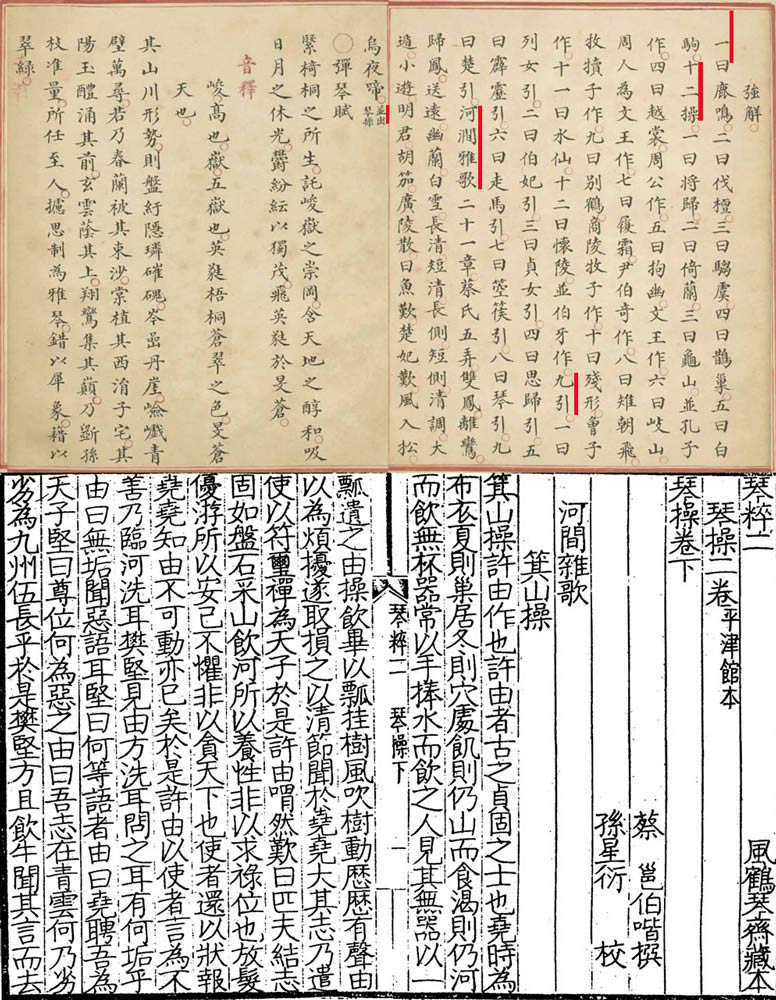 A Qin Cao attributed to
Cai Yong was often mentioned or even quoted over subsequent centuries,4 but there are no surviving copies of any Qin Cao attributed to Cai Yong prior to the Qing dynasty. The earliest known possible example of such a work prior to the Qing dynasty seems to be a Qin Cao listed in the Chu Xue Ji by the Tang dynasty literatus Xu Jian, but it was not attributed to Cai Yong.5 Later listings are clearly related to this one, but it is not clear how direct this influence was.
A Qin Cao attributed to
Cai Yong was often mentioned or even quoted over subsequent centuries,4 but there are no surviving copies of any Qin Cao attributed to Cai Yong prior to the Qing dynasty. The earliest known possible example of such a work prior to the Qing dynasty seems to be a Qin Cao listed in the Chu Xue Ji by the Tang dynasty literatus Xu Jian, but it was not attributed to Cai Yong.5 Later listings are clearly related to this one, but it is not clear how direct this influence was.
After this one can find during the Song and/or Ming dynasty several melody lists that are almost the same as the one in Chu Xue Ji, such as this listing found in versions of the Song or Ming dynasty handbook variously known as Taigu Yiyin and Taiyin Daquanji. But these again do not seem either to have been called Qin Cao or to have been directly attributed to Cai Yong.6
After this there do not seem to have been any further Qin Cao listings until the Qing dynasty, when many such "Qin Cao" appear with almost identical titles to the earlier ones, now attributed to Cai Yong (partial list). These generally have commentary on the melodies, but their content varies quite a bit and their sources are generally unclear. It is thus difficult to assess the connection of any of these surviving versions with a supposed original by Cai Yong himself.
The focus of this page is on the two Qin Cao versions most readily available in print today, which are as follows:
There are two primary differences between these two versions. First, both list four types of qin pieces: 5 Melodies, 12 Laments, 9 Preludes and 21 further "Hejian" pieces, but the earlier versions were only lists of titles. Secondly, the fourth sections of each list melody titles that are completely different from each other. The Song/Ming versions call the fourth section Hejian Yage, those from the Qing dynasty call it Hejian Zage (as did the Tang version, though it actually did not name any of its zage). To see these differences, compare the last section of the Song/Ming Taiyin list (as shown at the top of this page) with the last section of the better known Pingjin list shown here (the beginning of the original is in the lower image at right). From this it can be seen that the main differences between these two can be detailed as follows:
As shown here there were a number of early melody lists: more than one could have referred to as Qin Cao. Many more could have existed in handwritten form and been passed around with constant updating.
Thus it is not surprising that, as mentioned here, some skepticism has been expressed as to whether any of the actual content of the Qin Cao attributed to Cao Yong has actually survived: or which of the surviving parts actually can be safely attributed to him. Nevertheless, it is also certainly possible that Cai did somewhere list qin melodies, and that it was one such list that was included in the Chu Xue Ji .
Since none of the melody lists surviving from prior to the Ming dynasty have been shown to have seem to have had commentary for the individual melodies, but independent of the lists one can find commenatry on some of the melodies found in such lists, one might then argue that during the Qing dynasty some person or persons decided to take one of the old melody listings and introduce them as Cai Yong might have done, then refer to the resulting text as the Qin Cao of Cai Yong. This, however, is also little more than speculation.10
Here one might also speculate that the Chu Xue Ji list did not name the Hejian Zage melodies because that part of the original list had been lost. Further, that during the Song or Ming dynasty someone made up what they considered a likely list of Hejian pieces, headed by Cai Yong's own Caishi Wu Nong, but decided that Yage (Elegant Songs) would be more appropriate than Zage (Miscellaneous Songs). Then during the Qing dynasty some scholars who were more familiar with Cai Yong's story and work decided that there were other old melody titles that might be more appropriate to Cai Yong and for which, furthermore, there were existing introductions. So they selected these and went back tot the old title Hejian Zage.
Hopefully further research will one day take this beyond the realm of speculation and into that of educated guesswork.
In addition to these two types of Qin Cao attributed to Cai Yong himself, there have also been various other Qin Cao attributed to other writers. Sometimes this may refer to a single piece, other times specifically to (lists of) "cao", other times to (lists of) melodies in general. This leads to some confusion because "Qin Cao" is quoted extensively in Yuefu Shiji, Qin Shi and elsewhere, but the author/source is almost never identified. This suggests the quote should be from the most famous version, by Cai Yong. However, the quotes there are not always the same as what is given the Pingjin Guan or other existing editions of the surviving Qin Cao attributed to Cai Yong. This leaves open the question of differing editions as well as competing titles. Here comments about this are generally referenced through links or in footnotes.
Preface to the Revised Edition
Preface Head
The qin is 3 chi, 6 cun, 6 fen long, resembling the 360 days in a year. It is 6 cun wide, resembling the 6 harmonies. Above the (文?) is called a "pool"; below is called a "cliff". A pool is a pond; it speaks of being level. Below (this? is the area) called a "shoreline"; a shoreline is a guest, it speaks of being ready to serve. It is broad in front and narrow in back, (thus) resembling social rank. Above it is round, below it is square, (thus) following the plan of heaven and earth.
The five strings (are gong?.... elsewhere the words 宮也 are omitted; perhaps some other editions include the four names of what were considered the five original strings), resembling the five elements (metal, wood, water, fire, earth). The big (first) string is the master; it is broad-minded and genial. The small string (second string) is the servant, modest and not disorderly. Wen Wang and Wu Wang each added a string (see Zhu Quan comment); this was in order to draw together the affections of the master and vassal. Gong (string) is lord, shang (string) is servant, jue (string) is the people, zhi (string) is affairs, yu (string) is objects.
Qin Cao had five melodies for Book of Songs poems. The first was (all five are listed as below); the 12 laments were (listed as below); the 9 preludes were (listed as below). There were 21 Hejian Zage (not listed in the preface).
(List of the melodies in Qin Cao, with introductions to each (Qing dynasty edition, as in QQJC XXX/17-30)
(Five Melodies for Book of Songs Poems 歌詩五曲)
(Twelve Laments 十二操)
(Nine Preludes 九引)
(21 Hejian Zage 河閒雜歌二十一章 ;
compare Hejian Yage
22;
QQJC XXX/24-30)
There seems to be significant variety in the Supplemental Notes of the various editions. For example, two further songs listed elsewhere include:
1.
Qin Cao attributed to Cai Yong
This page was revised in 2022 with help from Tao Ran, whose M.A. thesis at Nanjing University discusses the significance of the differences between the varying versions of the Qin Cao, but "is not yet ready for publication." The dissertation title is,
Also helpful has been this article:
This has information that will be incorporated into her upcoming (as of 2023) book about Qin Cao. As can be seen from the title, this article focuses on "cao". Regarding the word's meaning she quotes the famous literatus 劉向 Liu Xiang (77 BCE–6 CE) on early use it:
琴書存目 Qinshu Cunmu entry 12 outlines the Qing dynasty editions of Qin Cao, giving the following as references. Most of them seem to be collections that contain an edition of Qin Cao.
21570.92 琴操 lists the pieces (giving only "雜歌 za ge" for the last section, i.e., no mention of 河間/河閒 hejian or 雅歌 ya ge). There is some skepticism that any of the versions of Qin Cao surviving today actually date back to Cai Yong himself. Of this David R. Knechtges, Ancient and Early Medieval Chinese Literature, p.65, writes:
This suggests that tracing the existing materials to before the Song dynasty will be very difficult. Could it also mean that the passage copied here from Taiyin Daquanji is an outline of some text connected only in some uncertain way to Cai Yong, but that was later expanded to form a work called "Qin Cao" and attributed to him?
2.
The various 琴操 Qin Cao
In addition, there were also some early Qin Cao attributed to others. To my knowledge none of these now exists, in which case it is not possible to know whether these are the same Qin Cao but attributed to others, or are competing lists also called Qin Cao. Thus, for quotations simply attributed to a "Qin Cao", especially those that do not seem specifically to refer to either of the Cai Yong versions, one must consider that these quotations referred to the other books of that name. The ones known by name include,
In addition there are a number of collections of poetry or lyrics called Qin Cao. These include,
In some cases it is not clear even whether "Qin Cao" is referring to the title of a list (annotated or not), or whether it simply means "a qin melody".
3.
Image: two editions of Qin Cao
Further detail in the next two footnotes.
4.
Early references to a Qin Cao by Cai Yong
5.
Chu Xue Ji: Source of the melody list in Taiyin Daquanji?
Note that the last section is called Hejian Zage and its "21 melodies" are not named. In the next surviving occurrence they will be named but referred to as Hejian Yage. The title Hejian Zage does not seem to recur until the Qing dynasty editions.
6.
Qin Cao, Taiyin Daquanji edition
7.
Qing dynasty editions of Qin Cao attributed to Cai Yong
8.
Qin Cao, Pingjin Guan edition
Although all these extended editions of Cai Yong's Qin Cao apparently survive only because of their varying Qing dynasty versions, beginning around 1800, Qin Cao was mentioned or quoted enough in early sources that all these later works are commonly attributed directly to him. However, as can be seen from the above, the inconsistencies both in the titles and in the accompanying explanations (or lack thereof) makes it impossible to know what Cai Yong himself actually wrote.
9.
Differences between the two versions
10.
How old are the existing Qin Cao attributed to Cai Yong?
12.
Preface to the Revised Edition of Pingjin Guan (琴操校本序)
(Copied here from Colin Huehns [trans], Jao Tsung-I, Harmoniouness)
Translation copied from Brill.
13.
Original Chinese of this Qin Cao Preface Head (琴操,平津館校本,序首; QQJC XXX/19)
The words translated here as "falsehood" and "low desires" are "邪 xie" (40180) and "淫 yin" (18095). According to 40180.44 "邪淫 xieyin" these were first brought together in Shi Ji, annals of Xia; but here they seem to be used separately, so was apparently later that they came to be used together as an expression for debauchery, the antithesis of the aims with guqin. In general, "邪淫 xieyin" seems to be the more common term, but it can also be written "淫邪 yinxie".
14.
Van Gulik translated the beginning of this preface in Lore, p. 42.
15.
Commentary on each melody
16.
鹿鳴 Lu Ming: Deer Call
17.
伐檀 Fa Tan: Chop Sandalwood
From 1910 there is a
recording by Yang Baoyuan.
18.
騶虞 Zouyu: The Zouyu (a fabulous tiger)
18.
鵲巢 Que Chao: Magpie's Nest
29.
白駒 Bai Ju (White Colt)
21.
Huailing Cao
22.
河間雅歌 Hejian Yage versus 河間雜歌 Hejian Zage
It thus remains unclear why these two representative versions, as
outlined here, have completely different content for the fourth part. It is also not clear why the various Za ge listings in the Qing dynasty editions such as those listed here, also have considerable differences. Nevertheless, those later Za ge listings seem to get a lot more attention than this earlier Ya ge list. For this I have not found an explanation (other than the later list is the one with explanations).
The 21 Hejian Yage titles are as follows:
As mentioned above, the 21 (+3) Hejian Zage are almost completely different from these 21 Hejian Yage. One can speculate, perhaps based on the Tang dynasty
Chu Xue Ji list, that these Ya Ge may have originally themselves been called Za Ge(or perhaps there was a mistake based on similarity of the characters 雅 and 雜). Unfortunately, that listing has no content. As yet I have not found any other lists called "Hejian Yage". And although the Hejian Yage list in Taiyin Daquanji says it is from Qin Cao, and just above it are also listed the contents of the first three sections (though with no mention of Cai Yong), there are no accounts of the content of the Ya Ge.
This thus contrasts with what is Qinxue Congshu
Book I Parts 2, which has details of each Hejian Zage piece (details not yet online; it is also in
Qin Fu, p. 739ff). All the
later Qin Cao seem also to have this commentary, though its lists also differ.
Note that the 1525 commentary on You Lan (#6 in Hejian Yage) says it is included among 21 "雜弄 Zanong", making no mention of "Yage".
Appendix:
(歌詩五曲)
自傷不逢時,托辭於薌蘭云。
遂受之,獻於文王之廟。
宣王出遜,吉甫從之,伯奇乃作歌,以言感之於宣王。宣王聞之,曰:「此孝子之辭也。」吉甫乃求伯奇於野而感悟,遂射殺後妻。
故曰《別鶴操》。後仍為夫婦。
遂自經而死。
曲終,縊而死。
曲終,自投河而死。子高聞而悲之,乃援琴而鼓之,作《箜篌引》以象其聲,所謂《公無渡河》曲也。
後許由死,遂葬於箕山。
文公驚悟,即遣求得於綿山之下。使者奉節迎之,終不肯出。文公令燔山求之,火熒自出。子綏遂抱木而燒死。文公哀之,流涕歸,令民五月五日,不得舉火。
於是乃援琴而鼓之,曰:
曲終,遂自投淄水而死。
昭君有子曰世違,單于死,子世違繼立。凡為胡者,父死妻母。昭君問世違曰:「汝為漢也,為胡也?」世違曰:「欲為胡耳。」昭君乃吞藥自殺。單于舉葬之。胡中多白草,而此冢獨青。
Return to the top, to the annotated handbook list, or to the Guqin ToC.
This Song/Ming source names Cai Yong and lists most of the melodies but does not use the title "Qin Cao" . Its contents, also listed
here and shown in the
image at the top of that page
(expand) from a Ming dynasty edition of Taiyin Daquanji.
7
From its content below note in particular
its melodies. The beginning of its Hejian Zage is shown in the lower half at right.8
Contents of Qin Cao
(Pingjin Guan edition)
By Ma Ruichen, 180512
In the Pingjin Guan edition this is as follows:
13
(A version of the original text of the introductions is in the
Appendix below. There may be inconsistencies in different Qing dynasty editions. Not yet translated; follow the links or footnotes for further details of each piece..15)
(Individual melody titles should perhaps also render "cao" as "lament")
Qin Cao Supplemental Notes 琴操補遺
Seems to introduce old melodies, citing the sources.
覆巢毀卵。鳳不翔留。
慘予心悲。還轅息陬。
Footnotes (Shorthand references are explained on a
separate page)
Regarding the meaning of "cao" in "Qin Cao", "cao" has the basic meaning of "melody" or "melodies", but also a more specialized meaning sometimes translated as "lament". Both of these meanings can be found in the individual qin cao in the list attributed to Cai Yong: it divides melodies into various types, one of which is the cao, or lament, but there are also cao in other sections.
陶冉,《琴操》的文本生成與影響流變 (Tao Ran, The Text Generation and Variations of Influence on Qin Cao).
Dorothee Schaab-Hanke, Qin Pieces Made by Gentlemen in Misery: Reconsidering the Meaning of Cao in Cai Yong’s Qincao, in minima sinica Zeitschrift zum chinesischen Geist 30.2 (2018).
A gentleman relies on the way of the elegant zither. This is why he may entrust his thoughts to (his play) while being completely relaxed. A piece that was composed by someone who was in sorrow and anger because his way was obstructed, is called a cao. It means that someone even when he encounters misery will not lose his principles.
讀畫齋 Duhuazhai (1799; missing 五曲#4 explanation +
河閒雜歌 7 & 8); 補 diff.
漢魏遺書輯 Han Wei Yishuji (1802)
惠氏校錄 Huishi Jiaolu
玉函山房輯 Yuhan Shanfang Ji
(Return)
Because in the materials referenced on this website there is so much mention of "Qin Cao" without further qualification, these references are not always clear. Since the most famous list called "Qin Cao" (whether it is the annotated version or not) is said to be by Cai Yong, there is a tendency simply to ascribe these references to his listing. The first problem with this is the fact that, as mentioned in the account above, there are at least two versions of the Qin Cao list attributed to Cai Yong (see in particular the two different Hejian sections). This issue is discussed further in this footnote.
by Huan Tan (ca. 43 BCE - 28 CE; QSCM, #10)
by Han Yu (all set to music in (Taigu Yiyin)
(Return)
This shows the short version plus the beginning of the long version.
(Return)
To be added.
(Return)
This information comes from the thesis of Tao Ran, which cites the original source of this list as a Tang dynasty publication by 徐堅 Xu Jian (659–729;
Wiki)
called 初學記 Chu Xue Ji([唐]徐堅:《初學記》卷十六《樂部》,中華書局,1962,第386頁。; text here copied from ctext,
Folio 16). That chapter mentions Cai Yong several times and quotes a 琴賦 Rhapsody on the Qin attributed to him, but it does not seem directly to put his name on the list it has, in the first section, of a 琴操 Qin Cao (Qin Melodies). The list gives the content of Qin Cao is as follows (reformatted here):
(Return)
The top half of the image above
(expanded; "強觧" [i.e., 強解] comes from the end of the "音釋" yinshi, translated there in two parts) is from a facsimile edition, but the same text can be found in Qin Fu p. 74 as well as QQJC I/26 (except that there the last section of Qin Cao melodies is called 河間雅歌 Hejian Yage instead of 河澗雜歌 Hejian Zage). In both cases the list is identified as from Qin Cao only at the end. Red marks have been added to show that statement as well as the headings for each group of pieces.
(Return)
The Ming dynasty listing, as mentioned above, differs from the later editions in that the last section is called 河間雅歌 Hejian Yage rather than 河間雜歌 Hejian Zage. The earliest edition with 河間雜歌 Hejian Zage is apparently the one in the 讀畫齋叢書 Duhuazhai Congshu (1799), followed shortly by one in 漢魏遺書鈔 Han Wei Yishu Chao (1802). On this see further above.
(Return)
平津館叢書 Pingjin Guan Congshu (9371.241; compiled by 孫星衍 Sun Xingyan, 1753-1818) was published in the early 19th century but the date of works copied into the collection is not certain (www.chinaknowledge.de says some date from the Song dynasty). QSCM (which also includes other Qin Cao) has only an outline; I have seen two reprints of what is apparently the complete version of this edition:
Also in Tong Kin-Woon's Qin Fu, p.739 (p.746 begins the 河間雜歌 Hejian Zage; note however that for the Taigu Yin version Qin Fu p.74 has 河澗雅歌 for Hejian Yage).
This edition has punctuation and some commentary (double-column) added.
(Return)
The upper image top right shows the earlier version simply listing all the pieces, with almost all on one page; the image here shows that the list is preceded by yinshi commentary. By contrast, the image from the Pingjun Guan edition (lower image at top right) has not finished its commentary on the first piece by the end of the first page.
(Return)
The first matter to address with this question is the fact of the two competing za ge.
(Return)
By 馬瑞辰 Ma Ruichen ca. 1777 - 1853; Bio/82. The text here begins (first 5 of 37 lines),
引廞同音通用爾雅廞興也。鄭康成曰:「廞興也,猶詩之興。」是因卽詩因物起興之義也。隋《經籍志》也。....
(Return)
It is not clear how much of the original text of this preface (translated above) might be found in souces earlier than the Qing dynasty editions. It is unclear whether or not there is any significance to the fact that, as with the Chu Xue Ji, it does not list the titles of the Heijian Zage.
(Return)
(Return)
Some editions have different commentary. The
Pingjin Guan edition is cited here as a readily available complete set.
(Return)
Mao#161; Seng, Most ancient;
Zha's Guide 30/237/444;
6 handbooks
(Return)
Mao#112 (坎坎伐檀兮,寘之河之干兮....); Seng, Most ancient. All set the lyrics
Zha's Index 39/267/553; 4 handbooks:
(Return)
Mao#25; Seng, Most ancient. Not in Zha's index
(Return)
Mao#12; Seng, Most ancient.
Zha's Index 39/--/555; two handbooks,
1745 (XVI/361 & 369: only note names) and
1835
The Shi Jing poem has an allegory to a magpie raising a 鳩 cuckoo. The Qin Cao preface is missing.
No connection to Magpie Bridge (鵲橋 Que Qiao: see lyrics for Qing Ping Yue).
(Return)
Mao#186; not in Seng. Not in Zha's index
(Return)
This lament from Qin Cao, attributed here to Bo Ya (see under Gao Shan), may no longer exist, but the Song dynasty melody list Qin Shu: Qu Ming has the second version below as an alternate title for Gao Shan. Huai Ling has been written two ways.
(Return)
ZWDCD has no 河間; its 17634 has only .153 河閒樂 Hejian Yue and I have not found other dictionary references. (I have also seen the hejian of 河間雜歌 written as 河澗 but 17634 has no 河澗.) Furthermore, as outlined above, after the listing surviving from the Ming dynasty Taigu Yiyin with its 21 Hejian Yage there seem to have been a variety of Qin Cao with longer commentary and for unknown reasons differing content of the "further pieces" of the fourth part, generally called "Hejian Zage".
(上古, 中古 and 下古 refer to the list of Seng Juyue; there does not seem to be a version of this list with commentary)
河間雅歌 Hejian Yage
(Return)
平津館叢書琴操解題
Commentary on melodies included in the
Pingjin Guan Book Collection edition of Qin Cao
(Compare the 1911 reprint in
QQJC
XXX/17 or
Qin Fu /
739)
《鹿鳴操》者,周大臣之所作也。王道衰,君志傾,留心聲色,內顧妃後,設旨酒嘉肴,不能厚養賢者,盡禮極歡,形見於色。大臣昭然獨見,必知賢士幽隱,小人在位,周道凌遲,必自是始。故彈琴以諷諫,歌以感之,庶幾可復。歌曰:「 呦呦鹿鳴,食野之蘋。我有嘉賓,鼓瑟吹笙。吹笙鼓簧,承筐是將。人之好我,示我周行。」 此言禽獸得美甘之食,尚知相呼,傷時在位之人不能,乃援琴而刺之,故曰《鹿鳴》也。
《伐檀操》者,魏国女之所作也。伤贤者隐避,素餐在位,闵伤怨旷,失其嘉会。夫圣王之制,能治人者食于人,治于人者食于田。今贤者隐退伐木,小人在位食禄,悬珍奇,积百谷,并包有土,德泽不加百姓。伤痛上之不知,王道之不施,仰天长叹,援琴而鼓之。
《騶虞操》者,邵國之女所作也。古者聖王在上,君子在位,役不逾時,不失嘉會。內無怨女,外無曠夫。及周道衰微,禮義廢弛,強凌弱,眾暴寡,萬民騷動,百姓愁苦;男怨於外,女傷其內,內外無主:內迫性情,外逼禮義。欲傷所讒,而不逢時,於是援琴而歌。
(騶虞操)缺
《白駒操》者,失朋友之所作也。其友賢居任也。衰亂之世,君無道,不可匡輔,依違成風,諫不見受。國士詠而思之,援琴而長歌。
(十二操)
《將歸操》者,孔子之所作也。趙簡子循執玉帛,以聘孔子。孔子將往,未至,渡狄水,聞趙殺其賢大夫竇鳴犢,喟然而嘆之曰:「夫趙之所以治者,鳴犢之力也。殺鳴犢而聘余,何丘之往也?夫燔林而田,則麒麟不至;覆巢破卵,則鳳皇不翔。鳥獸尚惡傷類,而況君子哉?」於是援琴而鼓之云:「翱翔於衛,復我舊居;從吾所好,其樂只且。」
(案《水經注》,漯水引,孔子臨狄水而歌曰:「狄水衍兮風揚波,船楫顛倒更相加。歸來,歸來兮,胡為斯疑?」是《將歸操》之脫文。今本《水經注》狄譌作秋,又脫未句從宋本。韓文考異引補。又《史記,孔子世家》:「孔子聞竇鳴犢、舜華之死也。臨河而嘆。乃還息乎陬鄉。作為陬操以哀之。」集解王肅曰:「陬操,琴曲名也。」孔叢子引與此四句正同。)
《猗蘭操》者,孔子所作也。孔子歷聘諸侯,諸侯莫能任。自衛反魯,過隱谷之中,見薌蘭獨茂,喟然嘆曰:「夫蘭當為王者香,今乃獨茂,與眾草為伍,譬猶賢者不逢時,與鄙夫為倫也。」乃止車援琴鼓之云:
何彼蒼天,不得其所。逍遙九州,無所定處。
世人暗蔽,不知賢者。年紀逝邁,一身將老。」
《龜山操》者,孔子所作也。齊人饋女樂,季桓子受之,魯君閉門不聽朝。當此之時,季氏專政,上僭天子,下畔大夫,賢聖斥逐,讒邪滿朝。孔子欲諫不得,退而望魯,魯有龜山蔽之。辟季氏於龜山,托勢位於斧柯;季氏專政,猶龜山蔽魯也。傷政道之凌遲,閔百姓不得其所,欲誅季氏,而力不能。於是援琴而歌云:
《越裳操》者,周公之所作也。周公輔成王,成文王之王道,天下太平,萬國和會,江黃納貢,越裳重九譯而來獻白雉,執贄曰:「吾君在外國也,頃無迅風暴雨,意者中國有聖人乎?故遣臣來。」周公於是仰天而嘆之。乃援琴而鼓之,其章曰:
《拘幽操》者,文王拘於里而作也。文王備修道德,百姓親附。文王有二子,周公、武王皆聖。是時崇侯虎與文王列為諸侯,德不能及文王,常嫉妒之。乃譖文王於紂曰:「西伯昌,聖人也。長子發、中子旦,皆聖人也。三聖合謀,將不利於君,君其慮之。」紂用其言,乃囚文王於里,擇日欲殺之。於是文王四臣太顛、閎夭、散宜生、南宮適之徒,往見文王。文王為反目者,紂之好色也;桴其腹者,言欲得奇寶也;蹀躞其足者,使疾迅也。於是乃周流海內,經歷風土,得美女二人、水中大貝、白馬朱鬣,以獻於紂。陳於中庭,紂見之,仰天而嘆曰:「嘻哉,此誰寶?」散宜生趨而進曰:「是西伯之寶,以贖刑罪。」紂曰:「於寡人何其厚也!」立出西伯。紂謂宜生:「譖岐侯者,長鼻決耳也。」宜生還,以狀告文王,乃知崇侯譖之。文王在里時,演八卦以為六十四卦,作郁尼之辭:「困於石,據於蒺藜。」乃申憤以作歌曰:「殷道溷溷,浸濁煩兮。朱紫相合,不別分兮。迷亂聲色,信讒言兮。炎炎之虐,使我愆兮。無辜桎梏,誰所宣兮。幽閉牢,由其言兮。遘我四人,憂勤勤兮。得此珍玩,且解大患兮。倉皇迄命,遺後昆兮。作此象變,兆在昌兮。欽承祖命,天下不喪兮。遂臨下土,在聖明兮。討暴除亂,誅逆王兮。」
《岐山操》者,周太王之所作也。太王居豳,狄人攻之,仁恩惻隱,不忍流洫,選練珍寶犬馬皮幣束帛與之。狄侵不止。問其所欲,得土地也。太王曰:「土地者,所以養萬民也。吾將委國而去矣,二三子亦何患無君?」遂杖策而出,窬乎梁而邑乎岐山。自傷德劣,不能化夷狄,為之所侵,喟然歎息,援琴而鼓之云:
《履霜操》者,尹吉甫之子伯奇所作也。吉甫,周上卿也,有子伯奇。伯奇母死,吉甫更娶後妻,生子曰伯邦。乃譖伯奇於吉甫曰:「伯奇見妾有美色,然有欲心。」吉甫曰:「伯奇為人慈仁,豈有此也?」妻曰:「試置妾空房中,君登樓而察之。」後妻知伯奇仁孝,乃取毒蜂綴衣領,伯奇前持之。於是吉甫大怒,放伯奇於野。伯奇編水荷而衣之,採花而食之,清朝履霜,自傷無罪見逐,乃援琴而鼓之曰:
何辜皇天兮遭斯愆。痛歿不同兮恩有偏,誰說顧兮知我冤。」
《雉朝飛操》者,齊獨沐子所作也。獨沐子年七十無妻,出薪於野,見飛雉雄雌相隨,感之,撫琴而歌曰:
時將暮兮可奈何,嗟嗟暮兮可奈何?」
《別鶴操》者,商陵牧子所作也。牧子娶妻五年,無子,父兄欲為改娶。妻聞之,中夜驚起,倚戶悲嘯。牧子聞之,援琴鼓之云:
《殘形操》者,曾子所作也。曾子鼓琴,墨子立外而聽之。曲終,入曰:「善哉鼓琴!身已成矣,而曾未得其首也。」曾子曰:「吾晝臥見一狸,見其身而不見其頭,起而為之弦,因而殘形。」
《水仙操》者,伯牙之所作也。伯牙學琴於成連先生,先生曰:「吾能傳曲,而不能移情。吾師有方子春者,善於琴,能作人之情,今在東海上。子能與我同事之乎?」伯牙曰:「夫子有命,敢不敬從。」乃相與至海上,見子春受業焉。
闕。 案事類賦樂部注引《樂府解題》,《水仙操》前段與此文略同下。
「乃與伯牙俱往,至蓬萊山,留伯牙曰:『子居習之,吾將迎之。』刺船而去。旬時,伯牙延望無人,但聞海水洞湧,山林杳冥,愴然嘆曰:『先生移我情矣!』乃援琴而歌,作水仙之操。」
足證此文之闕。
《懷陵操》者,伯牙之所作也。伯牙鼓琴,作激徵之音。伯牙鼓琴作滶徵之音也。(下缺)
(九引)
《列女引》者,楚莊王妃樊姬之所作也。莊王愛幸樊姬,不敢專席,飾眾妾使更侍王,以廣繼嗣。莊王一日罷朝而晏,樊姬問故,王曰:「與賢相語。」姬問為誰。曰:「虞丘子。」樊姬曰:「妾幸得侍王,非不欲專貴擅愛也,以為傷王之義,故所進與王同位者數人矣。今虞丘子為相,未嘗進一賢,安得為賢?」明日,王以樊姬語告虞丘子,稽首辭位而進孫叔敖。樊姬自以諫行志得,作《列女引》曰:
《伯姬引》者,伯姬保母所作。伯姬者,魯女也,為宋共公夫人。共公薨,守禮固節。魯襄公三十年,宋災,伯姬存焉。有司請出,伯姬曰:「不可。吾聞之,婦人夜出,不見傅母不下堂。傅至矣,母未至也。」逮乎火而死。其母悼伯姬之遇災,故作此引。
《貞女引》者,魯漆室女所作也。漆室女倚柱悲吟而嘯,鄰人見其心之不樂也,進而問之曰:「有淫心欲嫁之念耶?何吟之悲?」漆室女曰:「嗟乎,嗟乎,子無志,不知人之甚也。昔者,楚人得罪於其君,走逃吾東家。馬逸,蹈吾園葵,使吾終年不厭菜;吾西鄰人失羊不還,請吾兄追之,霧濁水出,使吾兄溺死,終身無兄,政之所致也。吾憂國傷人,心悲而嘯,豈欲嫁哉?」自傷懷結,而為人所疑,於是褰裳入山林之中,見女貞之木,喟然嘆息,援琴而弦,歌以女貞之辭云:
厥道不移,善惡並兮。屈躬就濁,世徹清兮。懷忠見疑,何貪生兮。」
繫骸骨於林兮。托神靈於女貞。
《思歸引》者,衛女之所作也。衛侯有賢女,邵王聞其賢而請聘之,未至而王薨。太子曰:「吾聞齊桓公得衛姬而霸。今衛女賢,欲留。」大夫曰:「不可。若女賢,必不我聽;若聽,必不賢。不可取也。」太子遂留之,果不聽。拘於深宮,思歸不得,心悲憂傷,遂援琴而作歌,曰:
執節不移兮,行不詭隨。坎坷何辜兮離厥。」
《辟歷引》者,楚商梁子所作也。商梁子出遊九皋之澤,覽漸水之台,張置罟,周於荊山,臨曲池而漁。疾風隕雹,雷電奄冥,天火四起,辟歷下臻,玄鶴翔其前,白虎吟其後,瞿然而驚,謂其僕曰:「今日出遊,豈非常之行耶」何其災變之甚也?」其僕曰:「孤虛設張,八宿相望,熒惑於角,五星失行,此國之大變也,君其返國矣!」於是商梁子歸其室,乃援琴而歌嘆,韻聲激發,象辟歷之聲,故曰《辟歷引》。云:
退隆愧,隱隱闐闐,國將亡兮喪厥年。」
《走馬引》者,樗里牧恭所作也。樗里牧恭為父報怨,而亡林岳之下,有馬夜降,圍其室而鳴,於是覺而聞走馬聲,以為吏追之,乃奔而亡。明視,天馬跡也。乃曰:「吾以義殺人,而天馬來降以驚動,吾處不安,以告吾邪?」乃感懼入沂澤之中,作《走馬引》。後果仇家候之不得也。
《箜篌引》者,朝鮮津卒霍裡子高所作也。子高晨刺船而濯,有一狂夫,被發提壺,涉河而渡。其妻追止之,不及,墮河而死。乃號天噓唏,鼓箜篌而歌曰:
《琴引》者,秦時倡屠門高之所作也。秦時採天下美女以充後宮,幽愁怨曠,咸致災異。屠門高為之作《琴引》以諫焉。
《楚引》者,楚遊子龍丘高所作也。龍丘高出遊三年,思歸故鄉,心悲不樂,望楚而長嘆,故曰《楚引》。
(二十一河間雜歌)
《箕山操》,許由所作也。許由者,古之貞固之士也。堯時為布衣,夏則巢居,冬則穴處,飢則仍山而食,渴則仍河而飲,無杯器,常以手捧水而飲之。人見其無器,以一瓢遺之。由操飲畢,以瓢挂樹,風吹樹動,歷歷有聲。由以為煩擾,遂取損之。以清節聞於堯,堯大其志,乃遣使以符璽禪為天子。於是許由喟然歎曰:「匹夫結志,固如盤石。采山飲河,所以養性,非以求祿位也;放髮優游,所以安已不懼,非以貪天下也。」使者還,以狀報堯。堯知由不可動,亦已矣。於是許由以使者言為不善,乃臨河洗耳。樊堅見由方洗耳,問之:「耳有何垢乎?」由曰:「無垢,聞惡語耳。」堅曰:「何等語者?」由曰:「堯聘吾為天子。」堅曰:「尊位何為惡之?」由曰:「吾志在青雲,何乃劣劣為九州伍長乎?」於是樊堅方且飲牛,聞其言而去,恥飲於下流。於是許由名布四海。堯既殂落,乃作箕山之歌曰:
日月運照,靡不記睹。游牧其間,何所卻慮。
歎彼唐堯,獨自愁苦。勞心九州,憂勤厚土。
謂餘飲明,傳禪易祖。我樂如何。蓋不盼顧。
河水流兮緣高山,甘爪施兮棄錦蠻。
高林肅兮相錯連,居此之處傲堯囗。」
《周太伯》者,周太王古公之長子也。古公有子三人:長者太伯,次者虞仲,少者季歷。季歷之子昌,昌即文王也。古公寢疾,將死,國當有傳,心欲以傳季歷,乃呼三子謂曰:「我不起此病,繼體興者,其在昌乎?」太伯見太王傳季歷,於是太伯與虞仲俱去,被髮文身以變形,託為王採藥。後聞古公卒,乃還奔喪,哭於門外,示夷狄之人,不得入王庭。於是季歷謂:「太伯,長子也,伯當立,何不就?」太伯曰:「吾生不供養,死不飯含,哭不臨棺,不孝之子,焉得繼父乎」斷髮文身,刑餘之人也,戎狄之民也,三者除焉,何可為君矣!」季歷垂涕而留之,終不肯止,遂委而去。到江海之涯,吟詠優游,仰覽俯觀,求膏腴之處。適於吳,率以仁義,化為道德;荊越之人,移風易俗,成集韶夏,取象中國,乃太伯之化也。是後季歷作《哀慕之歌》,章曰:
我季如何?梧桐萋萋,生於道口。宮館徘徊,台閣既除。
何為遠去,使此空虛?支骨離別,垂思南隅。瞻望荊越,
涕淚雙流。伯兮仲兮,逝肯來遊,自非二人,誰訴此憂?」
《受命》者,謂文王受天命而王。文王以紂時為岐侯,躬脩道德,執行仁義,百姓親附。是時紂為無道,刳胎斬涉,廢壞三仁,天統易運,諸侯瓦解,皆歸文王。其後有鳳凰銜書於文王之郊。文王以殷帝無道,虐亂天下,皇命已移,不得復久,乃作鳳凰之歌,其章曰:「翼翼翔翔,彼鸞凰兮。銜書來遊,以命昌兮。瞻天案圖,殷將亡兮。蒼蒼昊天,始有萌兮。五神運精,合謀房兮。與我之業,望來羊兮。」
《文王思士》者,文王之所作也。文王思得賢士與為治,出田,援蓍而卜之,得所獲非龍非麟,非虎非熊,乃帝王師也。至渭之陽,果遇呂尚,與語,大悅之,曰:「吾先人太公有言,當有聖人適周,子其是耶?」遂載與之俱歸,立以為師,號曰太公望。文王悅喜,乃援琴而鼓之,自敘思士之意,故曰文王思士。
(孔子學《文王操》於師襄。文王所製操非一。後人不能盡得其傳。當時所傳者其《文王思士》曲與?案:《事類賦》,樂部注....文王思士誤矣。)
《思親操》者,舜耕歷山,思慕父母。見鳩與母,俱飛鳴,相哺食,益以感思。乃作歌曰:
瞻彼鳩兮徘徊。河水洋洋兮青泠。
深谷鳥鳴兮嚶嚶,設置張兮,思我父母 力耕。
日與月兮往如馳,父母遠兮,吾將安歸?」
《周金滕》者,周公作也。書曰:武王薨,太子誦襲武王之業,年十歲,不能統理海內。周公為攝政。是時周公囚誅管蔡之後,有謗公於王者,言公專國大權,詐策謀將危社稷,不可置之。成王聞之,勃然大怒,欲囚周公。周公乃奔於魯而死。成王聞公死,且怒之,且傷之,以公禮葬之。天乃大暴風疾雨,禾稼皆偃,木折傷,成王懼,發金滕之書,見周公所為武王禱命以身贖之書。成王執書而泣,曰:「誰言周公欲危社稷者?取所讒公者而誅之。」天乃反風霽雨,禾稼復起,成王作思慕之歌。
《儀鳳歌》者,周成王之所作也。成王即位,用周召畢榮之屬,天下大治,殊方絕域,莫不蒙化,是以越裳獻雉,重譯來貢,太平之瑞,同時而應,麒麟游苑囿,鳳凰來舞於庭,頌聲並作,僉然大同。於是成王乃援琴而鼓之,曰:
於胥樂兮民以寧,鳳凰來兮百獸晨。」
《龍蛇歌》者,介子綏所作也。晉文公重耳,與子綏俱亡,子綏割其腕股,以救重耳。重耳復國,舅犯、趙衰,俱蒙厚賞,子綏獨無所得。綏甚怨恨,乃作龍蛇之歌以感之,遂遁入山。其章曰:
捲排角甲,來遁於下。
志願不與,蛇得同伍,
龍蛇俱行,身辨山墅。
龍得升天,安厥房戶,
蛇獨抑摧,沉滯泥土。
仰天怨望,綢繆悲苦,
非樂龍伍,惔不眄顧。」
《芑梁妻歌》者,(案《文選》古詩十九首注引芑作杞)齊邑芑梁殖之妻所作也。莊公襲莒,殖戰而死。妻歎曰:
外無所依,內無所倚,將何以立?
吾節豈能更二哉?亦死而已矣!」
哀感皇天,城為之墜。
《崔子渡河操》,閔子騫所作也。崔子蚤失母,後母常以其死母名呼之,不應輒笞之。崔子乃以渡河為辭,繫石於腰,自沉而死。閔子大其能,為文隱傷痛之,故援琴而鼓之,以美其意,故曰崔子渡河。
《楚明光》者,楚王大夫也。昭王得氏璧,欲以貢於趙王。於是遣明光奉璧之趙。郡中羊由甫,知趙無反意,乃讒之於王曰:「明光常背楚用趙,今使奉璧,何能述功德?」及明光還,怒之,明光乃作歌曰《楚明光》。
《卞和》者,楚野民,得玉璞以獻懷王。懷王使樂正子占之,言非玉,以為欺謾,斬其一足。懷王死,子平王立。和復抱其璞而獻之。平王復以為欺,斬其一足。平王死,子立為荊王。和復欲獻之,恐復見害,乃抱其玉,而哭荊山之中,晝夜不止,泣盡,繼之以血。荊王遣問之,於是和隨使獻王。王使剖之,中果有玉,乃封和為陵陽侯。和辭不就而去。作退怨之歌曰:
穴山采玉,難為功兮。於何獻之,楚先王兮。遇王暗昧,信讒言兮。
斷截兩足,離余身兮。俯仰嗟歎,心摧傷兮,紫之亂朱,粉墨同兮。
空山噓唏,涕龍鐘兮。天鑒孔明,竟以彰兮。沂水滂沛,流於汶兮。
進寶得刑,足離分兮。去封立信,守休芸兮。斷者不續,豈不冤兮。」
《曾子歸耕》者,曾子之所作也。曾子事孔子十有餘年,晨覺眷然,念二親年衰,養之不備,於是援琴而鼓之,曰:
噓唏歸耕,來日安所耕,歷山盤兮欽崟!」
《梁山操》者,曾子之所作也。曾子幼少,慈仁質孝,在孔子門有令譽。居貧無業,以事父母,躬耕力作,隨五土之行,四時惟宜,以進甘肥。嘗耕泰山之下,遭天霖澤,雨雪寒凍,旬月不得歸,思其父母,乃作憂思之歌。(案北堂書鈔天部藝文類聚天部文選擬今日良宴會詩注太平御覽天部引皆作乃作梁山之操。)
《諫不違歌》者,衛靈公之所作也。史魚者,衛靈公之相。時蘧伯玉執清廉之節,脩仁義之方,史魚乃薦伯玉於靈公。公曰:「諾。」其後未用。史魚複入,曰:「臣聞抱玉朝君,不如貢賢。夫國危者則思仁,思安者則急賢,公何嫌疑?」靈公謂史魚以庭褒虛飾,良久乃應之。史魚出,謂其子曰:「我思竭愚志,以報塞恩紀,薦伯玉於公,公以我言為不信,將自殺以明之?我死後勿斂,用伯玉乃斂。」語畢,進藥自殺。靈公聞之,曰:「痛哉!寡人謂史魚徒謙退欲進士者也,不意乃至於身死。」臨喪,拜伯玉代史魚。公知史魚以尸諫也,為諫不違之歌,泣曰:「寡人負史魚,悔焉無及者也。」
《莊周》者,齊人也。明篤學術,多所博達,進見方來,卻睹未發。是時齊王好為兵事,習好干戈,莊周儒士,不合於時。自以不用,行欲避亂,自隱於山岳。後有達莊於王,遣使齎金百鎰,聘以相位,周不就,使者曰:「金至寶,相尊官,何辭之為?」周曰:「君不見夫郊祀之牛,衣之以朱彩,食之以禾粟,非不樂也。及其用時,鼎鑊在前,刀俎列後。當此之時,雖欲還就孤犢,寧可得乎?周所以飢不求食、渴不求飲者,但欲全身遠害耳。」於是重謝使者,不得已而去,復引聲歌曰:
渴不求飲,飢不索食。避世守道,志潔如玉。
卿相之位,難可直當。岩岩之石,幽而清涼。
枕塊寢處,樂在其央。寒涼固回,可以久長。」
《孔子厄》者,孔子使顏淵執轡,到匡郭外,顏淵舉策指匡穿垣曰:「往與陽虎正從此入。」匡人聞其言,孔子貌似陽虎,告匡君曰:「往者陽虎,今復來至。」乃率眾圍孔子,數日不解,弟子皆有飢色。孔子仰天而嘆曰:「君子固亦窮乎?」子路聞孔子之言悲感,悖然大怒,張目奮劍,聲如鐘鼓,顧謂二三子曰:「使吾有此厄也!」孔子曰:「由來!今汝欲斗名,為戮我於天下。為汝悲歌而感之,汝皆和我。」由等唯唯。孔子乃引琴而歌,音曲甚哀,有暴風擊拒,軍士僵仆。于是匡人乃知孔子聖人,瓦解而去。(一云陳、蔡詩時作。)
《三士窮》者,其思革子之所作也。其思革子、戶文子、叔衍子,三人相與為友,聞楚成王賢而好士,三人俱往見之。至於豪磝巖之間,卒逢飄風暴雨,相與俱伏於空柳之下。衣寒糧乏,度不能俱活,三人相視而嘆曰:「與其飢寒俱死也,豈若並衣糧於一人哉?」二子以革子為賢,推衣糧與之。革子曰:「生則同樂,死則共之。」固辭。二子曰:「吾自以相與為猶左右手也,左傷則右救之,右傷則左救之。子不我受,俱死,無名於世,不亦痛乎!」于是革子受之,二子遂凍餓而死。其思革子抱二子尸而埋之,號天哭泣,揭衣糧而去。往見楚王。楚王知其賢者,於是旨酒嘉肴,設鐘鼓而樂之。革子愴然有憂悲之色。楚王心動,怪而不悅,乃推樽罷樂,升琴而進之。其思革子援琴而鼓之,作相與別散之音。王曰:「子琴音何苦哀也。」革子推琴離席,長跪涕流而下,對曰:「臣友三人,戶文子、叔衍子,竊慕大王高義,欲俱來謁,至於磽磝岩之間,逢飄風暴雨,衣寒糧乏,不能俱活。二子俱不以臣為不肖,推糧與臣,二子逢凍餓死。大王雖陳酒肴,設樂,誠不敢酣樂也。」王曰:「嗟乎,乃至是耶?」於是賜其思革子黃金百斤,命左右棺斂,收二子而葬之,以其思革子為相,故曰《三士窮》。
《聶政刺韓王》者,聶政之所作也。政父為韓王治劍,過期不成,王殺之。時政未生,及壯,問其母曰:「父何在?」母告之。政欲殺韓王,乃學塗入王宮,拔劍刺王,不得,窬城而出,去入太山。遇仙人,學鼓琴,漆身為厲,吞炭變其音。七年而琴成,欲入韓,道逢其妻,從置櫛,對妻而笑。妻對之泣下,政曰:「夫人何故泣?」妻曰:「聶政出遊,七年不歸,吾嘗夢想思見之。君對妾笑,齒似政齒,故悲而泣。」政曰:「天下人齒,盡政若耳,胡為泣乎?」即別去。復入山中,仰天而嘆曰:「嗟乎,變容易聲,欲為父報仇,而為妻所知。父仇當何時復報?」援石擊落其齒。留山中三年習操,持入韓國,人莫知政。政鼓琴闕下,觀者成行,馬牛止聽,以聞韓王。王召政而見之,使之彈琴。政即援琴而歌之,內刀在琴中。政於是左手持衣,右手出刀,以刺韓王,殺之,曰:「烏有使者生不見其父,可得使乎?」政殺國君,知當及母,即自犁剝面皮,斷其形體,人莫能識。乃梟磔政形體市,懸金其側,有知此人者,賜金千斤。遂有一婦人,往而哭曰:「嗟乎,為父報仇邪?」顧謂市人曰:「此所謂聶政也。為父報仇,知當及母,乃自犁剝面。何愛一女子之身,而不揚吾子之名哉?」乃抱政尸而哭,冤結陷塞,遂絕行脈而死。故曰《聶政刺韓王》。
《霍將軍歌》者,霍去病之所作也。去病為討寇校尉,為人少言,勇而有氣,使擊匈奴,斬首二千。復六出,斬首千餘萬級,益封萬五千戶、侯祿、大將軍等。於是志得意歡,乃援琴而歌之曰:
載戢干戈,弓矢藏兮。麒麟來臻,鳳凰翔兮。
與天相保,永無疆兮。親親百年,各延長兮!」
《王昭君》者,齊國王襄女也。昭君年十七時,顏色皎潔,聞於國中。襄見昭君端正閑麗,未嘗窺看門戶,以其有異於人,求之皆不與。獻於孝元帝。以地遠,既不幸納,叨備後宮。積五六年,昭君心有怨曠,偽不飾其形容。元帝每歷後宮,疏略不過其處。後單于遣使者朝賀,元帝陳設倡樂,乃令後宮妝出。昭君怨恚日久,不得侍列,乃更脩飾,善妝盛服,形容光暉而出。俱列坐,元帝謂使者曰:「單于何所願樂?」對曰:「珍奇怪物,皆悉自備。唯婦人醜陋,不如中國。」帝乃問後宮,欲以一女賜單于,誰能行者起。于是昭君喟然越席而前曰:「妾幸得備在後宮,粗醜卑陋,不合陛下之心,誠願得行。」時單于使者在旁,帝大驚,悔之不得復止。良久,太息曰:「朕已誤矣!」遂以與之。昭君至匈奴,單于大悅,以為漢與我厚,縱酒作樂。遣使者報漢,送白璧一雙,駿馬十匹,胡地珠寶之類。昭君恨帝始不見遇,心思不樂,心念鄉土,乃作
怨曠思惟歌曰:
養育毛羽,形容生光,既得生雲,獲侍帷房。
離宮絕曠,身體摧藏,志念幽沉,不得頡頏。
雖得餒食,心有徘徨,我獨伊何,改往變常。
翩翩之燕,遠集西羌,高山峨峨,河水泱泱,
父兮母兮,道里悠長,嗚呼哀哉,憂心惻傷。」
《處女吟》,魯處女所作也。缺
《流澌咽》缺
《雙燕離》缺

