|
T of C
Home |
My Work |
Hand- books |
Qin as Object |
Qin in Art |
Poetry / Song |
Hear, Watch |
Play Qin |
Analysis | History |
Ideo- logy |
Miscel- lanea |
More Info |
Personal | email me search me |
| SQMP ToC | Listen to 聽錄音 my recording with trasncription / 首頁 |
|
11. Captured Unicorn
- mangong mode: 3 5 6 1 2 3 5 2 |
獲麟
1
Huo Lin Capturing a Qilin 3 |
 Related versions of Huo Lin survive in at least eight handbooks from 1425 to 1670.4 The
tuning is quite rare.
Related versions of Huo Lin survive in at least eight handbooks from 1425 to 1670.4 The
tuning is quite rare.
This title also appears in Lixing Yuanya (1618), but this uses standard tuning and has a different melody. The variants can be seen as evidence that the piece was indeed played during this period.
The SQMP third edition and the nearly identical version in Fengxuan Xuanpin (1539) both add punctuation. Xilutang Qintong, which calls it Jin Wei, 5 with Huo Lin as an alternate title, is slightly different, and calls the mode nanlü. The number of characters in lyrics for the Chongxiu Zhenchuan Qinpu version allows them to be paired to the tablature for SQMP.6
Zhu Changwen's Qin History doesn't mention this story in its biography of Confucius. The basic story is mentioned in a variety of sources, such as Zuo Zhuan and Chun Qiu, but none of them is as complete as the version here.
Lord Chu Shang originally thinks the animal is unlucky because the appearance of strange animals was generally considered unlucky. However, in Chinese society qilin are generally considered good luck, so when he finds out that this strange beast has been identified as such he has it brought home; presumably he does not accept Confucius' opinion that the fact that the qilin had been wounded makes this an unlucky omen. In fact it is not clear from the story whether the qilin appeared wounded to show the times were unlucky, or whether the times were unlucky and so the qilin was wounded.
The earliest version of the story occurs near the end of Zuo Zhuan, a history attributed to Confucius himself. Confucius had recently been rejected in his efforts to gain employment in the six countries he visited (the theme of #32 Yi Lan is related to this). Now with this new evidence that the times were bad, he is said to have stopped writing the history (the book continues for 12 more years, but with little information).
Hunts such as the one described in this story were part of the training for the ruler's army, and would have involved a large number of people. A commentary to the Zuo Zhuan version says that Daye, where the hunt took place, was a marshland in northeast Juye7 county of the Gaoping region of Shandong province. They think they have captured a jun,8 defined in the dictionary as a hornless deer.
This was one of the first pieces I learned from Shen Qi Mi Pu; it was the late 1970s and I couldn't find a recording, so I learned it from the transcription in Guqin Quji 1 of the performance by Guan Pinghu based on his own reconstruction, recorded in the 1950s. Guqin Quji says this version is from Fengxuan Xuanpin (1539), but that 1539 version seems to have been copied from 1425.9
Subsequently I found a copy of the recording by Guan Pinghu (not in the Lao Ba Zhang but with his Favorite Pieces). However, by that time I had come up with my own interpretation of the rhythm.10 Now there are other recordings available (especially on the internet), but pretty much all of them seem to copy Guan Pinghu or try to follow his version closely.
The Emaciated Immortal says
Qin History12 states,
Music
(Timings follow the recording on
my CD;
聽錄音 listen with
transcription)
Six sections:14
(00.00) 1. Distressed because of the time (being wrong for a unicorn to arrive)
(00.56) 2. Hunting in the west
(01.16) 3. Capture of the qilin
(01.50) 4. A long sigh
(02.47) 5. Deep resentment (at not being appreciated)
(03.24) 6. Stop writing (history)
(04.24) -- Piece ends
Return to the Shen Qi Mi Pu ToC or to the Guqin ToC.
Footnotes (Shorthand references are explained on a
separate page)
| 1. 獲麟 Huo Lin references | Qilin from the painting above next to one from an old sketch then a lin from the same source (enlarge) |
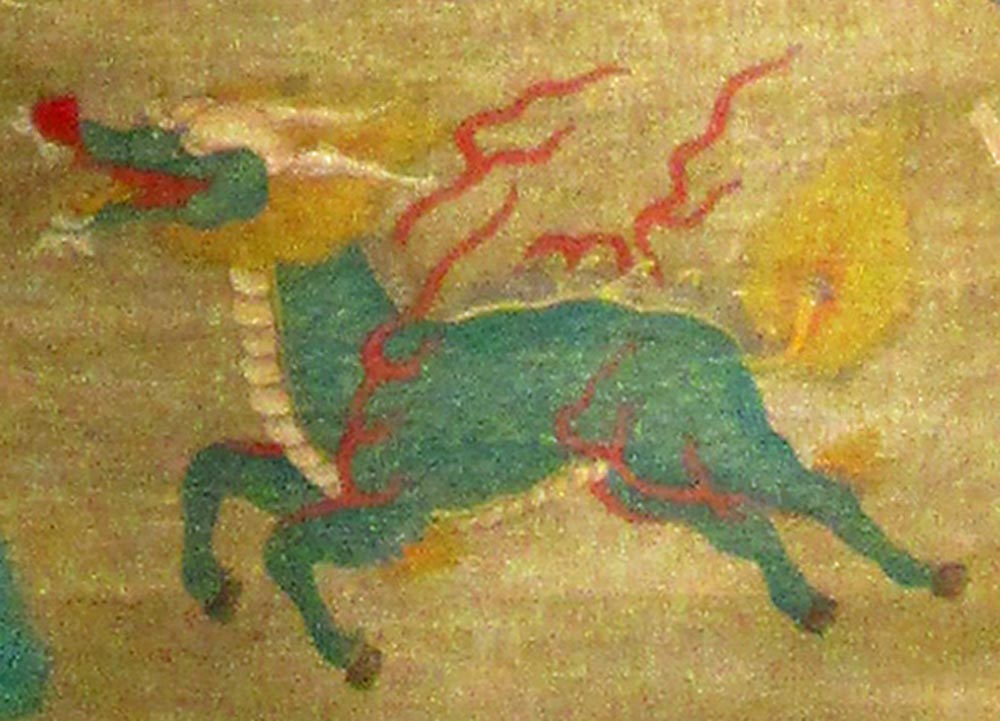
 Huo Lin is often translated as "captured unicorn", but "unicorn" is more poetic (or convenient and lazy) than biological or even mythical: here lin refers to 麒麟 qilin, which are depicted in a great variety of ways, and the marvels associated with them, though perhaps usefully evocative, are generally quite different from those associated with the Western unicorn. As for images, the three here show first a closeup of the qilin in the painting above, one from "毛詩名物圖說 Commentary on Illustrations from Mao's Edition of the Shi Jing", then a lin from the same source (full image).

21232.25 獲麟 huolin quotes a variety of sources (not Shi Ji), none with information that adds detail to what comes with this melody. Other related entries include,
- 48628 麒 qi (no separate image)
Can be short for 麒麟 qilin; sometimes said to be 牡麒麟 male - 48667 麟 lin has this image from 金石索 41049.147 (19th c. from old stone reliefs, etc.; see also the third of the three images)
Sometimes said to be 牝麒 female, but also as just short for 麒麟 qilin, in spite of the image here

Many depictions show two horns, or antlers instead of horns, while some may even have none and still be called qilin (with a mythical beast how does one determine correctness for this?). In this regard one can read claims that if it has two horns (or no horns it all) it must be female. The animals in this category seem generally to be written with the deer radical (鹿 lu); this, of course, is true also of the jun ("hornless deer") mentioned below.
| Related animal references | Pixiu, bixie then uncertain object (enlarge); the pixiu image in particular is quite odd |
 "Hornless deer" reminds one that neat (or even understandable) categorization may be impossible. During the Ming dynasty when traders brought giraffes to China apparently some people identified them as "qilin". Other animals sometimes apparently seen as qilin, but with no horns or antlers, include (and are probably better seen as one of) the following. (Note use of the radical 豸 zhi or zhai, which 37338 describes as 獸長脊 animals with long ribs or 無足蟲 reptiles).
- 37456.7 貔貅 pixiu says "猛獸名,形與虎似、或謂似熊 name of a wild beast, like a tiger or bear"
This entry also has the first of this second set of three images, saying it comes from 禮器圖 25404.231xxx (皇朝禮器圖式?). After the above definition the entry relates a story from 世紀 Shi Ji in which 貔 Pi and 貅 Xiu seem to be clan names; it then relates another story, perhaps connected to the image, beginning by saying the bixie "謂勇猛之軍隊 is a fierce fighting military unit"; I have not yet figured out how this connects to the animal or the image of it - pixiu usually look quite similar to the other two images here. Some popular online entries say these other two images are actually two types of pixiu. - 辟邪 (variously) bixie, biya, pixie, piya;
39505.35 辟邪 has the full version of the second image here, saying it is of a "玉辟邪 (大清會典圖) Jade bixie (Illustration from the Collected Statutes of the Great Qing)". It describes the 辟邪 bixie as "the same as 邪辟 xiebi" (concerning which 40180.67 has a quote from 禮記,樂記, but no image, though it adds more specifically that the xiebi is "獸名,漢人多雕刻辟邪獸形為物飾 the name of a wild beast that Han people like to carve ornamentally"). - 天祿 tianlu (no image; the third one at right, resembling online images of pixiu, may just be standing in for the tianlu)
5961.1006 "heaven's gift"; (4): 獸名 name of a wild animal(古玉圖譜 Old Jade Illustrations Manual [Song dynasty]: "漢多以為雕刻之飾 Han people mostly usually use it as a carved ornament"), then a reference to see .1009 辟邪天祿 bixie tianlu, which has a reference from 漢書 Han Shu quoting 孟康 as saying (and thereby suggesting the word originally named a real animal introduced from abroad) it was, "桃拔,一名符拔,似鹿長尾,一角者,或為天鹿,兩角者,或為辟邪", a taoba, also called a fuba, resembling a deer with a long tail; with one one horn it was a tianlu (天鹿, not 天祿) while if it had two horns it was a bixie". The third image here, which comes from the China Gallery at the University of Pennsylvania Museum, is the female of a pair. At first glance it seems to resemble objects often identified as various types of pixiu. It has two horns flat against its head while its partner has one horn. However, they are labeled as "qilin". Although the above suggests that the tianlu/bixie pair are similarly horned, if these figures really identify themselves as qilin, why object?

With such a profusion of marvelous beasts, one might wonder what reference books Confucius consulted before deciding the animal was a huolin. In any case, one should be careful when reading that any of these has "always" been depicted or interpreted in any specific way.
(Return)
2.
慢宮調 Mangong Mode and Tuning ( 3 5 6 1 2 3 5;
tracing chart)
Huo Lin is the only melody in Shen Qi Mi Pu that uses this tuning, so commentary on its mode is included here.
The relative pitches of this tuning ( 3 5 6 1 2 3 5 ) are achieved by slackening the 1st, 3rd and 6th strings one half tone each from standard tuning (1 2 4 5 6 1 2), giving 7 2 3 5 6 7 2, then transposing upwards so that the notes have the names of notes in the Chinese pentatonic system (1 2 3 5 6). The same relative tuning, which can also be achieved by tightening the 2nd, 4th, 5th and 7th strings, may elsewhere be called by the following four different mode names (note that the Zha Guide references are only for modal preludes using this tuning):
- 神品慢宮意 Mangong (Zha Guide 26/--/--; only in 1589 [VI/87] and 1602 [VI/437; identical])
- 夷則 Yize (Zha Guide 21/--/--; only in 1525 [III/209])
- 南呂 Nanlü (Zha Guide 22/--/--; lists it as only in 1525 [III/230], but a prelude of the same name using guxian tuning is in 1571 [QF/272])
- 太簇 Taicou (Zha Guide 21/--/--; lists it only in 1525 [III/193], where it refers to lowered third string tuning; in fact, no modal prelude with this name uses the tuning 3 5 6 1 2 3 5, but the name is used to categorize some named melodies that do use this tuning, such as the five in the taicou mode section of 1876 or some occurrences of Xie Xian You)
As this list and the chart below show, in spite of the number of names there are only three existing modal preludes using this tuning (four including the one repeat); and as the following shows, in contrast to guxian diao (tighten 2nd/5th/7th strings = lower 1st, 3rd, 4th and 6th) very few pieces in surviving tablature used this lowered 1st, 3rd and 6th string tuning. Also, some melodies that do use this tuning and refer to it by one of the above names may have no modal prelude.
Melodies that do use this tuning include:
Tianwen'ge Qinpu (1876), in its
taicou mode section, has both a Xiexian You (XXV/538) and a related later version of Baji You (XXV/526). It also has the Ping Sha (XXV/530) from 1744 as well as the other two melodies listed here.
For much of Huo Lin the main tonal center is 6 (la), with the secondary tonal center being 3 (mi). However, the main tonal center sometimes changes to 1 (do), and the melody ends on do. Man Gong is the only mode in SQMP that does not include a modal prelude (diaoyi or kaizhi).
Xilutang Qintong (1525) calls Huo Lin by another name,
謹微 Jin Wei, and prefaces it with a diao yi, called 南呂意
Nanlü Yi. It gives incorrect instructions on the tuning (it does not mention slackening the third string), but the tuning is clearly the same as here. In Xilutang Qintong the tuning is also the same for 夷則調 Yize mode; Yize Prelude, Chutai Yin and Yuan You are listed above. At the beginning of the Yi Ze mode section, in addition to giving the tuning method, the handbook says that the tuning is commonly called Man Gong, and that both Nan Lü and Man Gong have the fourth string as gong (do). These three yi ze mode melodies survive only in Xilutang Qintong. The tonal center again is do, with sol as the secondary center. La and mi are again important, but perhaps not as much so as with Huo Lin. However, in the Yi Ze mode melody Qingjing Jing la and mi are the most important tonal centers.
Xilutang Qintong describes the same tuning for 泉鳴調 Quanming mode, but this is incorrect: for this tuning you must lower the 1st string a whole tone instead of a half tone. It includes three melodies, 鳴鳳吟 Mingfeng Yin, 鳳翔千仞 Feng Xiang Qian Ren and 孤竹君 Guzhu Jun. These three also survive only in Xilutang Qintong.
For more on modes see Modality in Early Ming Qin Tablature.
(Return)
| 3. Image: Capturing a unicorn and (at right) Captured Unicorn | From "Traces of the Sage Confucius" (expand) |
 The image above is by
Bai Yunli. I am not sure what the source was for his imagery.
The image above is by
Bai Yunli. I am not sure what the source was for his imagery.
At right is an illustration from page 99 of 孔子聖蹟圖 Traces of the Sage Confucius, 1996. Its inscription tells a similar story to the one here, as follows:
哀公十四年,魯,西狩獲麟。孔子感焉,作「春秋」。按「孔叢子」日:「叔孫氏樵而獲麟, 眾莫之識, 棄之五父之衢, 冉有告曰:「麋身而肉角,豈天之夭乎?」 夫子往觀焉,泣曰: 「麟也。麟仁獸,出而死,吾道窮矣!
Not translated; source unclear.
(Return)
4.
Tracing Huo Lin
See Zha Fuxi's Guide 3/32/38 and the Appendix below. Note that the 1589/1609 listing seems to be a mistake, and the 1618 version seems to be musically unrelated.
(Return)
5.
Jin Wei 謹微 (also jinwei)
謹微 36717.xxx. Jin Wei is translated here as "respectful and polite', but Tong Kin-Woon says it is short for jinxiao zhenwei 僅小慎微 (36717.xxx, but see .73), meaning " be careful".
This title appears only in Xilutang Qintong (1525), where the commentary ends by saying Confucius wrote the story as a warning. Although the melody there is very similar to that in 1425, which ends on do (1), 1525 then adds after that do a harmonic coda that has as its final note mi (3): 3 is one of the tonal centers but 1 and 6 seem more important to the melody, and this 3 sounds rather odd.
By contrast, the 1525 modal prelude (Nanlü Yi) ends on 5 and 1. This prelude, which could thus be used with the 1425 version, has no punctuation; there are also at least two clusters that seem mistaken, and one which is unintelligible. This suggests it may have been copied from an old manuscript (something the 1425 compiler Zhu Quan saw but rejected because of the errors?).
(Return)
a6.
Pairing the lyrics
Lyrics were paired by a quite strict formula of one character for each dian, apparently defined as any right hand and certain left hand strokes. The number of characters in the lyrics of the 1585 version matches quite well the number of characters the present Huo Lin needs in each section. However, the phrasing of the lyrics seems to have no correspondence with the phrasing of the music. For more on this see the examples of <1491.
(Return)
7.
Gaoping Juye Xian 高平鉅野縣
46302 has no 高平 Gaoping; 41166.18 Juye says Juye is in the north part of modern Juye county, Shandong province.
(Return)
| 8. "Hornless deer" (麏 jun) (compare huolin, above) | 麏 jun |
 48618 麏 jun (鹿 over 君; no image) says only that it is the same as 麇 jun (鹿 over 禾). 48592 麇 has the picture at right of a hornless deer, but confusing explanations, associating this character with other obscure 鹿 radical characters such as 麕 (鹿 over 囷) and 麞 (鹿 over 单). There are also a number of other strange looking animals written with this radical.
The translation "muntjac" comes from Mathews. See also
muntjac, etc. If the animal confused with a huolin was really a hornless deer, it brings further into question the idea both that "qilin" should be translated as "unicorn" and that it must have horns.
(Return)
9.
Reconstruction by Guan Pinghu
The staff notation of his dapu is in Guqin Quji 1, pp.25-28. My own rhythms are still quite similar to those of Guan's.
The introduction in Guqin Quji I, p.5, says of the modality, "the qin tune uses yu mode as a basis, with alternate appearances of zhi mode and gong mode. It weaves harmonics and open strings sounds together into a tune. In many places it uses doubled intervals, such as octaves, fifths, thirds and unisons. Its form has a lot of (these?) special points."
(Return)
10.
Developing interpretation
My version, like Guan's, has quite a regular rhythm but a shifting meter. Perhaps over time my version has acquired some more regular meter, but this serves to highlight the places where the meter shifts.
(Return)
11.
Original preface
The original text is,
琴史 Qin Shi: book name, or just the history of qin? Zhu Quan's sources are problematic. It is not from Zhu Changwen's Qin History.
(Return)
12.
For the original Chinese text see 獲麟.
(Return)
13.
操 cao in ancient contexts could mean "lament".
(Return)
14.
For the original Chinese section titles see 獲麟.
(Return)
Return to top
Appendix I: Chart Tracing Huo Lin
Based mainly on Zha Fuxi's Guide
3/32/38
(See also the Man Gong Tuning chart below)
|
琴譜
(year; QQJC Vol/page) |
Further information
(QQJC = 琴曲集成 Qinqu Jicheng; QF = 琴府 Qin Fu) |
|
1. 神奇秘譜
(1425; I/115) |
6T; 2nd edition adds some phrasing
no modal prelude |
|
. 浙音釋字琴譜
(<1491; I/--) |
Not in this edition, but
lyrics of 1585 fit 1425, so perhaps it was originally included
|
|
2. 西麓堂琴統
(1525; III/228) |
10T; "謹微 Jin Wei, also called Huo Lin"; almost = 1425, but adds odd phrase in harmonics at end;
preceded by 南呂意 Nanlü Yi; |
|
3. 風宣玄品
(1539; II/99) |
6T; virtually same as 1425 but put with gong mode melodies;
"mangong mode", but tuning not explained and no modal prelude; also reconstructed by Guan Pinghu |
|
4. 重修真傳琴譜
(1585; IV/346) |
6T; lyrics; related; see <1491;
no modal prelude |
|
5. 玉梧琴譜
(1589; VI/85) |
7; called 獲麟操 Huolin Cao; 8; starts the same, but then very different;
preceded by a Shenpin Mangong Yi; |
|
. 琴書大全
(1590; V) |
No tablature, but commentary on p.237 says another title for this is
泣獲麟 Qi Huolin (Weep for the Captured Qilin) |
|
6. 藏春塢琴譜
(1602; VI/429) |
7; identical to 1589 above;
also preceded by Shenpin Mangong Yi |
|
. 真傳正宗琴譜
(1589; VII/???) |
Zha Guide lists this and says "called 獲麟操 Huolin Cao" and
"楊倫伯牙心法"
but this seems to be a mistake (see Guide p. [總105] 63ff) |
|
. 理性元雅
(1618; VIII/310) |
3; jue mode; called 獲麟解 Huolin Jie;
unrelated to above |
|
7. 古音正宗
(1634; IX/368) |
6, titled; starts very similar to #1, then more variation at end;
adds coda at end in harmonics; no modal prelude |
|
8. 琴苑新傳全編
(1670; XI/407) |
6, titled; virtually same as #1; also no modal prelude
|
Appendix II: Chart Tracing Man Gong Tuning
(Lowered 1st, 3rd and 6th strings: 3 5 6 1 2 3 5 )
| Based mainly on Zha Fuxi's Guide (further details): |
|
神品慢宮意 Mangong
(Guide 26/--/--)
夷則 Yize (Guide 21/--/--) 南呂 Nanlü (Zha Guide 22/--/--) 太簇 Taicou (Zha Guide 21/--/--) |
|
琴譜
(year; QQJC Vol/page) |
Further information
(QQJC = 琴曲集成 Qinqu Jicheng; QF = 琴府 Qin Fu) |
|
. 神奇秘譜
(1425; I/115) |
Man'gong is the only tuning in SQMP for which there is a melody but no modal prelude;
Huo Lin is in SQMP Folio I, which has no "diao yi" but does have two "Kai Zhi": in Guangling San and before Qiuyue Zhao Maoting. |
|
. 浙音釋字琴譜
(<1491; I/--) |
Neither this edition nor 1585 has a modal prelude in this tuning
|
|
1. 西麓堂琴統
(1525; III/193) |
No modal preludes using this tuning have the name Taicou (comment);
太簇意 Taicou Yi in 1525 is a prelude for Dinghui Yin and Dunshi Cao (1425) |
|
2. 西麓堂琴統
(1525; III/209) |
夷則意 Yize Yi ("The meaning of Yize mode);
a prelude in 1525 for Chutai Yin and Yuan You |
|
3. 西麓堂琴統
(1525; III/230) |
南呂意 Nanlü Yi ("The meaning of Nanlü mode);
a prelude in 1525 for Jin Wei, i.e. Huo Lin; the Nanlü Yi in 1571 actually uses guxian tuning |
|
3. 玉梧琴譜
(1589; VI/87) |
神品慢宮意 Shenpin Mangong ("The meaning of Mangong mode);
a prelude in 1589 and 1601 (VI/429) for Huo Lin |
| |
Return to the top, to the Shen Qi Mi Pu ToC or to the Guqin ToC.