|
T of C
Home |
My Work |
Hand- books |
Qin as Object |
Qin in Art |
Poetry / Song |
Hear, Watch |
Play Qin |
Analysis | History |
Ideo- logy |
Miscel- lanea |
More Info |
Personal | email me search me |
| SQMP ToC Should be played together with Qiuyue Zhao Maoting | Listen to my recording with transcription 首頁 |
|
12. Opening Fingering
- Huangzhong mode:2 1 3 5 6 1 2 3 |
開指
1
Kai Zhi |
| Connecting the Kai Zhi: see red marks 3 |
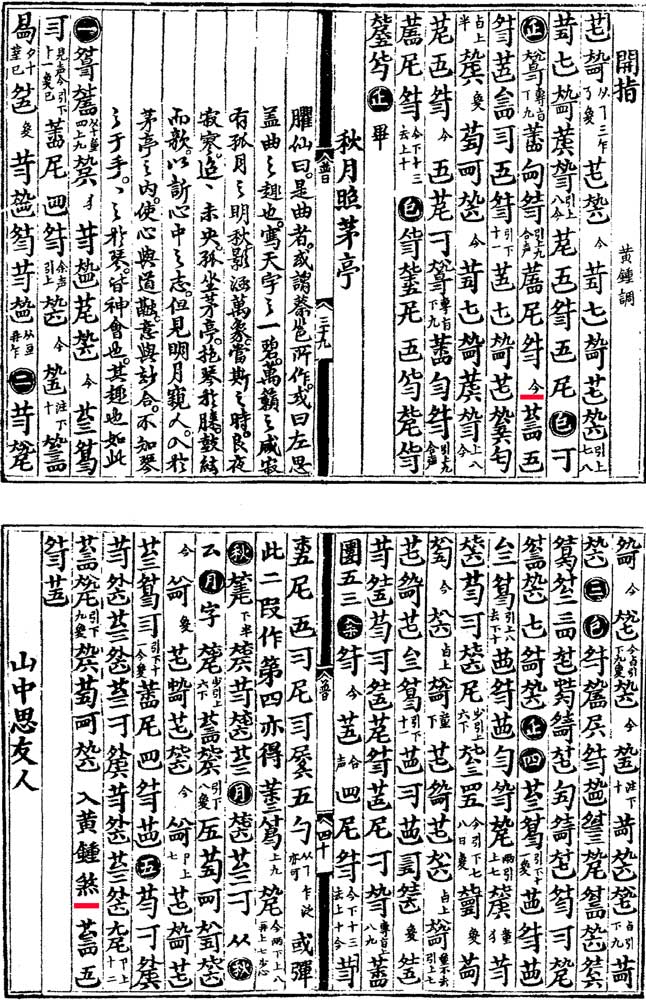 Kai zhi (kaizhi), literally "opening fingering", can be compared to diao yi, literally "modal meaning". The two words are sometimes said to have the same meaning, but the literal translations seem to suggest that a kaizhi was intended to warm up the fingers for play while the diaoyi was a sort of modal prelude familiarizing you with the essence of music in that mode: the word "kaizhi does not seem to appear together with a modal name while with diaoyi the mode is almost always named. Functionally, kaizhi are sometimes said (there seems to be no available direct information on this) to have been developed as preludes to specific melodies whereas diaoyi more generally introduced any melody in that mode. Indeed, during the Ming dynasty pieces in a certain mode were often grouped after a modal prelude. However, complicating this interpretation, some surviving diaoyi seem to have been attached to specific pieces.
The term kaizhi is attached to at least four surviving pieces, all short:4
- The present one, which clearly has an intimate attachment to the following melody, Qiuyue Zhao Maoting;
- The one used as the first section of (or prelude to) Guangling San;
- One called Kaizhi Huangying Yin (Prelude to Golden Oriole Intonation), included in the Yuan dynasty compilation Shilin Guangji.
- Kaizhi Lu Shangyi, the first entry in the shang mode section of Wenhuitang Qinpu (1596).5
The first three of these are modal preludes attached to specific melodies; the function of the fourth is unclear. In general, though, they can be compared to the diaoyi of Folios 2 and 3, all of which seem to have been intended for groups of pieces rather than single pieces. As for examples of later diaoyi that seem to have been designed for specific melodies, these seem often to have been part of a set of three, first a diaoyi, then a related yin (intonation) followed by a full melody. One such example is the set connected to Qiu Hong. Other examples can be found in Xilutang Qintong (see one such set from its Table of Contents).
The clear and specific relationshp of the present kaizhi to the following melody, Qiuyue Zhao Maoting, is shown by the fact that the latter ends with the apparent indication then to play the kaizhi again, beginning at a point about one third of the way through. Red marks have been added to the image at right to show this more clearly. The further explanation here gives more details, while this footnote details how other people who have reconstructed the melody have not noticed this relationship.
The modal characteristics of this kaizhi and its Qiuyue Zhao Maoting are similar: the tonal centers shift between 1 (do) and 6 (la; the main body ends on 6, with the harmonic coda ending on 1. When 1 and 6 are the tonal centers the secondary center is 3 (mi). In fact, 3 is so significant as also at times to seem to be a tonal center; in such passages the melody make take on characteristics of what have elsewhere been described as a "3-7, or theoretical jue, mode". Non-pentatonic tones are mainly 4 and 7: the kaizhi has 4 twice and 7 six times; Qiuyue Zhao Maoting has correspondingly more of both. The kaizhi has one 5# and one 4#; Qiuyue Zhao Maoting has nine 4#, the latter usually coming just before or after 3.
The other Folio I pieces grouped here (see modal characteristics) are:
- Shanzhong Si Youren; 3 sections
Section 1: starts 5, ends 1; Section 2: mostly 6; Section 3: starts 3, ends 6; Coda: 1. Mostly pentatonic, but with 4#s as neighboring tones to 3. - Xiao Hujia; six quite long sections
Tonal centers on 1 (with 3), 6 (with 3) and 3; quite complex, with many non-pentatonic tones, particularly 4, 4# and 7, perhaps all associated with 3 as tonal center. Ends on 5/1 (inverted 5th). - Yi Zhen
Main tonal center seems to be 3, but often moving to 5 or 1. Main body ends 5; harmonic coda ends 1 (strongly).
The few later handbooks which include Qiuyue Zhao Maoting didn't seem to realize its connection to the kaizhi. Perhaps for that reason this kaizhi appears only here.
Besides my own, the only other recording of this kaizhi is one by Liang Mingyue, who plays it as a prelude to #14 Shanzhong Si Youren.6
For some reason all the SQMP pieces dealing with themes of north and central Asia use the present tuning, which is also called Wuyi Diao.7
None.
00.00 Opening
The closing harmonics also occur in
Qiu Yue Zhao Maoting, as follows:
Return to the Shen Qi Mi Pu ToC
or to the Guqin ToC.
1.
Opening Fingering (開指 Kaizhi or Kai zhi)
2.
Huangzhong (Yellow Bell) Mode 黃鐘調
There is no separate heading for this title in front of the five melodies categorized as Yellow Bell Mode in Folio I. For more details on this mode see Shenpin Wuyi Yi. For more on modes in general see Modality in Early Ming Qin Tablature.
It is not clear why this tuning is used for all the Shen Qi Mi Pu melodies with a Central or Northern Asian theme. See, e.g.,
#45 Huangyun Qiusai,
#46 Longshuo Cao, and
both Hujia (#15 and
#47).
3.
Tablature for Kai Zhi and Qiuyue Zhao Maoting
(expand image)
4.
Surviving Kaizhi
5.
Kaizhi Lushang Yi 開指魯商意 (QQJC. VI/194)
6.
A Taiwan recording entitled Xiaoxiang Shuiyun (SMT or SMCM 1017). Liang apparently did not realize that Qiuyue Zhao Maoting needs to end with the Kaizhi, as explained above.
8.
Music
Preface
Music8
(Timings follow the recording on
my CD;
聽錄音 listen with
transcription)
Not divided into sections
00.13 Compare ending for Qiu Yue Zhao Maoting (begins at m.23 here, at m.114 there [03.45 of that recording])
01.06 Closing harmonics
01.23 End
(02.34) - harmonics
(02.53) - End
Footnotes (Shorthand references are explained on a
separate page)
42157.xxx (no kaizhi entry). See Qin tunings and Modality in Early Ming Qin Tablature for further information about kaizhi and diaoyi.
(Return)
To tune to Yellow Bell mode (黃鐘 48904.1327 yellow bell), slacken 1st and tighten 5th strings each a half step.
(Return)
The red marks have been added here to show how to connect the Kai Zhi to the melody that follows it. As can be seen at top right, the four clusters that follow the red mark in the Kai Zhi (near the bottom of the fourth line then top of the fifth line from the right) are the same as the four clusters at the end of Qiuyue Zhao Maoting (bottom of the third row from bottom left and then top of the second line from the left). The text preceding the latter says,
"入黃鐘煞 go to huangzhong ending", i.e., play the end of the kaizhi for huangzhong mode, starting with the notes indicated by the following four clusters.
(Return)
See the Appendix below. Perhaps the reason Zha's Guide did not include this Kaizhi is that it was not included in the SQMP Table of Contents.
(Return)
Kaizhi Lu Shangyi, the first entry in the shang mode section of Wenhuitang Qinpu (1596), is rather like a standard shang mode prelude, with
lyrics similar to those of other shang modal preludes (see also
those of
Gu Qiu Feng). It is not, like earlier surviving kaizhi, attached to a specific melody, and it is unclear why the name was used here.
(Return)
(Return)
Timing follow my recording.
(Return)
Appendix: Chart Tracing (lack of) Kai Zhi;
More details with Qiuyue Zhao Maoting

|
琴譜
(year; QQJC Vol/page) |
Further information
(QQJC = 琴曲集成 Qinqu Jicheng; QF = 琴府 Qin Fu) |
|
1. 事林廣記
(Yuan; I/18) |
One section, 26 notes
Unrelated to the following (see comments) |
|
2. 神奇秘譜
(1425; I/112) |
Used as prelude to, or first section of,
Guangling San; no phrasing indicated
Later GLS that are copies of 1425 also have this kaizhi (see in chart) |
|
3. 神奇秘譜
(1425; I/129) |
Here: one section, no phrasing indicated
Intimately connected to Qiuye Zhao Maoting |
|
浙音釋字琴譜
(<1491; I/248) |
Qiuye Zhao Maoting but no kaizhi to go back to;
no lyrics are provided for the closing notes (i.e., the notes from the kaizhi) |
|
風宣玄品
(1539; II/377) |
Qiuye Zhao Maoting but no kaizhi
|
|
重修真傳琴譜
(1585; IV/498) |
Qiuye Zhao Maoting but no kaizhi
|
|
4. 文會堂琴譜
(1596; VI/200) |
開指魯商意 Kaizhi Lushang Yi
Lyrics; unrelated to earlier kaizhi or any specific melody |
|
思齊堂琴譜
(1620; IX/34) |
None: Its Qiuyue Zhao Maoting is unrelated
|
|
琴苑新傳全編
(1670; none) |
Qiuyue Zhao Maoting ends on XI/414 just before "入黃鐘煞" without adding mention of the Wuyi Yi harmonics or giving the five figures of the old Kaizhi; again no kaizhi itself, or mention of it |
Return to the Shen Qi Mi Pu ToC or to the Guqin ToC.