|
T of C
Home |
My Work |
Hand- books |
Qin as Object |
Qin in Art |
Poetry / Song |
Hear, Watch |
Play Qin |
Analysis | History |
Ideo- logy |
Miscel- lanea |
More Info |
Personal | email me search me |
| Qin Bios / Ruse of the Empty City | 首頁 |
|
Zhuge Liang
1
|
諸葛亮
Old image of Zhuge Liang2 |
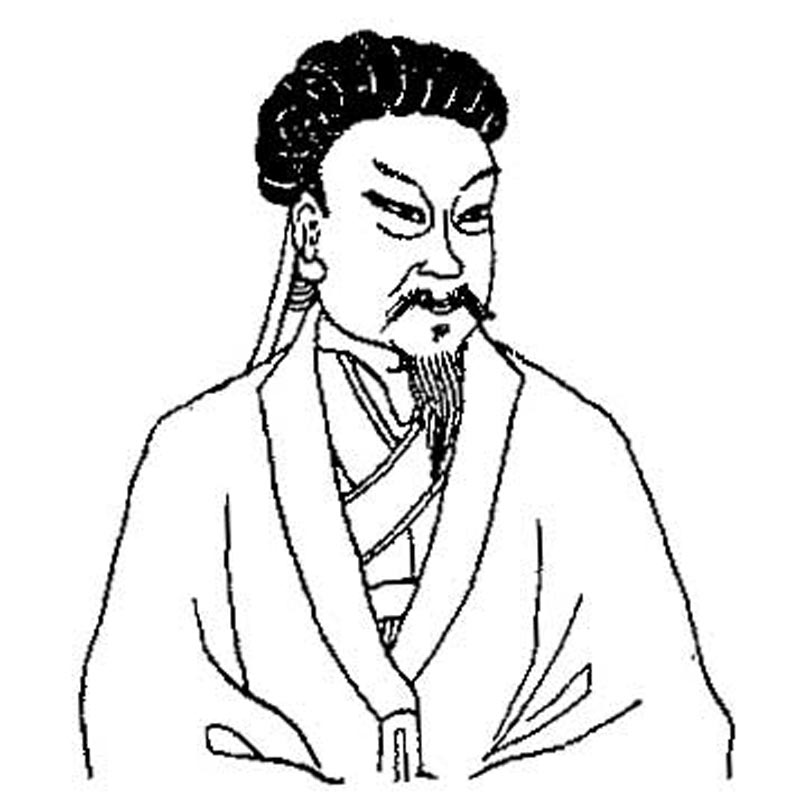 Zhuge Liang (181 - 234), also called Zhuge Kongming, is one of China's most beloved heroes from antiquity. He was the archetypal Sleeping Dragon3 - a hidden talent waiting to be discovered - best known for his exploits as a strategist and military leader in support of Liu Bei,4 who came from a poor branch of the Han imperial family to become the ruler of what popular history considers the legitimate successor to the Han dynasty, the Shu (or Shu Han) Kingdom, based in Sichuan province. This view was solidified by the popular 13th century epic Romance of the Three Kingdoms (San Guo Yanyi), loosely based on the official history of the period, the Annals of the Three Kingdoms (San Guo Zhi).5
The historical background for all this is as follows. As the Han dynasty, with its capitals in Chang'an and Luoyang, was disintegrating, three centers of power arose:
- Luoyang, the base of Cao Cao6 (155 - 220), a Han prime minister whose Kingdom of Wei is generally considered in official histories to have been the most legitimate successor of Han.
- Jiankang (Nanjing), the base of Sun Quan7 (181 - 252), son of a military leader prominent in the Han fight against the Yellow Turbans and other rebellious grups; Sun's most famous strategist was Zhou Yu.8
- Sichuan province (first the eastern part then eventually also Chengdu), the base of Liu Bei (162 - 223); Liu Bei had grown up in Hebei, but was a warlord in Hubei/Hunan when he met Zhuge Liang.
This Three Kingdoms period is said of have ended in 280 CE. when the Jin dynasty, with its base in Luoyang, gained ascendancy.
Zhuge Liang himself was from Shandong, but during the disorders that followed the collapse of the Han dynasty he had retired to a country retreat at Longzhong in Hubei province.9 Meanwhile, according to The Romance of the Three Kingdoms, Liu Bei, Zhang Fei and Guan Yu met (perhaps somewhere in what is today Hebei or Henan province: the Romance does not give the exact location) and soon swore their "Oath of the Peach Garden"10 whereby, as the "Three Brothers of the Peach Garden", they would fulfil their vow to bring justice and order to China. Some time later Liu Bei (dragging along his two sworn brothers) made three trips to Zhuge Liang's retreat at Longzhong before successfully persuading him to join in Liu Bei's efforts.11 After Zhuge Liang joined them they become, for a time, very successful.
Zhuge Liang and the Qin
The Romance of the Three Kingdoms, in its account of Liu Bei's visits to Zhuge Liang (Chapters 37 and 38), depicts Zhuge Liang playing the qin.12 Later Zhuge Liang's association with the qin is made more prominent through the story of the Ruse of the Empty City (Chapter 90). Here, by playing the qin on the city walls, he makes the enemy think the empty city must be well defended.13
As for the Annals of the Three Kingdoms, I have not read them and so do not know all the details of what it says about Zhuge Liang and the qin.14 It does not seem to make any reference to this ruse. But apparently it does suggest that Liu Bei initially came to see Zhuge Liang to find some important music books from the imperial palace, taken from there by Cai Yong (133 - 192). It is perhaps for this reason that Zhuge Liang is said to have carried on the qin tradition of Cai Yong.
Today Zhuge Liang's qin connection is perhaps most famous through the popular modern melody Sleeping Dragon Intonation (臥龍吟 Wo Long Yin), discussed further below.
Specific qin melodies sometimes attributed to or otherwise connected to Zhuge Liang include the following:
Meanwhile, Qinshu Daquan, Folio 13, #38, has lyrics for a Liangfu Cao attributed to Zhuge Liang; the attribution does not specify whether it is referring to the lyrics or to the (missing) melody.18 The lyrics are different from those of any of the seven Liangfu Yin in YFSJ.
Zhuge Liang is said to have written a qin handbook called Qin Jing. The handbook no longer exists but some information about it is given in Qinshu Cunmu, #15.
1.
Zhuge Liang 諸葛亮
(Wiki)
Further regarding 諸葛孔明 Zhuge Kongming, 7077.130/1 孔明 mentions first Zhuge Liang then four other people, but the others seem to have no relevance to here.
Relevant melodies mentioned here include:
The modern Sleeping Dragon Melody (臥龍吟 Wo Long Yin) is mentioned further below.
2.
Sleeping Dragon (臥龍 Wo Long)
Sleeping Dragon Intonation (臥龍吟 Wo Long Yin)
3.
Zhuge Liang image
4.
劉備 Liu Bei (162 - 223)
The title Long Yin is found it ancient lists, and a melody called Shui Long Yin survives in at least 11 handbooks from 1589 to 1751, some of them attributing the melody to Zhuge Liang. However, there is no evidence to support any claims that the surviving melody actually dates back to Zhuge Liang's times.
Though often discussed separately (Zha's Guide lists it in 23 handbooks from 1609 to 1910), this is in fact a version of the melody Shuilong Yin. At least one handbook attributes it to Zhuge Liang.
Zhuge Liang is said to have been particularly fond of the melody Liangfu Yin. Yuefu Shiji has lyrics for a Liangfu Yin attributed to him (plus poems by six other people); although it is in a section of Matching Songs, elsewhere it is sometimes listed as a qin song.
Footnotes (Shorthand references are explained on a
separate page)
36553.156 includes the image above. Zhuge Liang was also known as 諸葛孔明 Zhuge Kongming, and the Sleeping Dragon (臥龍 Wo Long, sometimes translated Crouching Dragon; see below).
Dragon Intoning on the Sea; also called Night Rain on a River
Liangfu Intonation (梁甫吟 Liangfu Yin)
Memorial on Dispatching the Troops (出師表 Chushi Biao)
(Return)
30741.18 says first that 臥龍 wo long "謂眠臥直龍也 is a dragon lying down and asleep", its earliest reference being a poem by 庚信 Geng Xin (513-581). It then says, "謂特出而未見用之奇才也 this refers to an outstanding but as yet undeployed person of marvelous skill". As a term it might thus be seen either as similar to or as one type of scholar-recluse (隱士 yinshi). However, the term became so popularly associated with Zhuge Liang that it might almost be considered a nickname for him. Wo Long is also rendered in English as Crouching Dragon, though this more accurately is a translation of another nickname of Zhuge Liang, 伏龍 Fulong (435.148 but see .151 伏龍鳳雛); compare Flying Dragon (飛龍 Fei Long, under Cao Zhi).
This composition, more commonly called Sleeping Dragon Melody, is a modern ensemble piece subsequently arranged for solo qin. It first appeared as a song of this title in a popular mainland television series called "三國演義 Romance of the Three Kingdoms" (1994-5; episode 27 of 84?); the English title is often rendered as "Zhuge Liang Leaves his Thatched Cottage". The TV version features qin with other instruments and has lyrics that begin, "束髮讀詩書,修德兼修身....". People now like to think of it as a traditional qin melody and solo versions can easily be found on the internet (especially YouTube). When asked to play it I commonly try to interest them instead (or also) in an actual traditional melody called Shui Long Yin, which can be considered as a Ming dynasty equivalent.
(Return)
The image above was copied from 36553.156 諸葛亮, which said it was from 三才圖會 Sancai Tuhui. There are numerous other online examples, in particular from temples that honor him, e.g., this one from Wiki.
(Return)
Liu Bei, style name 玄德 Xuande, was from 涿郡 Zhuojun (modern 涿州, just south of the modern Beijing municipality). When 15 he was sent to study with 盧植 Liu Zhi (a student of 馬融 Ma Rong), but did not stay long. Around 185 he became involved in the military struggle against the Yellow Turban. After this he became a magistrate in Pingyuan (in modern Shandong province). First an opponent then a friend of Cao Cao, around the year 200 Liu Bei joined a conspiracy against Cao Cao, the failure of which led Liu Bei to flee and join 袁紹 Yuan Shao, then also in Shandong. Eventually his struggles, with the assistance of his sworn brothers and Zhuge Liang, he made his way to Sichuan, where in 221 he declared himself emperor of the Han (Shu Han) dynasty.
(Return)
Records (or Annals) of the Three Kingdoms (三國志 San Guo Zhi) is the original historical account (see in Wikipedia).
(Return)

| 6. 曹操 Cao Cao (155 - 220; Wiki) | Cao Cao (from Sancai Tu Hui) |
 Cao Cao, style name 孟德 Mengde, nickname 阿瞞 Aman, also called 曹吉利 Cao Jili and 魏武帝 Emperor Wu of Wei, was from a prominent family with close royal connections through a eunuch. Like Liu Bei he fought against the Yellow Turbans, but he then became more and more powerful in the capital through a combination of Machiavellian schemes and competent administration. Eventually he was the virtual ruler. In around 207 he ransomed Cai Wenji from her captivity in Central Asia, and married a daughter of his to the emperor. From 210 until his death in 220 his administrative center was at 鄴 Ye, northeast of Luoyang. 魏武帝 Wei Wudi (Emperor Wu of Wei), by which he is known
YFSJ (it includes 16 poems attributed to him), is the posthumous name given him by his son, Cao Pi (next).
Cao Cao, style name 孟德 Mengde, nickname 阿瞞 Aman, also called 曹吉利 Cao Jili and 魏武帝 Emperor Wu of Wei, was from a prominent family with close royal connections through a eunuch. Like Liu Bei he fought against the Yellow Turbans, but he then became more and more powerful in the capital through a combination of Machiavellian schemes and competent administration. Eventually he was the virtual ruler. In around 207 he ransomed Cai Wenji from her captivity in Central Asia, and married a daughter of his to the emperor. From 210 until his death in 220 his administrative center was at 鄴 Ye, northeast of Luoyang. 魏武帝 Wei Wudi (Emperor Wu of Wei), by which he is known
YFSJ (it includes 16 poems attributed to him), is the posthumous name given him by his son, Cao Pi (next).
Cao Cao is mentioned on this site in connection with the Red Cliff Ballad; this includes a reference to his poem 短歌行 Duan Ge Xing ([4+4]x16; included in at least one list of qin melody titles). It is earliest found in Wen Xuan Volume 27 魏詩, 魏武帝曹操 (Haixiao 1197), where it is said to be a Yuefu song (see also under 魏武帝 Wei Wudi in Yuefu Shiji 30/446-8).
However, Cao Cao is mostly of interest here because of his potential connection to the most ancient surviving guqin melody, 碣石調幽蘭 Jieshi Diao You Lan. Transcriptions and recordings of this melody can be found here, but to appreciate the possible connection one should read from various historical sources.
The most detailed biography of Cao Cao in English is Rafe de Crespigny, Imperial Warlord: A Biography of Cao Cao 155-220 AD, Brill 2010; parts can be read via Google Books (for his Jieshi Pian just search it for "jieshi"). In Romance of the Three Kingdoms Cao Cao is villain. However, he and his children (see next) were noted literati and in some ways supporters of arts. His Jieshi poems, mentioned here, are interesting in part for their potential connection to the melody Jieshi Diao You Lan.
As for Cao Cao's connection to the Towering Rock, it is interesting to read a claim that Cao Cao would "compose poems whenever he ascended a high spot, and when a piece was finished, he would have it set to music." (Fusheng Wu, Written at Imperial Caommand: Panegyric Poetry in Early Medieval China". SUNY Press, 2008, p.26.)
In a section called "Why Cao Cao" at the end of his book, Professor De Crispigny (op.cit, p.504) summarizes nicely Cao Cao's appeal.
There is no question that Cao Cao could be clever and cruel, and many of his actions were harsh and unjust. He was, however, an exceptional man in a dangerous time, and both his words and his actions are remarkable. It is, in fact, the combination of his brilliant ability and his personal failings that render Cao Cao a fascinating character to study and a continuing source of fantasy and imagination over centuries since his death. Above all, he must be remembered as a man who sought, with energy and skill, to control his own destiny.
Such may be the thoughts when
playing or listening to the guqin piece Towering Rock Melody Secluded Orchid. There is no clear answer as to why this pre-Tang You Lan was a "Jieshi Diao" version of it. Is that title making a deliberate contrast between Confucius' failure and Cao Cao's success (momentary though they may have been)? Whether or not such considerations went through the minds of people connected to the melody at that time, it can add a dimension to the appreciation of an amazingly complex and compelling musical creation.
曹丕 Cao Pi (188 - 227)
曹植 Cao Zhi (192 - 232)
Translated in Robert Joe Cutter, The Poetry of Cao Zhi
(De Gruyter Mouton, 2020; pp.12-13).
One expects "悲絃 bei xian" (11088.23 令人悲傷之琴音 strings that cause "bei": sadness, strong emotions) to refer to qin, but here it seems to be to its "country cousin", zheng.
7.
孫權 Sun Quan (181 - 252)
In 220 Cao Pi, style name 子桓 Zihuan, formally established the 魏 Wei dynasty in Luoyang, thus ending the Han dynasty. He first declared his father
Cao Cao, who had just died, the first emperor (see above), then in 221 himself took the title 魏文帝 Emperor Wen of Wei. Giles calls him Ts'ao P'ei (Cao Pei); ICTCL, p.794, focuses on his writing. He was the second son of Cao Cao and older brother of Cao Zhi (see below). Cao Pi was a noted writer, and a letter in which he mentions qin is included in QSDQ, Folio 16, #46.
Cao Zhi, style name 子建 Zijian, the third son of Cao Cao, was (ICTCL/790) "an imaginative, influential poet....gregarious and fond of acting, singing, and talking, but politically naive." ICTCL also associates him with the "Seven Masters of the Jian'an period". Relevant connections include the following:
仰清風以歎息,寄餘思於悲絃。
I pick up a plain cither, forlornly impassioned; Lift the mournful tones of the Greater Odes.
Looking up into a fresh breeze, I heave a sigh; Consign my thoughts to these sad strings.
(Return)
Sun Quan, style name 仲謀 Zhongmou, was the son of 孫堅 Sun Jian, a military leader prominent in the Han fight against the Yellow Turbans and other rebellious groups. After executing Liu Bei's loyal friend Guan Yu in 219, he declared allegiance to Cao Cao and in 222 was made prince of Wu, but in 229 he declared himself 吳大帝 Wu Dadi Great Emperor of the Wu dynasty, based in Nanjing.
(Return)
| 8. 周瑜 Zhou Yu (175-210; Wiki) | Zhou Yu plays qin in Red Cliff |
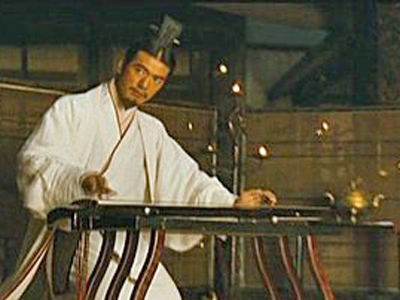 It is acknowledged that Zhou Yu was an accomplished musician, but to my knowledge there are no stories from his own time connecting him either to playing or to commenting on the qin. Nevertheless, at least one scene from the film Red Cliff has him playing qin (image at right and details).
3597.639 周瑜 has an image and short entry for Zhou Yu. The only source it mentions is 三國志 Sanguo Zhi #54. Here (see CTP, 三國志,吳書九), there is no mention of qin, only one line about how when he was young he was skilled at music and in particular could tell when people made mistakes when playing music:
Compare this to stories often connected to people who can tell what is on someone's mind by hearing them play qin (for example, this passage in the entry on Cai Wenji). Perhaps it is from this that stories of Zhou Yu himself playing qin have originated.
The lengthy Wikipedia article does mention that Zhou Yu was an expert in music but it focuses mostly on his military activities. It also gives numerous references from Sanguo Zhi as well as references to 三國演義 Sanguo Yanyi.
(Return)
9.
隆中 Longzhong
Longzheng, where Zhuge Liang is said to have had his retreat, is now a "hill resort" (tourist spot) about 10 miles west of 襄樊 Xiangfan (the former 襄陽 Xiangyang) in northern Hubei province.
(Return)
10.
Oath of the Peach Garden (桃園節義 Taoyuan Jieyi)
15099.137 桃園節義 Oath of the Peach Garden (or grove) concerns the meeting of 劉備 Liu Bei with 張飛 Zhang Fei and 關羽 Guan Yu (the Three Sworn Brothers: see Japanese image). Liu Bei and Zhang Fei were both from Zhuojun in Hebei; Guan Yu was from Shandong, but also traveled to Zhaojun. They were also all in Shandong, but I have as yet found records of peach gardens in these places. Most writings about this are fictionalized accounts that seem studiously unwilling to suggest where the Peach Garden actually was. (This taoyuan is unrelated to the 桃源 taoyuan meaning Peach Tree Spring.)
(Return)

11.
Three visits
From Chapter 37 of the novel; the CCTV TV series Sanguo Yan Yi had an episode telling this story.
(Return)
12.
Brewitt-Taylor, Tuttle, p.389ff. He calls the qin a lute.
(Return)
13.
Ruse of the Empty City (空城計 Kongcheng Ji)
The Kongcheng Ji story was extracted and made into a popular Peking opera story. More recently, the CCTV TV series Sanguo Yan Yi had an episode telling this story. Unlike the opera versions, Zhuge Liang can actually be heard playjng the qin - apparently a modern composition. There is no traditional qin melody relating this story, nor any historical record of what Zhuge Liang played.
(Return)
14.
The information in this paragraph comes from Hsu Wen-Ying, The Ku-Ch'in, pp.124-8. Her references are to the biography of Zhuge Liang in the San Guo Zhi. Unfortunately her English is a bit difficult to follow.
(Return)
15.
水龍吟 Shui Long Yin: Water Dragon Intonation
I have reconstructed this melody from Yuwu Qinpu (1589): see separate commentary.
(Return)
16.
Dragon Intoning on the Sea (滄海龍吟, Canghai Long Yin)
Zha Guide 30/234/-- lists this separately, but it is clearly related to
Shuilong Yin.
See further comments.
(Return)
17.
Liangfu Intonation (Liangfu Yin 梁甫吟)
(see also Liangfu Cao below)
There is no surviving qin melody with this title. 15135.85 梁甫 Liangfu says it is same as 梁父: a mountain in Shandong near Taishan (Mount Tai, the east sacred mountain, associated with Confucius.
15135.86 梁甫吟 Liangfu Yin says it is a Yuefu Xianghege (see YFSJ, Folio 41, pp.605-8).
YFSJ, under this title and 泰山梁甫吟 Taishan Liangfu Yin, has lyrics attributed to seven people. The first, attributed to Zhuge Liang himself (no doubt incorrectly), is translated in (Birrell, Popular Songs, pp. 98 - 9). The original is as follows:
問是誰家墓,田彊、古冶子。力能排南山,文能絕地紀。
一朝被讒言,二桃殺三士。誰能為此謀?國相齊晏子。
Old lists of qin melodies include the title Liangfu Yin. See QSDQ, Folio 12;
QYYY, Qin Shu list;
Qinqu Pulu. The latter also lists a 梁甫引.
(Return)
18.
梁父操 Liangfu Cao (see also Liangfu Yin above)
15135.85 and .86 do not mention a cao. The lyrics, in Qinshu Daquan, Folio 13 (no music), do not correspond with any of those in YFSJ.
(Return)
19.
Memorials on Dispatching the Troops
(出師表 Chu Shi Biao;
see in Wikipedia)
1839.183 says Chu Shi Biao is in 三國志 San Guo Zhi, Wen Xuan, etc. David Knechtges, Wen Xuan, I, p.43, discusses Chu Shi Biao as well as other 表 memorials in that collection. Although two memorials have been attributed to Zhuge Liang, experts have also said that the style and some other aspects of the second memorial suggest that it quite likely was by another author. The two memorials are:
- First Memorial on Dispatching the Troops (前出師表 Qian Chu Shi Biao; 2025.xxx; also called simply Chu Shi Biao)
- Second Memorial on Dispatching the Troops (後出師表 Hou Chu Shi Biao; 10332.58).
A setting of both for qin survives only in Chongxiu Zhenchuan Qinpu (1585; QQJC IV, pp. 327 - 333). Lixing Yuanya (1618) has Qian Chu Shi Biao (QQJC VIII, pp. 318 - 322), with the same lyrics, but it is set for 9-string qin.
The qin setting for the first memorial is compared below to the version in Wen Xuan, Chapter 37 (pp. 1670 - 75), called simply Chu Shi Biao; see also in Zha Guide 26/213/390: the last number refers to a punctuated version of the text. The qin setting for the second memorial is compared with some online versions; see also in Zha Guide 26/214/392. The qin tablature version selects phrases from the text to use as titles for each section, as shown here. It also adds a few characters; these are put in () brackets. It omits a few characters; these are added here in 《》 brackets. It also changes a few characters: most of these are indicated by separate comments.
- 前出師表 Qian Chu Shi Biao
- 先帝創業
先帝創業未半,而中道崩殂﹔今天下三分,益州疲弊,此誠危急之秋也。然侍衛之臣不懈於內﹔忠志之士忘身於外者,蓋追先帝之殊遇,欲報之於陛下也。- 遺德恢弘
誠空開張聖聽,以光先帝遺德,恢弘志士之氣﹔不宜妄自菲薄,引喻失義,以塞忠諫之路也。
(Note: For 誠空開張聖聽 Wen Xuan has 誠宜開張聖聽)- 論其刑賞
宮中府中,俱為一體,陟罰臧否,不宜異同,若有作姦犯科及為忠善者,宜付有司,論其刑賞,以昭陛下平明之理﹔不宜偏私,使內外異法也。
(Note: 姦=奸)- 志慮忠純 侍中、侍郎郭攸之、費禕、董允等,此皆良實,志慮忠純,是以先帝簡拔以遺陛下:愚以為宮中之事,事無大小,悉以咨之,然後施行,必能裨補闕漏,有所廣益。 將軍向寵,性行淑均,曉暢軍事,試用於昔日,
- 以眾議舉
先帝稱之曰能,是以眾議舉寵為督。愚以為營中之事,悉以咨之,必能使行陣和睦,優劣得所。親賢臣,遠小人,此先漢所以興隆也﹔親小人,遠賢臣,此後漢所以傾頹也。- 痛恨桓靈
先帝在時,每與臣論此事,未嘗不歎息痛恨於桓、靈也!侍中、尚書、長史、參軍,此悉貞良死節之臣,願陛下親之、信之,則漢室之隆,可計日而待也。- 枉屈三顧
臣本布衣,躬耕於南陽,苟全性命於亂世,不求聞達於諸侯。先帝不以臣卑鄙,猥自枉屈,三顧臣於草廬之中,諮臣以當世之事;由是感激,遂許先帝以驅馳。後值傾覆,受任於敗軍之際,奉命於危難之間,爾來二十有一年矣!先帝知臣謹慎,故臨崩寄臣以大事也。- 北定中原
受命以來,夙夜憂歎,恐託付不效,以傷先帝之明,故五月渡瀘,深入不毛。今南方已定,兵甲已足,當獎率三軍,北定中原,庶竭駑鈍,攘除奸凶,興復漢室,還於舊都;此臣所以報先帝而忠陛下之職分也。- 損益進盡
至於斟酌損益,進盡忠言,則攸之、禕、允等之任也。願陛下托臣以討賊興復之效;不效,則治臣之罪,以告先帝之靈﹔若無興德之言,則責攸之、禕、允等之慢,以彰其咎。- 察納雅言
陛下亦宜自謀,以諮諏善道,察納雅言,深追先帝遺詔。臣不勝受恩感激。今當遠離,臨表涕零,不知所言。 - 遺德恢弘
- Hou Chu Shi Biao 後出師表
- 先帝慮深
先帝慮(深以)漢、賊不兩立,王業不偏安,故托臣以討賊《也》。以先帝之明,量臣之才,故(當)知臣伐賊,才弱敵強《也》。然不伐賊,王業亦亡。惟坐而待亡,孰與伐之?是故托臣而弗疑也。- 五月渡瀘
臣受命之日,寢不安席,食不甘味﹔思惟北征,宜先入南:故五月渡瀘,深入不毛,并日而食,臣非不自惜也。顧王業不可偏安于蜀都,故冒危難以奉先帝之遺意。而議者謂為非計。今賊適疲于西,又務于東,兵法"乘勞":此進趨之時也。- 謹陳其事
謹陳其事如左:高帝明并日月,謀臣淵深,然涉險被創,危然后安﹔今陛下未及高帝,謀臣不如良、平,而欲以長策取勝,坐定天下:此臣之未解一也。- 論安言計
劉繇、王朗,各據州郡,論安言計,動引聖人,群疑滿腹,眾難塞胸﹔今歲不戰,明年不征,使孫策坐大,遂并江東:此臣之未解二也。- 髣髟弗孫、吳
曹操智計,殊絕于人,其用兵也,髣髟弗孫、吳,然困于南陽,險于烏巢,危于祁連,逼于黎陽,几敗北山,殆死潼關,然后偽定一時耳﹔況臣才弱,而欲以不危而定之:此臣之未解三也。
(Note: 髟弗 [髟 over 弗] is not in my computer; for 髣髟弗孫、吳 online versions have 仿怫孫、吳)- 稱操猶能 (compare 稱操為能)
曹操五攻昌霸不下,四越巢湖不成,任用李服而李服圖之,委任夏侯而夏侯敗亡,先帝每稱操為能,猶有此失﹔況臣弩下,何能必勝:此臣之未解四也。- 臣到漢中
自臣到漢中,中間期年耳,然喪趙雲、陽群、馬玉、閻芝、丁立、白壽、劉合、鄧銅等,及驅長屯將七十余人,突將無前,叢叟、青羌,散騎武騎一千余人,此皆數十年之內,所糾合四方之精銳,非一州之所有﹔若復數年,則損三分之二也。當何以圖敵?此臣之未解五也。- 民窮兵疲
今民窮兵疲,而事不可息﹔事不可息,則住與行,勞費正等﹔而不及今圖之,欲以一州之地,與賊持久:此臣之未解六也。- 東連吳、越
夫難平者,事也。昔先帝敗軍于楚,當此時,曹操拊手,謂天下已定。──然后先帝東連吳、越,西取巴、蜀,舉兵北征,夏侯授首:此操之失計,而漢事將成也。- 鞠躬盡瘁
然後吳更違盟,關羽毀(天)敗,秭歸蹉跌,曹丕稱帝:凡事如是,難可逆見。臣鞠躬盡瘁,死而後已﹔至于成敗利鈍,非臣之明所能逆睹也。
(Return) - 五月渡瀘
Return to the top or go to qin biographies,