|
T of C
Home |
My Work |
Hand- books |
Qin as Object |
Qin in Art |
Poetry / Song |
Hear, Watch |
Play Qin |
Analysis | History |
Ideo- logy |
Miscel- lanea |
More Info |
Personal | email me search me |
| XLTQT ToC / #120 Yi Guanshan / autumn theme | 聽錄音 Listen to my recording, with transcription / 首頁 |
|
121. Autumn in the Han Palace
- Wuyi mode/tuning:2 1 3 5 6 1 2 3 |
漢宮秋
1
Han Gong Qiu Han Gong Qiu illustration from Kuian Qinpu 3 |
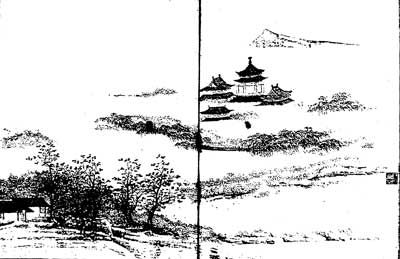 A wuyi mode version of Han Gong Qiu survives only in Xilutang Qintong.4 In addition, its prelude, Yi Guanshan,5 also occurs only here.
However, the title Han Gong Qiu is also used for an unrelated yu mode melody connected to the same story. Versions of this latter melody, also called Han Gong Qiu Yue (Autumn Moon over the Han Palace), Han Gong Qiu Yuan (Autumn Lament in the Han Palace) and Qiu Shan Yin (Autumn Fan Intonation6), survive in at least 49 handbooks from 1589 to 1946.7
The prefaces for all these are in some way connected with the Ban family,8 Ban Jieyu9 in particular, but there are some confusing details.
Ban Jieyu came from a family already very well known, though not yet as famous as it was to become. By her skillful action she at one time rescued her brother Ban Zhi10 from a charge of treason. Ban Zhi became the father of Ban Biao,11 an historian who in turn was father of Ban Gu12 and Ban Zhao,13 the brother and sister who were responsible for completing the history of the former Han dynasty; Ban Gu's twin brother Ban Chao14 was perhaps China's most famous frontier general.
Gazeteers include Guanshans in Shaanxi and Shandong provinces, but it is also a common allusion to separation from home. The prelude could thus also be translated Homesick.15
The story related in the afterword to the present Han Gong Qiu is a scaled down version of a fairly well-known story about Ban Jieyu, the imperial concubine who at one time was the favorite of the Han emperor Chengdi (r. 51 – 7 BCE).
Ban Jieyu had already proven her moral values by resisting the emperor's attempts to persuade her to ride with him in his chariot, her artistic talents through her ability to recite poems from the Shi Jing, and her generosity by introducing her attendant Li Ping to the emperor. Eventually, however, she lost out to Zhao Feiyan,16 after which great skill was required to survive the jealousy of Zhao and her sister. To do this Ban Jieyu first had to defend herself against accusations that she had cursed the emperor. She then found safety by arranging to serve the empress dowager in her palace.
Two poems attributed to Ban Jieyu concern this matter. One, often said to be her best, is called Phapsody of Self-Commiseration.17 In it she speaks of her virtue, and her sadness at having been abandoned.
| The poem in calligraphy by Bai Yunli |
|
The attribution of the other poem, called Yuan Ge Xing is more tentative, but it is included here because the words can be used as lyrics for Section 5 (harmonics) of the present melody with only minimal departure from the standard pairing method.19
At right is a silk fan with this second poem. In it Ban Jieyu compares herself to an autumn fan discarded after the summer heat; the expression "autumn fan" then came to mean a discarded lover. The fan came in a box 27x41 cm that now also has several similar but blank silk fans. The poem itself is in a Yue Fu style.18 Clear and pure as frost and snow. Made into a fan for joyous trysts, Round as the bright moon. In and out of my lord's cherished sleeve, Waved back and forth to make a light breeze. Often I fear the arrival of the autumn season, Cool winds overcoming the summer heat. Discarded into a box, Affection cut off before fulfillment. |

|

Ban Jieyu of the Han dynasty lost favor and was sent to live (in the outer quarters); this was the regret (like that of) a round fan in an autumn wind. This melody also describes the meaning of her lonely desolation.
Music
Eight sections (untitled;
(see transcription, which begins with #130 Yi Guan Shan; timings follow my recording 聽錄音)
00.00 1.
01.09 2.
01.44 3.
02.52 4.
03.14 5. (harmonics; the poem can be sung here [comment])
04.04 6. (04.17: sound of a fan snapped shut?)
04.40 7.
04.56 8.
05.24 harmonics
05.38 end
During the harmonic passage (from 3.14-4.02 on the recording linked above), one can read or sing these lyrics (i.e., the text of the poem 怨歌行 Yuàn Gē Xíng) together with the pronunciation and translations, as follows:
新 裂 齊 紈 素, 鮮 潔 如 霜 雪。
Xīn liè Qí wán sù, xiān jié rú shuāng xuě.
Newly cut white silk from Qi, clear and pure as frost and snow.
裁 為 合 歡 扇, 團 團 似 明 月。
Cái wèi hé huān shàn, tuán tuán sì míng yuè.
Made into a fan for joyous trysts, round as the bright moon.
出 入 君 懷 袖, 動 搖 微 風 發。
Chū rù jūn huái xiù, dòng yáo wéi fēng fā.
In and out of my lord's cherished sleeve, waved back and forth to make a light breeze.
常 恐 秋 節 至, 涼 飆 奪 炎 熱。
Cháng kǒng qiū jié zhì, liáng biāo duó yán rè.
Often I fear the arrival of the autumn season, cool winds overcoming the summer heat.
棄 捐 篋 笥 中, 恩 情 中 道 絕。
Qì juān qiè sì zhōng, ēn qíng zhōng dào jué.
Discarded into a box, affection cut off before fulfillment.
The lyrics have been sung in performance; and although they are not sung on the current recording, the pdf of the transcription has an extra page at the end, in which the lyrics have been added.
Footnotes (Shorthand references are explained on a
separate page)
1.
Autumn in the Han Palace (漢宮秋 Han Gong Qiu) (QQJC III/216)
18531.154: Yuan opera about Wang Zhaojun; no mention of Ban Jieyu. None of the qin prefaces mentions Zhaojun. There was an opera 班超投筆 Ban Zhao Casts Aside her Pen (see 王沛 Wang Pei, p.340.)
(Return)
2.
Wuyi mode (無射調 Wuyi diao)
For wuyi tuning, from standard tuning lower the first and raise the fifth strings a half step each. For more on the modal characteristics see
Shenpin Wuyi Yi. For more on modes in general, see Modality in Early Ming Qin Tablature.
(Return)
3.
Kuian Qinpu illustration (QQJC XI/54)
The melody of the version of Han Gong Qiu accompanying this illustration is the common yu mode melody; it is thus different from that of this 1525 version. However, but this other version still connects to the story of Ban Jieyu alone in her palace.
(Return)
4. Zha's Guide 21/192/-- has 32 entries, but only the first uses wuyi tuning (see also the footnote below). (Return)
5.
Wuyi mode version of Han Gong Qiu
Perhaps it is the uncommon tuning that led to the 1525 melody being e only version paired with 憶關山 Yi Guanshan. There
(Return)
6.
秋扇吟 Qiu Shan Yin (Autumn Fan Intonation)
7.
Tracing 漢宮秋(月) Han Gong QiuYue (羽音 yu mode)
To sum up, this melody has proven to be quite popular since its re-introduction in 1589. Zha's Guide arranges the over 50 occurrences into three separate entries for what (except for this, the first) are actually versions of the same melody. In other words, over 50 versions of this melody survive and are musically related to the yu mode Han Gong Qiu. The list also includes a 秋扇吟 Qiushan Yin as an alternate title; three are called 漢宮秋怨 Han Gong Qiu Yuan.
8.
Ban 班;
See next and also the fan poem. No connection to
Qiuhu Xing. (25505.260 qiu shan #2 says "abandoned woman", giving a number of references to Ban Jieyu).
(Return)
Details moved to the Appendix.
(Return)
The Ban family, which traced its origins to the state of Chu, had become wealthy through an ancestor who moved around the beginning of the Han dynasty to the northern frontier. See John E. Wills, Jr., Portraits in Chinese History, p.90ff.
(Return)
| 9. Ban Jieyu 班婕妤 (48-06 BCE; Bio/1827) | Ban Jieyu and Emperor Cheng of Han |
 Jieyu was a rank meaning something like "favored beauty"; her actual given name is unknown. Some account of her distinguished family is included above. The story of the emperor abandoning her in favor of
Zhao Feiyan is well known, though her biography in 列女傳
Lienü Zhuan mentions only her propriety, not her love. The Qing dynasty image at right (from an online version of that book) of her greeting the emperor does not seem intended to highlight her beauty: was it intended to emphasize her propriety?
Jieyu was a rank meaning something like "favored beauty"; her actual given name is unknown. Some account of her distinguished family is included above. The story of the emperor abandoning her in favor of
Zhao Feiyan is well known, though her biography in 列女傳
Lienü Zhuan mentions only her propriety, not her love. The Qing dynasty image at right (from an online version of that book) of her greeting the emperor does not seem intended to highlight her beauty: was it intended to emphasize her propriety?
Yuefu Shiji attributes to her the Song of Resentment (怨歌行 Yuan Ge Xing), also called Lament of the Autumn Fan (秋扇怨 Qiu Shan Yuan), related above in connection to the present melody. There is controversy about this attribution; more certainly attributed to her are two rhapsodies, Rhapsody of Self-Commiseration (自悼賦 Zi Dao Fu) and Rhapsody on Pounding Silk (搗素賦 Dao Su Fu; no apparent connection with Dao Yi). The latter mentions qin twice, once together with se and once in a passage that refers to Boya playing it while Zhong Ziqi listens:
鐘期改聽,伯牙馳琴,
桑間絕響,濮上傳音;
(Not yet translated)
The lyrics used here with the present qin melody are partially quoted in Zong-qi Cai, (蔡宗齊 Cai Zongqi), ed., How to Read Chinese Poetry, p.212, together with translations and discussion of other two poems that concern Ban Jieyu.
(Return)
10.
Ban Zhi 班稚 (Former Han; Bio/1827)
Ban Zhi, father of Ban Biao, was once accused of treason. He was rescued by his sister, Ban Jieyu.
(Return)
11.
Ban Biao 班彪 (3 - 54 CE; Bio/1826)
Ban Biao, with his son Ban Gu (next footnote), was the principal author of
漢書 The History of the (Former) Han, which continued where 司馬遷 Sima Qian's Shi Ji ended, ca. 100 BCE.
(Return)
12.
Ban Gu 班固 (32 - 92 CE; Bio/1826
Wikipedia).
Ban Gu (班孟堅 Ban Mengjian), with his father (班彪 Ban Biao (previous footnote), were the principal authors of 漢書 The History of the (Former) Han. Originally it began where Sima Qian's work ended, but Ban Gu's idea was to make the work into a unified history of the entire former Han. It was thus a model for the later official histories. He was also a poet: his 兩都賦 Two Capitals Rhapsody is translated by Knechtges in Wen Xuan, Vol.1.
Ban Gu also wrote 白虎通 Baihu Tong (or Bohu Tong, Discourses in the White Tiger Hall), "a record...of discussions on the classics and on Confucian themes held at the court of the Han Emperor Zhang (r.75-88 C.E.) in 29 C.E.)." (Sources of Chinese Tradition, I, p.344.)
(Return)
13.
Ban Zhao 班昭 (ca.49 - ca.120; Bio/1826)
Ban Zhao, daughter of Ban Biao, is most famous for her essay Nü Jie (女誡), Lessons for Women (see translation by Nancy Lee Swan in The Columbia Anthology of Traditional Chinese Poetry, p.534ff; compare with Cai Yong's Nü Xun). Some of the later prefaces to Han Gong Qiu say Ban Zhao wrote it, not Ban Jieyu.
(Return)
14.
Ban Chao 班超 (32 - 104; Bio/1826;
Wiki)
Son of Ban Biao, he led a quiet life until his brother helped him get a good official post. He distinguished himself so well at this that he was sent with 竇固 Dou Gu to western China. Dou Gu then the Emperor himself sent Ban Chao on further, into Central Asia, where he spent 31 years, to great distinction.
There seems to be a reference to Ban Chao in the following line of the song Sheng De Song:
(He) came back alive through Yumen Guan, but did not hope for a fief in Li Quan (Sweet Springs).
According to 《後漢書·班超傳》the biography of Ban Chao in the History of the Latter Han, after he served many years in Central Asia,
He did not dare hope to see again (his basecamp in) Jiu Quan district, but he did hope that while alive he would be able to come back through Yumen Pass."
Yumen Guan was a pass in the Great Wall not far from Dunhuang, now part of Gansu Province. Jiu Quan (40665.125 酒泉) was also in Gansu (see further), but as a base camp inside the Great Wall, it was closer to "civilization". The "Li Quan" (40946.3 醴泉) of Sheng De Song, is almost certainly a copy error. There is one near Xi'an in Shaanxi province (or it can simply mean "Sweet Springs"), but it has no association with Ban Chao, who in fact died in Luoyang.
Thanks again to Yang Shao-Yun for pointing out the likely connection of the lyrics with Ban Chao, as well as the likeliness that is was a copy error (there is a similar error - 骨+修 instead of 骨 - in
a later line of the same song.)
(Return)
15.
關山 Guanshan
This could simply mean "mountain pass" as well as specific places; more under
Yi Guanshan as well as
Guanshan Yue.
(Return)
16.
趙飛燕 Zhao Feiyan
Her biography is also in the Lienü Zhuan.
(Return)
17.
Rhapsody of Self-Commiseration (自悼賦 Zi Dao Fu)
See David Knechtges, Wen Xuan, I., pp.33 and 505. It is translated in Burton Watson, Columbia Book of Chinese Poetry, p.75. (N.Y., Columbia U, 1984), Albert O'Hara, The Position of Women in Early China according to Lieh Nü Chuan (Taipei, Mei Ya, 1945), and Women Writers of Traditional China (Stanford, 1999).
(Return)
18.
Song of Resentment (怨歌行 Yuan Ge Xing)
More questionably attributed to 班婕妤 Ban Jieyu and also called Lament of the Autumn Fan (秋扇怨 Qiu Shan Yuan), this poem is in the Yue Fu lyrics section of
Wen Xuan (p. 1196) as well as in YFSJ, Folio 13 [p.616]; there are further poems about her on p.626ff. These are not in a qin section but with Xianghe Ge, originally a type of folk song. There are several translations of Yuan Ge Xing, including by Watson, p.77. The original is,
裁為合歡扇,團團似明月。 (for 團團 Wen Xuan says 即圓圓)
出入君懷袖,動搖微風發。
常恐秋節至,涼飆奪炎熱。
棄捐篋笥中,恩情中道絕。
For performances of Han Gong Qiu featuring these lyrics during the harmonic passage (from 3.14-4.01 on my recording) see
above.
(Return)
19.
Xilutang Qintong melodies with paired lyrics in some sections
Xilutang Qintong is noted for its melodies with lyrics in only one or two sections. It also has several, including this one, that have no lyrics but where lyrics do exist that could be (or could have been) paired to them following what seems to have been a standard pairing method; the present melody is one of the latter. For ones that do have this pairing see, for example, #34 Xing Tan and #155 Feng Qiu Huang. As for the normal pairing method, see under Cipai and Qin Melodies.
Although the text of the Ban Jieyu poem is not included with the tablature, the words of the poem are close enough to this pairing method that it seems quite possible an earlier tablature included this, or at least that either the original performer or the transcriber had it in mind. So I often sing the lyrics when I play the melody.
(Return)
20.
漢宮秋解題 (1525; English)
漢班婕妤失寵出居、為團扇秋風之恨。此曲蓋益寫其淒涼煢獨之意者。
(Return)
Return to the annotated handbook list or to the Guqin ToC.
Appendix: Chart Tracing Han Gong Qiu Yue
Based mainly on Zha Fuxi's Guide; further comment above.
- 21/192/-- 漢宮秋 Han Gong Qiu
32 entries from 1525 to 1876; - 29/227/436 漢宮秋月 Han Gong Qiu Yue
18 entries from 1589 to 1946 - 38/--/-- 秋怨 Qiu Yuan
One entry (1691) but see also 1726
|
琴譜
(year; QQJC Vol/page) |
Further information
(QQJC = 琴曲集成 Qinqu Jicheng; QF = 琴府 Qin Fu) |
|
01. 西麓堂琴統
(1525; III/216) |
8; 無射調 wuyi mode (1 3 5 6 1 2 3
Different from all the others, which are in 羽調 yu mode |
|
02. 玉梧琴譜
(1589; VI/67) |
羽調 Yu mode; 9 sections; "亦名秋扇吟 also called
Qiushan Yin";
Begins "散勾二...."; except for this opening, later versions are all related to this one (but see below) |
|
03.
真傳正宗琴譜
(1589; VII/123; ...月) |
10 sections; 散挑五....; earliest of four with lyrics (昭陽昭陽昭陽殿,嚴鎖深邃宮....)
Lyrics are unrelated to those of the Ban Jieyu poem; "楊掄太古遺音" |
|
04 真傳正宗琴譜
(1609; VII/210; ...月) |
16 sections; 散挑五....; no lyrics and longer, but still related to the 1589 version
"伯牙心法" |
|
05. 文會堂琴譜
(1596; VI/253) |
10 sections; 散挑五....
|
|
06. 藏春塢琴譜
(1602; VI/414) |
13 sections; 散挑五....;
"亦名秋扇吟 also called Qiushan Yin" |
|
07. 陽春堂琴譜
(1611; VII/411) |
9; 散挑五....
太古正音欽佩 |
|
08.
松絃館琴譜
(1614; VIII/148) |
10; 散挑五....
|
|
09.
理性元雅
(1618; VIII/250; ...月) |
10T; 散挑七.... but then like 1589
Second version with lyrics, almost same as those of 1589 |
|
10. 思齊堂琴譜
(1620; IX/60) |
14 sections; 散挑五....
|
|
11. 樂仙琴譜
(1623; VIII/386) |
18 sections; 散挑五....
|
|
12. 古音正宗
(1634; IX/349) |
14; 散勾二.... (compare #2: 1589)
|
|
13. 義軒琴經
(late Ming; IX/442) |
8; 散挑五...
Preceded by a 羽意 yu modal prelude that begins 散勾二.... |
|
14. 徽言秘旨
(1647; X/182) |
10; 散挑五...
秋 written 龝 |
|
15. 徽言秘旨
(1647; X/283) |
10; 散挑五...
|
|
16. 徽言秘旨訂
(1692; fac/) |
Should be identical to 1647
|
|
17. 愧菴琴譜
(1660; XI/56) |
12; 散挑五...; image
|
|
18. 臣奔堂琴譜
(1663/5; XI/133) |
14; 散勾二... (compare #2: 1589)
|
|
19. 琴苑新傳全編
(1670; XI/401) |
16; 散挑五...;
|
|
20. 大還閣琴譜
(1673; X/418) |
10; 散挑五...
|
|
21. 澄鑒堂琴譜
(1689; XIV/305) |
10; 散挑五...
|
|
22. 德音堂琴譜
(1691; XII/571) |
12; 散挑五...;
Titled "秋怨 Qiu Yuan" |
|
23. 琴瑟合璧
(1691; XIII/23) |
10; 散挑五....; "范氏.... handcopied 1829
third version with lyrics, almost same as 1589; Zha Guide has "...月"(?) |
|
24. 蓼懷堂琴譜
(1702; XIII/16; ...月) |
16; 散挑五....
two versions but |
|
25. 蓼懷堂琴譜
(1702; XIII/278) |
10; 散挑五....
|
|
26. 誠一堂琴譜
(1705; XIII/400) |
10; 散挑五....
|
|
27. 五知齋琴譜
(1722; XIV/511; ...月) |
16; begins "散挑五 in 早 ...." (compare 1802);
fourth version with lyrics in 10 sections (almost = 1589); written after the melody |
|
28. 存古堂琴譜
(1726; XV/273) |
16; begins "大慢 散挑五..."
"漢宮秋怨"; compare 1691 "秋怨" (12 sections) as well as next |
|
29. 光裕堂琴譜
(~1726; XV/352) |
16; begins "大慢 散挑五..."
"漢宮秋怨" |
|
30. 琴書千古
(1738; XV/427) |
10; 散挑五...
|
|
31. 琴學練要
(1739; XVIII/178) |
16T; 散挑五...
(治心齋琴譜) |
|
32. 春草堂琴譜
(1744; XVIII/262) |
10; 散挑五...
|
|
33. 蘭田館琴譜
(1755; XVI/260; ...月) |
16; begins "大慢 散挑五...."
Compare 1726 |
|
34. 琴香堂琴譜
(1760; XVII/122) |
10; 散挑五...
|
|
35. 研露樓琴譜
(1766; XVI/498) |
16; begins "爰散挑五...."
Compare 1726 |
|
36. 酣古齋琴譜
(n.d.; XVIII/407; ...月) |
10; "散挑五...."
|
|
37. 自遠堂琴譜
(1802; XVII/423; ...月) |
16; begins "散挑五 in 早爰...." (compare 1722 and next)
"宮調羽音" |
|
38. 裛露軒琴譜
(>1802; XIX/342; ...月) |
16 sections; "散挑五 in 早 ...."; "=1722"
no lyrics |
|
39. 響雪山房琴譜
(>1802; XIX/409) |
16; "散挑五..."
|
|
40. 小蘭琴譜
(1812; XIX/454) |
16; "散挑五..."
|
|
41. 琴譜諧聲
(1820; XX/128) |
10; "散挑五..."
|
|
42. 指法匯參確解
(1821; XX/283) |
10; "散挑五..."
|
|
43. 峰抱樓琴譜
(1825; XX/339) |
10; "散挑五..."
|
|
44. 鄰鶴齋琴譜
(1830; XXI/58) |
11; "散挑五..."
|
|
45. 二香琴譜
(1833; XXIII/143; ...月) |
18; "散挑五..."
|
|
46. 悟雪山房琴譜
(1836; XXII/361; ...月) |
18; "散挑五..."
|
|
47. 行有恒堂錄存琴譜
(1840; XXIII/196) |
11; "散挑五..."
|
|
48. 天聞閣琴譜
(1876; XXV/304; ...月) |
1702; 漢宮秋月 |
|
49. 天聞閣琴譜
(1876; XXV/310) |
1744; 漢宮秋怨 |
|
50. 天籟閣琴譜
(1876; XXI/195; ...月) |
16; "散挑五..."
|
|
51. 響雪齋琴譜
(1876; ???) |
Zha lists it here, but the book is not in QQJC; originally part of 1807?
|
|
52. 希韶閣琴譜
(1878; XXVI/276) |
Listed in ToC p.276 but that section is missing
|
|
|
Several later versions still to be added.
|
Return to the annotated handbook list or to the Guqin ToC.