|
T of C
Home |
My Work |
Hand- books |
Qin as Object |
Qin in Art |
Poetry / Song |
Hear, Watch |
Play Qin |
Analysis | History |
Ideo- logy |
Miscel- lanea |
More Info |
Personal | email me search me |
| Daoist Qin Themes Performance Themes My Performances My Repertoire 2019 program | 首頁 |
|
Confucian Qin Themes
1
"Confucian melodies?" Confucius Confucian learning images |
儒家主題
Confucius teaching students at the Apricot Tree Forum 2 |

Neither Confucius nor any of his direct disciples expounded on a specific Way of the Qin (see Qin ideology. And such an ideology generally involves Daoist, Buddhist and other aspects of traditional Chinese ways of thought as well as Confucian. However, all these approaches emanate from and/or are reactions to a Confucian core.3 This page does not directly address the issue of what is specifically Confucian about qin music (comment). Instead it instroduces melodies that themselves illuminate this theme.
Here one might begin with melodies with "Kongzi" (Confucius) in the title, but these are all late (post-Ming) and quite rare, the most notable one being one with several names, perhaps most noteworthily Kongzi Du Yi ("Confucius Reads the Yi Jing").4 Equally rare, and none surviving, are a few melodies included in early (pre-Ming) melody lists such as this one that have Confucius in the title.5
Nevertheless, there are a great many melodies both ancient and new with Confucian themes. Most of them seem to survive earliest from Ming dynasty handbooks.6
Surviving melodies on a Confucian theme include ones connected to stories about Confucius himself and to those that specifically endorse Confucian principles. Other melodies to consider for inclusion are those that use lyrics from the Book of Songs, supposedly edited by Confucius; those that concern the virtues of ancient rulers; and those that have a connection to the region of Confucius' home town, Qu Fu in Shandong province.7
Perhaps because of Confucius' connection to the Book of Songs as well as accounts of his playing qin as he taught (as in this account from the Zhuangzi), it was often argued that the only proper qin music was music that was sung.8
Melodies for Confucian academies? 9
Specific melodies are grouped below into three categories. However, it could also be very interesting to arrange a program with melodies that research and logic (a combination of knowledge and imagination?) suggest could most likely have been heard in Confucian academies. It would be a great challenge to select the best music for such a program,as it would try to recapture the atmosphere of such an academy, as there seems to be little or no information about what music was actually played at Confucian academies during the imperial period. Related to this, it is difficult to say what is distinctive about music with Confucian themes, just as there is with trying to identify musical characteristics of melodies with a Daoist theme. Here perhaps more distinctive are differences based on which of the following three categories the melodies belong to: those set to Confucian texts, which may or may not have been sung; those set to Confucian-related lyrics that at onetime almost certainly were sung; and melodies with Confucian themes but no known lyrics. What follows here are lists based on an attempt to imagine what melodies might have been most suitable for study in an imperial Confucian academy.
Perhaps most unique amongst these three are the melodies with text settings focused on Confucian learning. So first on the list are melodies that have lyrics or texts that present the sort of ideas to which students might have been exposed at traditional academies, which during the imperial period largely focused on Confucian principles.
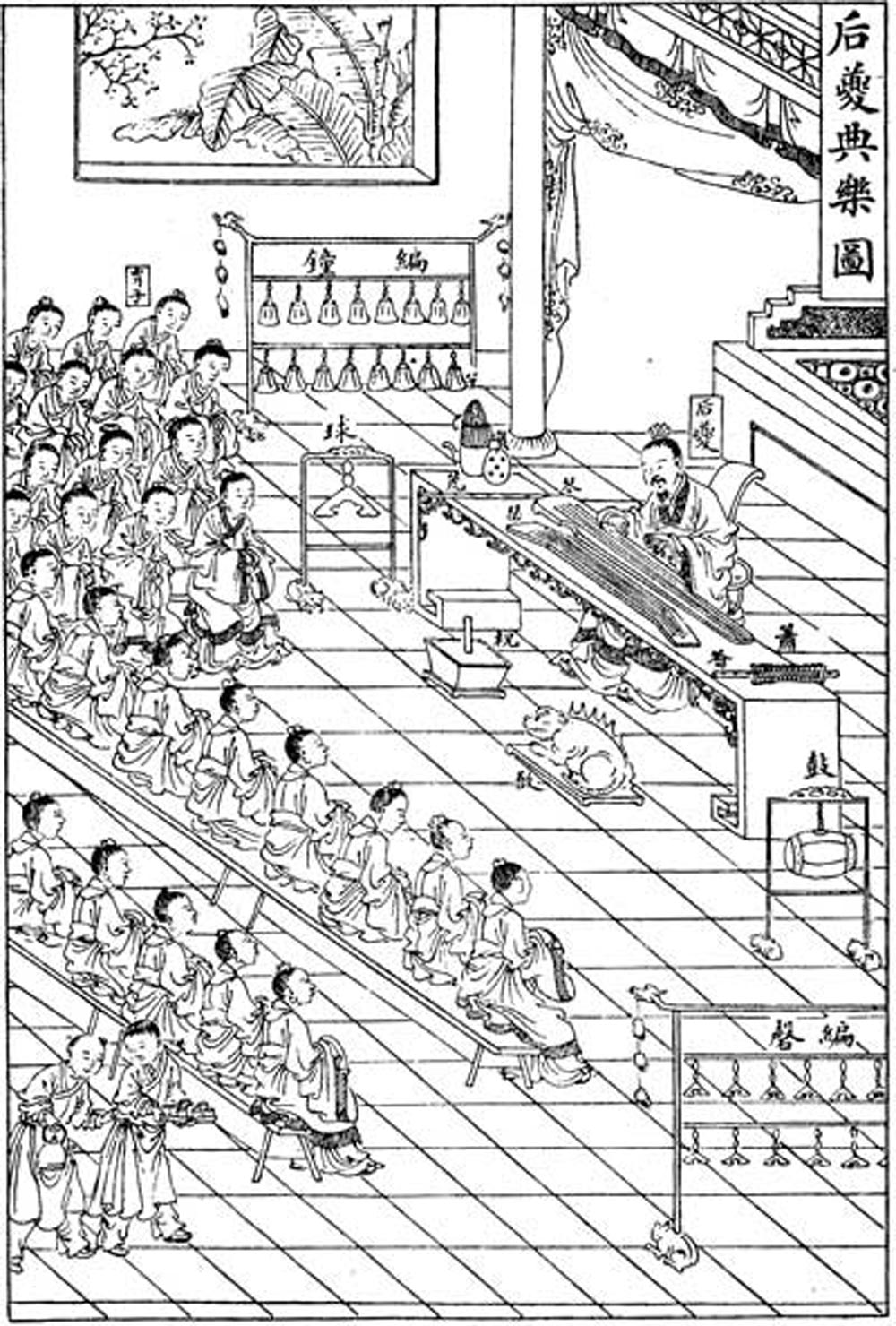
The first illustration, above right, suggests that Confucius played qin as he taught.
The second illustration, below right, purports to show a legendary sage teaching the rules of music using a qin, but here it is used to suggest the possibility that such ideas inspired some later teachers of Confucian learning also to play qin as part of their instructing. Although this has seldom been explored, it does seem possible, if not likely, that if this did occur, melodies with text settings, such as the following, would certainly have been suitable.
| I. Qin Melodies for Confucian Learning (儒學琴曲 Ruxue Qinqu)10 | Teaching with qin: An imaginary Confucian School?) |
- Cry of the Ospreys (關雎 Guan Ju, >1505 ;
listen with lyrics)
First listen to the qin setting in the Book of Songs, then to the >1505 version setting for qin a Confucian interpretation: with wife and husband in harmony so is the world. - (Wen Wang) Thinks of Shun ([文王]思舜 [Wen Wang] Si Shun, >1505;
listen with lyrics)
also called Wen Wang's Melody (文王操 Wen Wang Cao)
The Annals of History (史記 Shi Ji) writes that Confucius learned Wen Wang Cao from 師襄 Shi Xiang (illustration). - Proximate Sage Melody (亞聖操 Yasheng Cao, 1511;
listen with lyrics)
The lyrics of this piece invoke Yan Hui, the favorite student of Confucius. "Yasheng" suggests "second only to Confucius himself", and Yan Hui was one of a few people so named. - Song of Auspicious Clouds (卿雲歌 Qing Yun Ge, 1525;
listen with lyrics)
The lyrics of this melody are said to have been sung by Emperor Shun when he announced that, rather than appointing his own son to succeed him, he was appointing the most worthy person, Yu. Because of this sentiment these lyrics were used in 1913 for the first national anthem of the Republic of China. - Moufu Admonishes his Lord (謀父匡君
Moufu Kuang Jun;
lyrics)
This melody, also called Qizhao Shi (Good Advice Poem, from the Zuo Zhuan; Watson, p.167) concerns 祭公謀父 Duke Moufu of Zhai (on Yellow River north of Zhengzhou, Henan) giving good Confucian advice to an early Zhou king. Each section begins with his lyrics. - 18 Scholars Ascend Yingzhou (十八學士登瀛州 Shiba Xueshi Deng Yingzhou, 1530;
lyrics)
The lyrics concern the role of the Hanlin Academy; a related instrumental melody is "Ying Zhou" - Hymn of Grand Moral Virtue (盛德頌 Sheng De Song, 1530;
listen with lyrics)
The lyrics here quote or paraphrase many Confucian principles - The Great Ming United (大明一統 Da Ming Yi Tong, 1539;
listen with lyrics)
The lyrics and music of this melody form what sounds like an anthem glorifying the Ming dynasty. - Bright Virtue Prelude (明德引 Mingde Yin with
Sacred Confucian Canon (孔聖經 Kongsheng Jing, 1591; listen with lyrics)
Musical setting of The Great Learning and a commentary by Zhu Xi; used for Confucian ceremonies? - Three Talents Intonation (三才引 San Cai Yin, 1676)
This setting, surviving only from Japan, has text from the Doctrine of the Mean, Chapter 26. - Hail Greatness Intonation (大哉引 Da Zai Yin, 1676)
Surviving only from Japan, it sets for qin more text from the Doctrine of the Mean, Chapter 27.II. Poem settings (see also below, Qin songs that use lyrics from the Book of Songs)
- Song of Southern Breezes (南風歌 Nan Feng Ge, 1511;
listen with lyrics)
Lyrics from Yuefu Shiji, by tradition attributed to Emperor Shun, celebrate his rightful place as emperor; see also the Song of Auspicious Clouds, above. - Thinking of Parents (思親操 Si Qin Cao, 1511;
listen with lyrics)
Lyrics from Yuefu Shiji, also by tradition attributed to Emperor Shun (both melodies use only five strings), celebrate his following the cardinal Confucian virtue of honoring his parents. - About to Return Melody (將歸操 Jiang Gui Cao, 1511)
Confucius, on his way to Jin, hears an advisor there has been executed, so he returns home. (Illustration) - Turtle Mountain Melody (龜山操 Guishan Cao, 1511)
Confucius leaves the city and thinks of this mountain because the duke of Lu has accepted a gift of dancing girls from Qi, and is ignoring his official duties. (Illustration) - Deer Call (鹿鳴 Lu Ming, 1618;
listen with lyrics)
A song setting for a Shi Jing banquet melody, sometimes played by court orchestras; a later version for qin is popularly played today, but this is the earliest surviving version - Stray Thoughts (偶成 Ou Cheng, 1676;
listen with lyrics)
Surviving only from Japan, this sets a poem by the Song dynasty neo-Confucian philospher (and teacher) Cheng Hao (who is also connected to Jing Guan Yin).III. Instrumental pieces
- Captured Unicorn (獲麟 Huo Lin, 1425)
A unicorn is captured at Da Ye, near Qufu. This is thought to be a lucky omen, indicating a good prince is at hand, but Confucius reveals that in fact it was unlucky, because no such prince is at hand. (Illustration) - Cranes Cry in Nine Marshpools (鶴鳴九臯 He Ming Jiu Gao, 1425)
The title comes from a poem in the Book of Song - Flourishing Orchid (猗蘭 Yi Lan, 1425)
Confucius, after being rejected at many courts, returns home to Lu. He finds a lovely orchid alone in a field, and compares it with himself. (Illustration) - Song of Southern Breezes (南薰歌 Nanxun Ge, >1505)
Nanfeng Ge, in Kongzi Jiayu,11 says,The breezes coming from the south are mild;
They can solve my people's worries.
The breezes coming from the south are timely;
They can bring abundance to my people's property. - Apricot Tree Forum (杏壇 Xing Tan, 1425)
Gingko Tree Forum? Xing Tan is said to be the place in Qu Fu where Confucius taught his students. (Lyrics Section 10); further illustrations) - Fragrant Orchids (佩蘭 Pei Lan, 1539)
According to Confucius Household Sayings, Confucius said that when you first go into a room you notice whether the smell is good or bad, but after a while you get used to it; so a good person should always find good surroundings. An orchid worn at the belt symbolizes this. (There is also a Chu Ci reference.) - Evening Talk by a Snowy Window (雪窗夜話 Xue Chuang Ye Hua, 1525)
I play the purely instrumental version, which is mostly about snow itself, but the sung version (1539) has a Confucian text; - Secluded Orchid (幽蘭 You Lan, 1525)
Same theme as 猗蘭 Yi Lan, but unrelated melodies (see also next) - Secluded Orchid
(碣石調幽蘭 You Lan, 6th-7th c.)
Earliest surviving qin melody; same theme as #2 Yi Lan, but unrelated melodies (see also previous). - Contemplative Intonation (靜觀吟 Jing Guan Yin, 1579)
Tentatively associated with a Song dynasty Confucian, it suggests, "All things in a contemplative manner attain what they need".
To my knowledge no studies have been done as to whether these melodies have musical characteristics that distinguish them from other melodies (further comment).
Footnotes (Shorthand references are explained on a
separate page)
1.
Confucian qin themes ("Confucian melodies"?)
The melodies here are selected purely on a thematic basis, not on a musical or structural basis (regarding which see
Modality in early Ming qin tablature). Musical and structual considerations include:
- Do these melodies tend to be more pentatonic than other melodies?
Pentatonic music (using 5 notes, usually do re mi sol la) is thought to be more ancient than diatonic/heptatonic music (using 7 notes); did Confucius write about this? Some of the melodies here do include non-pentatonic notes. Did some people consider these to be either mistakes or simply bad?- Do these melodies favor certain tunings?
"Standard tuning" is often considered more traditional. On this basis did anyone criticize the tuning used in a melody such as this setting of the Great Learning?- Do these melodies have unique modal characteristis?
My own observations on mode focus on actual music from tablature: which notes are "most important" (tonal centers, based on their position in the melodies). The melodies here on Confucian themes are assigned to various moders, and a musical analysis does not suggest anything unique about them. Chinese writings on mode tends to focus on more cosmological considerations. Do such considerations allow/require certain modal characteristics for Confucian melodies?- Is the pairing of words and music different from that of other melodies?
Almost all surviving qin tablature tries to pair words and music by a strict method of one character for each right hand stroke, none for left hand slides or other ornaments. It has been said that a strictly Confucian melody would be purely one note per syllable. Only a few short melodies are syllabic like this. What writings attributed to Confucius actually discuss this? - Do these melodies favor certain tunings?
As suggested above, this topic does not yet seem to have been fully resarched. If such unique musical characteristics can be found, then perhaps one can speak more confidently of certain qin melodies being "Confucian melodies" rather than "melodies on Confucian themes".
(Return)
| 2. Images of Confucius | A common motif shows Confucius with qin |
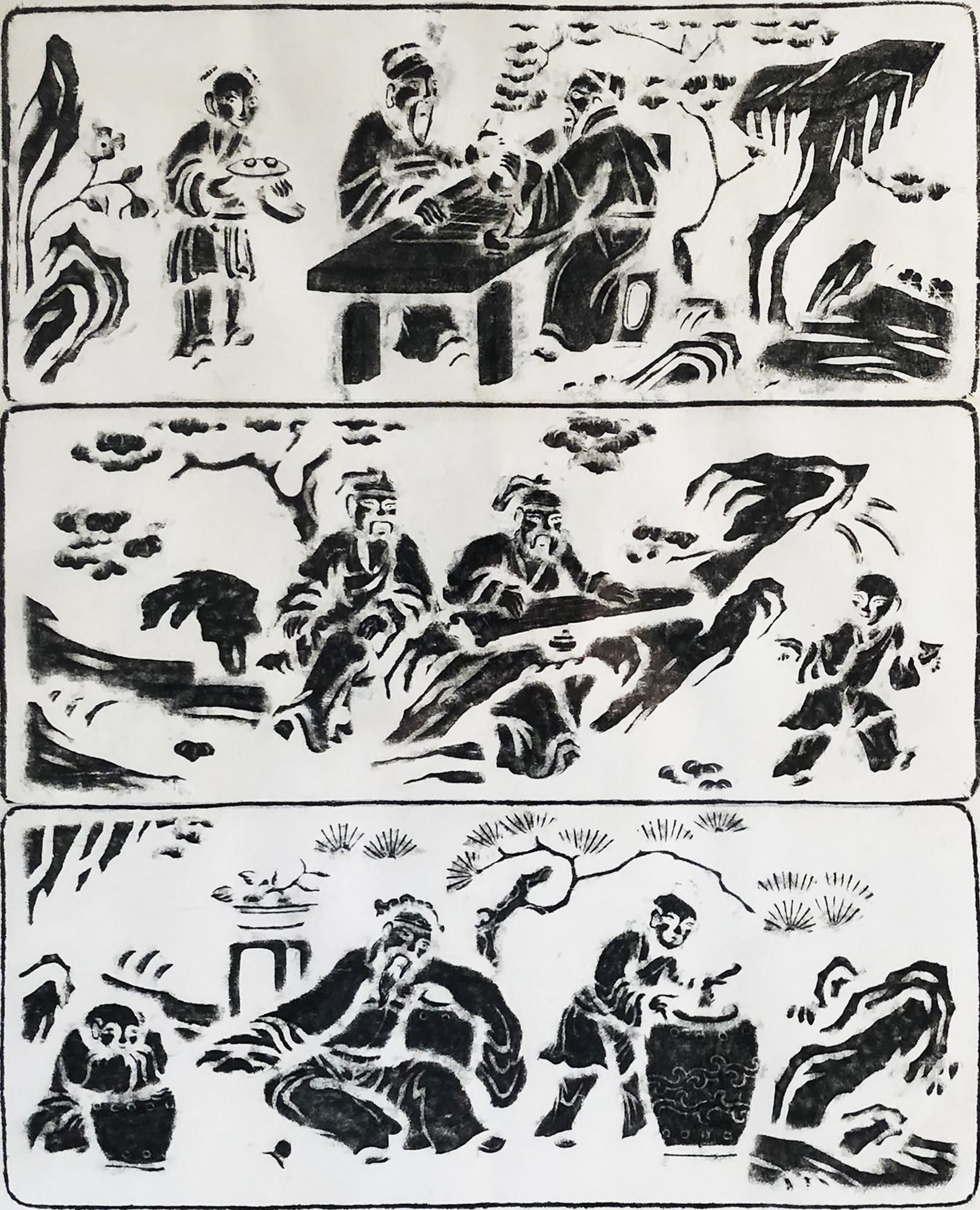 There have been many popular illustrations showing Confucius playing qin. The image at right is a rubbing said to be from an old Chinese temple. The image above, showing Confucius playing qin while teaching student, is by 白雲立 Bai Yunli. For further images of Confucius see also:
Minzi
Xing Tan art
Huo Lin (Captured Unicorn)
Yi Lan (Flourishing Orchid)
(Wen Wang) Si Shun ([Wen Wang] Thinks of Shun)
Jiang Gui Cao (About to Return Melody)
Guishan Cao (Turtle Mountain Melody)
Many such images can be found as woodblock prints in 孔子聖蹟圖 Traces of the Sage Confucius; only the ones above by Bai Yunli are copyrighted here. On the internet there are many other images of Confucius playing the qin.
Another interesting image:
明仇英《人物故事圖冊》之《竹院品古》。(故宮博物院藏)?
(Return)
3.
Confucian ideology and the qin
One summary of this ideology is the following passage connecting qin play with the Confucian attitude of 仁 ren, commonly translated as "benevolence":
孔子和儒家琴論
Confucius and the Confucian qin discourse
Confucius' ideal personality, had "benevolence" at is core; this had a profound impact on way traditional qin music was used by literati to cultivate their moral character, and it endowed qin music with a unique cultural heritage. He advocation of "兼濟天下 helping the world" as a defining characteristic infiltrated the hearts of countless Chinese qin players since ancient times, and turned this into a sense of historical responsibility that says, "As for the rise and fall of the world, everyone is responsible." In ancient China, although a large number of qin players were frustrated and living in seclusion in the mountains, they still took the rise and fall of the world as their own responsibility. They worried about the world and its people, and turned this love for their homeland into passionate qin music. Examples of this include such melodies as "Qu Yuan Asks a Ferryman for Advice" (Qu Yuan Wen Du), "Scratch the Head and Ask Heaven" (Sao Shou Wen Tian), and "Falling into Grief" (Li Sao). There have been many patriotic qin players in history, such as Wang Yuanliang, a qin player in the late Southern Song Dynasty (when it was resisting attacks from the Jin, who controlled north China). He was a famous poet at that time and was enshrined in the inner court for his skill in playing the qin. According to records, Wang Yuanliang twice brought his qin when he visited the anti-Jin general Wen Tianxiang in prison. He played for him the qin melodies Eighteen Beats of the Nomad Flute" and "Detained in Gloom" in 10 Sections (details). At a time of national crisis, Wang Yuanliang thereby showed the high integrity of a scholar and qin player.
The Chinese text here was originally posted January 13, 2011 on 七絃琴 7xian.com. As of 2023 it was on shijiuhuacha.com. Regarding the quotes within this passage,
- "兼濟天下" (jian ji tian xia) is from "窮則獨濟其身,達則兼濟天下。" The origin of this seems to be 孟子盡心章句上9 (Mengzi, Chapter 9a), which has "善 shan" instead of "濟 ji", thus: "窮則獨善其身,達則兼善天下。", translated by Legge (ctext) as "If poor, they attended to their own virtue in solitude; if advanced to dignity, they made the whole kingdom virtuous as well." The translation "helping the world" seems to reflect a more recent understanding of the text, though my understanding of the ideas behind this suggest you can "help the world" by correct thought and following proper rituals, not just by doing good deeds.
- "天下興亡,匹夫有責" is attributed to 顧炎武 Gu Yanwu (1613 – 1682; Wiki).
For Wen Tianxiang see also the setting for qin of his Song of Integrity (Zheng Qi Ge). And his loyalty also seems to have been recorded in lyrics accompanying the qin melody Hymn of Grand Moral Virtue (end of Section 3).
(Return
4.
Surviving melodies with "Kongzi" (Confucius) in the title
The Zha Guide includes only two such titles:
- Kongzi Du Yi (孔子讀易 Confucius Reads the Yi Jing.
- Kongzi Diao Ji Zha (孔子弔季札 Confucius Mourns Ji Zha). To my knowledge this melody has not been studied in modern times.
However, the Guide has at least two further melodies and/or titles that sem to be connected to Kongzi Du Yi. These are:
See the separate entry concerning the relationship between these two and Kongzi Du Yi. These latter two in particular relate stories that have a connection ("孔子讀易 Confucius Read the Yi Jing" so much that the "韋編 Leather Bindings [of his copy] 三絕 wore out three times"). As for all four, the only ones that have been played recently are the ones discussed further in the separate entry. Since they all seem to date from after the Ming dynasty I have not actually studied them carefully myself.
In sum, my tentative conclusion about these is that although the stories of the Wei Bian and Du Yi seem to be similar, some of the Wei Bian melodies are musically unrelated to each other, and seem not all to be musically related to any of the Du Yi melodies. However, this is a preliminary opinion based on examining the tablatures, not actually playing or hearing all the melodies. Further study is needed.
5.
Ancient (lost) melodies with "Kongzi" (Confucius) in the title
There seems to be no existing tablature for any of these early titles.
6.
Late surviving melodies on the theme of Confucius
Looking at this another way, melodies with a Confucian theme that I have not yet tried to reconstruct were mostly published beginning in the Qing dynasty. Some are virtually unknown, such as,
There are certainly others just waiting to be discovered.
7.
Themes
8.
Did Confucius say qin music should be sung?
Qin songs that use lyrics from the Book of Songs (詩經 Shi Jing)
Here it is perhaps significant that these 12 are among the very few surviving pre-modern qin song settings that do not pair the tablature and lyrics using the very word-intensive
traditional pairing method: here there are quite a few extra strokes/notes per syllable. Having more notes per syllable should make it easier to make these song settings interesting. Was it difficult to get published songs that did not follow traditional rules? Was it possible to publish these songs because they had a supposed precedent in the Tang dynasty?
Thus one might argue that there were certainly more settings done of Shi Jing songs, but they were never published - perhaps never could be.
The melodies listed here were all published during the Ming dynasty; no link to the title means my reconstruction has not been finalized. Not included are several further melodies that seem to have originated during the Qing dynasty (next footnote).
9.
Melodies for Confucian academies?
From this it can be seen that devising a program of music for Confucian academies would best be served by involving someone with a broad knowledge of the Chinese educational system during the Imperial period, something I do not have. Most famously, students at traditional Chinese academies were training to pass the civil service exams. However, only a small percentage were successful at this. What happened to the others? And more specifically, were there widely differing curricula at different schools?
Even more specifically, what sorts of academies might involve (whether vaguely or specifically) Daoist and/or Buddhist music?
In sum, although yet I have not uncovered specific evidence for qin melodies being played at such traditional academies, this is certainly a topic worthy of further examination. Perhaps it could even be used to suggest music that might be appropriate for schools today.
(Return)
For these ancient titles a quick search of
these melody lists turned up only,
(Return)
It should be emphasized that the listing of melodies here is not exhaustive; in particular, my personal focus being melodies published during the Ming dynasty, this page does not give much detail about the melodies that seem to have originated during the Qing period.
No details as yet, as I have not examined this tablature. However, the melody, attributed to
Wang Zhongshan, concerns Confucian values (and is attributed to "Judge Dee").
(Return)
These are discussed further below, but see in particular details of an actual program on this, my 2019 program that took place in Hangzhou.
(Return)
As yet I have not found a specific quote from Confucius himself on this matter. Those who make this argument usually point to entries in the Book of Songs that have been or could be used as lyrics for qin songs. These include the following:
These include:
(Return)
Since ancient times there have been teachers and groups fostering Confucian learning. From the Han dynasty onwards there were government academies for this; during the Tang dynasty these were either supplemented with or replaced by private academies. For a basic background on this see, e.g., various Wikipedia articles such as those on Imperial Academies
(太學 Taixue),
Academies 暴匡人
(書院 Shu Yuan) and the Imperial College (國子監 Guozijian).
(Return)
| 10. Qin Melodies for Confucian Learning (儒學琴曲 Ruxue Qinqu) | (Full illustration above; details) |
 Title for my 2019 program in Hangzhou: Playing and singing without stopping (絃歌不輟 Xian Ge Bu Chuo)
As mentioned above, a number of programs could be done on the theme of Confucian learning. The alternate title given here was developed in 2019 for my first such program, detailed below. The program uses qin melodies with appropriate lyrics to evoke an image such as the one at right (full version above), where an audience can read or can have read Confucian texts that are being illustrated through qin music.
絃歌不輟 Xian Ge Bu Chuo is actually a phrase found in the book of Zhuangzi (ctext, with translation by Legge). The passage tells of Confucius playing a string instrument (usually interpreted as a qin) while traveling in Kuang, a district in the Song kingdom (apparently in what is today's Henan province). Suddenly a group of Song ruffians surround him and act in an apparently threatening manner. Nevertheless, Confucius does not stop. (Here the Chinese text says only "不惙", not specifying if this means he doesn't stop traveling or doesn't stop playing.) When asked about this by one of his disciples, Confucius says that he has offered his services to rulers but they have all rejected him. As a result he is now talking to, and/or playing for, anyone who will listen. Eventually the leader of the ruffians apologizes, saying that until they heard him (or heard him play his music) they thought he was someone who was their enemy. They then leave.
| 插圖:孔子聖蹟圖 Illustration from "Traces of the Sage Confucius" | 匡人解圍 Surrounded by Kuang (expand) |
 Illustration #62 from this book (expand from image at right) tells a similar story to that just described from Zhuangzi,
but here Confucius is traveling in his oxcart and not playing music. The text on the illustration says,
Illustration #62 from this book (expand from image at right) tells a similar story to that just described from Zhuangzi,
but here Confucius is traveling in his oxcart and not playing music. The text on the illustration says,
As Confucius was going to Wei....
"絃歌不輟 Xian Ge Bu Chuo" is not specifically mentioned in this illustration, but the above explanation should make it clear that it can apply to a program on the theme of Confucian education, such as what is outlined below.
As a result of such stories the phrase "絃歌不輟 xian ge buchuo" has at times been used to suggest providing music and song for anyone who will listen (so as to educate them and/or raise their spirits): thus 不惙 means he didn't stop playing. This perhaps suggests an interpretation that Confucius would stop in public places and play for anyone who would listen.
This also brings to mind a quote from 論語,衛靈公 Book 15 Duke Ling of Wei in the Analects of Confucius, where it has, 子曰:「有教無類。」 Confucius said, When it comes to education there aren't different categories (of people)"
(ctext). This is generally interpreted as meaning that everyone should be educated. It is thus in contrast to the attitudes one can find in qin literature saying you should not play qin for certain types of people (see, for example,
in this list.)
(Return)
11.
Confucius' Household Sayings (孔子家語 Kongzi Jiayu)
See under Confucius: a collection of stories attributed to Confucius but most probably dating from the Han dynasty. Quoted variously on this site: see especially the
six selections from four books.
(Return)
The program of this title in Hangzhou, 2019, focused on the following melodies (in roughly chronological order):
Appendix
絃歌不輟:2019 中國節目一部分
Playing and Singing without Stopping
a version of
Qin melodies for Confucian learning
| Commemorative seal (see at left; expand) |
 (At right are the four sides of a 紀念姓名章 commemorative seal [the bottom side, with my name, is not shown]. It was given to me the day after the Hangzhou performance outlined below, which took place on 10 November 2019. The seal carver was 叢一 Congyi [meaning "學習要專注 focused on learning"], a nickname of 黎驕 Li Jiao, a qin student of 陸海 Lu Hai.
Warmup melodies honoring a Daoist who was also adviser to an Emperor
- 關雎曲一:
Guan Ju Qu (Melody of Cry of the Ospreys, Section 1 (of 10), 1511)
The lyrics, the first poem in the 詩經 Shi Jing (pdf), are used in this program as a prelude for #2 (next). - 關雎:
Guan Ju (Cry of the Ospreys, >1505)
This long piece is paired with text (pdf) that gives a later Confucian interpretation to the Shi Jing lyrics. - 杏壇:Xing Tan, (Apricot Tree Forum, 1525)
Gingko Tree Forum? Xing Tan is said to be the place in Qu Fu where Confucius taught his students. (Lyrics Section 10 [pdf]; further illustrations) - 卿雲歌:
Qing Yun Ge (Song of Auspicious Clouds, 1525)
Ancient lyrics (pdf) used for the first Chinese national anthem: with good government the country will prosper - 瀛州:
Yingzhou, 1525)
An instrumental melody ccnnected to a story celebrating scholars who advise the government - 十八學士登瀛州:
Shiba Xueshi Deng Yingzhou (Eighteen Scholars Ascend Yingzhou, 1530)
A related melody paired with lyrics (pdf) celebrating scholars featured in the previous melody - 聖德頌: Sheng De Song
(Hymn of Grand Moral Virtue, 1530)
Repeats and/or rephrases various ancient writings on moral virtue, also giving examples (pdf of original text) - 大明一統:Da Ming Yi Tong (Unity of the Great Ming, 1539)
Music and lyrics (pdf) that glorify the Ming, ending with "皇帝萬歲萬萬歲 Long live the emperor" - 鹿鳴: Lu Ming (Deer Calls, 1618)
Poem 161 of the 詩經 Shi Jing, a banquet song (pdf of lyrics) - 文君操:
Wenjun Cao (Song of Wenjun, 1539)
A love song (pdf} also known as A Phoenix Searches for his Mate (鳳求凰 Feng Qiu Wang): it is famously sung by a scholar who falls in love on his way to take the imperial examinations; the lady is presumably impressed by the Confucian path he has chosen as well as by the song he sings.
The complete version of this program includes melodies where the Confucian connection is not so direct, such as the first and last ones listed here.
And for contrast and as time permits, some non-Confucian themed melodies could also be included, such as Zhuangzi's Butterfly Dream
Return to the top