|
T of C
Home |
My Work |
Hand- books |
Qin as Object |
Qin in Art |
Poetry / Song |
Hear, Watch |
Play Qin |
Analysis | History |
Ideo- logy |
Miscel- lanea |
More Info |
Personal | email me search me |
| Xianweng Cao / Tracing chart / Beginning HIP / Tiaoxian Pin / Videos for learning guqin |
Transcription from 1585 /
Videos from 1585 /
 with lyrics
首頁 with lyrics
首頁
|
|
Strum Silk Prelude
- Like Xianweng Cao, invokes the Song dynasty recluse Chen Tuan 2 - Standard tuning (no mode indicated): 5 6 1 2 3 5 6 3 |
操縵引 1
Caoman Yin Caoman Yin (expand) 4 |

The discussion here concerns a melody that was often the first piece a student would learn. It has most commonly been known by any of these three names:
Throughout this period the "Xianweng lyrics have always been related to a version of the melody presented here. However, when I began studying in the 1970s the title "Xianweng Cao" seems to have been applied only to a separate melody that uses similar lyrics and is also chant-like, but its music, though somewhat related, is quite different and seems to be of more recent origin.4
It is particularly the earliest versions of Caoman Yin that had lyrics about Xian Weng attached, and it presumably is for this reason that "Xianweng Cao" came to be used as an alternate title. However, never seems to have been used as the primary title of a melody until it was applied to the Xianweng Cao discussed here on a separate page. Today versions of both melodies are used simply as beginners' melodies, and it is quite likely that both of them originated for this same purpose. The repetition of the same pitches played on open strings then stopped strings (sometimes called xianweng yin5) helps train the ear to correct tuning as well as to play in tune.
In any event, the repetitious and straightforward nature of the melodies and lyrics allow it to serve more advanced players both as a sort of warm up melody and as a way of centering oneself prior to playing: the effect of playing it in a calm manner might be compared to the effect that making ink was intended to have on someone preparing to do calligraphy.6
Earliest versions usually divided in three parts, such as in
1552 and 1585
Originally the first section of Caoman Yin, but in 1589 and later the second and third were usually dropped.
This is the most common name used today; however, it does not seem to have been used officially as a title until the late 20th century.
| 陳摶:仙翁 Chen Tuan, the "Transcendent Venerable One" | Chen Tuan: "Sleeping meditation" |
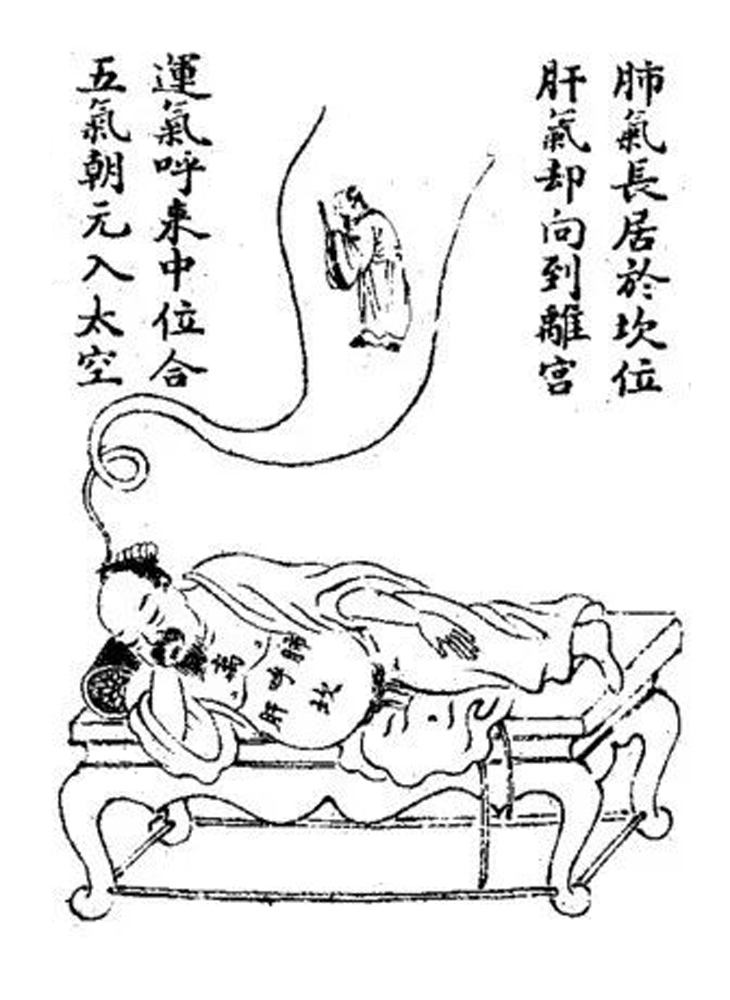 In all cases, "Transcendent Venerable One" refers to the 10th century recluse Chen Tuan: this was one of his nicknames. As outlined in
this footnote, Chen Tuan is thought of primarily as a Daoist, but he has also been connected to the development of neo-Confucianism. Early sources mention his ability to sleep (the image at right comes from one of the manuals of "sleeping meditation" said to have been inspired by this). Later this and other of his reputed meditation practices led to him being associated with a number of "internal arts".
In all cases, "Transcendent Venerable One" refers to the 10th century recluse Chen Tuan: this was one of his nicknames. As outlined in
this footnote, Chen Tuan is thought of primarily as a Daoist, but he has also been connected to the development of neo-Confucianism. Early sources mention his ability to sleep (the image at right comes from one of the manuals of "sleeping meditation" said to have been inspired by this). Later this and other of his reputed meditation practices led to him being associated with a number of "internal arts".
On the other hand, there seem to be no extant stories that tell of him playing the qin, and it is not clear how this melody came to be associated with him. The lyrics clearly are about him, not by him.
There are no lyrics. Because its preface, which does not mention Xianweng, has only the central part of the preface to the 1557 version, and its comments with each of the three sections are briefer than those in 1557, it is the 1557 commentary that is translated here.9
Later versions of Caoman Yin can be found in many early qin handbooks, under various titles.15 In addition, there are a number of essays (often called Tuning Method) that mention Xian Weng;16 they may or may not be related to something called a "Xianweng method".17 As for melody titles, though, the only related use of "Xianweng" I have yet found in the old handbooks so far seems to be "Tiao Xianweng Ge",18 the title of a version of Caoman Yin beginning with Qinxue Lianyao (1739). This version has characteristics of both the original and the present versions.19
These melodies are almost always included with the essays at the beginning of the handbooks, rather than with the regular melodies. Perhaps this indicates they were considered only as meditations (or as introductory exercises).
The preface to the 1557 version suggests that unless one begins with simple melodies, one will never master the qin.20 My own teacher told me that the seemingly most simple pieces were the ones that required the greatest art.21 This still leaves open the question of whether this piece is more meditation or more fingering exercise.
(This section forms the preface to 1552. The meaning of the original version seems quite obscure.)
He then took out from his sleeve the tablature for Adjusting the Strings Prelude (Caoman Yin), in three sections. It was written by Shi Cao of Wei. The Daoist explained it. The Daoist called himself Woodcutter of Jiuhua Mountains.
(I.) Beginning Harmony, The notes are fixed
(Tentative translation24)
(II.) Great Harmony, Master and vassal have virtues in harmony
(Tentative translation25
(III.) Small Harmony, The notes are harmonious
(Tentative translation26)
The video was shot by Tiffany Lau in March 2019; it was then edited by Jim Shum 沈聖德, a teacher at 台北藝術大學.
The lyrics of the version played today are included under Xianweng Cao.
1.
Strum Silk Prelude (操縵引 Caoman Yin)
6/917 操縵,操弄琴弦。
《禮記.學記》﹕ “不學操縵,不能安弦。”
陳澔集說﹕ “操縵,操弄琴瑟之弦也。初學者手與弦未相得,故雖退息時,亦必操弄之不廢,乃能習熟而安於絃也。”
北周 庾信 《〈越國公集〉序》﹕
“若使言乖節目,則曲臺不顧;聲止操縵,則成均無取。”
清 張岱 《陶庵夢憶.絲社》﹕
“《越中》琴客不滿五六人,經年不事操縵,琴安得佳?”
一說,操縵即今之和絃。
清 黃生 《義府》卷上﹕ “《禮記.學記》 ‘不學操縵,不能安絃’注,以‘縵’為琴瑟之絃,非也。《周禮》‘磬師’‘教縵樂’注,謂雜聲之和樂者也。疏云”‘雜弄調和’。按繒無文曰縵,此云雅聲,云雜弄,皆謂無文耳。《學記》之‘操縵’即今之和絃。”
Recorded versions of Xianweng melodies
The present page takes special note of the three versions of this melody that I have transcribed and played: these are also the three earliest surviving versions of this melody, published in the following handbooks.
Called Caoman Yin, this version was written using longhand tablature (wenzipu);7 a typed version of the original (pdf is here together with my transcription. Longhand tablature was generally thought to have been completely replaced by the current shorthand tablature some time in the Tang dynasty. It has a short preface followed by a melody in three sections8:
This version, also called Caoman Yin and without lyrics, has an extended general preface, plus more detailed prefaces for each of the three sections.10 The general preface clearly identifies this as a beginners' melody; it also mentions "xianweng", using it as an honorific for a Daoist encountered in the Jiuhua Mountains.11 Xianweng, as mentioned above, was one of the nicknames for the famous Song dynasty recluse Chen Tuan, and the lyrics of later versions all mention Chen Tuan along with Xianweng. Here, although the writer addresses the Daoist as "xianweng", the Daoist identifies himself as the "Woodcutter of Jiuhua Mountains". The woodcutter plays the melody there transcribed, attributing it to a Warring States period music master named Shi Cao;12 according to tradition, when Shi Cao played the qin immortals would come to listen. Each section also has a statement attributed to this Woodcutter of Jiuhua Mountain. The titles of the three sections are the same as those in 1552 (see above):
Also in the 1573 edition (facs/41), this is the first surviving version with lyrics. It has no overall title, but each of the three sections is titled and has a short commentary.13 The short commentaries do not mention either name, but the lyrics invoke both Xianweng and Chen Tuan in a way that suggests they are the same person.14 Because in 1585 the lyrics are not in the melody section, Zha's Guide does not include them until
1596, where they are listed as three separate melodies. The sections/melodies are named:
Original 1559 Preface
The 1552 general preface, and the commentary with each section, is given
here, in Chinese, along with my transcription. However, since its preface is only the central section of the 1557 General Preface, and its commentary with each section is shorter, the more detailed 1557 prefaces are translated here.22
Moreover, Cao Man is Harmonizing the Strings. Nowadays people esteem small details. As a result some of their string harmonization is not as good as it should be. So when they play a melody, perhaps they get halfway through, and they have to go back to harmonizing the strings; thereupon they cause the rhythm to continue, and the sounds suddenly stop. Then even if it is a piece as beautiful as Guan Ju, they cannot cause the five tones to become elegant and not disorganized. All sorts of strange things (洋洋乎) fill ears.
Melody
The earliest version (1552) has been transcribed but not recorded.27 It uses much the same lyrics as later versions. The second version (1557) has no lyrics. The earliest version recorded is the third,
from 1585. The only other one recorded is from
ca. 1676.
Listen on .
The lyrics there and in other versions include the following names or expressions:
陳摶 Chen Tuan (Proper name of Chen Tuan)
陳希夷 Chen Xiyi (Nickname of Chen Tuan)
得道 de Dao (Achieved the Dao)
的那 dena ("of that", filler syllables with no meaning)
 Watch video dubbed onto a camera shot panning the Rock Garden at Ryoanji Temple, Kyoto
No commentary; lyrics (not sung on video)
are,
得道陳摶仙翁,得道陳摶仙翁,
得道陳摶仙翁,得道陳摶仙翁,
得道仙翁,得道仙翁,
得道仙翁,得道仙翁,
陳希夷得道仙翁,
Footnotes (Shorthand references are explained on a
separate page)
The title could also be translated as Adjust the Strings Prelude. The term Caoman is found it two ancient sources. In a passage in the Book of Rites it seems to mean "adjust the strings"; in other sources it seems to mean simply "play on the silk strings". Both translations suggest that this is an essential beginner's melody.
The definition 操縵,雜弄弦屬也 suggests putting the mixed strings in their proper order. The quote from a passage in the Book of Rites is translated in The Book of Rites (Selections), Shandong Friendship Press, 1999, pp. 144/5, Records of Education, "For music could not very well be learned without learning to adjust and pluck the strings of the musical instruments."
The definition 操縵,操弄琴絃 suggests simply playing the qin strings. Here the commentary begins with the passage from the Book of Rites, but the following quotations also give the alternate meaning. The Ji Shuo of Chen Hao (1261 - 1341, see Giles) was a standard text on the Book of Rites. Yu Xin (513 - 581) was a noted poet; no further information on his Yue Guo Gong Ji. Zhang Dai (1599 - 1684?), nicknamed Tao'an, was a noted writer and qin player. Huang Sheng (also 17th c.) was a writer from 歙縣 She county in Anhui.
(Return)
| 2. Chen Tuan (陳摶 906 [some sources say 871!] - 989) | Two images of Chen Tuan |
 Chen Tuan (42618.1012; also .1013) was style named 圖南 Tunan, self-nicknamed 扶搖子 Fu Yaozi; as mentioned in the lyrics here he was also called 陳希夷 Chen Xiyi, referring to the title Master of the Inaudible and Invisible, bestowed upon him in 984 (希夷先生 Xiyi Xiansheng; 9025.26 希夷 xiyi: 無聲曰希,無色曰夷,為道之本體也。 Xi is what cannot be heard; yi is what cannot be seen. The name thus refers to the basic structure of the Dao. It also suggests longevity, hence 希夷﹕靈芝也 a longevity plant, perhaps a phantasmagoric mushroom. Sources of information on Chen Tuan include Livia Kohn's online Chen Tuan: Discussions and Translations (Three Pines Press) as well as The Life and Teachings of Two Immortals, Volume II: Chen Tuan (SevenStar Communications, 1993; Volume I is Kou Hong, a rather strange romanization of Ge Hong, putting the author's reliability into question). There is a brief note on Chen Tuan in
Wikipedia. And
Feng Menglong wrote a story about him in 喻世明言 Yushi Mingyan (translated, see
Story 14: Chen Xiyi Rejects Four Appointments....; pp.240-251).
Chen Tuan (42618.1012; also .1013) was style named 圖南 Tunan, self-nicknamed 扶搖子 Fu Yaozi; as mentioned in the lyrics here he was also called 陳希夷 Chen Xiyi, referring to the title Master of the Inaudible and Invisible, bestowed upon him in 984 (希夷先生 Xiyi Xiansheng; 9025.26 希夷 xiyi: 無聲曰希,無色曰夷,為道之本體也。 Xi is what cannot be heard; yi is what cannot be seen. The name thus refers to the basic structure of the Dao. It also suggests longevity, hence 希夷﹕靈芝也 a longevity plant, perhaps a phantasmagoric mushroom. Sources of information on Chen Tuan include Livia Kohn's online Chen Tuan: Discussions and Translations (Three Pines Press) as well as The Life and Teachings of Two Immortals, Volume II: Chen Tuan (SevenStar Communications, 1993; Volume I is Kou Hong, a rather strange romanization of Ge Hong, putting the author's reliability into question). There is a brief note on Chen Tuan in
Wikipedia. And
Feng Menglong wrote a story about him in 喻世明言 Yushi Mingyan (translated, see
Story 14: Chen Xiyi Rejects Four Appointments....; pp.240-251).
The upper illustration at right comes from an edition of Chen Tuan's biography in Lie Xian Quan Zhuan. Chen Tuan is said to have been originally from 真源 Zhenyuan (now in eastern Henan province), also the reputed birthplace of Laozi. He may have studied to become an official during the Later Tang dynasty (923-935) but apparently spent much of this time wandering amongst various mountains, finally becoming a recluse at 華山 Hua Shan, a famous mountain range east of modern Xi'an. History records that at least three times, in 956, 976 and 984, he visited the Later Zhou and Song court in Kaifeng. During the 984 visit he was given the title mentioned above, Master of the Inaudible and Invisible. His writings are said to have been influential in the development of Neo-Confucianism, but he is most famously associated with Daoism. A poem attributed to him, Returning to My Retreat, is included in Red Pine (trans.), Poems of the Masters, Port Townsend, Copper Canyon Press, 2003; p.458.
Chen Tuan's reputed ability to sleep was related in various Daoist legends. The bottom image at right, a black statue of Chen Tuan sleeping under a quilt, is connected to this. Such legends were already forming during his lifetime. He was particularly famous for meditation, and so his ability to sleep became related to meditation: other images, such as the one above, come from books said to have preserved his "sleeping gongfu" (睡功 shui gong). There is at least one book in English about these practices (Tom Bisio: Daoist Sleeping Meditation), but the origins of the related techniques are not clear. The image at right of him sleeping (compare uncovered with covered) was taken in a grotto dedicated to Chen Tuan at the Jade Spring Temple (玉泉院 or 玉泉廟) by the north entrance to the Hua Shan park district. This temple also has a stone inscription of the text of Qingjing Jing, illustrations of Chen Tuan flying on a crane and of Mao Nü playing the qin (but not of Chen Tuan playing the qin), and more recently a giant outdoor statue of Chen Tuan sleeping (location uncertain: image).


There is no evidence suggesting Chen Tuan himself played or even wrote about the guqin. Nevertheless, in addition to his seemingly being honored by the lyrics of the melodies variously called Caoman Yin and Xianweng Cao, he has also been associated with at least two other melodies:
Once again, there is no actual evidence connecting Chen Tuan with these or any other guqin melodies.
Chen Tuan and "internal arts" such as Liuhe Bafa (六合八法)
This does not prove that they were not ancient terms or that they do not describe ancient practices, only that the editors presumably did not find the terms used within ancient literati culture.
Popular culture associates Chen Tuan (Chen Xiyi) with "Life Energy Cultivation (氣功 qigong; Wiki), more specifically with a number of internal arts (內功 neigong; again Wiki). Some stories even say he founded an internal Chinese martial arts form called Liuhe Bafa (Six Harmonies Eight Methods), also known as Shui Quan (Water Boxing, see also in Wikipedia). Classical dictionary references do not give sources for either 六合八法 Liu He Ba Fa (1477.168 only 六合 liuhe) or Water Boxing (水拳 Shui Quan 17458.xxx). The connection with Chen Tuan is through a legend of uncertain origin that centuries after Chen's death a 李東風 Li Dongfeng (East-wind Li, Bio/xxx) learned Hua Mountain Taiji Quan (華岳太極拳 Hua-Yue Taijiquan) from now-lost texts Chen had left behind, then wrote down its principles in the form of a 134-line mnemonic formula (訣 jue, often rhymed). Each verse consists of five-characters, and this Liuhe Bafa Five-character Formula (六合八法五字訣 Liuhe Bafa Wuzi Jue, q.v.), with its teachings, are said then to have passed down through 宋元通 Song Yuantong, then various other people, spreading out and forming the basis of the modern 六合八法 Liuhe Bafa martial arts system. None of the early names other than Chen Tuan is in historical dictionaries, and from looking at the original verses and at modern translations, e.g., by
Paul Dillon, with commentary, I have not found out a date or source for the story making the connection to Chen Xiyi, nor have I found any connection to guqin. (Thanks to K. Conor Foxx for advice; he has also done a translation.)
3.
Tuning and mode
4.
操縵引 Caoman Yin to 仙翁操 Xianweng Cao (See also the tracing chart below.)
Althouth there is a clear relationship between the lyrics of the early Caoman Yin and those of the Xianweng Cao transcribed above, and there are also melodic similarities, the differences suggest that this Xianweng Cao did not simply grow out of Caoman Yin. And although a recognizable form of this Xianweng Cao may date back to the 19th century, from my brief examination of all available handbooks I have not been able to find any specific evidence for this.
On the other hand, information from
Tong Kin-Woon suggests this Xianweng Cao may have originated as a Meian School melody (although it is not in Meian Qinpu). According to Dr. Tong, he learned this Xianweng Cao in 1969 from the Meian School master 吳宗漢 Wu Zonghan (1902—1991), originally a student of 徐立蓀 Xu Lisun (徐卓 Xu Zhuo). At the time Wu was teaching qin at the National Academy of Arts (then called 國立臺灣藝術專科學校 Guoli Taiwan Yishu Zhuanke Xuexiao) in 板橋區 Banqiao district, just south of Taipei. Dr. Tong says at the time Sun Yü-Ch'in was not teaching qin and few people knew he played. After Tong met Sun he introduced Sun to Wu and they became friends. Thus, when Wu left for Los Angeles in 1972 Sun took over the teaching position in Banqiao. Tong then began studying with Sun, but Tong believes that at this time he must have introduced Wu's Xianweng Cao to Sun, to use as a beginners' melody. Tong does not know about the history of the piece before this, and only more recently played a version of the Caoman Yin that many people today are calling Xianweng Cao.
Some earlier handbooks seem to have similar explanations but without using the words xian and weng (e.g., see 1596#1).
Nevertheless, this "xianweng" technique is perhaps one of the reasons why "仙翁操 Xian Weng Cao" is the popular title for the beginners' melodies that came in several forms but all
(as with my video) feature so many passages pairing the same note played on an open string and a stopped string, as well as two harmonics playing the same note on two separate strings. At one time these melodies were more commonly referred to by
other names. However, the surviving lyrics have almost always mentioned Chen Tuan by name. Thus the source of the connection between the melodies and either Chen Tuan or the xian weng technique remains a mystery.
6.
Centering through repetition
Regarding "prior to playing", it might be noted that old handbooks always placed the tablature for Caoman Yin among introductory essays, not together with the other melodies.
The modern shorthand tablature, outlined here, is said to have developed from longhand tablature during the Tang dynasty. As yet there do not seem to be any studies into whether these longhand examples from the Ming dynasty are evidence of antiquity, or evidence of attempts to forge antiquity. The only authenticated surviving melody using longhand tablature is Jieshidiao You Lan.
Although this use of longhand tablature may suggest great antiquity for this melody, it could also simply be a modern imitation of that style of writing down melodies, perhaps for pedagogical purposes.
8.
The section titles with the 1552 version are 初和 Chu He; 大和 Da He; 小和 Xiao He. The commentary is as follows:
9.
Although the 1557 handbook seems to have been published later, there is no clear indication proving that the text of the 1552 preface is older.
10.
See translation above. The titles are the same as those of the 1552 version, but each section also has a subtitle.
11.
Woodcutter of Jiuhua Mountains 九華山樵
12.
衛人師曹 9129.xxx. Shi Cao's qin biography, 琴史琴補 Qin Shi Bu #16 says he was a music master in the court of Duke Ling of Wei. It does not mention Xianweng Cao, but says that whenever Shi Cao played many immortals would gather. Shi Cao is also mentioned in some of the later prefaces to Caoman Yin.
13. The section titles and commentary with the 1585 version are as follows:
14.
The lyrics are mostly as follows:
However, the second section of this handbook also inserts the lyrics of a song beginning "Summer goes, winter comes, spring turns to autumn....". These lyrics also accompany one section of the qin melody Xing Tan (#34 of Xilutang Qintong, 1525).
15.
Tracing 操縵引 Caoman Yin (and 仙翁操 Xianweng Cao; also see chart)
Because of the incomplete nature of his listings of these, making the chart below required looking through the introducturoy essays to find them; often not included in the Table of Contents may make them relatively easy to miss
By looking directly at the handbooks for the various versions and titles I have found 17 entries up to 1802. More details will be added once I have examined the 30-volume edition of Qinqu Jicheng published in 2011; the pagination used here follows that edition.
The version I learned of
16. Tuning Method (調絃法 Tiaoxian Fa): tuning essays that mention 仙翁(音) Xian Weng (Yin)
Most likely these are also in other handbooks as well; e.g., see also next footnote.
17.
Xianweng method (仙翁法 Xianweng Fa)
18.
Play Xianweng's Song (調仙翁歌 Tiao Xianweng Ge)
I have not yet examined these Tiao Xianweng Ge well enough to know if any of them forms a link between the older Caoman Yin and the Xianweng Cao melody that I learned from Sun Yü-ch'in.
19.
Published versions of 仙翁操 Xianweng Cao
Sun Yü-ch'in did not sing the lyrics when he taught Xianweng Cao, but I remember seeing them at that time. He did give me some tablature, but always said we should copy him, not look at tablature. The tablature of Xianweng Cao I have from Taiwan has number notation underneath but no lyrics. It is very similar to the version in Yinyinshi Qinpu, but it has no lyrics. For my own transcription into staff notation I added the lyrics from memory, then later checked it with the version in Yinyinshi Qinpu.
20.
The preface in this 1557 version says this as follows.
21.
He actually said this in connection with the melody
Xiang Fei Yuan, played today very much as it is written in Taigu Yiyin (1511). Taigu Yiyin has many simple songs. At that time there was apparently debate about singing style vs. purely instrumental style, but I haven't found specific details about this. One can imagine that the debate involved the relative value of a simple style vs. a complex one, but again I have not found the details.
Xianweng Cao, one to two minutes long, begins and ends on the same two notes. This naturally allows one to play the melody over and over. Such repetition can be settling. It also allows the player to focus on the subtle tones that can be produced by a silk string qin when played well. This is the essence of qin play.
This technique for settling down before playing is also in some ways comparable to the old custom of Chinese calligraphers rubbing their own ink. To do this they add water to the inkstone, then rub with another stone. To get in the right mood they might at times spend a considerably longer time than necessary doing this before beginning to write.
The repetitions of the modern Xianweng Cao seem more orderly than those of the old versions of Caoman Yin, making this meditative approach easier.
22.
杏莊太音補遺操縵引 Cao Man Yin of Xingzhuang Taiyin Buyi (1557, III/311)
23.
Original General Preface of 1557 (III/)
然操縵即和絃也。今人往視為小節。故有和絃未竟,而即鼓曲者,或曲方半,而復和絃者,遂使節奏方承,而音響遽輟。是以雖美如「關雎」,亦不能使五聲成文不亂。詳(1552: 洋洋)乎其盈耳也。
乃袖出操縵音三段。衛人師曹作。道人釋。道人號九華山樵。
24.
(I.) 初和,宮商定位 (Beginning Harmony; the notes are fixed)
25.
(II.) 大和,君臣合德 (Great Harmony, Master and vassal have virtues in harmony)
26.
(III.) 小和,律呂和平 (Small Harmony, The notes are harmonious)
27.
Cao Man Yin from 1552
Unless otherwise indicated, all are grouped with essays, not with melodies
The above chart probably has some omissions, but as far as I can tell none of the handbooks in Qinqu Jicheng called the melody Xianweng Cao or had a version more closely related to the version I originally learned than to the old Caoman Yin. For more on this see also Published versions of Xianweng Cao.
心意本無法,包羅小天地,要學心意功,無象亦無意,視不能如能,乘勢擊與顧,步步占先機,剛柔互參就,虛靈含有物,原來自我始,
The sound of Chen Tuan's sleeping was sometimes said to be a "Huaxu melody", and a qin melody of this name is included amongst the "most ancient" pieces in the Shen Qi Mi Pu (1425 CE; I/118), but as yet there seems to be no information to show how Chen Tuan became connected it.
This song in eight sections survives only in Taiyin Xisheng (1625; IX/174). The preface there says Chen Tuan composed it out of grief that there were no sages for their society in decline. The lyrics begin: 物之生於天地兮,何曾有盡藏。鱗之瑞兮,吾知其龍章....
Chen Tuan's connection here may be through his commentary on the 易經 Yi Jing. In fact, there is a lot of information on the internet about what might be generally referred to as "internal arts", but there is little historical detail. ZWDCD and HYDCD usually try to give the most ancient references to any terms they define, but here they have none:
(Return)
1=do, 2=re, etc.; in my transcription do is written as c, but the exact pitch depends on such things as the size and quality of the instrument and strings.
(Return)
Comparing these two is somewhat complicated by the fact that recently there has been a tendency to refer to modern descendants of Caoman Yin as Xianweng Cao. In general I refer to these two as I originally learned them, as can be distinguished by looking at my online transcriptions:
(Return)
5. Xianweng Sound (仙翁音 Xianweng Yin)
Example from 琴適 Qin Shi, 1611
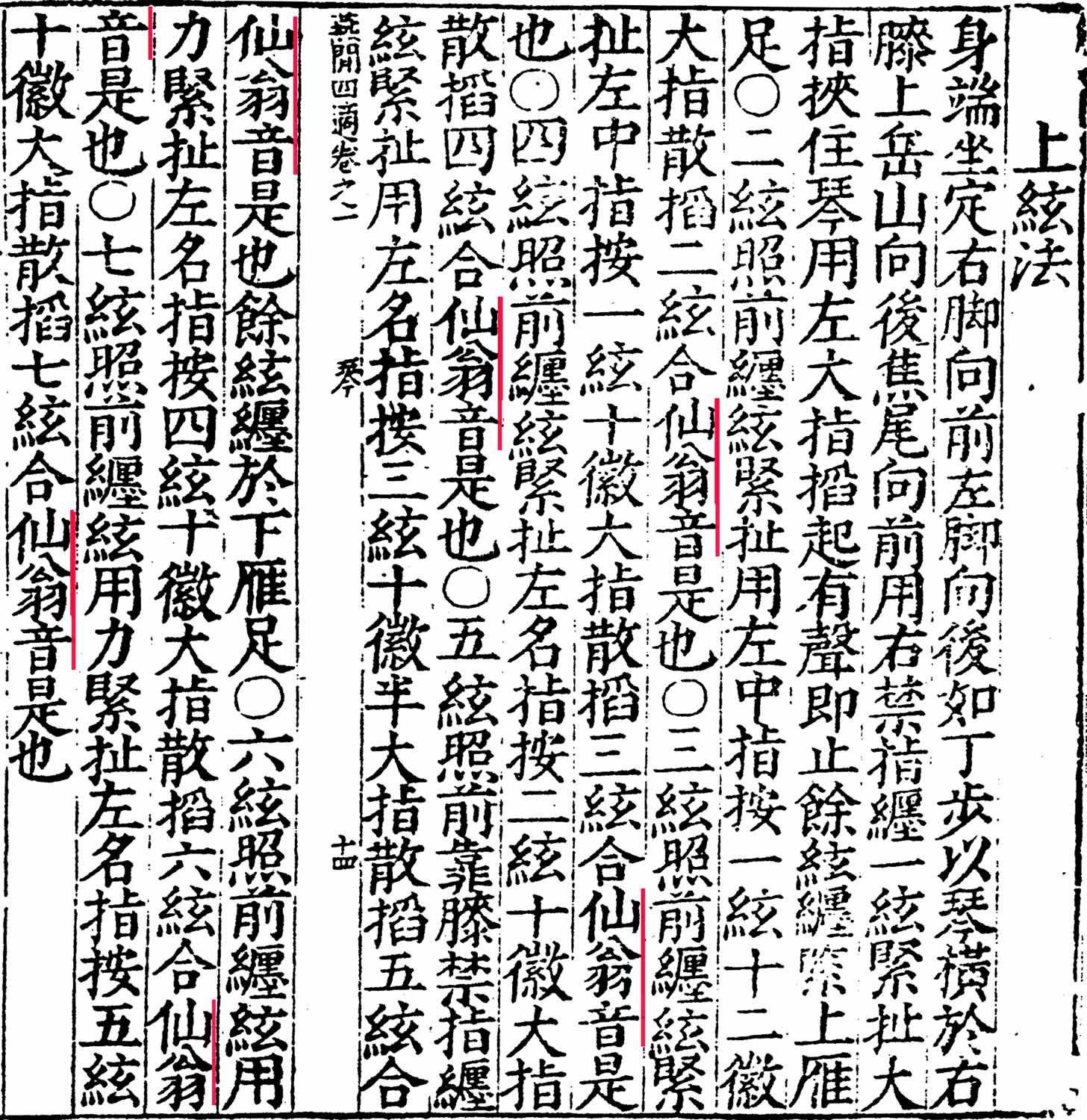 The earliest example I have so far found of the use of this term is in two connected sections of 琴適 Qin Shi (1611) called 上絃法 Shang Xian Fa (at right; expand) and 調絃法 Tiao Xian Fa (see here; more in this list). The first gives tablature for playing a series of two notes in which the first of each is an open string ("xian"?) and the second is a stopped string with the same pitch
("weng"?); together these are called "仙翁音 Xianweng Yin". The second section, 調絃法 Tiao Xian Fa, explains how to do this tuning by tightening and loosening strings, adding that plucking the open string with the right hand creates sound "仙 xian" then playing the unison on a stopped lower string creates the sound "翁 weng". (See also the further discussion here.)
The earliest example I have so far found of the use of this term is in two connected sections of 琴適 Qin Shi (1611) called 上絃法 Shang Xian Fa (at right; expand) and 調絃法 Tiao Xian Fa (see here; more in this list). The first gives tablature for playing a series of two notes in which the first of each is an open string ("xian"?) and the second is a stopped string with the same pitch
("weng"?); together these are called "仙翁音 Xianweng Yin". The second section, 調絃法 Tiao Xian Fa, explains how to do this tuning by tightening and loosening strings, adding that plucking the open string with the right hand creates sound "仙 xian" then playing the unison on a stopped lower string creates the sound "翁 weng". (See also the further discussion here.)
(Return)
The technique of playing a simple melody (or even a simple note pattern) repeatedly in order to settle down or center oneself before playing might be considered as an aid to meditation: do it until the mind is empty while playing. This is in some ways comparable to the old custom of Chinese calligraphers rubbing their own ink. To do this they add water to the inkstone, then rub with another stone. To get in the right mood they might at times spend a considerably longer time than necessary doing this before beginning to write.
(Return)
7.
Longhand tablature for Caoman Yin
typed text with transcription
 Longhand tablature for Cao Man Yin is included in at least six handbooks, as follows (see chart):
(Return)
(Return)
(Return)
(Return)
173.469 identifies 九華 Jiuhua as the name of mountains in Anhui and near the coast in Fujian. The more famous of these is the 九華山 Jiuhua Mountains west of Huangshan in Anhui province. I have found nothing to link this name or these places with Chen Tuan, who is instead associated with 華山 Hua Shan (31910.7/6 makes no mention of the number 9).
(Return)
(Return)
西峰曰,其法今只知云和琴而是不知法則也。子法定音和畢再從容於七絃從順鼓撫聲音次第輪環發揮自然入妙喜音者聽吾和聲美亦無窮矣。
法從七徽起(?走+尺)順輪鼓撫下九徽亦接順撫又下十十二次第依法和弄是也。
No commentary at the beginning, but the end suggests that one should use the above to fix the mind and calm the spirit:
已前隨應循環調撫音定心靜神清而起意。
(Return)
得道陳摶仙翁 De Dao Chen Tuan Xianweng (Chen Tuan ….)
陳摶仙翁 Chen Tuan Xianweng
(Return)
Zha Fuxi's Index is very much incomplete on these introductory/warmup melodies, presumably because they are almost always included in the introductory sections of handbooks, not with the listed melodies. His entries are as follows:
(Return)
See also above. This is a not-uncommon type of essay in early qin handbooks. I have not yet studied them carefully, but a number of them include instructions together with the name Ancient Immortal ("仙翁 Xianweng"), the term 仙翁音 Xianweng yin (Xianweng sound; see further), or the words "仙 xian" and "翁 weng" separately
(also see further). Examples include:
1.
琴適
(1611; VIII/14)Introduces the 仙翁音 Xianweng Sound: sections called 上絃法 Shang Xian Fa and 調絃法 Tiao Xian Fa explain tuning using the words 仙 xian and 翁 weng both separately and together. This is not in 1597 and neither handbook has the tuning melody.
2.
五知齋琴譜
(1722; XIV/392)調絃法 Tiaoxian Fa: does not seem to be an actual melody (compare 1802, 1864, etc.):
Commentary is mixed with longhand tablature, with "仙翁 Xianweng" at the end of many phrases
3.
自遠堂琴譜
(1802; XVII/296)From the third last line of p. 296 through p. 298 there is what seems to be an untitled longhand tuning exercise or test using the words 仙 xian and 翁
weng; from last line of top half of p.297 compare 1722
4.
琴學尊聞
(1864; XXIV/219)Untitled essay on tuning, beginning p. 218, mentions 仙 xian and 翁 weng
compare 17225.
琴學入門
(1864; XXIV/283)The essay 調和絃法 Tiaohe Xian Fa mentions 仙 xian and 翁 weng
See previous
6.
琴瑟合譜
(1870; XXVI/142)調絃法 Tiaoxian Fa is like earlier essays mentioning 仙 xian and 翁 weng (also in 琴府 Qin Fu)
See previous
7.
琴學初津
(1894; XXVIII/240)調絃歌 Tiaoxian Ge
Compare previous
(Return)
See, e.g., in Meian Qinpu (XXIX/196) and compare with Xianweng sound.
(Return)
See Qinxue Lianyao, Folio I, p.23 (XVIII/85; see 1739 below). The piece begins like the end of the version of Xianweng Cao that I learned, then has some phrases from the earlier versions.
(Return)
There are two versions of Xianweng Cao in 愔愔室琴譜 Yinyinshi Qinpu (2000), the handbook of 蔡德允 Tsar Teh-yun (Cai Deyun); neither version has any commentary.
(Return)
(Return)
(Return)
The melody of the 1557 Taiyin Buyi, like its commentary, is somewhat more elaborate than that of the 1552 Taiyin Chuanxi. The 1552 handbook is attributed to 李仁
Li Ren, who called himself Friend of Mounatins (友山 You Shan). Li is said to have brought melodies with him from Beijing to Nanjing. Taiyin Chuanxi has a close relationship with Xingzhuang Taiyin Buyi, compiled by 蕭鸞 Xiao Luan, who was from Henan.
(Return)
The original 1557 preface, translated above was undivided; here it is divided into three paragraphs. The 1552 preface consists of only the middle paragraph (minus the first character, 然). The original Chinese from 1557 is as follows:
(Return)
The original Chinese is as follows:
(Return)
The original Chinese is as follows:
(Return)
The original Chinese is as follows:
(Return)
THe 1552 melody can be described as follows:
(Return)
Return to top; go to Learning to play qin
or the Guqin ToC.
Appendix 1
Chart tracing 操縵引 Caoman Yin (and 仙翁操 Xianweng Cao)
(see comment as well as
Tuning Method (調絃法 Tiaoxian Fa): essays that mention Xian Weng)
琴譜
(year; QQJC Vol/page)
Further information
(QQJC = 琴曲集成
Qinqu Jicheng; QF = 琴府
Qin Fu)
__. 西麓堂琴統
(1525;
III/62)調絃品 Tiaoxian Pin; no connection to Tiaoxian Runong: related only to 1539; 2 sections; no commentary
no lyrics, no mention of Xianweng; title occurs only here; 1st piece; mode not mentioned
__. 風宣玄品
(1539;
II/83)一撒金 Yi Sa Jin; related only to 1525; 2 sections; no commentary
lyrics have no mention of Xianweng; title occurs only here; 7th piece; grouped with gong mode melodies
1. 太音傳習
(1552;
IV/5)操縵引: 初和, 大和, 小和; Caoman Yin, in three parts: Chu He, Da He (in harmonics) and Xiao He; earliest in 文字譜 longhand tablature
short preface does not mention Xianweng; related to next, but simpler; no lyrics; original /
transcription
2. 太音補遺
(1557;
III/311)操縵引: 初和, 大和, 小和; Caoman Yin, in same three parts, but longer; no lyrics; long preface mentions Xianweng and says the piece is by(衛)師曹公 Shi Cao of Wei: his bio says whenever he played immortals would come. Musically related to the other Caoman Yin.
. 新刊正文對音捷要
(1573; at front) not indexed; see next
3. 重修真傳琴譜
(1585;
IV/303)調絃入弄, 泛音調弄, 五徽調弄 Tiaoxian Runong, Fanyin Tiaonong (harmonics), Wuhui Tiaonong (no overall title; no connection to
1525); commentary before and after; lyrics all begin and repeat "得道仙翁....得道陳摶仙翁 (Transcendent immortal Chen Tuan who attained the Dao)", but adds a song
(lyrics) at the end of #2
(transcription)
4a.
真傳正宗琴譜
(1589;
VII/58)調絃入弄 Tiaoxian Runong with lyrics
4b. 真傳正宗琴譜
(1609; Facs.)Presumably identical to 1589
5a. 文會堂琴譜
(1596;
VI/175)Longhand 操縵引: 初和, 大和, 小和 as in 1552;
Followed by a 調絃 Tiao Xian with instructions on tuning by loosening and tightening strings to play unisons
5b. 文會堂琴譜
(1596;
VI/191)Titles, lyrics and tablature identical to 1585 but no commentary;
first three pieces in tablature section
6. 陽春堂琴經
(~1610;
VII/252)Caoman Yin, with Chu He, Da He and Xiao He; similar to 1552, again written using longhand tablature; no lyrics; commentary doesn't mention Xianweng
7. 陽春堂琴譜
(1611#1;
VII/351)Caoman Yin, with Chu He, Da He and Xiao He;
Same as 1589
. 琴適
(1611#2;
VIII/14)Introduces the Xianweng Sound, with sections called 上絃法 Shang Xian Fa and 調絃法 Tiao Xian Fa (see further). Not in
1597 and neither handbook has the tuning melody.
8. 理性元雅
(1618;
VIII/178)調五絃手以五二為主;調七絃手法以七四為主;調九絃手法以九六為主
3 pieces with Xianweng lyrics set for 5, 7 and 9 string qins, each a simple version of the melody
9. 古音正宗
(1634; IX/255)調絃入弄 Tiaoxian Runong: lyrics; earliest version in one section, but similar to first sections above, adding a short harmonic coda which has the first mention of 陳希夷 Chen Xiyi; no commentary; some modern recordings called Xianweng Cao seem quite similar to this.
10. 琴學心聲諧譜
(1664;
XII/49)調絃入弄 Tiao Xian Ru Nong (Xianweng lyrics)
11. 琴苑新傳全編
(1670;
XI/300)操縵引 Caoman Yin, as 1552: longhand tablature; no lyrics;
same as 1609?
12. 和文注音琴譜
(<1676; XII/167)調絃入弄 Tiaoxian Runong; adds pronunciation
Japan; above and also next
13a. 東皋琴譜
(1709;
XII/248)調絃入弄 Tiaoxian Runong
Japan; same as previous; see previous
13b. 東皋琴譜
(1772?;
XII/283)操縵引 Caoman Yin; compare previous
Japan; no lyrics; Zha Guide mentions it, saying "按即仙翁操或調絃入弄"
14a. 一峰園琴譜
(1709; XIII/494)古調絃法 Gu Diao Xianfa, one section + coda; Xianweng lyrics)
Introduction ("定絃法"); lyrics
14b. 一峰園琴譜
(1709; XIII/497)調絃散音 Tiaoxian Sanyin in two sections: 實音 Shiyin (stopped sounds) and 泛音 Fanyin (harmonics)
Introduction ("定絃法"); lyrics
15. 琴學正聲
(1715; XIV/35)初和 Chuhe, 大和 Dahe, 小和 Xiaohe; music like 1552; also no lyrics; intro somewhat different -- doesn't mention Xianweng, but attributes piece to Shi Cao of Wei.
16. 琴學練要
(1739; XVIII/85)調仙翁歌 Tiao Xianweng Ge; lyrics; one section; beginning is like the end of the modern version, then it uses some of the older phrases (facsimile edition is 治心齋琴譜)
17. 穎陽琴譜
(1751; XVI/48)操縵引 Caoman Yin; see 1670 above -- also uses longhand tablature; no lyrics; commentary, but doesn't mention Xianweng
18. 酣古齋琴譜
(n.d.; XVIII/436)調絃入弄 Tiaoxian Runong; 泛音調弄 Fanyin Tiaonong; lyrics
Placed at end of handbook!
19. 太和正音琴譜
(n.d.; XIX/9)調絃 Tiao xian; begins with longhand tablature (explanation?),
then (p.10) has melody in three sections similar to earlier versions (no lyrics)
20. 虞山李氏琴譜
(n.d.; XX/26)調絃入弄 Tiaoxian Runong; lyrics
Short melody (compare 1634 versions)
21. 琴學軔端
(1828; XX/391)調仙翁指南 Tiao Xianweng Zhinan
One section, no lyrics; reprint is difficult to read
22. 二香琴譜
(1833; XXIII/88)調絃入弄 Tiao Xian Runong
One section, no lyrics or commentary
23. 梅花仙館琴譜
(n.d.; XXII/9)調絃入弄 Tiaoxian Runong; short melody; no lyrics
XXII/22 has a second version, slightly different
24. 一經盧琴學
(1845; XXII/60)調絃法 Tiaoxian Fa; one section, no lyrics
25. 琴譜正律
(n.d.; XXIII/45)調絃入弄 Tiaoxian Runong
3 sections; lyrics; credits Yang Xifeng (Yang Biaozheng, compiler of Chongxiu Zhenchuan Qinpu; 1585); almost same as that version (q.v.)
26. 師白山房琴譜
(n.d.; XXIV/8)合絃仙翁調 Hexian Xianweng Diao and 仙翁泛音 Xianweng Fanyin (harmonics)
Similar to various Caoman Yin, but see last line of first piece
27. 青箱齋琴譜
(n.d.; XXIV/366-7)和絃 He Xian (lyrcs only on last phrase) and 泛音調弄 Fanyin Tiaonong (lyrics throughout)
調絃入弄 Tiaoxian Runong and 五徽調弄 Wuhui Tiaonong (only two: harmonic section seems tucked into #1; lyrics)
28. 枕經葄史山房雜抄
(n.d.; XXVII/83)調絃入弄 Tiaoxian Runong; 3 sections; lyrics; credits Yang Xifeng (Yang Biaozheng, compiler of Chongxiu Zhenchuan Qinpu; see 1585); also credits 諸城王冷泉 Wang Lengquan of Zhucheng (p. 82 has a related 和絃歌 Hexian Ge with gongche pu but no lyrics)
29. 雙琴書屋琴譜集成
(1884; XXVII/276)調絃入弄 Tiaoxian Runong; one section; first piece; attribution to Yang Biaozheng, compiler of Chongxiu Zhenchuan Qinpu (1585), but it has an elaborated version of the first section in that handbook (q.v.)
30. 琴學初津
(1894; XXVIII/241)和絃仙翁指法 Hexian Xianweng Zhifa, 泛和法 Fan He Fa and 演指仙翁吟 Yanzhi Xianweng Yin
The latter in particular, though still related to Caoman Yin, has more content; Xianweng lyrics; afterword
31. 琴學管見
(1930; XXIX/253)調絃入弄 Tiaoxian Runong; lyrics; one section; harmonic coda
Followed by the similar 得道歌 De Dao Ge
32. 愔愔室琴譜
(2000; pp. 10-11)Yinyinshi Qinpu has two melodies called 仙翁操 Xianweng Cao (lyrics but no commentary);
The first is related to this Xianweng Cao, the other to this Caoman Yin
33. ???
???This entry is being reserved for the as yet unlocated source of the version of Xianweng Cao that I originally learned. It is only vaguely connected (mainly through lyrics) to the Caoman Yin above. Existing modern copies that I have seen are arranged in one section, but could be considered as two. It is not in Meian Qinpu so is presumably not Meian school.
return to top
Appendix 2: Liuhe Bafa
Five-character Formula (六合八法五字訣 Liuhe Bafa Wuzi Jue)
兩腿似弓彎,彷彿臨大敵,形動如浴水,有法是虛無,釋家為圓覺,先從八法起,收放勿露形,生疏莫臨敵,剛在他力前,時時要留意,
調息坎離交,窈窈溟溟趣,雙單可分明,伸縮腰著力,目光如流電,若履雲霧霽,虛無得自然,道家說無為,養我浩然氣,鬆緊要自主,
動時把得固,柔乘他力後,蓄力如弓圓,上下中和氣,忽隱又忽現,陰陽見虛實,臂脊須圓抱,精神顧四隅,飄飄乎欲仙,無法不容恕,
有象求無象,遍身皆彈力,策應宜守默,一發未深入,彼忙我靜待,發勁似箭直,守默如卧禪,息息任自然,虛引敵落空,內外混元氣,
前四後佔六,浩浩乎清虛,放之彌六合,不期自然至,見首不見尾,不偏亦不倚,審機得其勢,攻守任君鬥,悟透陰陽理,動似蟄龍起,
避免敵重力,欲收放更急,息念要集神,掌握三與七,意動似懼虎,氣靜如處子,顯隱無與有,道理極微細,元根築基法,世間無難事,
神意要集中,欲緊未著力,見形尋破綻,處處無乘隙,法術二而一,形似游龍戲,舒筋活血脈,水火得相見,奇正得相生,犯者敵即仆,
凝神尋真諦,欲動似非動,蘊藏皆珠玉,欲學果有誠,推動轉輪器,運使求均衡,絲毫不相讓,呼吸細綿綿,缺一不能立,縱橫與起伏,
榮衛得適宜,精研內外功,動靜隨心欲,五總九節力,妙法有和合,靜中還有意,說難亦非難,久恒與智慧,一觸力即發,螺旋循環氣,
腕肘肩胯膝,升降緩而急,兩手輕輕起,陰陽運行數,一吸氣便提,心虛腹要實,麤成五字訣,欲學持有恒,離塵空虛寂,息念氣自平,
看易本非易,華嶽希夷門,使敵難迴避,逢敵莫惶張,足踏手脚齊,得法可應變,曲伸無斷續,意動氣相隨,氣氣可歸臍,率然取其勢,
後學莫輕視,升堂可入室,拳拳得服膺,默默守太虛,有志事竟成,力行最為貴,欲鬆似非鬆,開闔收與放,節節力貫串,有術方為奇,
轉移有曲折,關節含蓄力,一提氣便咽,首尾不相離。
(奇正得相生,動靜隨心欲,粗成五字訣,後學莫輕視。)
