|
T of C
Home |
My Work |
Hand- books |
Qin as Object |
Qin in Art |
Poetry / Song |
Hear, Watch |
Play Qin |
Analysis | History |
Ideo- logy |
Miscel- lanea |
More Info |
Personal | email me search me |
| TGYY ToC / #s 13/14/15 also concern Confucius / Confucian theme |
Listen with transcription 聽錄音 below or on
 /
首頁 /
首頁
|
|
16. Proximate Sage Melody
- Standard tuning:2 5 6 1 2 3 5 6 played as 1 2 4 5 6 1 2 |
亞聖操
1
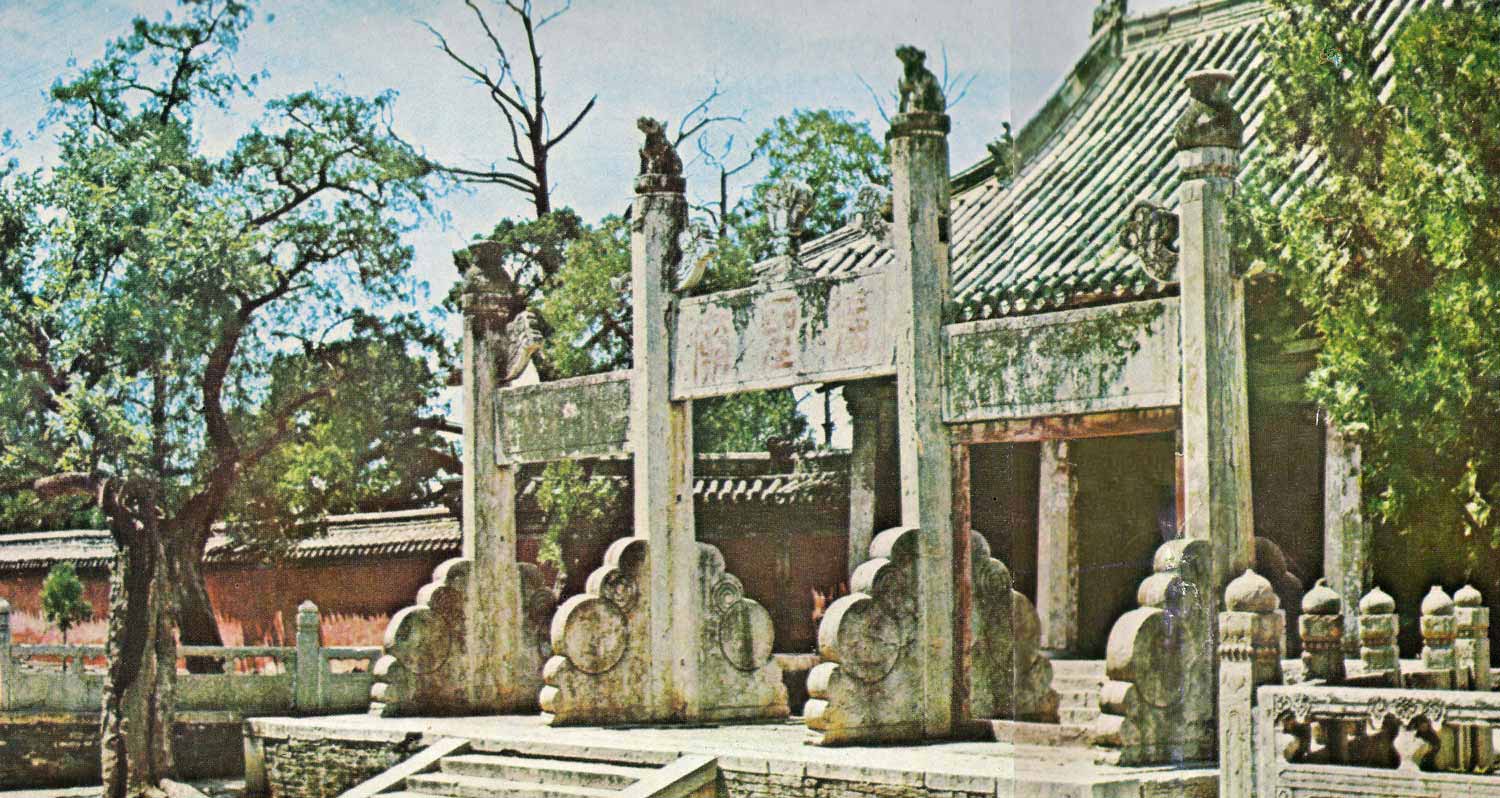
Yasheng Cao Temple of Yan Hui in Qu Fu3 |
 Ya Sheng Cao, later given various other titles including
Si Xian Cao,
Yi Yan Hui and
Fusheng Cao
(more below), is a chant-like song in honor of
Yan Hui, by reputation the favorite student of Confucius and for this reason also known as Ya Sheng, meaning the disciple second only to Confucius himself, or the disciple closest to him (further on this and other names below). He was considered so important that in Qufu, Confucius' home town, there is a large temple to Yan Hui (see photo at right). At one time there were also temples to Yan Hui in other places, and most temples to Confucius should also include shrines to Yan Hui.4
Ya Sheng Cao, later given various other titles including
Si Xian Cao,
Yi Yan Hui and
Fusheng Cao
(more below), is a chant-like song in honor of
Yan Hui, by reputation the favorite student of Confucius and for this reason also known as Ya Sheng, meaning the disciple second only to Confucius himself, or the disciple closest to him (further on this and other names below). He was considered so important that in Qufu, Confucius' home town, there is a large temple to Yan Hui (see photo at right). At one time there were also temples to Yan Hui in other places, and most temples to Confucius should also include shrines to Yan Hui.4
Classical texts have many references to Yan Hui. For example, the Analects of Confucius (Lun Yu) depict Yan Hui as someone who does not present himself in a clever way, but who is very contemplative and an ascetic. Then, according to the Shi Ji (Records of the Grand Historian),5
"Yan Hui was only 29 when his hair turned white. He died young. Confucius wailed bitterly, saying, "Ever since I have had Hui, my disciples have grown closer to me."
Many of the stories about Yan Hui have come from the third century CE Kongzi Jiayu.6 Also of note is a eulogy to Yan Hui by the Song emperor Gaozong.7
Classical texts also have Yan Hui (like Confucius himself) playing the qin.8 One example is in Zhuangzi Chapter 28 (Yielding Power). And the Qin Shi biography of Yan Hui, apparently drawing on Liezi, also has Yan Hui playing the qin.
The origins of the present Yan Hui melody are not known. Several later handbooks attribute it (or a version of it) to the well-known literati and artist Zhao Mengfu (1254 - 1322), but this seems rather doubtful.9 The earliest known surviving version is the present one, published in 1511, but versions of it seem to have been very popular at least through the rest of the Ming dynasty, occuring in almost 30 of the 35 handbooks published between 1511 and 1644, some handbooks having multiple versions; another 10 survive from the Qing dynasty. The most common later title is Si Xian (Cao) ([Melody of] Recalling the Sage); others, in addition to Yasheng Cao, are Fusheng Cao (or Fu Sheng Cao: Melody of the Alternate Sage), Yi Yan Hui (Recalling Yan Hui), and Gu Yan Hui (Old [version of] Yan Hui).10 However, whereas these versions are all melodically related, the modern title Weep for Yan Hui (Qi Yan Hui) has a totally unrelated melody.11
The preface in Taigu Yiyin clearly identifies this melody as a beginner's piece. Later handbooks suggest that the melody, or at least the lyrics, are an important source for qin music, but they do not specifically call it a beginner's melody. Handbooks do not place it before or at the front of their melody section, as happens with versions of Cao Man Yin, but instead usually place it with shang mode melodies. Some of them specifically say they do so because the melody is bei: deeply emotional.12
None of the commentaries mentions the structure or the modal characteristics of the melody.
- Regarding structure, the refrain found in many versions is perhaps the most distinguishing characteristic (because unusual, if nothing else). The refrain is written out at the end of the first section, then instructions at the end of each of the other sections say to repeat the refrain.13 There are also many musical couplets, with either the first phrase ending on la and the second on so, or the first on re then the second on do.14 These couplets and the refrain help suggest that the melody should flow along rhythmically.
- As for modal characteristics, as mentioned here subsequent versions tended to be grouped in shang mode. In the 1511 version itself the main tonal centers overall seem to be sol (5; zhi) and re (2; shang), but the refrain, the whole melody, and all sections except the first all end on do (1; gong). There are many non-pentatonic notes and the refrain includes all seven notes of a diatonic scale plus a flatted 7.15
The version in Taigu Yiyin has seven unnumbered verses in praise of Yan Hui, each beginning "Da zai Yan Hui!" (Awesome Yan Hui) followed by the refrain, which begins "Xian zai Yan Hui" (Worthy Yan Hui). The lyrics are not in Yuefu Shiji. Some expressions, such as da zai and xian zai, can be found in Lun Yu, while two of the verses are quoted almost directly from it (see #3 and #5 below). I have not yet traced the source of the rest, and it should be noted that there is considerable variation in the lyrics throughout the various versions.16
Of particular note are the song lyrics paired to the melody comprising the second half of Verse 7; these identical lyrics ("Summer goes, winter comes....") are later found in several other melodies. But although the late Ming Shantang Sikao attributes them to Confucius himself, they have so far not been confirmed in any sources earlier than the present publication.17
| Original preface18 | The story as illustrated in Asiapac |

As for this song, it is traditionally said that Confucius wrote it lamenting Yan Hui. Yan Hui had been a disciple of Confucius only a short period when he unfortunately died early at the age of 32. Confucius' lament grieved that there was no one left to carry on his methods. Its sounds called out sadly with heavy sobs, clearly cut off. Beginning study of qin should be from here. And for those at the beginning level, if they skip this and search for something else, the more their skills increase, the more distant it is from their understanding. As for this composition, it is like these sounds and is an allegory.
Music and Lyrics: Seven verses
19
A largely syllabic setting of the lyrics, which have irregular meter
(timings follow my recording:
listen 聽錄音 with my transcription 看五線譜;
compare my video)
大哉顏回,大哉顏回;
Da zai Yan Hui, da zai Yan Hui.
Awesome Yan Hui; awesome Yan Hui.
思憶顏回,思思憶憶顏回,
Si yi Yan Hui, si si yi yi Yan Hui.
Think of Yan Hui, think and recall Yan Hui.
天喪顏回,慟顏回顏回。
Tian sang Yan Hui, tong Yan Hui Yan Hui.
Heaven mourns Yan Hui, mourn Yan Hui, Yan Hui.
後皆接此:Refrain (00.20)
賢哉顏回,賢哉顏回,
賢哉若哉,天喪予顏回。
慟顏回顏回,天喪予顏回。
慟天喪顏回,弟子三千盡不如,
道學喪也顏回。
思憶顏回顏回,顏回道何存?
嘆後世無也,予顏回,
天喪顏回,道何存?
(第二段 Section 2. 01.08)
顏回,顏回,聽吾歌。
聲聲只為顏回喪。
天喪顏回,道學喪。
痛惜顏回,命何促?
痛哉顏回,痛哉痛哉顏回。
(第三段 Section 3. 02.32)
不遷怒,顏回;不貳過,顏回。
不幸短命死矣;今也,則忘。
未聞好學顏回。
(第四段 Section 4. 03.41)
(see Lun Yu 15-2)
憶昔當初,在陳絕糧顏回。
憶昔當初,在陳絕糧顏回。
痛念憶昔當初,在陳絕糧顏回。
痛念憶昔當初,在陳絕糧顏回。
(5. 04.56)
一簞食,顏回;一瓢飲,顏回。
在陋巷人不堪其憂。
回也,不改其樂。
(Section 6. 06.05)
大哉顏回,大哉顏回。
傷哉,傷哉,命夭顏回。
苦哉,苦哉,命夭顏回。
弟子三千盡不如顏回;
弟子三千盡不如顏回;
(Section 7. 07.20)
大哉顏回,大哉顏回。
天地推遷有榮辱,
四序循環多反復。
幾迴滄海變桑田,
幾度桑田變陵谷。
暑往寒來春復秋,
夕陽西下水東流。
將軍戰馬今何在?
野草閑花滿地愁。
(Closing Harmonics 09.00)
(end: 09.16)
Xian zai Yan Hui, xian zai Yan Hui.
Worthy Yan Hui, worthy Yan Hui.
Xian zai ruo zai, tian sang yu Yan Hui.
Worthy and approved, Heaven has destroyed me, Yan Hui.
Tong Yan Hui Yan Hui, tian sang yu Yan Hui.
Mourn Yan Hui Yan Hui; Heaven has destroyed me, Yan Hui.
Tong tian sang Yan Hui, di zi san qian jin bu ru.
Mourn Heaven's destroying Yan Hui, 3000 students none his equal.
Dao xue sang ye Yan Hui.
Study of the Way is destroyed, Yan Hui.
Si yi Yan Hui Yan Hui, Yan Hui Dao he cun?
Recall Yan Hui, Yan Hui; Yan Hui, how can the Way survive?
Tan hou shi wu ye, yu Yan Hui.
Mourn that later generations don't have my Yan Hui,
Tian sang Yan Hui, Dao he cun?
Heaven destroyed Yan Hui, how can the Way survive?
(3 / 4 / 5 /
6 / 7 / ending)
大哉顏回,大哉顏回;
Dazai Yan Hui, dazai Yan Hui.
Awesome Yan Hui; awesome Yan Hui.
Yan Hui Yan Hui, ting wu ge.
Yan Hui, Yan Hui, hear my song.
Sheng sheng zhi wei Yan Hui sang.
The sounds are only for Yan Hui mourning.
Tian sang Yan Hui, Dao xue sang.
Heaven mourns Yan Hui, study of the Way is destroyed.
Tong xi Yan Hui, ming he cu?
Painfully grieve Yan Hui, how urgent was Fate?
Tongzai Yan Hui, tongzai tongzai Yan Hui
Pain, Yan Hui; pain, pain Yan Hui
大哉顏回,大哉顏回。
Dazai Yan Hui, dazai Yan Hui.
Awesome Yan Hui; awesome Yan Hui.
Bu qian nu, Yan Hui; bu er guo, Yan Hui.
Doesn't vent anger, Yan Hui; won't repeat mistakes, Yan Hui.
Bu xing duan ming si yi; jin ye, ze wang.
Sadly a short fate and death; now I have no one,
Wei wen hao xue Yan Hui.
I've not heard of anyone eager to learn, Yan Hui
大哉顏回,大哉顏回。
Dazai Yan Hui, dazai Yan Hui.
Awesome Yan Hui; awesome Yan Hui.
Yi xi dang chu, zai Chen jue liang Yan Hui.
Recall the past, in Chen (state) without food, Yan Hui.
Yi xi dang chu, zai Chen jue liang Yan Hui.
Recall the past, in Chen (state) without food, Yan Hui.
Tong nian yi xi dang chu, zai Chen jue liang Yan Hui.
Painfully recall the past in Chen without food, Yan Hui;
Tong nian yi xi dang chu, zai Chen jue liang Yan Hui.
Painfully recall the past in Chen without food, Yan Hui;
大哉顏回,大哉顏回。
Dazai Yan Hui, dazai Yan Hui.
Awesome Yan Hui; awesome Yan Hui.
Yi dan shi, Yan Hui; yi piao yin, Yan Hui.
One bowl for food, Yan Hui; one gourd for drink, Yan Hui.
Zai lou gang ren bu kan qi you.
On such mean streets others couldn't bear the grief;
Hui ye, bu gai qi le.
But (Yan) Hui didn't turn from his joy.
Dazai Yan Hui, dazai Yan Hui.
Awesome Yan Hui; awesome Yan Hui.
Shangzai shangzai, min yao Yan Hui.
Painful, painful, fate killed young Yan Hui;
Kuzai kuzai, ming yao Yan Hui.
Bitter, bitter, fate killed young Yan Hui.
Dizi san qian jin bu ru Yan Hui.
Three thousand students, none that equals Yan Hui;
Dizi san qian jin bu ru Yan Hui.
Three thousand students, none that equals Yan Hui;
Dazai Yan Hui, dazai Yan Hui.
Awesome Yan Hui; awesome Yan Hui.
Tian di tui qian you rong ru.
Heaven and earth move along, waxing and waning.
Si xu xun huan duo fan fu.
Four seasons go round again and again.
Ji hui cang hai bian sang tian.
Oft again oceans change to mulberry groves; 20
Ji du sang tian bian ling gu.
Oft it is that mulberry groves change to hills and valleys.
Shu wang han lai chun fu qiu.
Summer goes, winter comes, spring turns to fall.
Xi yang xi xia shui dong liu.
Sun and stars westward set, rivers flow east.
Jiang jun zhan ma jin he zai?
Generals fighting on horseback, where are they now?
Ye cao xian hua man di chou.
Weeds block out flowers, filling the earth with gloom.
(泛音) 嘆人生再會難。
Tan ren sheng zai hui nan.
Mourn that man's life still is rough.
Footnotes (Shorthand references are explained on a
separate page)
1.
References
276.132 has only 亞聖 Ya Sheng, nothing about music. It identifies four people with this as a nickname:
- 顏回 Yan Hui (the entry refers to 朱熹孟子集註序說)
- 孟子 Mengzi (Mencius)
- 張昶 Zhang Chang (Eastern Han)
- 張機 Zhang Ji (Eastern Han)
The longest commentary is on Mencius, but the commentary with the present melody specifies Yan Hui, the only Yasheng contemporary to Confucius himself. I originally translated "Yasheng" as "Secondary Sage", short for "sage of secondary rank", i.e., the disciple second only to the Sage himself, but without such qualification that title implies minor, so I later changed the translation to "proximate sage".
(Return)
2.
Mode: shang?
Taigu Yiyin does not directly indicate mode. Other handbooks tend to put it in shang mode (see Shenpin Shang Yi). Its tonal centers on so and re, with sections ending on do, also suggest shang is the most likely mode.
(Return)
3.
Temple of Yan Hui in Qu Fu
Photo copied from Land of Splendours (pp. 436), an annotated collection of photographs from pre-1949 China.
(Return)
4.
Other Yan Hui Temples
Temples to Confucius generally also have altars to Yan Hui near their altar to Confucius, but details on this and on separate Yan Hui temples have not yet been researched.
(Return)
5.
Yan Hui in the Shi Ji
See the translation by W.H. Nienhauser, et.al., The Grand Scribe's Records, Vol.VII, p.65. In The Analects, Book XI, Section 7, Confucius says that Yan Hui was eager to learn, but that unfortunately he had died young, and now there was no one.
(Return)
6.
Kongzi Jiayu references
For Kongzi Jiayu see China Knowledge and the original text in the China Text Project.
(Return)
7.
Song Gaozong eulogy
The Song Gaozong emperor (1127-1163) composed a eulogy for Yan Hui. I have not seen yet this.
(Return)
8.
Yan Hui playing the qin
Whereas Confucius is often seen playing the qin while teaching, Yan Hui seems to do it for relaxation: it was natural
self-cultivation. (The Zhuangzi passage, from the chapter 讓王 Rang Wang (Legge: Kings who have wished to resign the Throne), can be found in online in the
China Text Project.
(Return)
9.
The Yan Hui melody and
Zhao Mengfu (1254 - 1322)
The 1625 handbook Taiyin Xisheng says
its version has tablature by "Zi'ang". In front of the Yasheng Cao in the 1634 Guyin Zhengzong is the statement "趙氏遺珍 Bequeathed gem of the Zhao family"; at the end it says, "子昂颜回操五段终 End of Zi'ang's Yan Hui Cao" in 5 sections" (QQJC IX/306-8). These have no further explanations, but then in the handbook Songfengge Qinpu (1677) the preface to Si Xian Cao begins,
As for this tablature, after Zi'ang (Zhao Mengfu) passed away, his rough draft of it was lost. I looked for it in many places, later obtaining it from the home of an "outer paternal uncle" (?) Wang Zilan. Taking up a qin and playing it, its sound was especially ancient and elegant....
Still later, an introduction to the unrelated later melody Qi Yan Hui suggests that Si Xian Cao was just one of several qin melodies passed down by Zhao Mengfu. As yet I have no further details on this.
(Return)
10.
Tracing versions of the present melody (tracing chart)
The tracing chart organizes these related melodies chronologically. The following list organizes them by title largely in line with
Zha Fuxi's Guide:
- 13/140/243 亞聖操 Ya Sheng Cao
nine handbooks: 1511/1515, 1525, 1548/1561, 1557, 1590, 1623, 1625 (quite diff!) and 1634 - 15/155/310 思賢操 Si Xian Cao
25 handbooks: 1525, 1530, 1539, 1552, 1579, 1573/1585, 1589, 1589, 1590, 1596, 1596/1611, 1602, 1611, 1611, late Ming, ? late Ming, 1670, 1677, 1677, 1730, ca. 1802, 1677 and 1893 - 19/181/370 憶顏回 Yi Yan Hui
one handbook: 1525 - 29/226/431 復聖操 Fusheng Cao
six handbooks: 1589, 1618, 1625, 1739, ca 1802, 1828 and 1890,
In addition the complete edition of Buxuxuan Qinpu (1556; surviving only in Taiwan) has a related 古顏回 Gu Yan Hui.
(Return)
| 11. Weep for Yan Hui (泣顏回 Qi Yan Hui; ruibin mode; Qin Fu, p.1377) | Transcription from Guqin Quji |
On the other hand at least one old melody list (published in 1590) does include a title that may be related.
There is online at least one online recording of the melody as published 1937, by Peiyou Chang. However, the more common version is the abbreviated one transcribed at right from Guqin Quji, Volume 1, pp.280-1. There tablature has no explanation as to how or why the abbreviation was done.
On the other hand, the lengthy afterword in Jinyu Qin Kan makes it clear that Xu actually adapted it from somewhere else. This afterword does not seem to say anything about the theme of the melody, only that it came from an old melody in the 簫管 wind instrument repertoire, was later adapted into the 琵琶 pipa repertoire by 嚴月秋 Yan Yueqiu, and from there it was made into a qin melody by Xu Yuanbai.
As can be seen at right, Qi Yan Hui is in ruibin mode, with no lyrics. It is attributed to Xu Yuanbai (1893—1957; so is it
also here?). The transcriptions shows the main tonal center to be equivalent to the open 5th string (do); its modality is thus different from earlier melodies that use ruibin tuning. The introduction there (p.10, #31) begins by saying that Zhao Mengfu (1254 - 1322; see above) "passed down some guqin melodies such as Si Xian Cao" that show his fondnes for Yan Hui, but there was no mention of this in the Jinyu Qinkan commentary and, in any case, this version has no apparent musical relationship to any of the earlier Si Xian Cao melodies.
(Return)
12.
Meaning of "bei"
More on this under Mozi Bei Ge.
(Return)
13.
Refrain
I have not examined the various versions closely enough to know whether any actually has a refrain that is written out each time.
(Return)
14.
Couplets
This does not seem to be as common in later versions, but I have not examined them carefully.
(Return)
15.
Non-pentatonic notes
It could be instructive to see whether/how this changes in later versions.
(Return)
16.
Tracing the sources
Some passages, such as "in Chen with no food" (Verse 4), and "oceans change to mulberry groves" (Verse 7), have no apparent connection with Yan Hui.
(Return)
17.
"Summer goes, winter comes"
The melody (in harmonics) of the second half of Section 7 repeats that of the first half, but one octave higher. Other places these lyrics occur include:
- Xing Tan in Xilutang Qintong (1525) (under which there is account from Shantang Sikao of its origin)
- Several other melodies also called Xing Tan
- Caoman Yin in Chongxiu Zhenchuan Qinpu (1585); Caoman Yin was a predecessor of Xianweng Cao.
There is as yet no information on the source of the lyrics in the first half of Section 7.
(Return)
18.
Original preface
The Chinese original begins as follows:
Zha's Guide has three later handbooks also with commentary. 1525 says that although this piece is attributed to Confucius himself, the term "Yasheng" applied to Yan Hui is rather late, suggesting the melody itself is also later. None of these latter three repeats the claim that one must learn this melody or never properly understand the qin.
(Return)
19.
Original lyrics
These are as follows:
1.
大哉顏回,大哉顏回;
思憶顏回,思思憶憶顏回,
天喪顏回,慟顏回顏回。
(後皆接此:)
賢哉顏回,賢哉顏回,賢哉若哉,天喪予顏回。
慟顏回顏回,天喪予顏回。
慟天喪顏回,弟子三千盡不如,
道學喪也顏回。
思憶顏回顏回,顏回道何存?
嘆後世無也,予顏回,
天喪顏回,道何存?
2.
大哉顏回,大哉顏回;
顏回,顏回,聽吾歌。
聲聲只為顏回喪。
天喪顏回,道學喪。
痛惜顏回,命何促。
痛哉顏回,痛哉痛哉顏回。
(接前)賢哉....
3. (論語 6-3)
大哉顏回,大哉顏回。
不遷怒,顏回;不貳過,顏回。
不幸短命死矣;今也,則忘。
未聞好學顏回。
(接前)賢哉....
4. (見論語 15-2)
5. (見論語 6-11)
6.
7.
(泛音)嘆人生再會難。
大哉顏回,大哉顏回。
憶昔當初,在陳絕糧顏回。
憶昔當初,在陳絕糧顏回。
痛念憶昔當初,在陳絕糧顏回。
痛念憶昔當初,在陳絕糧顏回。
(接前)賢哉....
大哉顏回,大哉顏回。
一簞食,顏回;一瓢飲,顏回。
在陋巷人不堪其憂。
回也,不改其樂。
(接前)賢哉....
大哉顏回,大哉顏回。
傷哉,傷哉,命夭顏回。
苦哉,苦哉,命夭顏回。
弟子三千盡不如顏回;
弟子三千盡不如顏回;
(接前)賢哉....
大哉顏回,大哉顏回。
天地推遷有榮辱,
四序循環多反復。
幾迴滄海變桑田,
幾度桑田變陵谷。
暑往寒來春復秋,
夕陽西下水東流。
將軍戰馬今何在?
野草閑花滿地愁。
(接前)賢哉....
(Return)
20.
Oceans to mulberry groves
18460.32 滄海桑田 refers to 神仙傳 Shenxian Zhuan, originally by 葛洪 Ge Hong (283-343): affairs of the world constantly change. The lyrics of this quatrain thus have a similar meaning as that of the more famous one that follows.
(Return)
Appendix: Chart Tracing Ya Sheng Cao
and other versions of the present melody
Further comment above, including a listing by title
This chronological chart is based mainly on the following entries in
Zha Fuxi's Guide
13/140/243
亞聖操 Ya Sheng Cao
15/155/310
思賢操 Si Xian Cao
19/181/370
憶顏回 Yi Yan Hui
29/226/431
復聖操 Fusheng Cao
All the melodies have lyrics unless otherwise indicated
|
琴譜
(year; QQJC Vol/page) |
Further information
(QQJC = 琴曲集成 Qinqu Jicheng; QF = 琴府 Qin Fu) |
|
1. 謝琳太古遺音
(1511; I/289) |
Ya Sheng Cao; 7 unnumbered sections, each with a refrain;
lyrics begin "大哉顏回//"; refrain begins, "賢哉顏回...." |
|
. 黃士達太古遺音
(1515; I/xxx) |
Presumably identical to 1511
|
|
2a. 西麓堂琴統
(1525; III/96) |
Si Xian Cao; 5 sections each with refrain called 果聲 guosheng [consequent sound];
"大哉顏回...."; guosheng begins, "天喪予也顏回...." |
|
2b. 西麓堂琴統
(1525; III/97) |
Ya Sheng Cao; 7 sections each with guosheng;
"大哉顏回//...."; guosheng: "有德行也顏回...." |
|
2c. 西麓堂琴統
(1525; III/98) |
Yi Yan Hui; 5 sections each with guosheng; longest of these 1525 versions;
"大哉顏回//...."; guosheng: "有德行也顏回...." |
|
3. 發明琴譜
(1530; I/343) |
Si Xian Cao; 7 sections, no refrain; first melody in handbook; "大哉顏回...." |
|
4. 風宣玄品
(1539; II/110) |
Si Xian Cao; 8 sections, titled, no refrain;
"大哉顏回...." |
|
5. 梧岡琴譜
(1546; I/408) |
Ya Sheng Cao; 7 sections, 5 with refrain;
no lyrics! |
|
6. 步虛僊琴譜
(1556; #18) |
Gu Yan Hui; 6 sections; one section mentions guosheng but none marked
no lyrics |
|
7. 太音傳習
(1552; IV/90) |
Si Xian Cao; 7 sections;
no lyrics |
|
8. 太音補遺
(1557; III/327) |
Yan Hui (ToC: Ya Sheng); 7 sections;
no lyrics) |
|
9. 琴譜正傳
(1561; II/452) |
Ya Sheng Cao; identical to 1546;
no lyrics |
|
10. 新刊正文對音捷要
(1573; #13) |
Si Xian Cao; same as 1585?
|
|
11. 五音琴譜
(1579; IV/206) |
Si Xian Cao; 7 sections;
no lyrics |
|
12. 重修真傳琴譜
(1585; IV/357) |
Si Xian Cao; 7 sections;
"大哉顏回...." |
|
13. 玉梧琴譜
(1589; VI/43) |
Si Xian Cao; 5 sections;
"天道何知,茫茫...."; S2 begins, "大哉顏回,庶呼屢空...." |
|
14a.
真傳正宗琴譜
(1589; VII/68) |
Fu Sheng Cao; 5 sections, titled;
"天道何知...."; 1609 edition is presumably the same |
|
14b.
真傳正宗琴譜
(1589; VII/70) |
Si Xian Cao; 7 sections, titled;
"大哉顏回...."; 1609 edition is presumably the same |
|
15a. 琴書大全
(1590; V/492) |
Ya Sheng Cao; 5 sections;
"天道何知...." |
|
15b. 琴書大全
(1590; V/496) |
Si Xian Cao; 7 sections;
"大哉顏回.." |
|
16. 文會堂琴譜
(1596; VI/200) |
Yan Hui aka Si Xian Cao; 7 sections;
"大哉顏回...." |
|
17. 綠綺新聲
(1597; VII/14 | Si Xian Cao; 7 sections;
"大哉顏回...." |
|
18. 藏春塢琴譜
(1602; VI/356) |
Si Xian Cao; identical to 1589;
"天道何知...." |
|
19. 陽春堂琴譜
(1611; VII/380) |
Si Xian Cao; 7 sections;
"大哉顏回...." (太古正音欽佩) |
|
20. 琴適
(1611; VIII/20) |
Si Xian Cao; identical to 1597;
"大哉顏回...." |
|
21a.
理性元雅
(1618; VIII/213) |
Fusheng Cao; 5 sections;
"天道何知...."; S2 begins "大哉顏回...." |
|
21b.
理性元雅
(1618; VIII/339) |
Si Xian Cao; 7 sections;
lyrics ("大哉顏回....") as 1585 but arranged for 1 string qin |
|
22. 樂仙琴譜
(1623; VIII/370) |
Ya Sheng Cao; 7 sections;
"大哉顏回...." |
|
23a. 太音希聲
(1625; IX/191) |
Yasheng Cao; 7 sections; ToC calls "泣顏回"; "趙子昂譜 tablature by
Zhao Zi'ang";
lyrics ("天道無知 [sic]...."; S2 begins, "大哉顏回....) and music both very different |
|
23b. 太音希聲
(1625; IX/201) |
Fusheng Cao; 5 sections, quite diff but still musically related; "天道何知,茫茫理數...."; S2 begins, "大哉顏回...." |
|
24. 古音正宗
(1634; IX/306) |
Ya Sheng Cao; 5 sections; "趙氏遺珍";
"大哉顏回...." |
|
25. 義軒琴經
(late Ming; IX/?) |
Si Xian Cao; 10 sections? (missing?)
|
|
26. 陶氏琴譜
(late Ming; IX/457) |
Si Xian Cao; 5 unnumbered sections;
"天道何知...." |
|
27. 琴苑新傳全編
(1670; XI/338) |
Si Xian Cao; 5 sections;
"天道何知...." |
|
28a. 松風閣琴譜
(~1677; XII/317) |
Si Xian Cao; 5 sections; "tablature of Zhao Zi'ang" (Zhao Mengfu!); ;
"大哉顏回...." |
|
28b. 松風閣琴譜
(~1677; XII/431) |
Si Xian Cao; 5 sections; same as previous;
"大哉顏回...." |
|
29. 一峰園琴譜
(1709; XIII/518) |
"惜賢操 Xi Xian Cao" but related here!; 5 untitled sections;
"天道何知,茫茫...."; S2 begins, "大哉顏回...."; attributes 趙子昂 Zhao Mengfu |
|
30. 立雪齋琴譜
(1730; XVIII/18) |
Si Xian Cao; 7 titled sections;
"大哉顏回...." |
|
31. 琴學練要
(1739; XVIII/162) |
Fusheng Cao; 5 sections;
"天道何知...." (治心齋琴譜) |
|
32a. 裛露軒琴譜
(>1802; XIX/150) |
Si Xian Cao; 7 sections; "from 1589", but without the lyrics;
No lyrics |
|
32b. 裛露軒琴譜
(>1802; XIX/153) |
Fusheng Cao; 5 sections; "from 1589", but without the lyrics;
No lyrics |
|
33. 琴學軔端
(1828; XX/464) |
Fusheng Cao; 5 sections (hard to see, but seems musically related); "天道何知...." |
|
34. 希韶閣琴瑟合譜
(1890; XXVI/435) |
Fusheng Cao; 5 sections;
"天道何知....", but seems to be musically unrelated |
|
35. 枯木禪琴譜
(1893; XXVIII/140) |
Si Xian Cao; 5 sections; seems musically unrelated
"天道何知...." (attached at end and not divided into sections) |
Return to the top, or to the Guqin ToC.