|
T of C
Home |
My Work |
Hand- books |
Qin as Object |
Qin in Art |
Poetry / Song |
Hear, Watch |
Play Qin |
Analysis | History |
Ideo- logy |
Miscel- lanea |
More Info |
Personal | email me search me |
| SQMP ToC Sung version 琴歌酒狂 流觴 Floating Wine-Cups version Guqin and wine In modern use | 聽錄音 my recording with transcription / 首頁 |
|
10. Wine Mad
- Gong mode,2 standard tuning: 5 6 1 2 3 5 6 |
酒狂
1
Jiu Kuang By Bai Yunli; see the whole image |
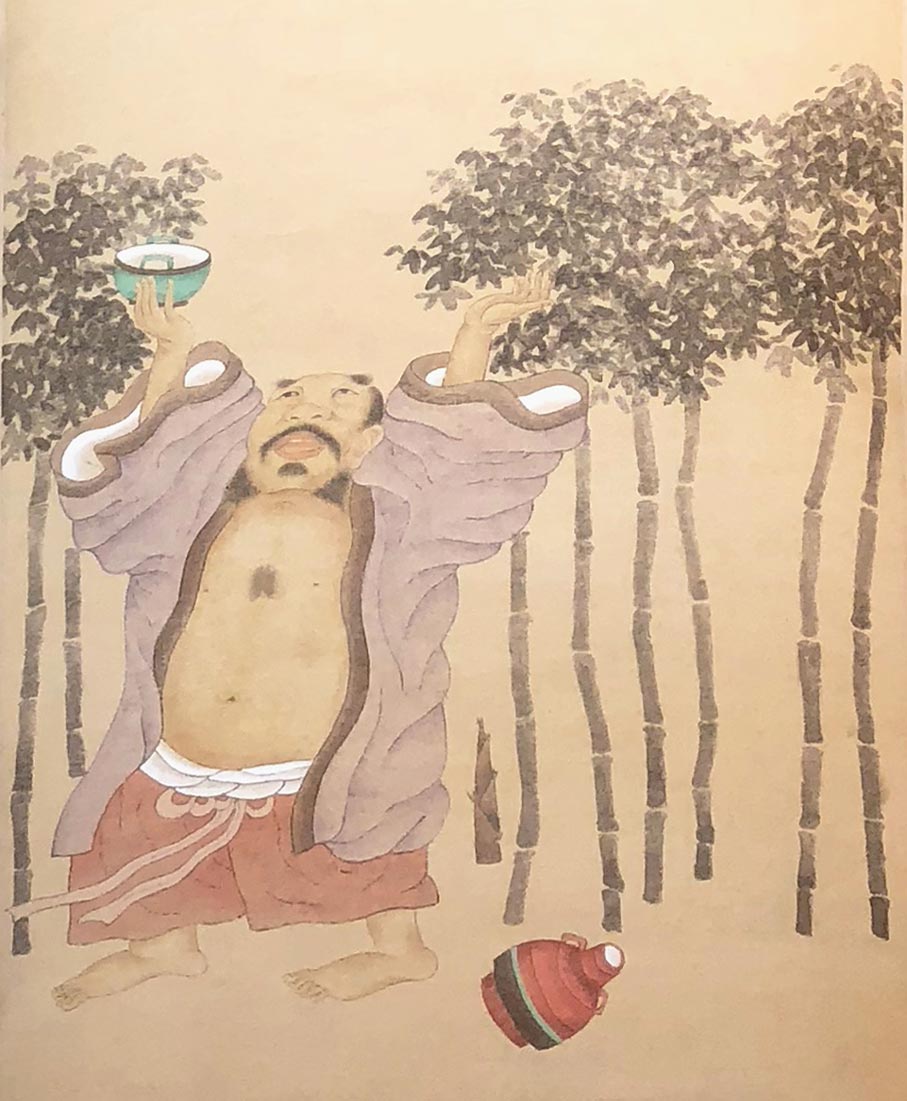 The preface to the earliest Jiu Kuang (Wine Mad; 1425) says it was
"created" by the famous poet, drinker and recluse Ruan Ji (210-263), one of the reputed Seven Sages of the Bamboo Grove. Jiu Kuang is one of the most popular melodies in the modern qin repertoire. However, for centuries before the 1950s it had apparently gone out of the active repertoire: in written form it survives in only ten traditional handbooks, nine of them from the Ming dynasty. One of these was given the title Floating Wine Cups. The earliest versions, from Shen Qi Mi Pu (1425; see in chart) through the fourth, are purely instrumental. The later ones all have lyrics. The last one during the Ming dynasty is Taiyin Xisheng (1625), then the one later version seems to be a re-copy of the song version from 1589 in an obscure handbook published in 1930 (again see appendix below.3).
The preface to the earliest Jiu Kuang (Wine Mad; 1425) says it was
"created" by the famous poet, drinker and recluse Ruan Ji (210-263), one of the reputed Seven Sages of the Bamboo Grove. Jiu Kuang is one of the most popular melodies in the modern qin repertoire. However, for centuries before the 1950s it had apparently gone out of the active repertoire: in written form it survives in only ten traditional handbooks, nine of them from the Ming dynasty. One of these was given the title Floating Wine Cups. The earliest versions, from Shen Qi Mi Pu (1425; see in chart) through the fourth, are purely instrumental. The later ones all have lyrics. The last one during the Ming dynasty is Taiyin Xisheng (1625), then the one later version seems to be a re-copy of the song version from 1589 in an obscure handbook published in 1930 (again see appendix below.3).
The Jiu Kuang heard today is usually based on, or is a variation on, the reconstruction made by the eminent qin player Yao Bingyan (1920 - 83) in the 1950s using triple rhythms.4 Triple rhythms have never been confirmed elsewhere in traditional Chinese music, and the surviving versions with lyrics cannot naturally be sung in triple rhythms. Today, however, almost all interpretations are based solely or largely on Yao's, with no questions asked. (This interpretation is discussed in further detail below.
However, when I did my own double rhythm reconstruction in the late 1970s I was not aware of Yao Bingyan's triple rhythm interpretation. The image I actually had in my mind as I reconstructed Jiu Kuang was of a chou, the comic figure in Chinese opera, staggering along in a pleasant stage of tipsiness. Although there was in fact an opera called Ruan Bubing (a nickname of Ruan Ji), it is of a later date (17th century) and there is no evidence suggesting that there is a specific connection between Jiu Kuang and any opera.5
Shen Qi Mi Pu includes Jiu Kuang in the section called Celestial Airs of Antiquity, consisting of the melodies Zhu Quan considered most ancient: he could find no one who played them, so he simply copied out the tablature as he found it. As is common with melodies in this section, Jiu Kuang is copied in 1552, and survives in similar versions dated 1525 (where it is called Liu Shang6) and 1539. After this comes the versions dated 1573 and 1585, with lyrics; these are quite different musically.7 The other three surviving versions, dated 1589, 1618 and 1625 (see appendix), and also having lyrics, are similar to each other and much closer to the SQMP version than to the 1573/1585 version.
All of these later versions have different endings. The versions with section titles all name their last section "Bend over and exhale", but none of these later endings has a passage similar to the SQMP coda translated here as "The sound of the immortal exhaling his wine."8
Liu Shang9 (Floating Wine-Cups), the 12th piece in Xilutang Qintong (1525), opens with the same basic melody, but this then alternates with a somewhat different interlude, and it adds two new sections at the end. The afterword connects the piece with a ceremony called Xiuxi,11 in which (particularly on the 3rd day of the 3rd lunar month) scholars would relax along a stream as laden wine-cups floated by; if a wine-cup stopped in front of a scholar he had to compose an appropriate poem or drink from the cup. The music of Liu Shang can be quite evocative; passages where the melody glides up and down, like wine-cups floating in a stream, alternate with interludes where the music seems to swirl around, like wine-cups bobbing in front of an attentive scholar.
The Jiu Kuang in Yang Lun Taigu Yiyin (1589) is particularly interesting, because it turns the SQMP melody into a quite singable drinking song.12 Its preface is somewhat different from those in SQMP and Xilutang Qintong, but it still concerns Ruan Ji and the other sages trying to stay away from the machinations of the Sima clan, who controlled the Jin dynasty. The lyrics can easily be sung in duple rhythm, but not in triple rhythm. The basic theme of the lyrics is that we enjoy drink, but we drink in a refined manner because we are gentlemen; this is different from the way the vulgar masses drink. The section titles are also quite evocative.13
Ruan Ji, said by Zhu Quan to be the author, came from his village south of Kaifeng to be an official in the Wei capital of Luoyang, but then left office to be a recluse. He then joined Xi Kang as one of the Seven Sages of the Bamboo Grove. There are many Chinese paintings of this group in their bamboo grove outside the city. A famous iconoclast as well as poet, drinker and recluse, Ruan Ji is often depicted listening to Xi Kang playing the qin.14 Apologists say he drank in order to express his contempt for the corrupt officials of his day; if someone asked him to work in the government, he used his enjoyment of wine to say he was not capable of doing it.
As with other seemingly older pieces such as SQMP #16 Yi Zhen, #43 Wu Ye Ti and #47 Da Hujia, the Jiu Kuang tablature marks off the beginning and ending of certain phrases with evocative words (the first phrase has the word "mad" at the front and "song" at the end, then has them repeated later ("play again from 'mad' to 'song'"), sometimes several times. Other melodies such as #6 Liu Shui, #8 Xuan Mo and #15 Xiao Hujia also do this, but to a lesser extent.
Triple rhythm for Jiu Kuang (see also rhythm in early Ming qin tablature)
As suggested above and in this footnote, most modern interpretations today are based solely or largely on the triple rhythm interpretation made by Yao Bingyan during the Zha Fuxi-led recording project of the 1950s. This was basically followed by other players recorded during that project (five of the others are listed here, but none here). Later writers such as Xu Jian in his Outline History (pp.36-37) and the eminent Chinese musicologist Yang Yinliu in his Outline History of Chinese Music (see the transcription in this pdf from pp.154-5) in discussing Yao's triple rhythm Jiu Kuang seemingly accepted it without question.
As a result many people (even those who are aware that traditional qin tablature does not directly indicate rhythm as well as that there is little suggestion of triple rhythm in early Chinese music writings) believe unequivocally that Jiu Kuang is actually evidence for triple rhythm in Chinese music.
According to Yao Bingyan himself, when he originally reconstructed Jiu Kuang in the 1950s he used double rhythm, but he later changed this to triple rhythms. Although triple rhythms were not known ever to have been a part of traditional Chinese music, according to what Yao wrote in an explanatory article,15 there were triple rhythms in poetry,16 the Tang qin master Chen Zhuo described music that could be played triple rhythm,17 and Jiu Kuang sounds good in triple rhythm, so he felt that this was a correct interpretation.
Today Jiu Kuang is one of the most commonly played qin pieces (by 2005 there were at least 15 recordings), with other players almost exclusively following Yao's rhythms, though perhaps in places making the tempo irregular so as to represent the idea of drunkenness. Indeed, this triple rhythm interpretation has become part of the modern tradition of qin play, and is also followed in adaptations of the melody for other early Chinese instruments. Yao's reasoning is certainly very interesting, and sometimes I have played Jiu Kuang, enjoying the triple rhythms (or irregular rhythms). However, I don't find Yao's reasoning convincing enough to be comfortable that everyone should play it that way. In addition, I find it more difficult to make the later versions mentioned here (especially the songs) fit into triple rhythm.18 So without saying Yao is wrong, my own recording uses predominantly double rhythms.
The Emaciated Immortal says
this piece was created by Ruan Ji; he sighed because the Dao was not being followed, and he was not in accord with the people of his era. So he forgot about the anxieties of society (by putting them) out of his mind and body; he made it his goal to rely on his enjoyment of being tipsy in order to enjoy his whole life. The meaning of the piece is like this; it is not really talking about being infatuated with wine. There is some profound Dao in this piece, but it is very subtle here, intentionally not explained to common people; (only) the most wise can attain this.
Music
(Timings follow the recording on
my CD;
聽錄音 listen with
transcription)
Four sections, untitled (here expanded to seven titled; plus a coda.19
Compare the sung version 琴歌酒狂 and
流觴 Floating Wine-Cups
(00.00) 1. (Enjoying wine and forgetting troubles)
(00.29) 2. (Drunkenly dancing like a flying immortal)
(00.51) 3. (Singing loudly to earth and heaven)
(01.12) 4. (Loving wine and forgetting the body)
(01.34) (5. Dashing off calligraphy on art paper)
(01.53) (6. Bending over to exhale wine)21
(02.07) (7. Hold up wine and feign madness)
(02.18) Coda: Sound of the immortal exhaling his wine.
(02.41) End
Return to top
Footnotes (Shorthand references are explained on a
separate page)
1.
Jiu Kuang references
40665.70 酒狂 has three references to drunken madness:
None has a musical reference, nor does the tale called Jiu Kuang in
Strange Tales from a Chinese Studio
(Liaozhai Zhi Yi;
last story in 卷四 Folio 4).
The complete poem by Bai Juyi is as follows:
年來數出覓風光,亦不全閒亦不忙。
放鞚體安騎穩馬,隔袍身暖照晴陽。
迎春日日添詩思,送老時時放酒狂。
除卻髭須白一色,其餘未伏少年郎。
The third line mentions spring as well as drunken madress.
(Return)
2.
Gong mode (宮調 gong diao)
For more on gong mode see Shenpin Gong Yi. For more general comments see Modality in Early Ming Qin Tablature.
(Return)
3.
Tracing Jiu Kuang
The appendix below is based mainly on Zha Fuxi's Guide 3/31/36 and 19/180/--: it did not include the versions dated 1552 and 1930. All surviving versions are musically related but only 1589 and 1630 seem to be identical to each other. Four have lyrics, but none of these can be matched to the SQMP music.
(Return)
4.
姚丙炎 Yao Bingyan and reconstructions of Jiu Kuang
There are many recordings by Yao and others; early ones, such as the 11 listed on this page, are with silk strings; later ones almost exclusively with metal strings (see my comments under silk strings). Bell Yong, Celestial Airs of Antiquity, 1997, has a transcription and some discussion, but there is no mention of the metal strings or of the oddity of the triple rhythm.
Xu Jian, QSCB, Chapter 3.B. (pp.36-7) mentions the triple rhythms as though they are an inherent part of the melody, rather than Yao Bingyan's interpretation from the 1950s. Other interpreters like to mix double and triple rhythms (e.g., phrases 3+3+3+2; perhaps suggesting the jerky motions of someone who is drunk), while still others try to use completely free rhythms (again in an attempt to imitate drunkenness). These should appeal to people as modern developments, not as confirmed historical reproductions.
(Return)
5.
Jiu Kuang and Chinese opera
The role type I have in mind is the 丑 chou, a comic figure immediately identifiable because the area around the nose and mouth is painted white. For more on the opera Ruan Bubing see under
Ruan Ji.
(Return)
6.
The 1525 and 1539 versions have more differences from SQMP (1425) than do their versions of most pieces from SQMP Folio I.
(Return)
7.
By tradition qin melodies are learned from a teacher, not from tablature. If a melody does not change through several tablatures this may be evidence that it was played from the tablature. There is some discussion of this in the article Historically Informed Performance (see in particular the section Traditional Chinese HIP?).
(Return)
8.
仙人吐酒聲 Xianren Tujiu Sheng (Sound of the Immortal Exhaling his Wine)
Also: 低地吐酒 Didi tu jiu (Bend over and exhale). For didi 539.18 低地 says low sound, quoting 西廂記 Xi Xiang Ji. "Tu jiu" is more commonly translated "retch wine" (i.e., 嘔酒 ou jiu), and for this reason some players have omitted this section as unworthy of the qin. My own interpretation here of "tu" (suggested by 唐健垣 Tong Kin-Woon) connects it to 3359.39 吐納 tu na, a Daoist 修煉 ascetic skill by which people expell impurities (bad qi) inside themselves; there is an example in Qinshu Daquan, Folio 17, #53. Another idea is that this tu might resemble the way Daoist priests spray wine from their mouths during religious ceremonies (though here problably without the religious implication).
(Return)
9.
流觴 Liu Shang
For liu shang, 17762.316 流觴 describes the custom of floating wine-cups, but has nothing about music. The linked Xilutang Qintong version has an Afterword which says, "During the Yonghe period (345-357) all the sages had a xiuxi at the Orchid Pavilion. It was mellow and sophisticated pleasure, a feast such as might occur once in a thousand years. Later people commemorated it with this piece. With the high flavor of the region along the north bank of the (Yangzi) River, one can broadly imagine it."
(Return)
11.
Xiuxi 修禊
A melody called 修禊吟 Xiuxi Yin occurs in nine handbooks beginning wtih Xilutang Qintong (1525), but none has an appended explanation. It is the third title in Xilutang Qintong, where it serves as a prelude to
Yang Chun (Bright Spring). As with Liu Shang, Xiuxi Yin is in the gong mode, and it also sounds very appropriate as an prelude to Liu Shang. However, there is no overt connection either in Xilutang Qintong or any later handbook.
Attempts have been made to revive the custom of Xiuxi. An annual event is organized at the Lanting Pavilion near Shaoxing. It seems particularly popular with Japanese, who have also constructed a Lanting Pavilion on Kyushu, the southern island of Japan.
12.
Commentary on the qin song Jiu Kuang in Yang Lun Taigu Yiyin, 1589 楊掄太古遺音琴歌《酒狂》 is in a
separate article. See also the appendix.
13.
The lyrics and section titles for Jiu Kuang in Yang Lun Taigu Yiyin, 1589, are included with my commentary there, both the Chinese original and
my translation.
14.
Ruan Ji himself is also said to have played the qin, though some sources apparently say it was the zheng zither.
15.
Yao Bingyan's article on Jiu Kuang
(pdf of original, copied from
www.cnki.net)
The article is subtitled "和意大利留學生卡利奥·拉法埃拉的談話 In discussion with visiting Italian student Raffaella Gallio" (葛曉蘭). The article begins with the original tablature and ends with a transcription. The discussion of rhythm is in the last section (經過 Process). Yao begins by saying he first tried double rhythms, but was not satisfied. Then he tried another rhythm and it made him want to get up and dance. He noticed the phrases were "三字句组成", which seems to mean they consisted of three notes (here, literally, "three words") each, and decided should be triple rhythm. Although he liked it very much he feared others would reject this strange rhythm. In looking for justification he mentioned not just the beauty of the triple rhythms but added that it doesn't have to be like the Western triple rhythm. He also mentioned the 三字經 Three Character Classic, other poetic references and the article on rhythm by Chen Zhuo (see next two footnotes). footnote).
16.
Triple rhythm in Chinese poetry?
17.
Chen Zhuo article suggests triple rhythm?
That article/section has not been translated. As best as I can understand, if the suggestion of triple rhythms for music of that time comes from here it is related to the second set of examples given above: "三字句節奏有五 three character phrases have rhythm of five types", the third type being "do three sounds quickly", the fourth being "do three sounds slowly". However, as it does not specify making the sounds equal in length (as perhaps the use of 匀 yun does under four character and five character phrases), this does not seem very strong evidence for triple rhythm. Specifically regarding Jiu Kuang, it was not known to have lyrics at that time, so it is not clear how this would apply in any case.
There have also been other arguments saying that triple rhythm was used in Tang dynasty music. What I have seen usually concerns a few bars rather than whole pieces. That I have not seen any convincing ones for whole melodies, or even extended phrases, in triple rhythm does not mean that they did not occur. What is relevant here is that Yao Bingyan's triple rhythm version of Jiu Kuang, and the fact that today almost everyone follows a version of this, cannot be used as historical evidence that it was ever played in this rhythm in the past.
18.
Triple rhythms and later versions of Jiu Kuang
19.
Original preface
20.
Original section titles
To this Shen Qi Mi Pu adds: 仙人吐酒);終。
To make the seven sections, the fourth section of 1425 is sub-divided into four sections. This division of SQMP into 7 sections plus a coda shows clearly one method of pairing it with the version published in 1589, making a combined melody about 6 minutes in length. To do this, alternate versions, beginning with SQMP Section 1, then playing 1589 section 1; continue like this, ending with the SQMP coda. If the 1589 version is sung, one can clearly distinguish between the two and thus gain a basic understanding of the relationship between them.
21.
低低吐酒 Bending over to exhale wine (retch wine?)
Return to top
805.226: 古代民俗于農歷三月上旬的已日(三國魏以後始定為三月初三)到水邊嬉戲以撥除不祥。
"The people of ancient times had a custom whereby during the first third of the third month according to the agricultural calendar [after the Wei dynasty of the Warring Kingdoms it became fixed on the third day of the third month] they would go play/sport by waters' edge in order to eliminate anything inauspicious." (Another reference says that from the Song dynasty there are indications that the same thing was done in the seventh month of the agricultural calendar.)
(Return)
(Return)
(Return)
(Return)
This article was originally published in Yinyue Yishu, 1981 #5, pp.26-31 (reference in the
bibliography, which also has some other related articles by Yao). See also the next footnote below.
(Return)
As an example Yao cites the Three Character Classic (三字經 San Zi Jing;
Wiki) in particular, though to my knowledge there has never been a suggestion it should be recited in triple rhythm.
(Return)
An article attributed to Chen Zhuo in Qinshu Daquan (1590), Folio 8 (QQJC, Vol.V/160-177), has a section called Rhythm (節奏 Jiezou; V/173). The complete article can be seen here under Chen Zhuo.
(Return)
To my mind it is quite clear that Liu Shang and the qin song versions of Jiu Kuang should not have triple rhythm. An argument that they are appropriate for the 1425 Jiu Kuang should thus center on the fact that the tablature is in SQMP, Folio I, melodies for which Zhu Quan said he could find no players. Perhaps at some time prior to the Ming dynasty the melody truly was played in triple rhythms, so the double rhythms used in the Ming dynasty were their incorrect interpretation. However, I do not know of any evidence to support this argument.
(Return)
See here.
(Return)
There being none in Shen Qi Mi Pu, these section titles are as those in Yang Lun Taigu Yiyin, as follows:
(Return)
Fengxuan Xuanpin (see QQJC, II, pp.73 - 74) adds a section break here, calling it Section 5.
(Return)
Appendix: Chart Tracing 酒狂 Jiu Kuang
Based mainly on Zha Fuxi's Guide,
3/31/36 and
19/180/--.
| 琴譜 | Page numbers refer to indicated volume in 琴曲集成 Qinqu Jicheng |
|
1. 神奇秘譜
(1425; I/126) |
4 sections + coda "the immortal exhales his wine" (仙人吐酒); none of the later lyrics fits
2nd edition adds some phrasing; placement in Folio I suggests it was so old no one played it any more |
|
2. 西麓堂琴統
(1525; III/75) |
8; called Liu Shang (流觴, Flowing Wine-Cups); this title only here; similar to 1425, but sections 7-8 consist of added material; explanation connects piece with the 修禊 Xiuxi ceremony but not with the melody Xiuxi Yin |
|
3. 風宣玄品
(1539; II/75) |
5; very similar to 1425 except ending; writes out repeats |
|
4. 太音傳習
(1552; IV/54) |
Music and preface are copied from 1425
|
|
5. ....琴譜真傳
(1573; facs / E70) |
6 titled sections; lyrics; added musical opening, then related but very different from 1425, esp. at end;
No coda; Sec 6: Bend down and exhale wine (低地吐酒 di di tu jiu); seems awkward to play but is more clear than 1585 |
|
6. 重修真傳琴譜
(1585; IV/331) |
6 titled sections; no coda; Sec 6: Bend down and exhale wine (低地吐酒 di di tu jiu
Seems to be a revision of 1573 with same lyrics, but QQJC copy is much harder to read in places |
|
7. 真傳正宗琴譜
(1589; VII/65) |
The song Jiu Kuang, in 楊掄太古遺音 Yang Lun Taigu Yiyin; 7 titled sections; lyrics (see translation); preface attributes Ruan Ji; music quite different from 1585 more closely related to 1425 & 1525, but another different ending |
|
8. 理性元雅
(1618; VIII/194) |
titles and lyrics are same as the 1589 version; the melody is very similar; precedes new Yang Chun |
|
9. 太音希聲
(1625; IX/142) |
titles (?) and lyrics related to the 1589 version; the melody opens with passage in double stops, then resembles others |
|
10. 琴學管見
(1930; XXIX/263) |
Tablature, lyrics and preface seem to be copied from 1589
|
Return to the top, to the Shen Qi Mi Pu ToC or to the Guqin ToC.