|
T of C
Home |
My Work |
Hand- books |
Qin as Object |
Qin in Art |
Poetry / Song |
Hear, Watch |
Play Qin |
Analysis | History |
Ideo- logy |
Miscel- lanea |
More Info |
Personal | email me search me |
| Qin Biographies Xi Kang Ruan Ji Ruan Xian plus Rong Qiqi Henan | 首頁 |
|
Seven Sages of the Bamboo Grove
Also translated as Seven Worthies of the Bamboo Grove |
竹林七賢
1
Seven Sages plus Rong Qiqi 2 (note left hand play) |
 The Seven Sages (or Seven Worthies) of the Bamboo Grove are seven well-known scholars and artists who lived around Luoyang (in modern Henan province) during the troubled times when the Wei dynasty was giving way to the Western Jin. There seems to be no surviving contemporary evidence of them considering themselves as a group, but later lore has them gathering in the nearby countryside, perhaps near Shanyang across the Yangzi river northeast of Luoyang.3 Here they engaged themselves in various refined activities4 including music5 and "pure conversation".6
An important theme in fine art,7 beginning from perhaps a century later, was a set of illustrations called The Seven Sages of the Bamboo Grove and Rong Qiqi (who in fact lived much earlier.) The earliest example survives in a molded-brick relief from a tomb in the Nanjing area. The figures are in two groups of four each. In the Chinese order of right to left they are (see at right),8
Wang Rong 9 (234 - 305) balancing a ruyi wand.
Shan Tao 10 (205 - 283) drinking wine.
Ruan Ji 11 (210 - 263) whistling (a famed whistler as well as drinker).
Xi Kang 12 (223 - 262) seems to be playing his qin backwards, or it is a left handed qin.
North wall
Xiang Xiu
13 (228 -281) sleeping.
Liu Ling
14 (3rd C) drinking (a famous wine drinker, he wrote a hymn praising its virtues).
Ruan Xian
15 (210 - 263) playing a ruanxian lute.16
Rong Qiqi
17 (5th C. BCE), like Xi Kang also playing either a left handed qin or a regular one backwards.
China: Dawn of a Golden Age, 200 to 750 AD, an exhibition at the Metropotan Museum of New York 12 October 2004 to 23 January 2005, included high quality copies of rubbings made from the original molded-brick relief, plus an actual relief of Xi Kang. Copies are included in the catalogue.18
In the brick reliefs both qins depict the instrument backwards, with the hui studs on the wrong side of the strings. I have not been able to find any discussion as to why the qins are both reverse images. The method for making the brick relief was first to carve the images in wood, press the wood against soft clay, then bake the clay into bricks. The fact that the reverse images can be corrected by looking at them in a mirror suggests perhaps that someone made an error in the transfer process.19 The names could have been added later. However, the other images do not seem to be reversed. In addition, the depiction of Xi Kang playing seems to show the qin extended out into the air in a manner defying gravity (but see further), and the depiction of Rong Qiqi's qin has the first stud much too close to the bridge.20 In the absence of any evidence that anyone ever made a left-handed qin, this has to be viewed simply as a mistake by either the artist or someone else involved in the manufacturing process.
An error more often noted is that Liu Ling's name is incorrectly written.21
Footnotes (Shorthand references are explained on a
separate page)
1.
Seven Sages of the Bamboo Grove
26424.106 竹林七賢 (sometimes written 竹林七仙). There is a detailed discussion of these seven personages in Audrey Spiro, Contemplating the Ancients: Aesthetic and Social Issues in Early Chinese Portraiture. University of California Press, 1990. See also R. H. van Gulik, Hsi K'ang's Essay on the Lute, pp.14-22.
(Return)
| 2. Images of the Seven Sages 竹林七賢圖 | The seven sages "at Shanyang" |
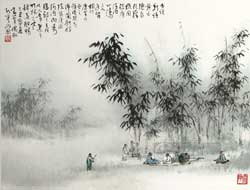 This brick relief is from a Nanjing tomb. See also more recent images such as the one at right by
Ou Haonian (歐豪年 1935 - ), plus another by Liu Jian; a web image search for "竹林七賢" will yield many more. The image at top came from Chinese Wikipedia.
This brick relief is from a Nanjing tomb. See also more recent images such as the one at right by
Ou Haonian (歐豪年 1935 - ), plus another by Liu Jian; a web image search for "竹林七賢" will yield many more. The image at top came from Chinese Wikipedia.

(Return)
3.
山陽 Shanyang: location of the Bamboo Grove?
8043.574: south side of a mountain; name of various districts; no reference here to the Seven Sages. It does mention at least three places that should be given some consideration as a possible location of the bamboo grove, but the overall impression is that, although several places may have over time been associated with the bamboo grove, its original location can probably never be proven. Some places to consider include:
- 輝縣,白泉 Baiquan in Huixian (about 60km due north of 鄭州 Zhengzhou [search for 35.484785,113.78643 on Google maps]).
輝縣 Huixian (Hui County), on the northwest side of 新鄉市 Xinxiang city, is about about 100 km southwest of 鄴 Ye, which until 220 had been the Wei administrative center. The Chinese Wikipedia article on the Seven Sages, 竹林七賢, says "當時的山陽縣,今河南輝縣西北一帶 Shanyang county of those days is today in the area of southeastern Huixian (輝縣 Hui County) of Henan province". In Huixian one can see a Baiquan Scenic Area. In 2006 the Henan government posted a webpage regarding this 百泉風景區 (Baiquan Fengjing Qu: 100 Springs Scenic Area; 23193.316.3.2 discusses Baiquan) that says it is centered on a lake along the south side of a 蘇門山 Sumen Hill, and in the past many famous people went there, including the Seven Sages of the Bamboo Grove. Other Chinese sites also mention this connection but, although a search for "Baiquan Scenic Area" gives many English references, I could not find any to the Seven Sages having been there. - 修武 Xiuwu, on the east side of 蕉作 Jiaozuo (about 25km west of Huixian [search for 35.243236,113.438988 on Google maps])
8043.574/4 山陽 Shanyang says this is a 舊縣名 old county name in what is "今修武縣 today's Xiuwu county" (on the east side of Jiaozuo). Xiuwu is about 100 km northeast of Luoyang, across the Yangzi River. 8043.574 gives some history, but does not mention Jiaozuo or the bamboo grove. However, internet searches for "Xiuwu" with "sages" does turn up suggestions that the bamboo grove may have been here. Perhaps, as Xiuwu is also just south of Yuntaishan (next), the two are the same. - 雲臺山/云台山 Yuntai Shan (north of Xiuwu, so also between Huixian and Jiaozuo [35.420601,113.426971 on Google maps])
雲臺山 43170.342xxx, 雲台山 43170.xxx, 云台山 258.xxx. The well-developed 蕉作云台山 Jiaozuo Yuntaishan Scenic Area northeast of Jiaozuo (info at Yuntai Shan, Yuntai Mountain, 雲臺山, etc) makes its own claims for being the location of the Bamboo Grove. The park may be new, but its claims seem to be gathering momentum. For example, the park includes a 劉伶醒酒台 Liu Ling's Sobering Up Terrace, 稽康淬劍石 Xi Kang Tempers his Sword Rock, 稽山牌 Xi Kang Stele, 孫登嘯台 Sun Deng's Howling Terrace, "and so forth". In 2015 a recent visitor wrote me that, "Recently a friend brought me to this site....Among other things, the site is marked with recent explanatory signs stating it to be the location of the bamboo grove; there is a small pavilion, probably late Qing or early Republic, featuring inscriptions about Ji Kang and a stele carved with the characters "嵇山"; and there is also a large flat rock inscribed with three large characters: 醒酒台 (Sobering up Terrace) -- people say this rock is where Ji and Liu Ling came to imbibe, and sleep it off." (Thanks to 韋傑夫 Jeffrey R. Williams, who adds that he is not sure of the source of these claims).
Further net searches for "竹林七賢" with "山陽" turn up a number of examples of such claims, including the commentary with the online source of the painting above.
(Return)
4.
For a suggestion that drinking wine could be a refined occupation see the
last verse in the
qin song version of Jiu Kuang which ends with the line, "Old toper's aims do not end with wine".
(Return)
5.
While the qin is a common motif throughout the history of Chinese art, depictions of the ruan are much less common. Could their appearance together in two paintings by Qiu Ying be an allusion to Ruan Xian and Xi Kang?
(Return)
6.
"Pure conversation" (清談 qingtan)
Also translated as "clear talk"; see
further.
(Return)
7.
A discussion of this is in van Gulik, op. cit., p.14, n.5. More detailed on the brick reliefs themselves is Audrey Spiro, op. cit.
(Return)
8.
It is not clear whether one set of four should precede the others.
(Return)
9.
Wang Rong 王戎 (234 - 305)
Wang Rong (21295.385; Giles; van Gulik, op. cit. p.20), style name 濬沖 Junchong, was a brother of 王衍 Wang Yan, also a Daoist scholar. He became a high official. For his illustration see Spiro, op. cit. pp.53-5. 如意 6195.92 says the ruyi ("as you wish") was originally a back-scratching wand (the modern plastic ones must have been inspired by the Chinese originals); it earned its name because it was effective.
(Return)
10.
Shan Tao 山濤 (205 - 283)
Shan Tao (8043.874; Giles; van Gulik, op. cit. p.19), style name 巨源 Juyuan, 好莊、老 liked the philosophy of Zhuangzi and Laozi. He was a recluse, but while in his 40s also became an official, eventually serving as a high official under Wudi, first emperor of the Jin dynasty (r. 265-290). His illustration is further elaborated in Spiro, op. cit. pp.51-53.
A story that Shan Tao's wife, Lady Han, arranged to see Xi Kang in bed with Ruan Ji is recounted in Brett Hinsch, Passions of a Cut Sleeve (pp. 69 and 187; reference: Liu Yiqing, Shishuo Xinyu, pp. 346-7). This is not related to Xi Kang's famous "Letter breaking off relations with Shan Tao".
(Return)
11.
Ruan Ji 阮籍 (210 - 263)
For the Ruan Ji illustration see Spiro, op. cit. pp.48-49 and 51.
(Return)
12.
Xi Kang 嵇康 (223 - 262)
For the Xi Kang illustration see Spiro, op. cit. pp.45-47 and 49.
(Return)
13.
Xiang Xiu 向秀 (228 -281)
Xiang Xiu (3389.41; Giles; van Gulik, op. cit. p.19) wrote a now-lost commentary on Zhuangzi. For his illustration see Spiro, op. cit. pp.55 and 57-59. 3389.42 is 向秀聞笛 Xiang Xiu hears a di flute (played by someone near Xi Kang's home after the latter's execution); as a result Xiang Xiu wrote 思舊賦 Si Jiu Fu (Rhapsody on Recalling Old Friends; see Knechtges [transl.], Wen Xuan III, p. 167ff). Bio in Qinshu Daquan
Folio 14.
(Return)
14.
Liu Ling 劉伶 (3rd c. CE)
Liu Ling (2270.878; Giles; van Gulik, op. cit., p.19), nickname 伯倫 Bolun. For his illustration see Spiro, op. cit. pp.56-7, 59 and 61. For his drinking see Owen, An Anthology of Chinese Literature, p.308. His work on wine, called 酒德頌 Jiu De Song (Wen Xuan, Folio 47), is translated by Richard Mather in Minford and Lau, Classical Chinese Literature, pp.271-2. The same book also translates other writings by the Seven Sages. Su Dongpo discusses him in an essay
(Return)
15.
Ruan Xian 阮咸 (210 - 263;
further)
See Giles: Yüan Hsien; Van Gulik, op. cit. pp.14 & 20, mentions him briefly. See next footnote for the instrument.
(Return)
16.
阮 Ruan lute (further)
This lute is also called a 阮咸 ruanxian (as with, or after, the person above). For further illustrations see Spiro, op. cit. pp.58-9 and 61.
(Return)
17.
Rong Qiqi 榮啟期 (5th C. BCE)
For the Rong Qiqi illustration see Spiro, op. cit. pp.60-61 and 62.
(Return)
18.
Seven Sages in art
See also, e.g., Yang Xin, et al, Three Thousand Years of Chinese Painting, pp.48 (Xi Kang to Wang Rong) and 49 (Rong Qiqi to Xiang Xiu).
(Return)
19.
Reversed image of Xi Kang playing qin
Perhaps this reversal could have occurred if the images were first drawn on paper before being carved in wood. The image is "corrected", with further discussion, under the Xi Kang illustrations.
(Return)
20.
The issue of hui is discussed in a
separate article.
(Return)
21.
It is written 劉靈 instead of the correct 劉伶 .
(Return)
Return to biographies or to the
ToC