|
T of C
Home |
My Work |
Hand- books |
Qin as Object |
Qin in Art |
Poetry / Song |
Hear, Watch |
Play Qin |
Analysis | History |
Ideo- logy |
Miscel- lanea |
More Info |
Personal | email me search me |
| Qin Biographies Qin Shi Xu Search this site | 首頁 |
|
Yelü Chucai
- Qin Shi Xu #30 (see also in Xu Jian and Rao Zongyi) |
耶律楚材 1
琴史續 #30 2 Ming dynasty image of Yelü Chucai 3 |
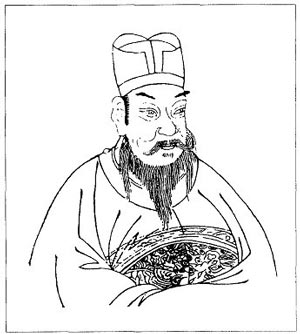 Yelü Chucai (1190 - 1244) was a descendent of the royal house of the Khitan, a Mongolic people whose Liao (or 契丹遼 Khitan Liao) dynasty (907 - 1125) once controlled much of northeast China from their capital city in 臨潢 Linhuang, near the modern city of 赤峰 Chifeng in what is today southeastern Inner Mongolia. He is best known as a statesman who brought Confucian learning to the Khitan Liao, with little mention of his interest in or importance to the qin zither, as discussed here below.
The area of north China controlled the Khitan Liao made them neighbors with the Song dynasty, in particular the Northern Song (960–1127), which had its capital in Kaifeng. During this period the Liao and Song, though competitors, co-existed through treaties, but when the 女真 Jurchen, a Tungusic people attacked the Liao from their base in Manchuria, the Song supported them. The result was that, after the Jurchen destroyed the Liao, they then drove the Song from north China and established the 金 Jin dynasty (1125-1234). The Jin initially had their capital near modern Harbin (1122-1153), but they moved it to Beijing (1153-1214) then Kaifeng (1214-1233), where they were destroyed by the Mongols. The Mongols then continued on to Hangzhou, the capital city of the Southern Song (1127-1280), which they also destroyed, establishing the Yuan Dynasty (1280-1368).
During this period the ancestors of Yelü Chucai served both the Liao and Jin governments. He himself was born in 薊城 Jicheng, an ancient part of what is now Beijing. According to his biography in the Yuan History, he spent all of his youth in the Beijing area and loved learning. Apparently through family tutors in his Khitan aristocratic household he mastered the classics (Confucian, Daoist and Buddhist) and also became learned in history, astronomy (including steppe cosmology/astronomy) and geography. The sources say that he had a prodigious memory, able to quote classical texts on command, and by 12 was writing essays.
Around 1213, when he was 23, he apparently entered official service under the Jin dynasty, initially in relatively junior scholarly positions. Here it is said his upright character and refusal to flatter limited his advancement in the corrupt final decades of Jin rule. However, there is little specific information about his life before 1218, when Genghis Khan (1162 - 1227), who had conquered the region in 1214, made him governor of Beijing.
By this time it is said his reputation as a learned, honest Khitan aristocrat made him stand out. Perhaps most importantly, after the Mongols summoned him to the royal court his early counsel emphasized administration over destruction — warning against depopulating conquered areas and arguing for taxation instead of massacre. This was particularly important as he soon became a close advisor to Genghis, accompanying him on some of his campaigns in Central Asia. He later became an administrator for Genghis' successor, Ogotai (1185 - 1241).
In all this he is said always to worked with benevolence. However, it is not clear when he acquired (gave himself?) the nickname Zhanran Jushi (The Tranquil Retiree). Dying at age 54, he would not have had a long retirement. 4
Yelü Chucai's connection to the qin is outlined in his entry in Qin Shi Xu below. It discusses his teachers and relates several of his experiences.
As for his own commentary on qin, Yelü Chucai's feelings seem to be expressed in particular through his poetry. Examples include:
In addition there is a preface to the poem, discussed also in Rao, Section 3. Here is a translation of the complete preface:
From my youth I devoted myself earnestly to the qin. As a youth, at first I received finger techniques from Mi Dayong; his style was tranquil, refined, and plain, forming a school of its own. Later I cherished the style of Qi Yan), which had the steep urgency of sounds from Shu (western Sichuan) — delighting the ears and eyes — and I often regretted never having been able to exchange fingerings with him directly and thus myself transmit the sound. After some twenty years had passed, I sought out his playing in Bianliang (Kaifeng) and was obtaining it, but he died midway [i.e. before I could fully learn it]. (Qi Yan's) son (Miao) Lan’s qin practice had deeply absorbed the subtle intent left by Qi Yan himself. In the winter of the year jiawu (1214), when I accompanied a hunt, I was excused on account of a foot ailment, and had sixty days of respite. During that time I played together with Lan more than fifty pieces. Thus I completely gained the refined principles of Qi Yan.
I therefore have composed this poem to record the matter.
Zhanran (i.e. I, Yelü Chucai,) having had an obsession with the qin, disdained the ordinary sounds of the string and pipe (ensembles).
Yet Qi Yan left descendants, who came after me across ten thousand li.
My former teacher Master Mi (Mi Dayong) had a plain style with even tones never hurried.
As for myself, I have always delighted in simplicity and indolence, while wealth and rank seem like shackles.
The original text of the poem is copied below.
Frequent application of vibrato grates upon the ears of the listener,
Van Gulik goes on to say that "Yelü Chucai in his later years adopted Qi Yan's classical style, and abandoned the technique taught by his earlier masters (Mi Dayong and the Old Master of 10,000 Pines).14
During the Tang, in the Qianfu era, the Court Musician Wang Yao once played it for Li Shanfu. In more recent times, during the Jin dynasty (Dading reign), in Bianliang the acting governor Wanyan Guanglu had the scholar Zhang Yanyi play it; and he asked Vice Minister Zhang Chong to prepare a tablature. Zhang Chong prefaced it with this explanation:
But Chong’s explanation, though plausible, is not quite right.
I myself believe that when Shuye created this piece, Jin had not yet usurped the throne. At that time, the shang mode music was close in sound to that of gong (mode), meaning “the minister acting in the ruler’s stead.” Thus he pointed at Sima Yi and his sons, whose power equaled that of a monarch, thereby admonishing the ruler of the day. Further, he introduced the story of Nie Zheng to censure the crime of such powerful ministers, worse than Xia Lei, and to lament the lack of a righteous man who could strike down the evil at the ruler’s side — thus arousing those with such purpose. Otherwise, what sense would there be in dragging in the distant story of Nie Zheng?
In the Taihe reign, the Court Musician Zhang Qizhi also played this piece. Yet when he came to the sections “Deep Reflection” and “Severe Trace,” he played them too slowly, with broken rhythm, and did not fully bring out their excellence. Only the recluse Old Master Qi Yan blended the sections into a single whole, which the scholar-officials all admired for its refinement and subtlety. His son Lan also inherited Qi Yan’s subtle intentions.
The poem itself, which includes a description of the melody as played by one Zhang Qizhi,12 might have been part of a collection of poems by Yelü Chucai. For this see Rao Zongyi's discussion of two poems, Preface to a Poem about Playing Guangling San and
Playing Guangling San All Day and Writing 50 Poems, both apparently a part of
Zhanran Jushi Ji.17
Chucai was enamored with the qin, disdaining vulgar music. Once he obtained a piece of hard timber, about three chi long, from the gates of an old palace. He carved it into a qin, and its tone was pure and clear. Delighted, he composed a poem about it.
At that time, those who were renowned for the qin included Mi Dayong, Qi Yan (“Cliff Dweller”), and Wansong Laoren (“Old Man of Ten Thousand Pines”). Mi Dayong’s playing was tranquil, elegant, and plain; Qi Yan’s style, by contrast, followed the Shu tradition — pressed and urgent. His son Lan inherited his art. Yelü Chucai studied finger-techniques from Mi Dayong. He always regretted not being able to meet Qi Yan in person and directly exchange techniques.
Twenty years later, when accompanying a hunt, (Yelü) fell ill with a leg ailment and was granted sixty days' leave. During this time he played together with Miao Lan19 more than fifty melodies. In this way he completely absorbed Qi Yan’s refined approach.
Yelü recorded the experience in this poem:
Now I behold Qi Yan’s intent:
Yin and nao vibrato techniques are simple and easy,
Both together form a single school,
A little faster, yet not impatient;
Wansong Laoren was another of Chucai’s teachers. Once he asked Chucai for a qin, and Chucai gave him the pieces Spring Thunder from the Chenghua Hall, and Sad Wind from Master Zhōngyu. Zhang Zhiwen studied Water Immortal from Chucai. In Zhang’s poems we find the lines: “When shall we meet again on the road to Yanshan? One song, facing the wind, I play ‘Water Immortal’.” This shows that Chucai was particularly skilled in Water Immortal.
(Sources: Yuan History; Zhanran Jushi Ji; Lüshuiting Zazhi; Chunhu Manlu.)
Yelü Chucai's son, 左丞相耶律鑄 Vice Premier Yelü Zhu,20 (1221 - 1285) was also a poet. Qinshu Daquan includes several poems by him about qin. See
1.
Yelü Chucai 耶律楚材
(Wiki)
The main sources for his life are:
2.
18 lines. Qin Shi Xu sources for Yelü Chucai are listed as:
湛然居士集,十四卷 Zhanran Jushi Ji
3.
Ming dynasty image of Yelü Chucai
4.
Source of Yelü Chucai's personal history
5.
Yelü Chucai and the qin
6.
On a Cold Evening Playing the Qin (冬夜彈琴 Dongye Tan Qin)
The melody has a preface, as follows (full translation above; elsewhere the first and
third lines have also been translated),
Yelü Chucai's complete poem then has 30 couplets, as follows (couplets 17-20 are translated):
棲巖有後人,萬里來相逐。
昔我師弭君,平澹聲不促。
我本嗜疏懶,富貴如桎梏。
Besides the complete translation above of the preface, the
preface and the
preface plus poem are discussed in Rao, Section 3.
7.
弭大用 Mi Dayong
8.
棲嚴 Qi Yan, nickname of Miao Xiushi
9.
苗蘭 Miao Lan
10.
萬松老人 Wansong Laoren (Old Master of 10,000 Pines)
12.
Loving the qin playing techniques of Qi Yan 愛棲巖彈琴聲法,二絕
多著吟猱熱客耳,強生取與媚俗情。
My translation is under Rao,
Section 3
13.
Van Gulik's footnote, p.76, explains: "'Wooden sounds' refers to the vibrato and other graces, produced by rubbing the string on the surface of the soundbox...."
14.
Van Gulik (p.76 footnote, but belongs with fn.71) calls them 弭大 Mita and 萬松 Wansong. His reference is Zhanran Jushi Wenji, Chapter 12, p. 2.
15.
Yelü Chucai's poem 彈《廣陵散》終日而成因賦詩五十韻 Playing
Guangling San at Midnight and Writing a Poem in 50 Rhymes (Couplets)
湛然數從軍,十稔若行役,而今近衰老,足疾困卑濕。
This poem has been translated into German by Manfred Dahmer; see Der Lange Regenbogen, Die Solosuite Guanglingsan für Qin; Uelzen, Medinizinisch Literarische Verlagsgesellschaft mbH, 2009; pp. 150-157.
16.
Preface to a Poem about Playing Guangling San (彈廣陵散詩序 Tan Guangling San Shi Xu)
18.
張器之 Zhang Qizhi (13th c. CE)
19.
Qin Shi Xu 30: Biography of Yelü Chucai
In some places Mi Dayong may have been shortened to "弭大 Mi Da". Another person mentioned in the text is 棲嚴 Qi Yan, whose name would mean "Dweller in Austerity" except that the name is usually written "棲巖" Qi Yan meaning "Cliff Dweller"), and this is the way it is interpreted here.
Near the beginning the characters "之裔" were originally written "元 over 犬" but without the top line of "元" missing, plus "欲". Other sources, presumably based on OCR, have written this as "突欲". However, that does not make sense so I have tentatively interpreted it as "之裔" ("descendant").
The complete original text is thus
紀以詩云:
20.
耶律鑄 Yelü Zhu (1221 - 1285)
This is the short title of a poem about studying with his teacher Mi Dayong.7 as well with his earlier teacher
Qi Yan ("the Cliff Dweller", a nickname of Miao Xiushi,8 along with Qi Yan's son Miao Lan.9 Later it mentions another player who inspired him,
Master Wansong.10
From childhood my heart was already set upon it; in adulthood my study became even more earnest.
Amid the press of wars and conflagrations, old tablatures were left unrecorded.
Looking back over twenty autumns, my silk and wood have lain bound and idle in the upper chamber.
They can continue the family craft; I regard them as younger brothers and uncles.
This winter, for sixty days, I played with them over fifty pieces.
Over fifty days I recorded new sounds; in ten mornings’ review they were already familiar.
"Lofty mountains" fill one with heroic spirit; "Autumn Waters" clear the heart and eyes.
"Sunny Spring" resounds with chimes of jade; "White Snow" shatters precious stone.
"Luo Riverbank" overflows with sorrow; the "Chu Concubine" sighs as though in tears.
"Li Sao" makes ghosts and spirits weep; its Breath stops shake the forest trees.
"Autumn Thoughts" exhausts the refined mood; "Three Joys in Song" comes from pure happiness.
Beyond these I cannot enumerate, but my thirsty heart is now replenished.
Like the music of the clear ancestral temple, solemn and stately was his bearing.
Now I observe Qi Yan’s intent: the rhythms change with sudden swiftness.
Though dense, they are never chaotic; cut off, yet able to continue.
The yin and nao [ornaments] are handled with ease;
light and heavy are divided as are rise and fall.
Hearing Qi Yan’s sound just once, I could not help but give my heart in admiration.
Together they form a single school, like spring orchids and autumn chrysanthemums.
Today I unite them into one, as the ocean gathers a hundred valleys.
A little faster, yet not impatient; seeming slower, yet not constrained.
The two masters studied for a lifetime; today all has returned to me.
Fortunate that I encountered Master Wansong — one awakening dissolved the three poisons.
Sooner or later I shall hang up my cap and go, building a thatched hut on Mount Lü.
With vegetables and bamboo shoots to fill the kitchen, coarse rice boiled of husked millet.
With my Spring Thunder zither by my side, how could I fear to eat without meat?
Morning and evening sated with pure sound—that alone is enough for my life.
Yelü Chucai's later advocacy of a simple style of qin play is perhaps summed up best in a set of two poems he wrote about Qi Yan, a nickname of his teacher Miao Xiushi. These have been translated as follows by R. H. Van Gulik in his Lore of the Chinese Lute.12
Frequent use of vibrato ritardando confuses the melody, frequent use of other vibrato leads to a lax style.
People of the present day do not understand the meaning of Master Qi Yan's music,
They only love the fashionable style, and play the qin so as to produce a rude noise.
This style is aimed only at captivating the common fancy.
The pure tones are simple - but who can appreciate them?
People only say that Qi Yan does not use the wooden sounds.13
This poem has the following preface, presumably by Yelü himself,
16
This poem, apparently from the same collection, also mentions qin.
Copied here under the melody Xiao Xiang Shui Yun, it is also an interesting northern reference to a region sometimes associated with southern exile.
Biography of Yelü Chucai (Qin Shi Xu #30)
The original text for the Qinshi Xu biography of Yelü Chucai is
below. Here is a tentative translation.
18
whose tones were plain and leisurely, never hurried—
like the music of the clear ancestral temple,
solemn, majestic in bearing.
rhythms shifting with sudden swiftness,
though dense yet never chaotic,
cut off yet able to continue.
light and heavy rise and fall in turn.
Hearing Qi Yan’s tones just once,
I could not help but give my heart in admiration.
like spring orchids and autumn chrysanthemums.
Now I unite them as one,
like the ocean embracing a hundred valleys.
seeming slower, yet without lag.
The two masters’ lifetime of study,
today has all returned to me.
Folio 19B, #156
Folio 20A, #76 and #77
Footnotes (Shorthand references are explained on a
separate page)
Yelü Chucai 29648.116 元,契丹人,履子,字晉卿,號湛然居士,又號玉泉老人.... was Khitan, during Yuan dynasty, son of Lü style name Jinqing, nicknames Zhanran Jushi and Yuquan Laoren. He rose to be Grand Councilor (丞相 Chengxiang; Hucker: in Yuan, active head of the Secretariat under an honorific Director [ling]).
《元史·耶律楚材传》 (the Yuan History, compiled in the 1370s: compare 新元史),
《湛然居士集》 Zhanran Jushi Ji: his own collected writings, and
Anecdotes preserved in later encyclopedias and Daoist/Buddhist records.
Also written simply as Yelu Chucai.
(Return)
See Chinese Wikipedia. Also in ctext but that is unpunctuated OCR. This work, in a preface plus 14 folios, is the most important collection of Yelü Chucai's own writings. It is included in Vol. 1191 of
Siku Quanshu. 18213.37
(ref: Siku Tiyao, ji, bie ji lei) says it consists mostly of Yelü Chucai's verse, which was quite distinctive.
(Return)
29648.116 says this is from 三才圖會 Sancai Tuhui.
(Return)
The information up to here comes from general online sources and deals mostly with official matters, though I have not seen a study of his own writings to know what personal details they include. In 1234, ten years before he died at the age of 54, the Mongols had driven the Jin from their capital (汴京 Bianjing (Kaifeng). He is known to have actively worked with Genghis Khan and then after 1227 with Genghis' son, Ögedei, who carried on with vast campaigns as well as establishing the new capital, Karakorum, in what is now Mongolia. After Ögedei died in 1241 it is not clear what Yelü Chucai was doing, but he is said to have died in Karakorum.
(Return)
Other references on this site can be found by searching my site here:
search me
(Return)
The full title is 冬夜彈琴頗有所得亂道拙語三十韻以遺猶子蘭 The Great Amount Learned while Playing the Qin on a Cold Evening; 30 miscellaneous musings for [Miao] Lan.
余愛棲巖如蜀聲之峻急,快人耳目,每恨不得對指傳聲。間關二十年,予奏之,索於汴梁,得焉。
中道而卒。
其子蘭之琴事,深得棲巖之遺意。甲午之冬,余扈從羽獵,以足疾得告。
凡六十日,對彈操弄五十餘曲,棲巖妙旨,於是盡得之。
因作是詩以紀其事云。
兒時已存心,壯年學愈篤。
倉忙兵火際,遺譜不及錄。
回首二十秋,絲桐高閣束。
能繼箕裘業,待予為季叔。
今冬六十日,對彈五十曲。
五旬記新聲,十朝溫已熟。
《高山》壯意氣,
《秋水》清心目。
《陽春》撼瓊玖,
《白雪》碎瑤玉。
《洛浦》太含悲,
《楚妃歎》如哭。
《離騷》泣鬼神,
《止息》振林木。
《秋思》盡雅興,
《三樂歌清福。
自餘不暇數,渴心今已沃。
如奏清廟樂,威儀自穆穆。
今觀棲巖意,節奏變神速。
雖繁而不亂,欲斷還能續。
吟猱從簡易,輕重分起伏。
一聞棲巖聲,不覺傾心服。
彼此成一家,春蘭與秋菊。
我今會為一,滄海涵百谷。
稍疾意不急,似遲聲不跼。
二子終身學,今日皆歸僕。
幸遇萬松師,一悟消三毒。
早晚掛冠去,閭山結茅屋。
蔬筍粗充庖,糲飯炊脫粟。
有我春雷子,豈憚食無肉。
旦夕飽純音,便是平生足。
(Return)
9988.xxx but see Van Gulik, where he is called Mi-Ta (pp. 76, 78, 83); it says there he played Zhejiang style, and that Yelü Chucai later abandoned this style for the Sichuan style of Qi Yan [Miao Xiushi - reference given is Zhanranjushi Wenji.
(Return)
Should be (also?) 棲巖 Qi Yan. Below are two poems Yelü Chucai wrote praising his qin play. He is mentioned by Van Gulik, Lore pp. 76n and 78n. This is said to be a nickname of Miao Lan, also called Miao Xiushi.
(Return)
Son of Miao Xiushi.
(Return)
25455.262 has nickname only for 楊彝 Yang Yi (late 14th c., so not him).
(Return)
These two poems by Yelü Chucai are in his 湛然居士文集 his Collected Works of Zhanran Jushi. Van Gulik's translation is in Lore, page 78, footnote 171 (transliteration here changed to pinyin). The original poems are,
世人不識棲巖意,祗愛時宜熱鬧琴。
純音簡易誰能識,即道棲巖無木聲。
(Return)
(Return)
(Return)
This poem is partially translated and further discussed in Wang Shixiang's
article on Guangling San; linked phrases, mostly mentioning section titles, are also discussed in Wang's chart there. The poem's original preface, also shown below, is discussed
here by Rao Zongyi):
歲暮懶出門,不欲爲無益。穹廬何所有,祇有琴三尺。
時複一弦歌,不猶賢博奕,信能禁邪念,閑愁破堆積。
清旦炷幽香,澄心彈止息,薄暮巳得意,焚膏達中夕。
古譜成巨軸,無慮聲千百,大意分五節,四十有四拍。 (These 8 lines, to 神泣, are translated here)
品絃欲終調,六弦一時劃,初訝似破竹,不止如裂帛。
(Chart)
忘身志慷慨,別姊情慘戚,衝冠氣何壯,投劍聲如擲。
呼幽達穹蒼,長虹如玉立。將彈發怒篇,寒風自瑟瑟。
瓊珠落玉器,雹墜漁人笠,別鶴唳蒼松,哀猿啼怪栢。
數聲如怨訴,寒泉古澗沚,幾折變軒昂,奔流禹門急。
大絃忽一捻,應絃如破的.雲煙速變滅,風雷恣呼吸。
數作撥刺聲,指邊攆霹靂,一鼓息萬動,再弄鬼神泣。
叔夜志豪邁,聲名動蠻貊,洪爐燬神劍,自覺乾坤窄。
鐘會來相過,箕踞方袒裼,一旦誅殺之,始知襟度阨。
新聲東市絕,孝尼無所獲,密傳迨王遨,會為仙露客。
近代有張研,妙指奠能及,琴遭震汴洛,屢陪光祿席。
器之雖有聲,錬此頭垂白,中間另起意,沈思至峻跡。
節奏似支離,美玉成破璧,為山功一簣,未精誠可惜。
我愛棲嵓翁,飜聲從舊格,始終成一貫,雅趣超今昔。
三引入五序,如作意如翕,縱之果純如,將終檄而繹。
嵇生能作此,史臣書簡策.又謂神所授,傅自華陽驛。
韓皋破是說,以為避晉隙,張崇作譜序,似是未為得。
我今通此論,是非自懸隔,商輿宮同聲,斷知臣道逆。
權臣侔人主,不啻韓相賊,安得聶政徒,元惡誅君側。
上樅悟天子,下則有所激。惜哉中散意,千古無人識。
(Return)
Quoted in Rao Zongyi, Section 3. Van Gulik's footnote, p.76, says, "Yelü Chucai was especially interested in the melody Guangling San...."
(Return)
10026.xxx; no further information, except that this was during 1201-1208, and Yelü Chucai's poem identifies Zhang as a Daizhao:
Qin Daizhao? See also Rao Zongyi, "Historical Account", p.87.
(Return)
The biography title, after "耶律楚材" is written:
耶律楚材,字晉卿,號湛然居士,遼東丹王之裔,八世孫。仕元至中書令。宦蹟具元史本傳。
楚材有琴癖,不喜俗樂。嘗得故宮門堅木三尺許斲為琴。有清聲。大喜。作詩詠之。同時以琴名者有弭大用、棲嚴、萬松老人之屬。(弭)大用琴閒雅平淡。棲嚴則蜀聲捘急。其子蘭傳其學。楚材受指法於大用。每恨不得,與棲嚴妙對指傳聲後二十年扈從羽獵以足疾得告凡六十日與苗蘭對彈操弄五十餘曲。棲嚴妙旨於是盡得之。
昔我師弭君,平淡聲不促。
如奏清廟樂,威儀自穆穆。
今覩棲巖意,節奏變神速。
雖繁而不亂,欲斷還能續。
吟猱從簡易,輕重分起伏。
一聞棲巖聲,不覺傾心服。
彼此成一家,春蘭與秋菊。
我今會爲一,滄海涵百谷。
稍疾意不急,似遲聲不踢。
二子終身學,今日皆歸僕。
元史
淮然居土集
綠水亭雜識
蒓湖漫鐵
(Return)
29648.166; Bio/1409. Rao Zongyi discusses a Yelü Shu ( 耶律璹 29648.xxx; Bio/xxx); this is apparently the same person.
(Return)