|
T of C
Home |
My Work |
Hand- books |
Qin as Object |
Qin in Art |
Poetry / Song |
Hear, Watch |
Play Qin |
Analysis | History |
Ideo- logy |
Miscel- lanea |
More Info |
Personal | email me search me |
| SQMP / Fan Canglang / in QSCB / Tracing chart / Illustrations | 聽錄音 Listen to my recording with transcription / 首頁 |
|
56. Marshbank Melody
- Qiliang mode (tighten 2nd/5th strings: 2 4 5 6 1 2 3 2 |
澤畔吟
Zepan Yin 1 4 illustrations |
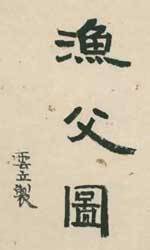 This Zepan Yin melody was quite common in early extant handbooks, surviving in nine of them from 1425 to 1585; usually it preceded
Li Sao. Later, however, it seems to survive in only one handbook, a repeat of the Shen Qi Mi Pu version in the 1670 Qinyuan Xinchuan Quanbian, which copies a number of old melodies. After this the title (and apparently the melody) disappear (see appendix).
This Zepan Yin melody was quite common in early extant handbooks, surviving in nine of them from 1425 to 1585; usually it preceded
Li Sao. Later, however, it seems to survive in only one handbook, a repeat of the Shen Qi Mi Pu version in the 1670 Qinyuan Xinchuan Quanbian, which copies a number of old melodies. After this the title (and apparently the melody) disappear (see appendix).
In addition, Xilutang Qintong (1525) has two versions, the present one and a second that seems musically unrelated except for the mode; and Zepan Yin is also the title of yet another melody (still in qiliang mode) found in handbooks dated 1589 and 1602 .3
Zepan Yin is the only piece Shen Qi Mi Pu ascribes to Xu Tianmin, the famous Song dynasty qin teacher and colleague of Mao Minzhong. Xu is better known as a collector and teacher of old qin pieces.4
The original reference to a fisherman by a marshbank comes from the chapter The Fisherman in the book of Zhuangzi.5 Here a passing fisherman makes a comment about Confucius' failings. Confucius goes down to the marshbank and receives a lecture before the fisherman rows off.
Perhaps this story was a model for the story related here, which can be found in a poem in the Chu Ci, the Songs of the South.6 The Chu Ci collection has several stories along these lines, all concerning (or perhaps written by) the unemployed scholar-official Qu Yuan (340?-278 BCE), but the section titles of the Zepan Yin here, as well as the titles and lyrics of the musically identical setting in Zheyin Shizi Qinpu, directly connect this melody with the poem called Chu Ci poem Yu Fu, The Fisherman. This poem presents a conversation between Qu Yuan and a fisherman on a marshbank; when Qu Yuan speaks of his grief, the fisherman responds by getting into his boat and singing a Canglang Song,7 the meaning of which is that when government is clean it is fine to work with it, but when it becomes dirty one should be happy to leave it.
The lyrics in the Zheyin Shizi Qinpu version of Zepan Yin, given below with translation, focus on Qu Yuan's complaint. For lyrics connected to the fisherman's response see those from the same source for Fan Canglang.
This story is related in detail in Qu Yuan's biography in The Book of History,8 which quotes another Chu Ci poem, Embracing Sand (Huai Sha, one of the Jiu Zhang), adding that after reciting the poem Qu Yuan jumped into the Miluo river and drowned himself, an event still commemorated by the Dragon Boat Festival on the fifth day of the fifth lunar month.
Other melodies connected to Qu Yuan's grief include the Li Sao (#57), which relates Qu Yuan's fanciful search for a worthy sovereign; and Qu Yuan Wen Du, which also depicts an encounter between Qu Yuan and a fisherman (or boatman).
Zhu Quan in Nanchang, although as a prince he could be considered an official, was in fact in a form of exile for having been associated with a rival competitor to the emperor, and so he had to steer clear of any official controversy. The lyrics added to this melody in Zheyin Shizi Qinpu also includes a reference to Canglang.
There is also a recording of this piece by Yao Gongbai, his own reconstruction, not Yao Bingyan's.
The Emaciated Immortal says
this piece is said to have been composed by Xuejiang (Xu Tianmin). It depicts Qu Yuan's upright service to his lord, being out-of-step with his (evil) times and thus sent into exile, then wandering along theqin banks of a river, having the heart of a man loyal to his lord and loving his country, resulting in his appearance seeming withered and melancholy. Furthermore, this connects with his meeting a fisherman and telling him (this story) in order to get rid of his feelings of depression at being covered with the dust (of society), not realizing that the old fisherman would disagree, then row his boat off by himself. (Qu) Yuan, having no one to whom he could speak his accusations, could do nothing and had to stop. This idea of there being nothing one can do cannot help but cause listeners to be moved to sadness, cry bitterly and shed tears, and be unable to stop sighing.
Music
Timings follow the recording on
my CD;
聽錄音 listen with
my transcription.
Four sections:10
(00.00) 1. Wandering along the bank of the river11
(00.42) 2. Meeting an old fisherman as he travels
(01.32) 3. Unfairly treated by society
(02.18) 4. Paddling the boat and singing.
(02.58) -- play harmonics of this mode
(03.14) -- Melody ends
The lyrics of Zepan Yin in Zheyin Shizi Qinpu (>1505; same melody/tablature as here) are as follows:
-- The lyrics are generally paired with the tablature following the standard pairing method.
-- Although they can be sung to the 1425 qin setting, in a few places they suggest different phrasing than here.
-- These 4 illustrations correspond to the 4 sections here.
- 澤畔吟
- 第一段 遊於江澤
Section 1: Wandering by the Rivers and Marshes遊於那江澤,形容變盡當時色。
Roaming through river and marsh,
my appearance utterly changed in accord with the tone of the age.千里一身,嗟去國,「天問」無聞,心空南北。
A lone body over a thousand li,
I sigh, having left my native land.
My “Heavenly Questions” go unanswered;
my heart, empty, drifts between north and south.愁相寒俟罪,長沙時移勢迫。
Grief meets cold as I await judgment.
In Changsha, the times shift, and power closes in.漁釣鷗盟,天寬地窄,此情空默默。
With fishermen and gulls I made my pact,
the heavens are vast, the earth narrow.
This feeling: I hold it in silent loneliness.- 第二段 行遇漁父
Section 2: Encountering the Fisherman行遇那漁父,委身問渡。
I met the fisherman, and humbly asked to cross.子非三閭那大夫,霜寒日暮,於斯何故?
“Are you not the great lord of the Three Houses>? Why do you linger here, in cold and twilight?”欲答情難訴,舉世俱皆濁,我獨清而恐污,
I wish to answer, but cannot express my grief.
The world is entirely foul, I alone am pure—yet fear contamination.眾人皆醉,我獨醒醒。
All are drunk, I alone sober.因遭所惡,故無所措,
Thus I am hated, so that I have no place to turn.空此孤忠回護。
Only my lonely loyalty remains to guard me.- 第三段 蒙世塵埃
Section 3: Soiled by the Dust of the World蕙世污塵埃,靈均只自哀
Even orchids in this age are defiled by dust, so I, Lingjun, must mourn alone.恐污潔白,此意徘徊。
Fearing my purity sullied, I linger in this thought.浮生槁木灰,蕭蕭草徑嘆無媒。
This fleeting life like dead wood and ashes; through weedy paths I sigh for lack of friends.心事摧頹,口空咍。時世疑猜此身。
My inner thoughts are broken; my mouth can only laugh bitterly.
In this age of suspicion, I am a solitary shadow.孤影楚天涯,物我總忘骸。大義殊乖。
At the ends of Chu’s sky—forgetting even body, self, and world.
Righteousness now estranged,逐客怯幽懷,嘆沉埋。
The banished guest hides his troubled heart.
I lament my burial in obscurity恢恢天網危,力犯風雷。
Heaven’s net is vast and perilous, yet I defy the storm and thunder.- 第四段 鼓枻而歌
Section 4: Singing while Beating the Boat’s Side鼓枻而歌,滄浪細和,嘔啞滹沱。
I beat the boat’s side and sing;
the Canglang waters softly echo.
Hoarse and broken, like the muddy Tuo.清濁從他。濯纓濯足:何可而不可?
Clear or turbid, let it be. Wash my tassel? Wash my feet?
Why should one be allowed, the other not?見疏空自苦風波。玉堂金馬,的那雨笠煙簑。
Though cast off, I suffer the storm alone.
From jade hall and golden court to rain-hat and reed cloak.光陰百歲事無多,忠節永無磨。
In a hundred years of fleeting life, few things truly matter—
but loyalty and integrity will never fade.尾聲
Coda(漁父曰?)不如隨時風月樂,優(游)遨遊。
(In the words of the fisherman), “It is better to follow the times and delight in wind and moon, roaming freely at ease.” - 第二段 行遇漁父
Zepan Yin (Marshbank Melody)
Return to the Shen Qi Mi Pu ToC or to the Guqin ToC.
Footnotes (Shorthand references are explained on a
separate page)
1.
References
澤畔吟 18858.33 zepan: Quotes the story from
Zhuangzi. See also comments by Xu Jian, p.107. Normally I don't translate such words in the title as "yin" and "cao", but in this case the related story also involves a song (滄浪歌 Canglang Ge, discussed further
below).
(Return)
2.
凄凉意 Qiliang Mode (see also tracing chart)
For further information on qiliang mode see
Shenpin Qiliang Yi and
Modality in Early Ming Qin Tablature.
(Return)
3.
Tracing Zepan Yin
The appendix below is largely based on Zha Guide 9/89/137.
(Return)
4.
Xu Tianmin
For further information on Xu and his contemporaries see
Historical Notes on the Silk
String Zither.
(Return)
5.
Zhuangzi, Section 31 Yu Fu, beginning. See translation by James Ware.
(Return)
6.
楚辭 Translated by David Hawkes (Penguin, p.206); see also Xu Yingchong, Poetry of the South, Hunan Publishing Co. p.163 (dual language). The conversation takes place along a marshbank.
(Return)
7.
Canglang Song (滄浪歌 Canglang Ge)
Reference under #52 Fan Canglang. Section 4 of the lyrics added to the Zepan Yin in Zheyin also include a reference to Canglang (the Canglang River?). However, there is no musical relationship to the surviving Fan Canglang melody, which is grouped here under the previous mode (ruibin).
(Return)
8.
See The Grand Scribe's Records, William Nienhauser, ed., Vol. VII, p.299.
(Return)
9.
For the original Chinese text see 澤畔吟.
(Return)
10.
For the original Chinese titles see 澤畔吟.
(Return)
- 11. Three marginal notes, in Sections 1, 2 and 4
- A marginal note near the beginning of Section 1 says,
"憔悴枯槁 his form is withered and wizened".
In Section 2 a passage is prefaced by, "我獨清醒 I am the only one who is clear-handed".
In Section 4 the first passage is described as, "此段鼓枻聲 this section has the sound of rowing".
(Return)
Appendix: Chart Tracing Zepan Yin
Based mainly on Zha Fuxi's Guide,
9/89/137.
|
琴譜
(year; QQJC Vol/page) |
Further information
(QQJC = 琴曲集成 Qinqu Jicheng; QF = 琴府 Qin Fu) |
|
1. 神奇秘譜
(1425; I/169 [detail]) |
4T; Zhu Quan attributes it to Xu Tianmin
Precedes Li Sao |
|
2. 浙音釋字琴譜
(>1505; I/264) |
4T; lyrics; otherwise same as 1425
Precedes Qu Yuan Wen Du |
|
3. 西麓堂琴統
(1525; III/251) |
#1: 4 sections; same titles but a few changes in music
No separate afterword: both this and next seen as preludes to Li Sao? |
|
. 西麓堂琴統
(1525; III/252) |
#2: 3 sections; "又 Also"; seems to be a completely new melody
Precedes Li Sao; no separate afteword |
|
4. 風宣玄品
(1539; II/303) |
4T; same titles as 1425; same music except for punctuation
|
|
5. 琴譜正傳
(1561; II/497) |
4T; titles as 1425; music also seems same as 1425;
not in 1546
|
|
6. 步虛僊琴譜
(1556; F7#3) |
4; titles as 1425; music also seems same
Not in QQJC/ see facsimile edition, folio 7, #3 |
|
7. 太音傳習
(1552-61; IV/168) |
4T; related to 1425
|
|
8. 太音補遺
(1557; III/393) |
4T; similar to 1425
|
|
9. 重修真傳琴譜
(1585; IV/511) |
4T; Titles diff. from >1505 but lyrics same;
Music is related to 1425 but very different |
|
. 玉梧琴譜
(1589; VI/92) |
3; new melody, different from both 1425 and 1525 #2
|
|
. 藏春塢琴譜
(1602; VI/445) |
3; same as 1589
|
|
10. 琴苑新傳全編
(1670; XI/417) |
4; no titles but seems to try to copy 1425: differences are mistakes?
|
Return to the Shen Qi Mi Pu ToC or to the Guqin ToC.