|
T of C
Home |
My Work |
Hand- books |
Qin as Object |
Qin in Art |
Poetry / Song |
Hear, Watch |
Play Qin |
Analysis | History |
Ideo- logy |
Miscel- lanea |
More Info |
Personal | email me search me |
| Novels and Operas / Performance themes / My performances / the seduction song? | 首頁 |
|
Qin in Xi Xiang Ji
|
古琴與西廂記
Scholar Zhang, qin and Oriole 2 |

In the Yuan drama Xi Xiang Ji, as written in the 13th c. CE by Wang Shifu,3 Scholar Zhang while preparing for the civil service exam comes to Buddhist monastery, where he sees and falls in love with Cui Yingying (Oriole).4 She falls in love with him after hearing him play the qin, but her mother has promised her to another. Later, by defeating some bandits, Scholar Zhang gains approval to marry Oriole, but when he then leaves to take the exam the mother again tries to marry her to the original suitor. Scholar Zhang returns just in time; he and Yingying then wed.
This story can be traced back to Yingying Zhuan, a Tang dynasty short story by Yuan Zhen (799-831),5 where it is Yingying who plays the qin. At one point she mentions the Sima Xiangru story, but there are no relevant lyrics; the qin is not used for seduction.
The qin song lyrics as they appear in the Yuan drama are almost identical to those that were in the earliest surviving complete zhugongdiao, called Xixiang Ji Zhugongdiao,6 dating from the 12th century. Although these lyrics are also attributed to Sima Xiangru, I don't know of any published occurrence earlier than here; Scholar Zhang plays them to seduce Ying-Ying.
The opera itself specifies that Scholar Zhang seduces Oriole by playing the qin song in his room while she listens from outside.7 The lyrics are the same as those of the qin melody Wen Jun Cao (links there to recordings). That melody is also sometimes called Feng Qiu Huang, and are said to have been used originally by Sima Xiangru to seduce Zhuo Wenjun, but outside of this context the Sima Xiangru lyrics are usually the lyrics used with the 1525 Feng Qiu Huang).
In an ensuing aria Student Zhang mentions several other qin melodies, suggesting they are less romantic.8 Still later, another scene also has him playing In the novel Hong Lou Meng Grandmother Jia mentions having heard someone playing qin melodies from this opera.
Many songs in operas are identified only by the name of a
cipai or qupai. Some of these names are also the names of guqin melodies. In Xi Xiang Ji these cipai/qin melody titles include:
This has not yet been studied in detail, but it seems that none of the word patterns of the opera lyrics are the same as those of that accompany these qin versions. In addition, there is no song title or cipai connected to potentially the most closely connected song in the opera, the seduction song Feng Qiu Huang.
The significance of these latter two observations is not clear. At a minimum it points to the difficulty if not impossibility of using such qin melodies to try to recreate songs such as might have been in the original opera.
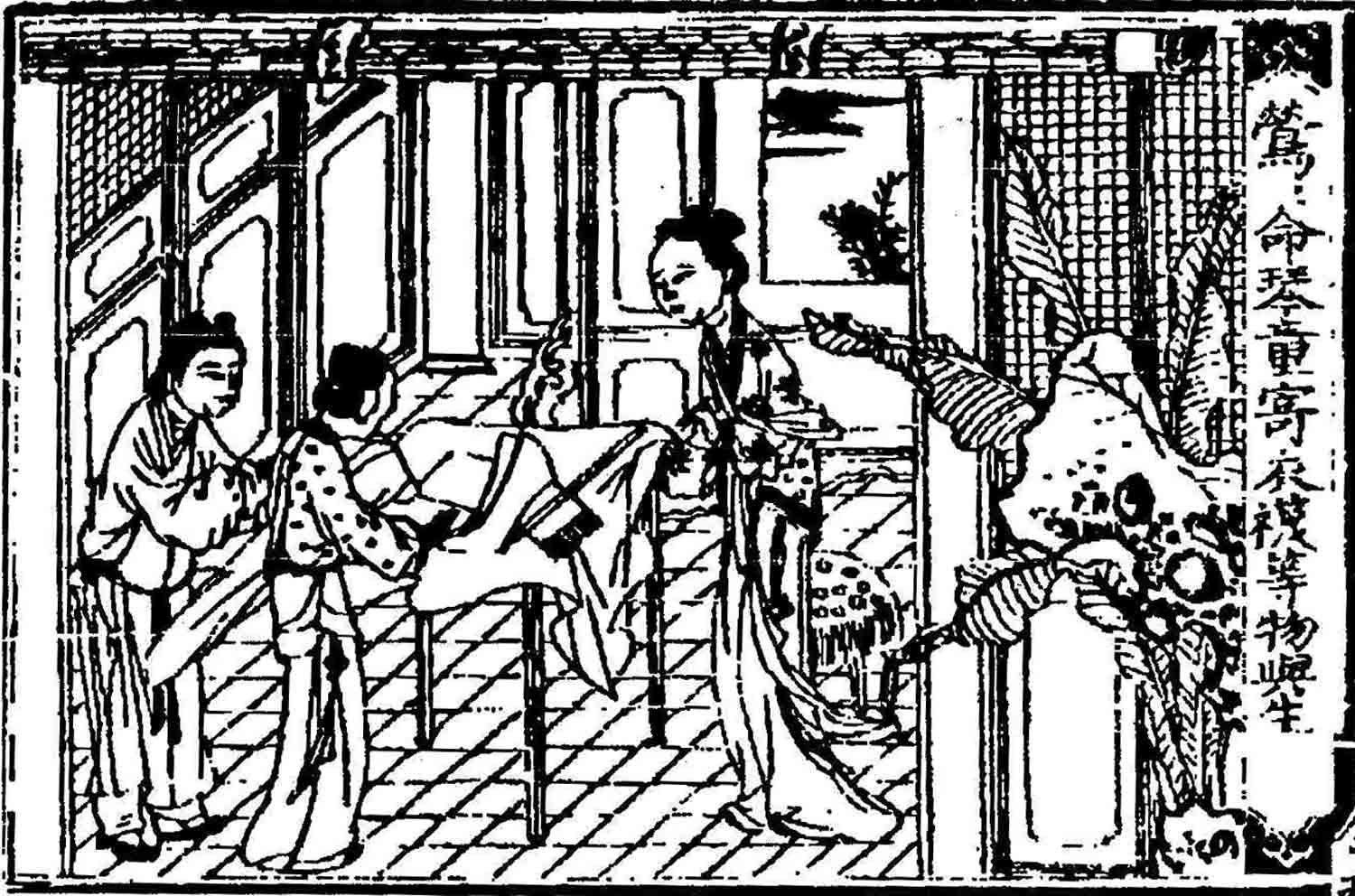
One of the characters in the play is a "qintong" (qin servant); this is one of the earliest mentions of this term.12
1.
Xixiang Ji 西廂記
(Wiki)
Meanwhile, the most complete translation is Stephen H. West and Wilt L. Idema (ed. and transl.), The Moon and the Zither; Berkeley, University of California Press, 1991 (4 acts). A modern illustrated abridgement is The Western Chamber, Hong Kong, Hai Feng Publishing Co. 1982. The play is discussed in LXS, p.33.
2.
Image
3.
王實甫 Wang Shifu (fl. 13th c.)
4.
張生 Scholar Zhang; 崔鶯鶯 Cui Yingying.
5.
Yingying Zhuan 鶯鶯傳
Yingying is also said to have been the one playing qin in "Yingying Plays the Qin" (鶯鶯操琴 Yingying Cao Qin), a song from the 評彈 pingtan repertoire. Pingtan is a traditional Chinese singing style apparently originating in Suzhou (Suzhou ballad singing [蘇州評彈 Suzhou Pingtan]). Performances include the lyrics, "香蓮碧水動風凉...."; these lyrics apparently date from the Qing dynasty. There are a number of melodies and variants that may be sung to these lyrics, and modern day references seem all to connect this song to the Xi Xiang Ji . However, in pingtan the lyrics are not actually connected directly to any versions of the story. See the discussion here.
6.
西廂記諸宮調 Xi Xiang Ji Zhugongdiao
As of 2024 the complete text could be found online at
www.my285.com. Scholar Zhang's seduction song lyrics (Section 4) here are as follows:
There are three differences here: 翙翙, 張絃 and 何時.
7.
Scholar Zhang seduces Oriole
Note that Oriole, she approaches the room where he is playing, speaks of the moon as "The Palace of Spreading Frigidity" (Guang Han Gong, as in Guanghan You), and as she hears him tuning the qin she wonders if her walking is causing sound from her hanging jade pendants (huanpei, as in Tianfeng Huanpei). See West and Idema, op.cit., p.267ff.
8.
West and Idema, p. 273. The Chinese text there has Scholar Zhang singing,
The three melodies mentioned are as follows,
The play dates from the 13th century: at that time could #1 and #3 been different, unrelated melodies?
9.
賀聖朝 He Sheng Chao (He Shengchao?)
Although ZWDCD does not include this title (it seems to have only the following related references: 賀 37609.xxx [praise; surname]; 聖朝 29727.224 a respectful way to refer to the current dynasty), a Wikipedia entry identifies it as a cipai, as follows:
賀聖朝,詞牌名。上下闋共四十九字。這一個詞牌格式變體較多。但是不管是何種變體,兩闋中凡五字句的節奏均為:×、××××。
[編輯] 詞牌格式
[編輯]代表作 Representative example: poem by Zhang Xian (990~1078)
Note that this does not fit the character arrangement given with the pingze pattern. However, the example in another Chinese Wiki entry does, a He Sheng Chao poem by 葉清臣 Ye Qingchen (? - 1051), as follows:
滿斟綠醑留君住,莫悤悤歸去。
The lyrics for the qin melody called He Sheng Chao Primary Form (? Zha Guide
賀聖朝第一體 He Shengchao diyi ti), included only in 松聲操 Song Sheng Cao
(XII/410, 1682), are somewhat different again:
Since there seems to be no structural connection between these examples (see also other online entries such as this one) and the Xi Xiang Ji lyrics, the significance of He Sheng Chao as an opera melody title is not yet clear. No source is given fro the qin melody.
10.
Dian Jiangchun 點絳唇 (點降脣)
Translated in The Moon and the Zither, p.172.
11.
Basheng Ganzhou 八聲甘州
Translated in The Moon and the Zither, p.219.
Although "qin tong" may usually be translated (and appear in paintings) as "qin boy", in some illustrations, such as the ones in this site with Cangwu Yuan and Hujia Shibapai, the qin carrier looks female. And in some literature both "qin tong" and (less commonly) "qin niang" may have been used for servants in general. In fact, their use here may suggest that both terms might have been euphemisms (pretentious euphemisms?) for servants (at least personal servants) in general.
This more general usage seems, for example, to be the case in another early novel, Jin Ping Mei (The Plum in the Golden Vase). Here there is mention of both qin tong and qin niang. These literally should mean "qin boy" and "qin girl", but in this novel "qin tong" seems to be a term more generally applied to male servants while "qin niang" seems always to be the name of (or a name used for) a female character in an opera, perhaps someone in a similarly more general role.
The idea that adding the word "qin" to a name is somewhat pretentious comes from facts such as that in the novel the main character Ximen Jing is often mentioned as having qins in rooms, but they seem to be there for decoration, since Ximen Jing himself is never himself depicted playing one. Similarly, in addition to 琴童 qin tong he has 棋童 qi tong, 書童 shu tong and 畫 hua tong, i.e., one named after each of the
four arts, though there is no suggestion that this had anything to do with their work or their skills.
In Chinese landscape painting it was a common motif to show the scholar walking in the countryside wih a qin carried either by himself or by a servant. Here the boy might also be responsiblve for such matters as brewing tea (illustration). Quite likely other tasks could have included stringing the instrument when necessary as well as perhaps even tuning it (further comment). These would be jobs for "real" qin boys.
Footnotes (Shorthand references are explained on a
separate page)
The Chinese text is online in several places. For example, in addition to
Gutenberg there are links in
"zh.wikisource" to three:
崔鶯鶯待月西廂記 (by
Wang Shifu, 1260 — 1336)
北西廂記 ("northern")
南西廂記 (Ming dynasty, "Southern").
(Return)
This is from 張國標 Zhang Guobiao, ed., 徽派版畫藝術 Art of Woodcut of the Huizhou School, 安徽省美術出版社 Anhui Publishing House, 1995, p.112 ("北西廂記").
(Return)
Courtesy name of Wang Dexin (1250-1307? see short entry in Wiki).
(Return)
(Return)
Yingying Zhuan is a Tang tale (傳奇 chuanqi; ICTCL/353,
Wiki) by 元稹 Yuan Zhen (ICTCL/949, which outlines the story); it is translated in James Hightower, "Yuan Chen and the story of Ying-ying." Harvard Journal of Asiatic Studies 33, 93-103. The translation is included in several compilations, including Stephen Owen, An Anthology of Chinese Literature. In this version it is Ying-ying, not Scholar Zhang, who plays the qin. In one case she stops when she finds out he is listening; later, when it becomes apparent that they will not marry, she plays it for him, expressing her grief as a parting gift.
(Return)
Zhugongdiao is explained in this translation from French Wikipedia entry. ICTCL, p.332, says the only surviving complete zhugongdiao script is the Xi Xiang Ji Zhugongdiao by Master Dong (董解元 Dong Jieyuan), which dates to around 1200; on p.409 it summarizes the plot (which now ends with Ying-ying and Scholar Zhang marrying).
鳳飛翙翙兮四海求凰,無奈佳人兮不在東牆。
張絃代語兮聊寫微茫,何時見許兮慰我彷徨?
願言配德兮攜手相將,不得于飛兮使我淪亡。
(Return)
Scholar Zhang, having lit the incense and tuned his qin, addresses it as follows (translation from Idema):
Ah, zither, you and I have been constant companions on our wanderings. The success of tonight all depends on your demonic quality, your golden chord marks, your jade bridges, your snake-patterned bellows in crinkled lacquer, your scorched tail of Yiyang wood, and your
icy strings....
(Return)
15 occurrences from 1559 to 1878; 1561 says it is the same melody as #3.
There is a qin melody called Old Toper's Intonation
(醉翁吟 Zui Weng Yin), but I do not know of a melody with the words Huang He (Yellow Crane) in the title.
Only in 1559, but says its original title was Qing Ye Wen Zhong (i.e., #1).
(Return)
The labeling of He Sheng Chao in Xi Xiang Ji suggests that it should be considered as following a cipai or qupai. Its lyrics (translated in The Moon and the Zither, p.384) are as follows:
少甚宰相人家,招婿的嬌姿。
其間或有個人兒似爾,
那堥那溫柔,這般才思?
想鶯鶯意兒,怎不教人夢想眠思?
(Cipai with 49 characters (compare 42 in Xi Xiang Ji, but a variety of forms; 5 character phrases tend to have the rhythmic pattern ×、××××. The standard ping ze patterns are:
平平仄仄平平仄,仄平平平仄。
平平仄仄仄平平,仄平平平仄。
平平仄仄,平平仄仄。仄平平平仄。
平平仄仄仄平平,仄平平平仄。
淡黃衫子濃妝了。步縷金鞋小。
愛來書幌綠窗前,半和嬌笑。
謝家姊妹,詩名空杳。何曾機巧。
爭如奴道,春來情思,亂如芳草。
三分春色二分愁,更一分風雨。
花開花謝,都來幾許。且高歌休訴。
不知來歲牡丹時,再相逢何處。
錦囊佳句,廣陵仙曲,箇中窮究。
芒鞋竹笠,偶來山右,見我渾如舊。
感君有意,笑余無綠,簿書辜負。
(Return)
See in Japan. The examples here are all shorter than the full cipai lyrics (full pattern is 4,7;4,5;4,5;3;4,5). The first example is,
望眼連天,日近長安遠。
(Return)
The structure differs from that of the melody of this title in
Japan. In the opera the melody is said to be in "仙呂調 xianlü mode" (also mentioned with Basheng Ganzhou there), but here the lyrics are:
羅衣寬褪,能消幾度黃昏?
風裊篆煙不捲簾,雨打梨花深閉門;
無語憑闌幹,目斷行雲。
(Return)
11. Qin boy (琴童 or 琴僮 qin tong; perhaps also 琴娘 qin niang: qin girl)
- Illustration at right is from The Moon and the Zither, p.367The inscription says, "Ying (Oriole) orders the qin servant
to take clothing, stockings and other things to the student"
 For 琴童 21570.xxx but
HYDCD 4/587 has "侍琴的童僕 a servant who takes care of the qin". It gives as its earliest example 宋,廖瑩中《江行雜錄》 River Travels Miscellany by Liao Yingzhong (late Song). Here is says, "琴童、棋童、廚娘等級。截乎不紊 The class of qin boys, chess boys and kitchen girls were restrained without confusion" (?). The next reference it gives is from here in Xi Xiang Ji (Idema translates the term as lute boy").
For 琴童 21570.xxx but
HYDCD 4/587 has "侍琴的童僕 a servant who takes care of the qin". It gives as its earliest example 宋,廖瑩中《江行雜錄》 River Travels Miscellany by Liao Yingzhong (late Song). Here is says, "琴童、棋童、廚娘等級。截乎不紊 The class of qin boys, chess boys and kitchen girls were restrained without confusion" (?). The next reference it gives is from here in Xi Xiang Ji (Idema translates the term as lute boy").
(Return)
Return to the Guqin ToC