|
T of C
Home |
My Work |
Hand- books |
Qin as Object |
Qin in Art |
Poetry / Song |
Hear, Watch |
Play Qin |
Analysis | History |
Ideo- logy |
Miscel- lanea |
More Info |
Personal | email me search me |
| Zheyin Yu Ge / Other images: #1 and #2 | 聽錄音 Listen to my recording with transcription / 首頁 |
|
08. Melody of the Fisherman's Song
- Ruibin mode,2 from standard tuning raise the 5th string: 2 3 5 6 1 2 3 |
漁歌調
1
Yuge Diao |
| From the Freer Gallery of Art: Wu Zhen, The Fisherman 3 |
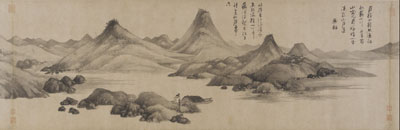 This title, usually with the same lyrics but generally with different music, survives in 12 handbooks up through Meian Qinpu (1931).4 Later versions usually have the title Leji Yin or Jile Yin (Melody of Great Happiness).5 All versions examined precede renditions of Yu Ge, later called Ao Ai.6 Sometimes a version of this melody is actually used as the first section of Ao Ai.7
When the melody has lyrics they are, as here, the poem Yu Weng (An Old Fisherman) by Liu Zongyuan (Liu Zihou, 773-819), a famous Tang dynasty poet.8
The comments in the preface below probably refer to the main piece as well, which follows.
The Beyond-Sounds Immortal says, this melody originated with a creation by Liu Zihou. The Royal Ancestor's handbook doesn't have this melody. But later people added to it so as to give shape to its structure and broaden its melodies. (It expresses) attaining pleasure on the rivers and lakes, not tied down by worldly restraints. Only people who flee fame and avoid society are able to discern that this is music of the highest caliber. I think this is much better than all other music.
Music and Lyrics10
Timings follow the recording on
my CD;
聽錄音 listen with
my transcription.
Compare with my video recording and new transcription
Set to The Old Fisherman by Liu Zongyuan; not divided into sections.
An old fisherman moors along the western cliff at night;
At dawn he draws clear water from the Xiang river and makes a bamboo fire.
The sun burns off the mist, but still no one else is to be seen;
In the green landscape his paddles splash "Ao Ai.".
Turning around one can see the river flow as if from the sky,
While above the cliff the clouds aimlessly pass by.
00.41 end (no closing harmonics)
Footnotes (Shorthand references are explained on a
separate page)
1.
Yu Ge Diao references
18586.87 only has only Yu Ge.
(Return)
2.
Ruibin mode 蕤賓調
1=do, 2=re, etc.; in my transcription do is written as c, but the exact pitch depends on such things as the size and quality of the instrument and strings. For more information about 蕤賓調 ruibin mode see
Shenpin Ruibin Yi. For modes in general see Modality in Early Ming Qin Tablature.
(Return)
3.
Wu Zhen (1280-1354): The Fisherman 吳鎮,漁父圖
The above is an excerpt from the Freer Gallery, Washington, D.C. There is also a painting on this same theme also attributed to Wu Zhen in the Shanghai Museum
(compare).
(Return)
4.
Tracing Yuge Diao (and Le Ji Yin)
The appendix below is based on Zha's Guide 11/117/200. Note that for 漁歌調 Yuge Diao the Guide has only two entries, but for 樂極吟 Leji Yin and 極樂吟 Jile Yin (beginning with 1552) there are ten more (see 24/201/384).
(Return)
5.
樂極吟 Leji Yin; 極樂吟 Jile Yin
These titles as well as 漁歌調 Yu Ge Diao refer to the same lyrics but a number of different melodic settings; see appendix.
Leji Yin 樂極 15829.22 has nothing related to music
Jile Yin 極樂 15464.80 also nothing related to music
(Return)
6.
Ao Ai 欸乃
A common name for the ruibin Yu Ge; not used with the standard tuning Yu Ge.
Most dictionaries give the pronunction of 欸乃 as ai nai (and 款乃 as kuan nai), and define it as the sound of oars rowing. However, as a qin melody these are generally read Ao Ai. Further details are given under Yu Ge.
(Return)
7.
For example, see Erxiang Qinpu, facsimile edition, IV, p.28.
(Return)
8.
柳宗元 / 柳子厚. For the association of Yu Ge Diao to Ao Ai see Xu Jian, Qinshi Chubian, p.75. Xu Jian transcribes the Mei'an Qin Handbook version of Leji Yin, but he uses the wrong tuning and so there are several errors.
(Return)
9.
Original Preface
The original Chinese preface is:
See further under 漁歌調.
(Return)
10.
Original lyrics
The original Chinese lyrics are 柳宗元,漁翁 Yu Weng by
Liu Zongyuan:
曉汲清湘燃楚竹。
煙消日出不見人。
欸乃一聲山水的那綠。
回看天際下中流。
巖上無心雲相逐。
(Return)
Appendix: Chart Tracing Yu Ge Diao (Le Ji Yin)
Based mainly on Zha Fuxi's Guide,
11/117/200 and 24/201/384
See also the Yu Ge / Ao Ai chart
|
琴譜
(year; QQJC Vol/page) |
Further information (QQJC = 琴曲集成 Qinqu Jicheng; QF = 琴府 Qin Fu)
漁歌調 Yu Ge Diao - - 樂極吟 Leji Yin 極樂吟 Jile Yin |
|
1. 浙音釋字琴譜
(<1491; I/217) |
1L; 蕤賓 (ruibin mode); precedes 漁歌 Yu Ge
|
|
2. 太音傳習
(1552-61; IV/179) |
1; no lyrics; precedes Ao Ai Ge; quite different from <1491
|
|
3. 太音補遺
(1557; III/399) |
1; no lyrics; precedes 欸乃 Ao Ai; same as 1552
|
|
4a. 新刊正文對音捷要
(1573; #60) |
Same as 1585
|
|
4b. 重修真傳琴譜
(1585; IV/471) |
1L; music different again; RB; precedes RB Yu Ge
|
|
5a. 真傳正宗琴譜
(1589; VII/138) |
1L; music related to 1552; precedes RB Yu Ge
|
|
5b. 真傳正宗琴譜
(1609; ___) |
Presumably same as 1589
|
|
6. 陽春堂琴譜
(1611; VII/430) |
1; no lyrics, related to 1552; melody w/ #2; RB Yu Ge
|
|
7. 和文注音琴譜
(<1676; XII/229) |
1; RB: identical to 1589 but precedes 高山 Gao Shan
|
|
8. 琴譜析微
(1692; XIII/143) |
1; related to 1589; precedes 離騷 Li Sao
Lyrics placed in front of the tablature rather than paired with it |
|
9. 臥雲樓琴譜
(1722; XV/146) |
1; precedes 離騷 Li Sao
An exact copy of 1692 (same printing plates?) |
|
10. 希韶閣琴譜
(1878; XXVI/363) |
Only the lyrics; precedes lyrics for 漁歌
Yu Ge;
Also see Zha Guide, p. 180 (總 222) |
|
11. 詩夢齋琴譜
(1914; ___) |
Not in QQJC; not paired with another piece;
Has afterword (Guide does not mention lyrics) |
|
12. 梅庵琴譜
(1931; XXIX/204) |
極樂吟 Ji Le Yin
ruibin mode, but music different |
Return to the Zheyin Shizi Qinpu index or to the Guqin ToC.