|
T of C
Home |
My Work |
Hand- books |
Qin as Object |
Qin in Art |
Poetry / Song |
Hear, Watch |
Play Qin |
Analysis | History |
Ideo- logy |
Miscel- lanea |
More Info |
Personal | email me search me |
| Van Gulik: painting of his teacher and illustration of Judge Dee / Lute? | 首頁 |
|
R.H. van Gulik and the Qin
1
|
高羅佩與琴
Van Gulik in Chongqing 2 |
 Robert Hans van Gulik (1910 - 1967) earned his doctorate from the University of Utrecht in 19353 then joined the Dutch foreign service, his first posting being to Japan, 1935 to 1942. During this time he traveled extensively in China, but did not live there until posted to Chongqing in 1943; after leaving China in 1946 he never returned.4 Meanwhile, in 1941 he had published Lore of the Chinese Lute, still (via revised editions) the primary published English language source for guqin history and ideology.5 His Hsi K'ang and his Poetical Essay on the Lute (also 1841) is also a valuable work. And guqin also featured in some of Van Gulik's other writings, including his most popular works, the Judge Dee mysteries.6
Here are two discussions of Van Gulik's own qin play and of his studies with Ye Shimeng.7
- From a book by fellow diplomat Chen Zhimai.8
Music has always been a favourite pastime of the Chinese scholar-official. During his first sojourn in Japan (1935-42), Dr. van Gulik became interested in the guqin, a zither-type stringed instrument dating back to remote antiquity. He dug deep into the literature on the subject and learned to play it under the instruction of a Chinese teacher.9 His first serious book, The Lore of the Chinese Lute, was published by Sophia University in Tokyo in 1940. When I first knew him, he was already a master of the instrument. It was his habit to carry the guqin, a rather clumsy thing, to various social functions in Chungking, and when the dinner was over, to play a few tunes for his friends' entertainment.11 I well recall one occasion, a hot summer evening, when we all attended a dinner party in a house perched precariously on the bank of the Chialing, a tributary of the Yangtse. After we all had had our share, of food and drinks, Dr. van Gulik started to play an ancient tune which, according to the Chinese, "simulated the music of water flowing gently down the slopes of high mountains". It was a romantic occasion, romantic in the traditional Chinese sense, which Dr. van Gulik deeply loved, and which we all thoroughly enjoyed. For how could we help being enthralled by this young man from Europe, whose physical features were anything but Chinese, playing for us this tune which had remained in the Chinese mind for two thousand years. In subsequent years Dr. van Gulik gave many guqin concerts to overflowing audiences in wartime Chungking to raise money for charities. They were his contributions to China's war effort. His music therefore became an aspect of his diplomacy.12
- From Robert Van Gulik and the Guqin Scores of the Sinological Institute, Leiden,
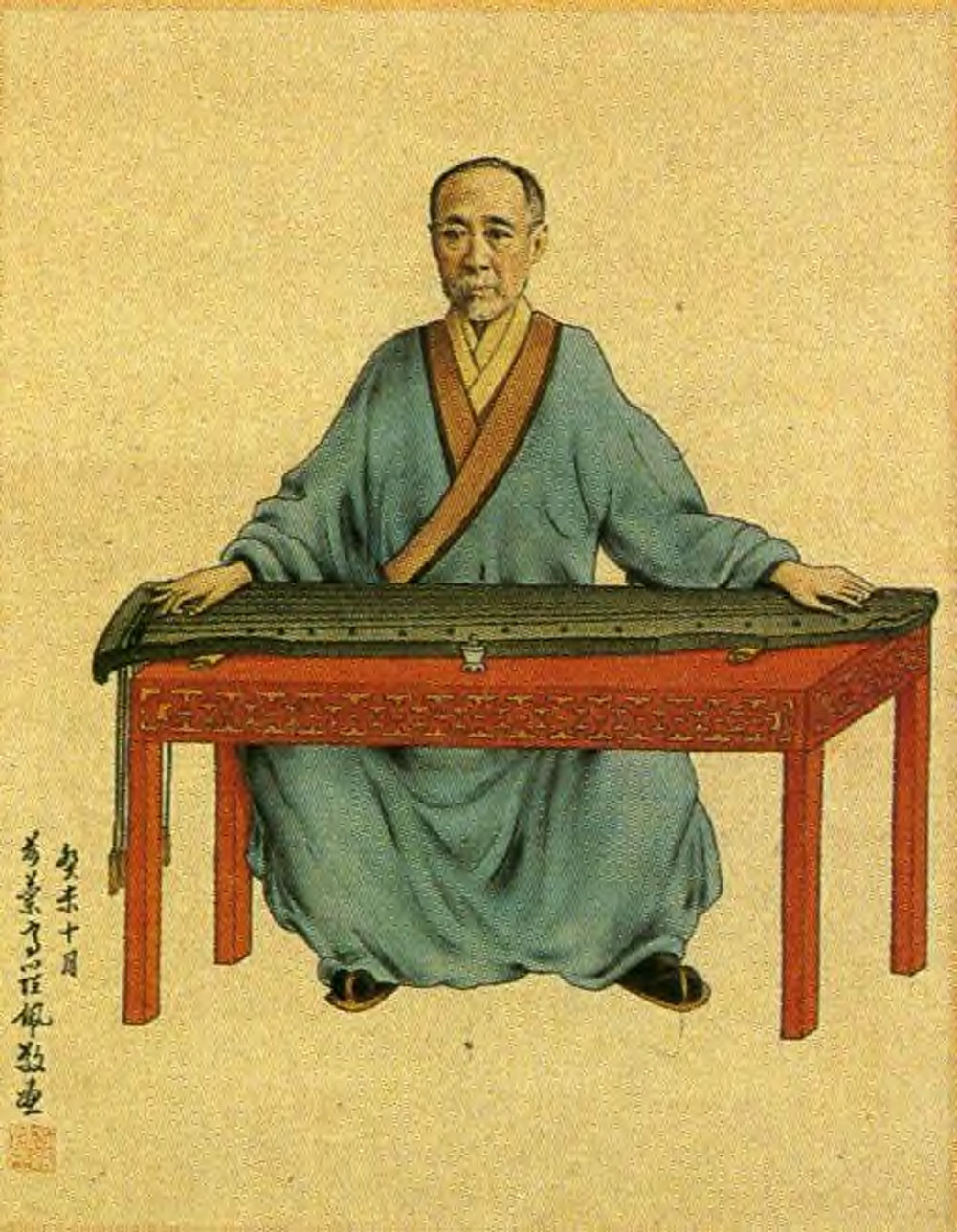
by Dai Xiaolian (translated and adapted by Jonathan P. J. Stock), pp.31-2.13From 1935 onwards, when van Gulik was posted to Japan, he frequently visited China to carry out study and research. He became a pupil of the famous guqin master Ye Shimeng, a member of the Fujian Minnan school of performance. Ye's teacher was Sun Jinzhai (dates not known [style name of Sun Bao]) and Sun's (teacher was) Zhu Fengjie (d. 1964; see Yuguzhai Qinpu). Van Gulik thus inherited a performance style of extensive tradition. Ye had a high standard of performance and was deeply respected by Van Gulik. (Ye) produced the Shimeng Zhai (Qinpu), a score of nineteen guqin pieces, teaching van Gulik Meihua Sannong first and later a total of ten pieces. Van Gulik was extremely upset when Ye died, dedicating The Lore of the Chinese Lute to his memory three years later (van Gulik, 1940). Van Gulik also carefully worked on a painting in traditional Chinese style entitled Master Ye Playing the Qin, the four edges of which bear the inscriptions of other qin players.14
Van Gulik's widow, Shui Shifang,15 said that the short time van Gulik spent living in China was the happiest period of his life. His transfer to the Dutch Embassy (1943), then located at the temporary capital Chongqing, enabled him to meet many well known qin players and aficionados, including Zha Fuxi, Xu Yuanbai and Wang Mengshu. Van Gulik joined and helped organise the Chongqing Tianfeng Qin Society,16 which met frequently for performance and discussion. The Dutch Embassy provided the Society with a meeting place, and van Gulik was able to collect a large number of guqin scores. These scores and treatises include hand-copied manuscripts and volumes and traditional block-printed and thread-bound books. Van Gulik purchased some of these items, copied others by hand himself and was given several by qin-playing associates.
Several passages in the Judge Dee novels have him playing guqin.17
Footnotes (Shorthand references are explained on a
separate page)
1.
Robert Hans Van Gulik and the Guqin
Van Gulik
(Wikipedia; Chinese name 高羅佩 Gao Luopei) was a scholar of great breadth. However, this page only concerns him in relation to the qin.
Relevant writings by or about Van Gulik include the following (see also this blog post by Stephen Jones):
- Gulik, R.H. van,
The Lore of the Chinese Lute
(zither). Hong Kong/Bangkok,
Orchid Books, 2011.
An essential resource; the 2011 edition does not include the color prints from the 2nd ed., Tokyo and Rutland, Tuttle, 1969. - Gulik, R.H. van, Hsi K'ang and his Poetical Essay on the Lute
(zither).
Tokyo and Rutland, Tuttle, 1969.
Out of print; also translated by Knechtges in Wen Xuan III/279. - Janwillem van de Wetering, Robert Van Gulik, His Life, His Work; NY, Soho Press, 1998 (originally D. McMillan Publications, 1987). The preface by Arthur P. Yin is currently online at the Orchard Press Website.
- The Robert Hans van Gulik Issue, Orientations (Hong Kong), November 1981.
Includes a bibliography and James Watt's The Qin and the Chinese Literati. - 陳之邁﹕荷蘭高羅佩。 文史新刊之 5 ;台灣﹕傳記文學社, 1969.
Chen Chih-Mai, Helan Gao Luopei (Van Gulik of Holland), 1969.
An appreciation of Van Gulik by a fellow diplomat. Includes bibliography and comments on VG's qin playing (see above). This book is available in some university libraries in the U.S.- C. D. Barkman and H. de Vries-van der Hoeven, Dutch mandarin: the life and work of Robert Hans van Gulik (1995; English edition, 2018)
- In Chinese: 李美燕,琴道-高羅佩與中國古琴(上冊) Li Meiyan, Robert Hans Van Gulik and the Chinese Lute; Jao Tsung-I Petite Ecole, University of Hong Kong, 2010 (cover and blurb)


Van Gulik's rational for calling the qin a lute is discussed elsewhere. Below there are further links regarding the Judge Dee mysteries.
(Return)
| 2. Images: Van Gulik in Chongqing | Playing qin in his library (unknown location) |
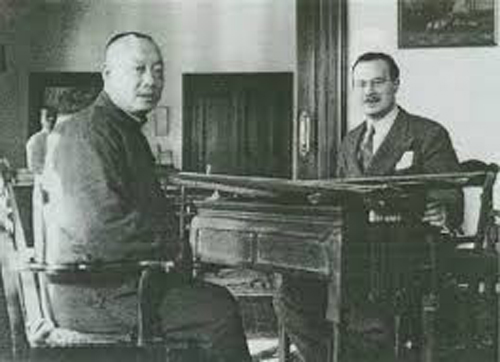
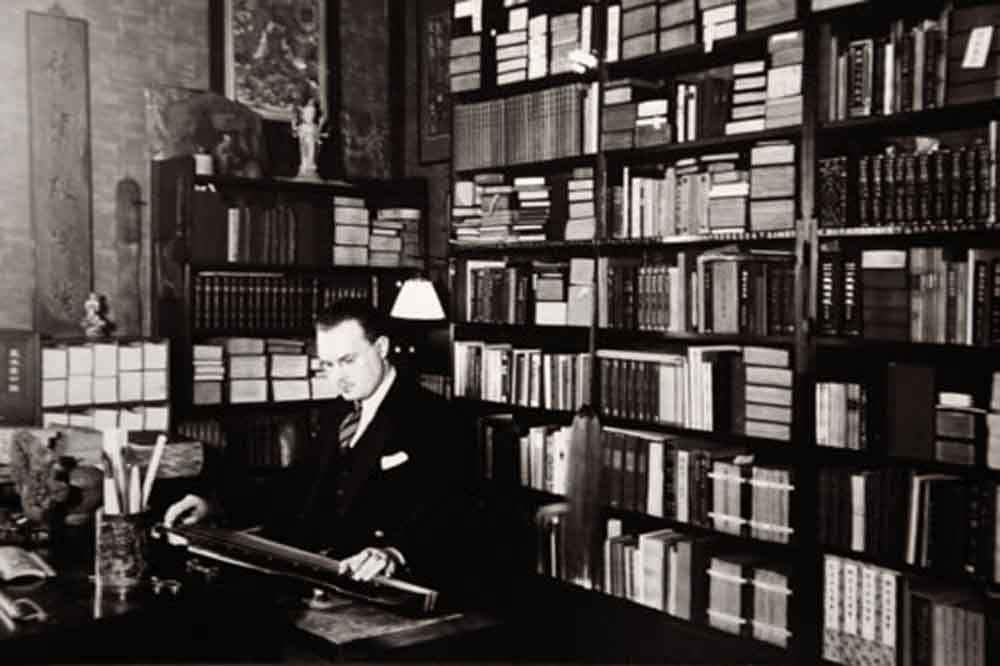 The pictures above were presumably taken while Van Gulik lived in Chongqing from 1943 to 1946, but he may have visited there other times. The upper image was taken from a website, where it was said the original belongs to a family member. The lower image, entitled Van Gulik in Chongqing ca.1945, comes from Janwillem van de Wetering, Robert van Gulik, His Life, His Work; New York, Soho, 1987.
There are further images below.
(Return)
3.
Doctorate
His 1935 doctoral dissertation, Hayagriva, the Mantrayanic Aspect of the Horse-cult in China and Japan, was simultaneously published by E.J. Brill.
(Return)
4.
Diplomatic Career
After China, the Dutch diplomatic service sent Van Gulik home (1946), the U.S. (1947), Japan (1948), India (1951), home (1954), Lebanon (1956), Malaya (1959), home (1963), Japan (1964, as ambassador to Japan and Korea). In 1967, while on leave in Holland, he became ill and died.
(Return)
5.
Lore of the Chinese Lute
The opinion that with guqin music melody is not important was stated by Van Gulik on pp. 1-2 of Lore, as follows:
Each note is an entity in itself, calculated to evoke in the mind of the hearer a special reaction. The timbre being thus of the utmost importance, there are very great possibilities of modifying the colouring of one and the same tone. In order to understand and appreciate this music, the ear must learn to distinguish subtle nuances: the same note, produced on a different string, has a different colour ; the same string, when pulled by the fore finger or the middle finger of the right hand, has a different timbre. The technique by which these variations in timbre are effected is extremely complicated : of the vibrato alone there exist no less than 26 varieties. The impression made by one note is followed by another, still another. There is thus a compelling, inevitable suggestion of a mood, an atmosphere, which impresses upon the hearer the sentiment that inspired the composer.
Playing the Lute is therefore entirely a question of touch, necessitating complete mastery of the finger technique of both hands.« This is the reason why it takes a fairly long time before one can play the Lute. Anyone with an ear for music may, in a month or so, become a tolerably efficient performer on the erh-hu, or, in a few months, on tne p'i-p'a. But studying the Lute is like playing the violin or piano: it takes years of assiduous and regular practice. The results, however, reward the labour, as the best of China’s past has found its expression in the music of the Lute.
To a great extent this is all true. But thus implying that melody is not also an important factor is, to me, somewhat like saying that with calligraphy everything is in the brushstrokes and it did not matter whether the characters made sense or were formed "correctly" (according to arguable convention). Perhaps it was that this latter would have been so obvious that it was not worthy of mention (again see the Watt article.)
6.
Judge Dee mysteries
He then went on to write his own novels, some based on traditional stories. In all 16 Judge Dee novels were published, as follows (from www.judge-dee.info/, in order of first publication in English):
See also:
The Van Gulik Wikipedia entry has further information plus a link to its Judge Dee page, which includes a more complete chronology from Van Gulik's writings.
7.
Ye Shimeng 葉詩夢 (1863-1937; image)
Zha Fuxi's Guide includes brief comments and a table of contents for Ye's qin handbook
Shimeng Zhai (Qinpu) (1914). His students also apparently also included 管平湖 Guan Pinghu. However, I could not find mention of Ye in the Jin Yu Qin Kan materials.
Dai Xiaolian's article also says Ye Shimeng studied qin from Sun Jinzhai, who in turn studied from Zhu Fengjie. However, commentary by Julian Joseph in connection with the handbook
Shiyixianguan Qinpu says one of Ye Shimeng's teachers was actually Sun's student Zhang Ruishan (who apparently also taught Liu E. Zhang Ruishan had a shop in Liulichang (in Beijing).
Zha Fuxi also wrote an article (p.142) discussing some of these people.
8.
陳之邁 Chen Zhimai
9.
Van Gulik's qin studies
As for his having also studied qin in Japan, a biography of Van Gulik in Dutch by Carl Barkman says the following (p. 64; thanks for this to Marco Huysmans, whose Judge Dee website is mentioned above):
11.
Playing qin at gatherings
12.
The essay goes on to discuss VG's research into 蔣興疇 Jiang Xingchou (1639-1695), better known as the Buddhist monk 心越 Shin-etsu. Shin-etsu went to Japan as a missionary in 1677 and taught guqin to many students.
13.
A footnote states, "The information contained in this section is derived from (the Chen Zhimai book) and an interview with van Gulik's widow, Shui Shufang, held on August 1st, 1991." The whole article was originally published as Helan cunjiande guqinpu yu Gao Luopei in Yinyue Yishu, the Journal of the Shanghai Conservatory of Music, no.2, 1992, pp.67-71.
14.
Van Gulik painting: Master Ye Playing the Qin
It was this book that first interested me in the guqin. Nevertheless, for me the book has two fundamental flaws:
(Return)
As a writer R. H. Van Gulik gained his greatest popularity as author of the Judge Dee mysteries, which I often recommend to friends as good introductions to early Chinese culture. He began this by translating some traditional stories about Judge Dee. These were privately published in Japan in 1949 as,
(Republished by Dover Books in 1976 as Celebrated Cases of Judge Dee)
Copied below
How Van Gulik came to write these stories.
A short play of this title by Wetering plus several modern mystery stories inspired by Van Gulik (cover).
Robert Van Gulik / Judge Dee, including a Scientific Bibliography.
(Return)
An online biography of Ye Shimeng from www.chineseguqin.com (since removed but see the Shimeng entry in Baidu) said this was the 潛號 name taken in retirement by 葉鶴伏 Ye Hefu, who originally had the name 佛尼音布 Foniyinbu, and was a nephew of the empress dowager (i.e., he was at least part Manchu). It said Ye's father served as an official in 粵 Yue (Guangdong/Guangxi), at which time Ye Shimeng began studying with players who had inherited the tradition of the
Yuguzhai Qinpu (any connection to the family tradition of Qing Rui [1816-1875], another Manchu who had recently been a leading player in Guangzhou?). Later in Beijing he studied Wuzhizhai Qinpu melodies from 孫晉齋 Sun Jinzhai (孫寶 Sun Bao: see 1875), melodies of the 蜀 Sichuan school from 李湘石 Li Xiangshi, and more. One of his students was 汪孟舒 Wang Mengshu.
(Return)
Chen, op. cit., pp.31-2. "Lute" and "Chinese lute" have been changed here to "guqin". The essay was presented to the Asiatic Society of Japan, 24 September 1968.
(Return)
Since Van Gulik's first qin teacher was 葉詩夢 Ye Shimeng (1863 - 1937; see above), the qin studies must have commenced during one of VG's numerous trips from Japan to China. VG dedicates Lore to Ye as his "first teacher" of the qin, suggesting he later had other teachers.
(Return)
See also mention of the Heavenly Air Qin Society below; the Chinese essay mentions VG's involvement in organizing the Society on p.12. On p.50 the essay adds that when VG was in Hong Kong in early 1967 he took part in two qin gatherings where he saw such qin friends as 徐文鏡 Xu Wenjing and 饒宗頤 Rao Zongyi.
(Return)
(Return)
(Return)
The original of this painting, copied below left, is in the Rijksmuseum voor Volkenkunde (State Museum of Ethnology) in Leiden. Marco Huysmans, whose Judge Dee website is mentioned above, told me that "this beautiful picture of the scroll comes from the Catalog of Christie's Amsterdam for the auction of the Van Gulik collection in 1983 (page 14; item 49). The description says, 'Note by Van Gulik: "The picture was drawn by me, except for the face, which was copied by an expert from the photograph attached to the obituary notice"'. It was sold for 5,130 Dutch Guilders (about 2,500 USD)."

|
Ye Shimeng
by R. H. Van Gulik |
Illustration from
Qin Xue Rumen |
|

|
癸未十月 October 1943
荷蘭高羅佩敬畫 Holland's Robert van Gulik respectfully sketched it
(Return)
15. Van Gulik's wife, 水世芳 Shui Shifang
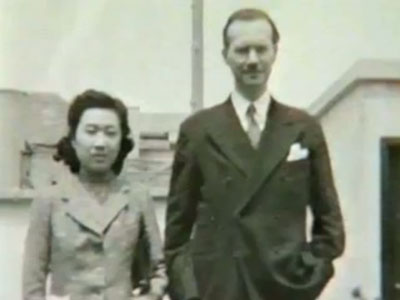
One of 8 children of a wealthy government official, she met Van Gulik in 1943 while he was at the Dutch Embassy in Chongqing and she, while working in the foreign office, tutored him once a week in Mandarin. After their marriage, when she was 22 and he about 10 years older, she followed him through his diplomatic life, but he died at the age of 57 and she, after a final trip to China, moved to Spain, apparently severing her connections with her past. Eventually, though, one of his granddaughters, Marie-Anne Souloumiac, did research on her grandmother, whom as a child she had heard was a "Chinese princess". After visiting and filming her in Spain in 2005 she made a 15 minute film about her grandmother's life, The Last Mandarin.
(In early 2013 it could be found online but as of later that year it seems to have been removed.) It has some personal information about Van Gulik himself, as well as a number of interesting images. Ms. Souloumiac herself subsequently moved to Shanghai, where in 2013 did an interview focused on her grandfather's Judge Dee mystery novels; as of late 2013 this interview was still
available online.
(Return)
| 16. Tianfeng Qin Society (天風琴社 Tianfeng Qin She) | First anniversary photo of the Tianfeng Qin Society |
 This Society must have achieved some status. The image at right (expand), taken in 1946 and inscribed "天風琴社成立紀念 Commemoration of the Establishment of the Tianfeng Qinshe", shows Van Gulik in the second from left in the second row; to his right is the "Christian General" 馮玉祥 Feng Yuxiang (1882-1948;
Wiki) and to Feng's right is the senior scholar-official 于右任 Yu Youren (1879-1974;
Wiki). There has been no suggestion that these latter two played the qin but they are said to have been founding members. Chinese sources say the main founding members were the local qin master 杨少五 Yang Shaowu (left end of the front row) and the famous Yangzhou qin master Xu Yuanbai (right end of the front row). Van Gulik was apparently friends with Yang Shaowu, often going to his home. There is also evidence that
Zha Fuxi and
Wang Mengshu may attended some gatherings, but as yet there is no clear mention of
Yang Yinliu.
This Society must have achieved some status. The image at right (expand), taken in 1946 and inscribed "天風琴社成立紀念 Commemoration of the Establishment of the Tianfeng Qinshe", shows Van Gulik in the second from left in the second row; to his right is the "Christian General" 馮玉祥 Feng Yuxiang (1882-1948;
Wiki) and to Feng's right is the senior scholar-official 于右任 Yu Youren (1879-1974;
Wiki). There has been no suggestion that these latter two played the qin but they are said to have been founding members. Chinese sources say the main founding members were the local qin master 杨少五 Yang Shaowu (left end of the front row) and the famous Yangzhou qin master Xu Yuanbai (right end of the front row). Van Gulik was apparently friends with Yang Shaowu, often going to his home. There is also evidence that
Zha Fuxi and
Wang Mengshu may attended some gatherings, but as yet there is no clear mention of
Yang Yinliu.
This photo comes from a web page that also has a 2012 news clipping from the Chongqing Morning Post (part of the Chongqing Daily News Group) about this qin society; its headline says, "天風琴社扛起重慶抗戰雅樂文脈 Tianfeng Qin Society bears the context of elegant music during the War of Resistance". The story, by a writer with the nickname 馬拉 Mala, begins by saying that during the war Chongqing had two gathering places for qin players, one at the 槐庵 Cassia Hut of 張孟虛 Zhang Mengxu, the other in the 清白家風 family residence of 楊少五 Yang Shaowu. The Yang family apparently had connections to Feng Yuxiang and Yu Youren as well as to Van Gulik, and so the Tianfeng Qin Society is thought to have grown from this.
The original copy of this group photograph apparently belonged to Yang Shaowu's grandson 楊生平 Yang Shengping but is now in Chongqing's 中國三峽博物館 China Three Gorges Museum (website), which opened in 2006 as successor to the Chongqing Museum (mentioned several times here). The Museum's 唐冶澤 Tang Yeze has done some research on the Society. The museum also has a large collection of old guqins, perhaps the largest in China outside its National Palace Museum. Many of these were restored and put on display for the first time in 2010, apparently after having been in storage for over 50 years. Since then the Museum has sent out qins in traveling exhibitions to various musueums; e.g., exhibitions in 2014 of "Guqin Collected by China Three Gorges Museum" included ones in Dalian, Shenzhen and Suzhou (the content and title of each exhibition might differ).
In 2008 the Tianfeng Guqin Academy (天風古琴院 Tianfeng Guqin Yuan) was established in Chongqing, its name apparently inspired by the old name Tianfeng Qinshe. The director of the Academy, 黃健華 Huang Jianhua, an artist as well as a qin player, at one time had a blog, but apparently no longer.
(Return)
| 17. Judge Dee plays guqin | Illustration from The Night of the Tiger |
 Van Gulik's own illustration at right (see initials upper left), subtitled, "He pulled the silk strings in succession", comes from The Night of the Tiger (R. H. van Gulik, The Monkey and the Tiger, p. 113). In the relevant passage (pp.112-6), not feeling sleepy in the middle of the night, Judge Dee goes into the room of a girl who recently died. Finding there a qin he decides to play it. He sees copies of the "well-known melody
'Three Variations on the Plum Blossom Motif'," but when he finds in a drawer the score of a song called Autumn of the Heart, with lyrics apparently by the dead girl, he decides to play that. As he does so, her ghost appears. From this he deduces that she must have been murdered.
Van Gulik's own illustration at right (see initials upper left), subtitled, "He pulled the silk strings in succession", comes from The Night of the Tiger (R. H. van Gulik, The Monkey and the Tiger, p. 113). In the relevant passage (pp.112-6), not feeling sleepy in the middle of the night, Judge Dee goes into the room of a girl who recently died. Finding there a qin he decides to play it. He sees copies of the "well-known melody
'Three Variations on the Plum Blossom Motif'," but when he finds in a drawer the score of a song called Autumn of the Heart, with lyrics apparently by the dead girl, he decides to play that. As he does so, her ghost appears. From this he deduces that she must have been murdered.
This particular passage may have been inspired by other stories of ghosts appearing when someone plays qin. Van Gulik translated several of these in Lore, including this one about Su Shi. There is no actual historical information as to whether or not the real Judge Dee ever played qin.
(Return)
Return to / Guqin ToC
Apprendix: Images from The Last Mandarin




|