|
T of C
Home |
My Work |
Hand- books |
Qin as Object |
Qin in Art |
Poetry / Song |
Hear, Watch |
Play Qin |
Analysis | History |
Ideo- logy |
Miscel- lanea |
More Info |
Personal | email me search me |
| 五音琴譜 Wuyin Qinpu (1579) ToC / Silk Zither Dreams / Flowers and Trees | Listen to my recording 聽錄音 with transcription / 首頁 |
|
18. Water Immortals' Melody
Shang Mode:2 1 2 4 5 6 1 2 |
水仙曲 1
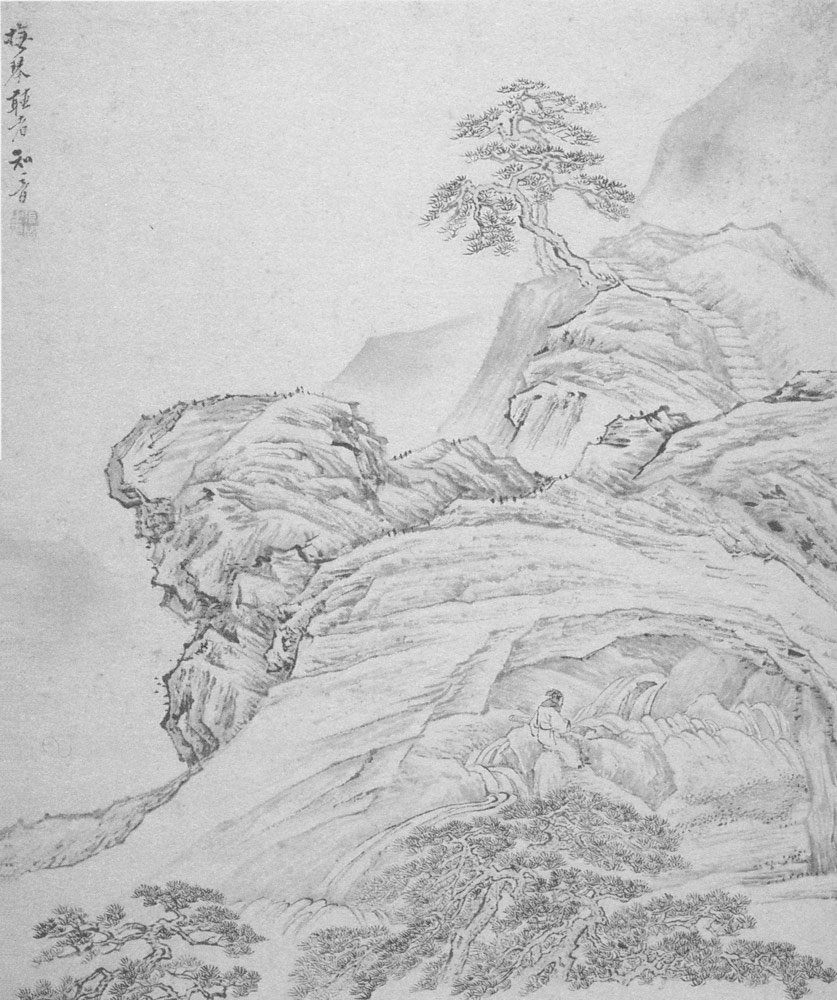
Shui Xian Qu Playing qin for a listener who understands (full image)3 |
 The Chinese word "shuixian", written with the characters meaning "water" and "immortal", today most commonly refers to a flower, the narcissus. If kept in water it can last a long time, hence its name.4 But it is also fragrant and the color of gold, the latter according to Chinese tradition symbolizing fortune and good luck, hence making it particularly popular at New Year. All this should make it possible for people who play qin melodies with shuixian in the title to feel they are evoking this flower, and perhaps this is particularly true of the present melody, which occurs only here in Wuyin Qinpu (1579), where it was published with no commentary.5
On the other hand, associating the narcissus with traditional Chinese stories can also be considered rather problematic because, whereas as a qin melody title Shui Xian Cao is very ancient, the narcissus flower was evidently introduced into China at a rather late date: perhaps as early as the 9th century, though its popularity seems most likely to date from the early Song dynasty (10th c. CE), after Arab traders had introduced it through ports in Fujian then Guangdong.6
There are a number of melodies in the Ming dynasty and later that are connected to the title Shui Xian. Those that have commentary mostly connect them to ancient stories unconnected with any flower. On the other hand the present melody, published only in the 1579 qin handbook Wuyin Qinpu, has no commentary at all. Of course, without the commentary one should be able to make any associations that seem appropriate, in particular as one can find mention of the shuixian flower in contemporary poetry and painting. So certainly the narcissus flower can be considered as a legitimate association and/or inspiration for this melody.7
Another viewpoint, however, says that one should first probe the full significance of the title and all its possibilities. This can begin with considering the possibility that the title refers simply to shuixian (literally, "water immortals") in general. Those connected to qin melodies with shuixian in the title are mentioned in some of the dictionary entries in this footnote. In addition there are some stories that mention qin in connection with water immortals, but not with any specific melody.8
Going back to the narcissus flower, before it became so popular the words "shui xian" more commonly referred to immortals who lived in the water. It is thus the nickname of any of a number of famous people in antiquity. In particular, though, it refers to the "immortal" sage Qu Yuan, whose suicide by drowning in a river is commemorated at the Dragon Boat Festival. Qu Yuan is evoked by a number of existing qin titles, and so it would not be surprising for qin melodies to use shui xian in the title to evoke him. This is also probably one reason for some of the confusion concerning this title, as will be discussed further below.
The other early association of this title suggests perhaps more strongly that it was most likely inspired by the Daoist idea of learning musical expression from nature.9
More specifically, one must consider at least three different stories from antiquity found in melodies that do have "shuixian" as the main title or an alternate title. These stories are as follows:11
- The legendary qin master
Bo Ya learns the significance of
nature in studying qin: the music of nature.
The most appropriate melody titles connected to this are those that mention shui xian (water spirits), as these titles directly connect to the story of Cheng Lian taking his student Bo Ya to an island, leading him to create a shui xian melody. However, as will be explored further below, all of the melodies discussed on this page (other than the 1425 Huangyun Qiusai) have at times had shuixian in the title. - The poet Qu Yuan (339–278 BCE) at the river's edge laments injustice in society
Although this story is perhaps most logically attached to the melody named Sao Shou Wen Tian (Scratch the Head and Ask Heaven), two of the melodies discussed here have had this as their title or alternate title. - The fabled beauty Wang Zhaojun (Mingfei; 1st c. BCE) laments having to spend her life on the frontier
This story was originally connected to the melody Huangyun Qiusai, also called Qiu Sai Yin, but in 1722 a new Qiusai Yin melody was introduced using the same story. Once again, though, at least three of the four main melodies that will now be outlined came to use this title. (Although there may be some logic in having Zhaojun scratch her head and ask heaven, there seems to be no logical connection between this story and shui xian)
Next it is necessary to consider four main melody titles (and the melodies themselves as relayed through the relevant surviving qin tablatures) that are connected to these stories. After this there will be a discussion that shows the complexity of trying to align them with the three stories just mentioned, whether it is by examining the melodies themselves or by tracing all their main and/or alternate titles. As will be seen, the confusion in connecting these three stories to the following four musically unrelated melodies dates back at least to the 17th century.12
- Shui Xian Qu; this is the most ancient of these melody titles, but prior to here only the introductions survive13
Standard tuning, shang mode; this melody only here in Wuyin Qinpu (1579; QQJC IV/220) - Sao Shou Wen Tian;14 also called Quzi Tian Wen 15 or Qiusai Yin, but sometimes associated with Shui Xian Qu and Shui Xian Cao
Raised 5th string tuning (ruibin); the earliest is in Chengjiantang Qinpu (1689; XIV/333) - Qiusai Yin; also called
Shui Xian Qu,
Shui Xian Cao or Sao Shou Wen Tian (especially with the Mei'an version)
16
Standard tuning, zhi yin; still played; earliest is in Wuzhizhai Qinpu (1722; XIV/495). - Huangyun Qiusai;
at least two versions are called Qiu Sai Yin
Lowered first, raised fifth string tuning (huangzhong); this melody survives first from Shen Qi Mi Pu (1425)
Of these only a version of the third of these melodies seems to have survived into the modern repertoire; the first and fourth are today found only in reconstructions. One related footnote traces the source tablatures in greater detail, while this one mentions transcriptions and recordings.17
Coming back to the present melody, it survives only through its inclusion in a qin handbook (Wuyin Qinpu) published in 1579 by a Ming prince who lived in what is today southeastern Shanxi province.18 None of the melodies in his handbook has any commentary, perhaps suggesting the handbook was originally intended for his own personal use. However, as wil be seen, it does seem most likely that here the title Shui Xian Qu alludes to the story about Bo Ya and Cheng Lian.
According to this story Bo Ya, already quite a skilled player, learns that the way to understand, and thus express, the true significance of qin melodies is to feel their connection to nature. The earliest surviving version of the story may be the one found with the entry called Shui Xian Cao in Qin Cao, a text attributed to Cai Yong (133 - 192). As also related in the biography of Boya in Qin Shi, the story tells of Cheng Lian taking his student Bo Ya to an island in the Eastern Sea (sometimes identified as Penglai) and leaving him there, saying that a master will soon come to teach him the true significance of qin music. Bo Ya, after waiting some days and hearing only the sounds of nature, finally realizes that it is these sounds that the true qin music will evoke. Perhaps attributing these sounds or this understanding to immortals living in the surrounding waters, Bo Ya then creates a melody called Shui Xian.
A later version of this story has Cheng Lian taking Boya into the mountains to learn about the relationship between qin music and the sounds of nature. Then Shui Xian is one of the melodies Boya plays for Ziqi when they meet on a boat near what is now Hanyang in the modern city of Wuhan.19
The only commentary accompanying a surviving melody with the title Shui Xian Qu is that in Jiaoan Qinpu,20 a handbook published in 1868. The commentary there connects this other melody to the Boya and Cheng Lian story related above.21 As for the surviving melodies that use the title Shui Xian Cao or simply Shui Xian, those that have prefaces invariably relate a version of the Cheng Lian story. Thus, although each of these later melodies is also known by completely unrelated titles, it is logical to conclude that in the qin tradition, no matter what the actual source melody is, the use of "shuixian" in the title is always intended to evoke the story of Cheng Lian teaching qin to Bo Ya.
The next associated melody, usually called Sao Shou Wen Tian (Scratch the Head and Ask Heaven), was first published in 1689, over 100 years later. It uses a raised (tightened) fifth string tuning. The earliest surviving melodies using this tuning call it ruibin mode, but later it seems more generally to have been called shang yin (not to be confused with the standard tuning shang mode used, for example, in the 1579 Shui Xian Qu). Although this melody is first called Sao Shou Wen Tian, and this title is usually associated with Qu Yuan, it was also called Qiu Sai Yin and even Shui Xian Cao. It does not appear in modern recordings or transcriptions, the latest surviving tablature I have found for any ruibin version having been published in 1876, or perhaps 1894.22
Regarding the raised fifth string tuning, as I have noted elsewhere titles commonly associated with this tuning usually have some connection of the Chu region (loosely the modern Hubei and Hunan provinces). It is thus tempting to suggest that it is only melodies using a raised fifth tuning that should be associated with a Qu Yuan story, as Qu Yuan was perhaps the most famous ancient representative of Chu culture. This may have once been the case, but there are also stories that connect Bo Ya to the Chu region (see, e.g., the Hanyang reference). In addition, the Shui Xian titles and the title Sao Shou Wen Tian, as well as the two tunings used for these melodies, have been so totally mixed together since the 18th century that it is not possible for me to make such an assertion at present.
The situation is further complicated by the continuing use of the third associated title Qiusai Yin, originally used as an alternate title for the earliest of these melodies (but fourth listed above), Huangyun Qiusai, which which concerns Wang Zhaojun captured by Central Asian nomads.
This third melody, first called Qiu Sai Yin and first surviving from a handbook published another 33 years later (the earliest version being dated 1722), returns to standard tuning, the mode here being called zhi yin (see zhi diao). However, this earliest version has Sao Shou Wen Tian as an alterate title, and it soon also appears with the title Shui Xian Cao (or even Shui Xian Qu). After this the titles connected to this melody seem generally mixed, and so do the stories. Mention of Wang Zhaojun becomes less common, the melody instead being associated either with the story of Boya and Cheng Lian, or with a story related to Qu Yuan. This melody is still in the active repertoire today.23
As has been mentioned, the confusion over these titles was noted in some of the early commentaries. However, I have not yet seen a suggestion that the three titles (not counting Huangyun Qiu Sai, the last related melody to which dates perhaps from 1557 or perhaps 1585) and three title-types connected to three stories, should be correctly aligned as mentioned above, with the Bo Ya story settled on one melody (using Shui Xian in the title), the Qu Yuan story on another (best title Sao Shou Wen Tian), and the Wang Zhaojun story on the third (call it Qiu Sai Yin). Perhaps one reason for this is that the only one of these melodies associated with only one title is the present one, Shui Xian Cao, was published in only one early handbook.
Further regarding this confusion, it should also be seen as evidence that, as with poetry, perhaps one should not demand that the meaning of a melody be simple and straightforward.
Original preface 24
None here, but see versions of the Bo Ya - Cheng Lian story in:
Yu Boya of Chu article in picture book
Other introductions to this title, as outlined below
Music
Seven Sections, untitled25
(see transcription; timings follow my recording 聽錄音)
00.50 2.
01.37 3.
02.25 4.
02.48 5.
03.22 6.
03.48 7.
04.21 harmonic coda
04.36 end
Footnotes (Shorthand references are explained on a
separate page)
1.
Shui Xian related titles
17458.118 is 水仙 shuixian; no 水賢 or 水僊. Shui Xian can also be transliterated Shui Xian. The shuixian terms used as melody titles have links to the footnote tracing the titles, below. There is more on the translation of 仙 xian under
Transcendant Venerable One. For related titles see also the early prefaces below. This 1579 version is the only shuixian melody I actively play.
Shui Xian Cao (17458.123 水仙操)
Shui Xian (or shuixian; 17458.118 水仙)
Shui Xianzi (17458.119 水仙子)
- Quotes 5961.1266 天隱子 Tianyinzi (Tang dynasty) on 天仙,地仙,水仙,神仙.
- 河伯馮夷 Hebo Pingyi (Hebo became an ancient deity of the Yellow River after tying a boulder to his back and jumping into the river to stop the flooding; he rode a dragon called Pingyi [sometimes called "Fengyi"]);
- 春秋伍子胥 Wu Zi Xu;
- 屈原 Qu Yuan (he became an immortal after jumping in the water);
- 晉郭璞 Guo Pu; and
- 唐陶峴 Tao Xian (Bio/2051: Tang dynasty scholar recluse).
Earliest reference: "本草 Ben Cao" (神農本草經? If so, Han dynasty? 本草原始 Ben Cao Yuan Shi? If so, early 17th c.). No early poetic references: introduced into China during Tang dynasty? See also below.
(Return)
2.
Shang mode (商調 Shang Diao)
For further information on shang mode see
Shenpin Shang Yi and
Modality in Early Ming Qin Tablature.
(Return)
3.
Playing qin for a listener who understands (撫琴聽者知音) (full image)
Painting by 上官周 Shangguan Zhou (1665-ca.1750) from an album of 12 leaves; copied from Scent of Ink, the Roy and Marilyn Papp Collection of Chinese Painting. Phoenix, Phoenix Art Museum, 1994; pp. 69 and 70. Here nature is the discerning listener, a corollary to nature as teacher. The inscription "撫琴聽者知音 Playing for a listener who understands" refers to one of the 十六樂事
16 Enjoyable Matters outlined by Su Shi (thanks to 孫小青 Sun Xiaoqing for identifying this).
Just for fun, compare Playing qin for an ox.
(Return)
4.
Associations of the name
Narcissus is the genus; the family in amaryllis; common names include daffodil and jonquil. They can be narcotic (narc!), medicinal or poisonous if eaten. The Chinese name "water immortal" (sometimes "water fairy"), however, is said more likely to be connected to its ability to grow and survive in nothing but water and air. Unlike in the west, where the beauty of the narcissus connected it with self-obsession, after its introduction into China it became more connected with purity and moral integrity, such in stories connecting it with Qu Yuan and the Xiang river goddesses. (Regarding the latter see the commentary on Shui Xian Cao in 1884, which suggests that some versions could also be called Xiangfei Yuan.
The following couplet by 黃庭堅 Huang Tingjian (1045-1105) has one of the earliest mentions of the narcissus in Chinese poetry.
Wang Chongdao sent me fifty stems of narcissus; delighted and in perfect sympathy with them, I composed these verses” (excerpt)
凌波仙子生塵襪,水上輕盈步微月。
The water-treading fairy, her stockings seeming to raise dust,
lightly, gracefully, she steps across the water in the faint moon.
是誰招此斷腸魂?種作寒花寄愁絕。
Who has summoned this heart-breaking spirit?
Planted as a winter flower, it bears and conveys utter sorrow.
Compare the four-line version quoted
here: later versions expanded it in various ways, calling this original couplet an "excerpt", but apparently the earliest version of this poem includes only this couplet. However, though still attributed to Huang, the longer versions are all said to consist of material that seems stylistically somewhat different, and there is no solid evidence that the original was actually any longer.
(Return)
5.
No commentary in Wuyin Qinpu
When I did my reconstruction I had in mind the story of Boya learning the significance of qin first from Cheng Lian then by going out to an
island and learning from nature.
(Return)
6.
Introduction into China
The earliest known Chinese reference is sometimes said to be in the flower section of the 9th century Youyang Miscellany (酉陽雜俎 Youyang Zazu;
(Wiki), which writes of a 捺祗 nai-chi, a word apparently coming from the Persian version of the Greek narkissos. It apparently did not get the name shui xian until it had become popular in Fujian, to which it had been brought by Arab and Persian traders. It is only from later in the Song dynasty that it became naturalized under the name "shui xian" and began to appear in Chinese lore and in poetry. Though now popular throughout China, it apparently remains particular so in Fujian and Guangdong.
See also Wolfram Eberhard, Dictionary of Chinese Symbols, p.204.
(Return)
7.
The flower Shui Xian in poetry
A couplet by Huang Tingjian (1045-1105) mentioning the shui xian as a flower has been mentioned above. Here now is a poem connecting shuixian as water sprites to the guqin but not in connection with any melody:
This is the name of a 謠 ballad by 溫庭筠 Wen Tingyun (ca.801 - ca.866) in Yuefu Shiji Folio 100. Its lyrics are as follows:
輕塵不起雨新霽,萬里孤光含碧虛。
露魄冠輕見雲發,寒絲七柱香泉咽。(魄 "form" also written 冕 "cap"; 柱 "pillar" also written 炷 "incense stick")
夜深天碧亂山姿,光碎平波滿船月。 (平 "flat" also written 玉 "jade")
A guest on the water at night rides a red carp;
a fabulous red luan bird and a pair of cranes report on Penglai and Yingzhou.
Light dust does not rise as the fresh rain ends and the sky clears;
for 10,000 li a lone radiance fills the empty blue sky.
Fog patches lighten at top revealing clouds issuing forth;
(the sound of) cold silk (strings) on seven posts (mimic) a fragrant spring choking and sobbing.
Deep into the night the sky obscures the mountain shapes;
light breaks across flattened ripples as moonlight fills the boat.
In this tentative translation note that the third line mentions 七柱 seven posts or 七炷 seven incense sticks. A qin has two soundposts (天柱 and 地柱) but seven zhen (寶軫 precious pegs). Whether or not "七柱 seven posts" means there is a confusion of number or terminology, 七 can go with the preceding 絲, thus alluding to qin; on the other hand, "七炷 seven incense sticks" could connect 七 with the following word 香 "fragrance": 4.277 七香 refers to seven types of incense.
(Return)
| 8. Evoking the flower by playing Shui Xian with art or poetry | Ming painting from the National Palace Museum |
 Although there is no record of a qin melody being connected explicitly to the narcissus, there are associations from both art and poetry that one can call on. As for poetry, the only poem that I have found connecting the flower with qin comes later than the present melody. And as for paintings, the only ones dating prior to the Qing dynasty that I have found have all been in monochrome ink, not color, and for many their sources are unclear, as witness the two shown here at right. Nevertheless, this is sufficient to show that the literati would have found the narcissus a worthy flower to admire alongside the qin.
| The narcissus in Ming art | Ming painting and fu poem from Christie's |
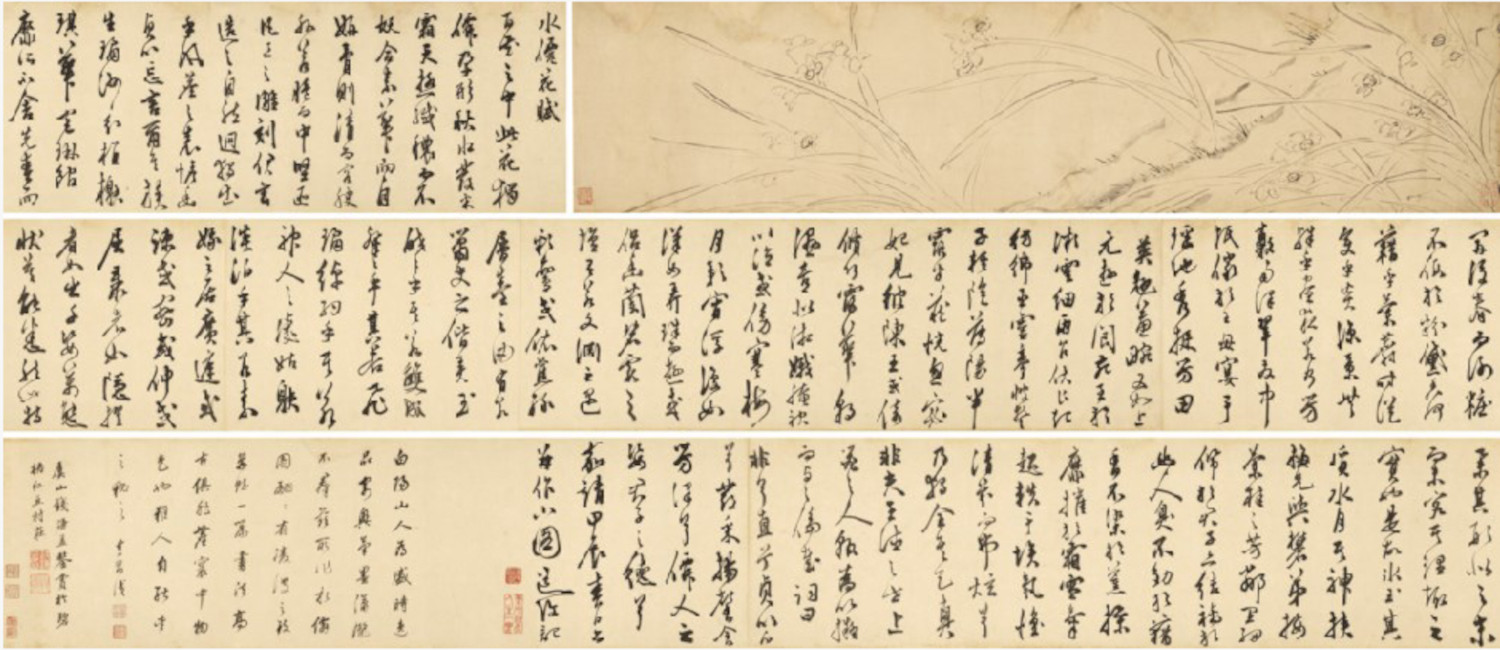 The Christie's painting shown at right was titled 陳淳:水仙花賦並圖: Chen Chun, Rhapsody on the Narcissus with an illustration. Chen Chen (1482—1544, from Suzhou; Wiki), had the style names Daofu and Fufu and the nicknames Baiyang and Mountain Man Baiyang. In 2023 Christie's had prepared it for auction in Hong Kong and so, as can be seen, the commentary on its website is all in Chinese.
The National Palace Museum painting linked directly above the one sold at Christie's is quite different: the Museum painting's (modern) title is 明陳淳寫生 卷 Ming Chen Chun, Sketches from Life, a scroll. Neither has commentary mentioning the other painting. And whereas the Christie's scroll is dated from 1544 and mostly consists of the fu text with the image showing a few shuixian plants that seem to be along a stream with flowers floating in it, the Palace Museum image is dated 1538 and seems to show the tops of five shuixian shown side by side with much more detail apparently given given to each plant.
One can find further related painting online, such as these here; I have not studied them carefully but there are quite a few by well-known painters from the end of the Song dynasty and later.
書法釋文:The text of the fu with the painting from Christie's was copied out on their website. According to their commentary it was written in 1544 (i.e, 35 years before Wuyin Qinpu was published) by Chen Daofu, i.e., Chen Chun himself.
《水僊花賦》百花之中,此花獨僊,孕形秋水,發采霜天,極纖穠而不妖,合素華而自妍。骨則清而容腴,外若脆而中堅。匪凡工之雕刻,伊玄造之自然。迥獨出乎風塵之表,憺幽貞以忘言。爾其族生瓊洲,分植榭琪,華宮琳館,靡所不舍。先春而開,後春而謝。粧不假於粉黛,香何藉乎蘭麝。時從變乎炎涼,景無殊於晝夜。若乃芳敷南澤,翠發中坁,儼於王母宴於瑤池。秀挺芳田,英翹蕙畹,又如上元游於閬苑。至於微雲細魚,乍伏乍起,仿佛巫靈,夢彼楚子,輕陰薄陽,半露半藏,恍惚宓妃,見彼陳王。或倚修竹,露華朝濕,意似湘娥,掩袂以泣。或傍寒梅,月影宵浮,復如漢女,弄珠而遊。或侶幽蘭碧霞之壇,有若文淵之遇彩鸞。或依蕉綠層臺之曲,有若簫史之偕弄玉。皎皎乎其若雙成,粲粲乎其若飛瓊,綽約乎其若神人之處姑射,淡泊乎其若素娥之居廣庭。或踈或密,或伸或屈,叢者如隱,擢者如出,千姿萬態,狀莫能悉。然此特舉其形似之末,而未究其理趣之實也。是故冰玉其質,水月其神。挾梅兄與礬弟,接蘭桂之芳鄰,宜紉佩於君子,亦結褵於幽人。臭不效於蕕,香不染於薰。操靡摧於霜雪,氣超軼於埃氛。懷清芬而弗炫兮,乃獨全其天真。非夫至德之世,上器之人,孰為比擬而與之倫哉。詞曰:非兮直兮,貞以白兮,發采揚馨,含芳澤兮,仙人之姿,君子之德兮。
題識:嘉靖甲辰(1544)春日書並作小圖,道復記。
In sum, it praises narcissus as uniquely “immortal” among flowers: born of autumn water, blooming in frosty weather, pure but not frail, fragrant without relying on orchid or musk, akin to plum, shan-fan (Symplocos), orchid, and cassia, and finally embodying both nature of an immortal and the virtue of a gentleman.
The qin and narcissus in Ming poetry
This poem is by the late Ming/early Qing Cantonese poet Chen Zisheng (1614–1675),
一一孤根發,叢叢翠葉新。
清琴彈此曲,白露謂伊人。
蓬島何年別,蘭堂幸可親。
安知芳草氣,不是雒川神。
Chen Zisheng, The Narcissus
One by one, solitary roots put forth;
clump by clump, green leaves grow fresh.
On a clear-toned qin I play this melody;
“white dew” seems to call her “that person.”
From what year did she part from Penglai Isle?
How fortunate, now, to be close in this orchid hall.
How can one know that this fragrance of grass
is not the goddess of the Luo River?
There has not yet been a thorough search of this topic.
(Return)
9.
Learning from nature (more Daoist themes)
In the qin tradition this Daoist ideal originates in the story of Boya learning from nature. A personal experience connected to this concept is presented with Silk Zither Dreams.
The Confucian attitude also connects music and nature, but is perhaps best known for connecting it the same way it connects nature to rites: if rites are performed correctly then society (including nature) will be in order; likewise if music is performed correctly (and the music is proper) society (including nature) will be in order. For an account of what improper music can do see the
pure jue melody.
(Return)
11.
Early Shui Xian Cao melodies and their Chinese introductions
See also the references above. The Chinese introduction quoted first below was copied from 17458.123 水仙操 Shui Xian Cao, so it should be the earliest published reference then known of the Bo Ya and Cheng Lian story. It is said to be from Explanations of the Music Bureau (樂府解題 Yuefu Jieti), the source of which seems to be somewhat uncertain: the original was lost, but it had comments that were later incorporated into Yuefu Shiji. Unfortunately, this does not explain why there is no separate entry for Shui Xian in YFSJ.
This is almost the same as online versions giving as their source 樂府古題要解 Yuefu Gu Tiyao Jie:
Compare this with the one published by 朱長文 Zhu Changwen (1041-1098) in his 琴史 Qin Shi biography of Boya
The introduction to 水仙操 Shui Xian Cao in the edition of 蔡邕琴操 Cai Yong 's Qin Cao published in 琴學叢書 Qinxue Congshu (1910; see Lament #11) is incomplete.
However, there is added commentary saying of the Shilei Fu (事類賦 244.141 宋,吳淑撰 a rhapsody by Wu Shu of the Song dynasty), 樂部注,引《樂府解題》,『水仙操』前段與此文略同, according to the Music Department, drawing on the Yuefu Jieti the former sections of Shuixian Cao, then adds the continuation from that source, finally concluding that the similarity is 足證此文之闕 enough to prove it is the missing part. The continuation is:
(Return)
12.
Tracing the titles:
Shui Xian (plus Shui Xian Qu, Shui Xian Cao
Qiu Sai Yin
(earliest; modern version)
Sao Shou Wen Tian
Zha Fuxi's Guide is organized according to title or story, which does not always correspond with melodic affiliation; this seems particularly true of the various melodies connected to the term "Shui Xian". Thus, in order to group the four distinct melodies with overlapping titles, listed above, one must collate information from at least six separate entries in the Guide. Note also that some of these are related to the earliest melody,
Huang Yun Qiu Sai (huangzhong tuning). However, as can be seen from
this chart, although two later publications of that melody changed the melody name to Qiu Sai Yin, the modern melody of that name did not emerge until over 150 years later.
- 24/201/-- 秋塞吟 Qiu Sai Yin (9 handbooks from 1551 to 1914)
Zha's Guide lists Sao Shou Wen Tian as an alternate title.- 1551 (Taiyin Chuanxi, IV/152); = Huang Yun Qiu Sai; afterword mentions Zhaojun
- 1557 (Taiyin Buyi (III/389); identical to previous
- 1722 (Wuzhizhai Qinpu, XIV/503); "also called Sao Shou Wen Tian"; mentions only Ming Fei, but title later may concern Qu Yuan or
Bo Ya
Earliest of what today may be called Qiu Sai Yin, Shui Xian Cao or Sao Shou Wen Tian (see Mei'an version)
"徵音,凡九段,金陵派 zhi mode (standard tuning), 9 sections; Jinling School"; begins w/3 ascending doublestops (in harmonics) - 1820 (XX/114); gong mode; 10 sect.; "一名屈子天問,一名水仙操,宮調 also called Quzi Tian Wen and Shui Xian Cao"; afterword (like 1722
- 1830 (XXI/48); 10 sect.; like 1722
- 1844 (XXIII/320); like 1722, with same commentary
- 1875 (XXVI/239); like 1722, with same commentary
- 1878 (see XXVI/365); like 1722, with same commentary, but called Sao Shou Wen Tian and also listed there
- 1914 (not in QQJC); 9 sections; Zha Guide has commentary saying "from 1907", but this melody is not there
- 25/211/-- 水仙曲 Shui Xian Qu (7 handbooks from 1579 to 1890)
Zha's Guide lists Sao Shou Wen Tian as an alternate title.
The only preface (see Guide, p.[455] 211 and 1868 below) connects the melody with Boya/Chenglian; see also Shui Xian Cao below.- 1579 (this melody only here in Wuyin Qinpu, QQJC IV/224); standard tuning, shang diao (no commentary)
- 1755 (XVI/251), standard tuning, zhiyin; like 1722 Qiu Sai Yin, but only opening double stop is 3rd note; "吳官心傳 from Wu Guanxin"; no other attribution
- 1760 (XVII/104), zhiyin; 10 則 sections; like 1722 and 1755 but begins w/2 doublestops; "same as Sao Shou Wen Tian"; otherwise no commentary
- 1785 (XVIII/402), zhiyin; 10 則 sections; begins like 1755 above; "same as Sao Shou Wen Tian"; otherwise no commentary
- <1802 (XIX/316); zhiyin, 7; like 1755 above; also has Sao Shou Wen Tian (RB; see below); no commentary
- 1849 (XXIII/365); begins like 1755 above, but 15 sections; also has Sao Shou Wen Tian (RB; see below); no commentary
- 1868 (XXVI/64; shang; 7; attrib. Boya (Zha also lists under Shui Xian Cao); begins like 1755 above; this handbook also has Sao Shou Wen Tian (RB; see below)
- 1878 (XXVI/352); zhiyin, 11; begins like 1755 above; no commentary
- 1890 (XXVI/453); zhiyin, 10; like 1722/1755 but notes 4-6 are the ascending double stops; no se part; no commentary
- 37/262/-- 搔首問(青)天 Sao Shou Wen (Qing) Tian (15 handbooks from 1689 to 1931; 12 are in ruibin tuning; recording on BiliBili)
; XVII/174); ruibin; 7 sections; related to 1689 (no commentary)
Zha Guide gives Qiu Sai Yin and Shui Xian Qu as alternate titles; commentaries mostly connect to Qu Yuan. - 1802 (Ziyuantang Qinpu; XVII/498); zhi diao, shang yin, but = ruibin; 7 sections; like 1689; no commentary
- <1802 (Yiluxuan Qinpu; XIX/116); ruibin, 7, "= 1689"
- 1833 (Erxiang Qinpu; XXIII/168); "yu yin" but = ruibin; like 1689; 8; afterword mentions Shui Xian Cao, etc.; seems to prefer Qu Yuan story
- 1833 (Lü Hua; XXI/456); 無射均 = ruibin; 8; notes/pitches are named; rel. to but quite diff. from 1689; beginning at XXI/459 is an extended phrase by phrase explanation of the whole melody
- 1836 (Wuxue Shanfang Qinpu; XXII/414); 無射均商音 raised fifth; 8 sections; related to 1689; short preface
- 1849 (Zhiyin Qinpu; XXIII/450); ruibin; 7; only comment a brief one with Sec. 6
- 1868 (Jiaoan Qinpu; XXVI/100); ruibin; 7; no commentary
- 1876 (Tianwenge Qinpu; XXV/573); = 1802; 8 sections; ruibin; attrib. Qu Yuan
- 1876 (Tianlaige Qinpu; XXI/244); ruibin; 7 sections; rel. 1689
- 1878 (Xishaoge Qinpu; XXVI/365); zhi yin; 10 sections; "also called Qiu Sai Yin"; like 1722 including attrib. to Zhaojun
- 1894 (Qinxue Chujin; XXVIII/377); shang yin (= ruibin); 8; rel. 1689; long afterword does not attribute
- 1931 (Meian Qinpu; XXIX/216); 林鐘調,徵音 linzhong diao, zhi yin (standard tuning); 9 sections; this is the most popular modern version; still related to 1722 (further comment)
- 2015 (Xiangjiang Rongshi Qinpu; Handbook of the Rong Family Tradition pp.99-102); (無射均商音 raised fifth tuning); 8 sections; two recordings; also one on bili)
- 1802 (Ziyuantang Qinpu, XVII/414); shangyin; 10; like 1722 Qiu Sai Yin but only third note is the harmonic doublestop; no commentary
- 1825 (XX/324); zhiyin; 9; like 1722, beginning with three ascending doublestops; no commentary
- 1828 (XX/408); zhiyin; 10; "also called Quzi Tian Wen"; like 1722, beginning with one doublestop; no commentary
- 1833 (XXIII/134); shangyin; 10; like 1722, but 3rd and 4th notes are the doublestops; first comment to connect melody to Boya/Chenglian story
- 1821 (XX/324); 9; like 1722, beginning with three ascending doublestops; no commentary
- 1836 (XXII/331); 11; like 1722, beginning with three ascending doublestops; commentary mentions Qinyuan Yaolu!
- 1839/ (XXIII/66); 9; like 1722 but 3rd and 4th notes are doublestops; attrib. Boya
- 1864 (XXIV/__); this attribution on QQJC p.165 must be a mistake as Qinxue Rumen does not have this title.
- 1868 (XXVI/64); this must also be a mistake, as 1868 actually calls it Shui Xian Qu (and so listed above). Does Zha list it here because the preface tells the Boya - Cheng Lian story?
- 1876 (XXV/448); "yu yin shang diao"; otherwise = 1802 (no commentary)
- 1884 (XXVII/340); gong diao shang yin; 12; "also called (!) 湘妃怨 Xiangfei Yuan, 秋塞吟 Qiu Sai Yin, 昭君怨 Zhao Jun Yuan, 搔首問天 Sao Shou Wen Tian, 屈子天文 Quzi Tian Wen; begins 3 harmonic double stops then stopped double stop (i.e., related to 1722 but more differences?
- 1893 (XXVIII/78); zhiyin; 7; like 1722, but only third note is doublestop; preface connects it with Boya/Chenglian
- 1894 (XXVIII/273); 黃鐘均商音 huangzhong jun shang yin, 10; like 1722, but only third note is doublestop; preface connects it with Boya/Chenglian; "By Zhong Ziqi, traditionally attributed to Cheng Lian."
- 1910 (XXX/227 and QF/977); "1802"; gongdiao shang yin; 10; adds rhythmic indication; no attribution
There may be more not mentioned in Zha's Guide.
(Return)
13.
Shui Xian Qu
See the early stories above.
(Return)
14.
Shake the Head and Ask Heaven (搔首問天 Sao Shou Wen Tian)
12802.7 搔首 has nothing on Qu Yuan, its earliest reference being to Shi Jing poem 42, 靜女 Jing Nü (Waley: Of Fair Girls; narrator scratches his head when he cannot find girl). As for 問天 wentian, 3840.7 connects it only to Qu Yuan's Tian Wen. I have found no modern transcriptions or recordings of the raised 5th tuning melody. Instead Sao Shou Wen Tian is today best known as the title of the
Mei'an version of Qiu Sai Yin.
(Return)
15.
Qu Yuan Asks Heaven (屈子天問 Quzi Tian Wen)
7845.5 屈子 Quzi = 屈原 Qu Yuan; nothing further. 5961.827 天文 Tian Wen refers to the poem of that name in the
Chu Ci.
(Return)
16.
Autumn Frontier Intonation (秋塞吟 Qiu Sai Yin or Qiu Sai Yin; see listing.)
Although the earliest surviving tablature with this title dates from
1551, the earliest new melody with this title is the Qiu Sai Yin in Wuzhizhai Qinpu (1722). Although historically the most common title for this melody is Shui Xian Qu (see in tracing list), it is best known today through either the
interpretations from 1722 by Wu Jinglue ("Qiu Sai Yin; qp
recording)
or Wu Zhaoji (Sao Shou Wen Tian;
recording);
or through the Mei'an Qinpu School version also called Sao Shou Wen Tian
(recording).
搔首問天 Sao Shou Wen Tian of the Mei'an school (recording)
A glance at the almost 50 entries grouped under five titles in the tracing melodies footnote above shows my preliminary attempt to categorize the approximately 40 earlier versions of the Meian Qinpu melody, based largely on the opening harmonic passage (specifically which notes are double stopped harmonics). A closer examination of these melodies should help further refine our understanding of how it was transmitted.
Perhaps because the most common title is concerns shuixian this melody is most commonly connected to the Boya/Chenglian. It is thus not clear why the Mei'an handbook attributes this melody to
Qu Yuan, adding that it was inspired by the same idea as (Qu Yuan's) Li Sao.
Lieberman, A Chinese Zither Tutor (his translation of Meian Qinpu), p.143ff, has a transcription (no tablature). A silk string recording by
Wu Zhaoji calls it Qiu Sai Yin, with Sao Shou Wen Tian as an alternate title.
17.
Modern recordings and transcriptions
In addition,
Guqin Quji, Vol. I, has transcriptions for four versions of #3:
The commentary on pp. 7-8 first mentions the Cheng Lian story, then mentions the other stories described above, concluding that the situation is indeed complicated.
18.
Compiler of Wuyin Qinpu
19.
Boya plays for Ziqi on a boat near Hanyang
21.
Celebrated each year on the 5th day of the 5th lunar month.
(Return)
22.
Last two published ruibin versions
23.
See footnote above regarding transcriptions and recording.
(Return)
24.
Chinese preface
Return to the annotated handbook list
or to the Guqin ToC.
As just suggested, in earlier handbooks (beginning with
1722) this melody was usually called either Qiu Sai yin, Shui Xian Qu, or Shui Xian Cao. However, in the absence of handbooks said to be Zhucheng (or proto-Meian), it is not clear when this melody became part of the Meian tradition, or why Meian Qinpu uses Saoshou Wentian as the main title (this is often given as an alternate title but as far as I can tell only the 1722 and 1878 handbooks previously used it as the main title.
(Return)
Significant recordings include the following:
(Return)
See further.
(Return)
This later version of the story can be found in many places online, but I have not found its source. According to this account, Cheng Lian took Boya to 泰山 Mount Tai in order to learn from nature. Meeting on the boat connects this story with the otherwise unrelated melody Jiang Yue Bai.
(Return)
Both are called Sao Shou Wen Tian. Tianwenge Qinpu (1876) says its version is from Ziyuantang Qinpu (1802). The preface to the version in Qinxue Chujin
(1894; shang yin) mentions Qu Yuan.
(Return)
None here, but see the early commentary included above.
(Return)