|
T of C
Home |
My Work |
Hand- books |
Qin as Object |
Qin in Art |
Poetry / Song |
Hear, Watch |
Play Qin |
Analysis | History |
Ideo- logy |
Miscel- lanea |
More Info |
Personal | email me search me |
| Handbook List / Table of Contents compare Wusheng Qinpu | 首頁 |
|
Wuyin Qinpu
Five Tones Qin Handbook (QQJC IV/191-257 1 |
五音琴譜
1579 |
| End of Wuyin Qinpu preface 2 |
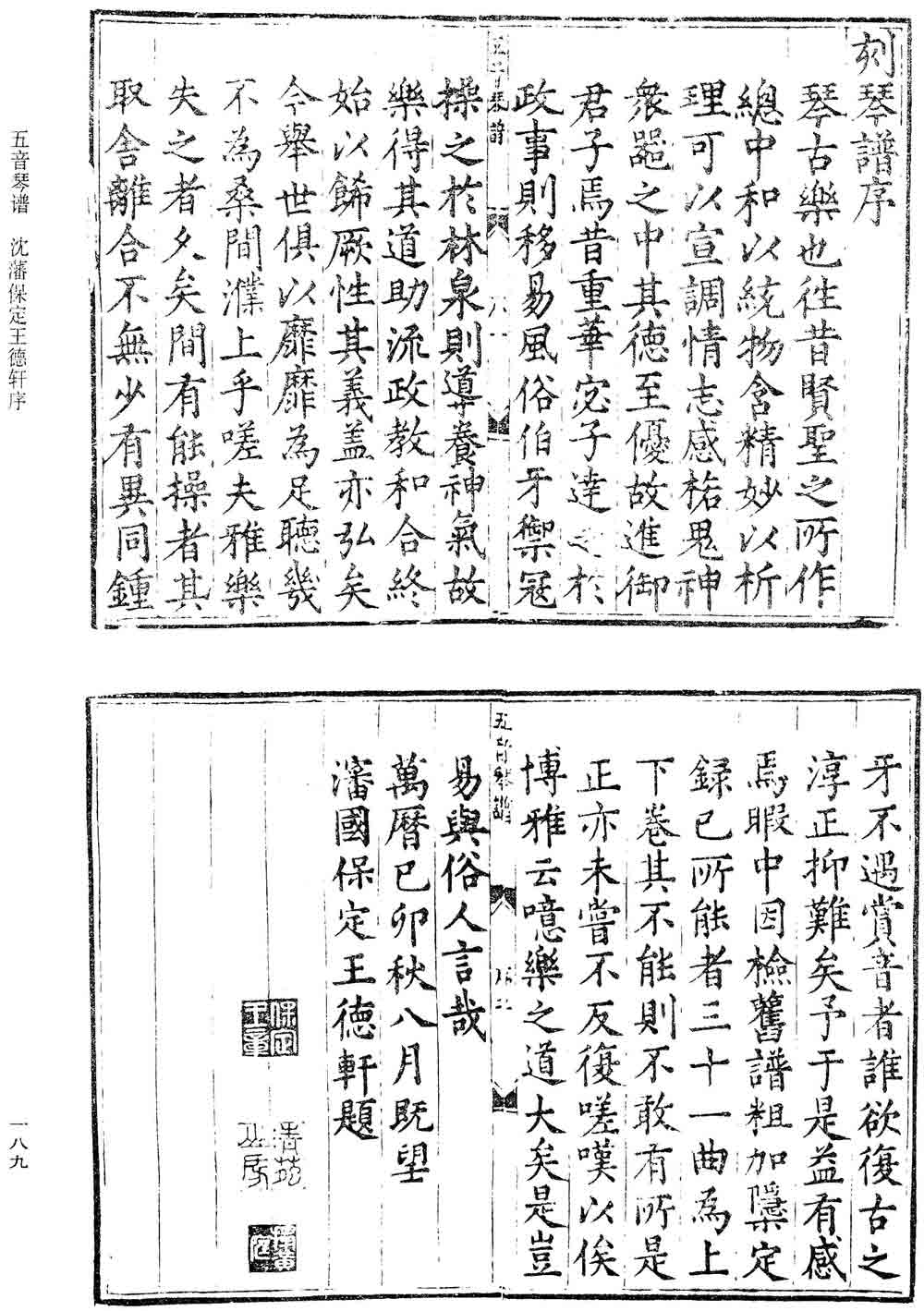 This handbook was published in two folios plus an appendix. It has 36 melodies, none with lyrics or commentary.3 Four of the melodies have their earliest surviving version here, as follows (I have reconstructed and recorded the first two):
- Jing Guan Yin (popular in Qing dynasty)
- Shuixian Qu (later a popular title, but this melody only here)
- Xiangyang Ge (only here)
- Ruilong Yin (popular melody later called Shuilong Yin and Canghai Long Yin)
For all of these I have written out transcriptions and I play the first two; I play Shuilong Yin from 1589.
Beyond this the handbook has been rather mysterious, beginning with the reason Zha Fuxi said the compiler of the book was named 朱珵 Zhu Cheng. This is also the name given on all the references I have been able to find, especially on the internet, but the correct name is 朱珵坦 Zhu Chengtan.4
In the only commentary from the handbook itself, the brief preface to 1579 shown above (complete version), the author gives his name only as "瀋國保定王德軒 Dexuan (his studio name), Prince of Baoding, House of Shen.5 There does not seem to be anything about when, where or how he may have gotten the tablature. Nor is there any information about any teachers he may have had. In fact, there seems to be nothing here or (as far as I have so far found) elsewhere to clarify who he was other than that he was Prince of Baoding of the House of Shen. In addition, the actual location of the Shen Principality is somewhat puzzling. The prince of Shen is said to have been based Lu (潞, in Shanxi), while the Prices of Lu (in particular Zhu Changfang) was actually based in Weihui, about 100 km to the southeast.6
Here, then, is a complete translation of the prince's own preface (the original text is below).
The qin is ancient music, created by the sages and worthies of former times. It gathers central harmony to order all things, contains subtle essence to analyze principle; it can express and regulate the feelings and intentions, and move and reach even the spirits and gods. Among all instruments, its virtue is the most excellent — therefore it is advanced and presented to the noble man.
In the past, Shun and Mizi brought it into affairs of governance, and thereby transformed customs and manners; Bo Ya, wearing his cap, played it among forests and streams, and thereby guided and nourished its vital spirit. Thus, when music attains its proper Way, it assists the flow of governance and moral instruction, harmonizes beginning and end, and assists and furthers politcal and moral teaching - its significance is indeed vast.
Now the whole world takes soft and enervating sounds as sufficient for the ear — are they not nearly the songs of Sangjian and Pushang? Alas! Correct music has long been lost. From time to time there are those able to play; yet in their choices, separations, and combinations, there are inevitably slight differences.
If Zhong Ziqi and Bo Ya did not encounter one who truly appreciates sound, who would wish to restore the pure correctness of antiquity? It is indeed difficult. Therefore I have felt this all the more deeply. In my leisure I examined old tablaturess, and roughly emended and stabilized them, recording those I am able to manage — thirty-one pieces in all — divided into upper and lower fascicles. As for those I cannot manage, I dare not impose corrections upon them; yet I have not ceased to sigh over them again and again, awaiting those of broad learning.
Ah! The Way of music is great indeed— how could it be easily explained to vulgar men?
Written on the day after the full moon, eighth month of the jimao year of Wanli (1579)
By Dexuan, Prince of Baoding of the Shen princely line
Regarding the mention of two fascicles (folios), this suggests that it was at an unspecified later date that he appended the five melodies from "non-standard" modes. At the beginning of each of the two folios is the statement, "瀋藩保定王德軒校刊 Revised and engraved by Dexuan, Regional Prince of Shen". This seems to be the same title as the author of the preface.
The style of music in this handbook seems somewhat different from that of its contemporaries; perhaps this is related to its place of origin; on the other hand, although it seems to have been compiled by someone it Shanxi province, this does not mean that it reflects a particular style from that place. It should be mentioned also that this handbook repeatedly uses several figures/clusters not mentioned in its explanation of finger techniques. Perhaps the editor simply copied fingerings from other handbooks, without regard for the actual usage in the handbook.7
The Preface by Zha Fuxi (QQJC IV/1), translated below, adds some analysis but fewer new details.
The author's own preface says (the original is
above),
Since this was a handbook that he himself used, it has differences from the collecting and storing style of the other tablature collections of all early periods. Its own style is uniform, as are its techniques.
(Some online sites seem to copy the original Chinese incorrectly. They also copy that the book was compiled by "Zhu Cheng" without questioning where that information came from.)
1.
Wuyin Qinpu 五音琴譜 (1579; QQJC IV/193-257)
2.
Image: End of the original preface to 五音琴譜 Wuyin Qinpu
萬曆己卯秋八月既望
Preface in Qinqu Jicheng, Vol. IV/1
by Zha Fuxi8
Beijing, Zhonghua Shuju Chuban Faxing, 1982
Footnotes (Shorthand references are explained on a
separate page)
262.539 五音 wuyin: gong, shang, jue, zhi, yu. Nothing about a book.
(Return)
Copied from QQJC/IV/189; the complete text is:
琴,古樂也,往昔賢聖之所作。
總中和以統物,含精妙以析
理;可以宣調情志,感格鬼神。
衆器之中,其德至優,故進御
君子焉。昔重華、宓子達之於
政事,則移易風俗;伯牙御冠
操之於林泉,則導養神氣。故
樂得其道,助流政教,和合終
始,以餙厥性,其義蓋亦弘矣。
今舉世俱以靡靡為足聽,幾
不為桑間濮上乎!嗟夫,雅樂
失之者久矣。間有能操者,其取
舍離合,不無少有異同;鍾
牙不遇賞音者,誰欲復古之
淳正?抑難矣。予於是益有感
焉。暇中因檢舊譜,粗加櫽定,
錄已所能者三十一曲,為上
下卷。其不能,則不敢有所是
正;亦未嘗不反復嗟嘆,以俟
博雅云。噫!樂之道大矣,是豈
易與俗人言哉!
瀋藩保定王德軒題
(Return)
3.
Melodies in Wuyin Qinpu
Versions of 19 of its 36 melodies are in Shen Qi Mi Pu (1425).
(Return)
4.
Ming Regional Prince Zhu Chengtan 明藩王朱珵坦 (not 朱珵 Zhu Cheng by itself)
14779.484 is 朱珵堦 Zhu Chengjie, but it has none of the other Zhu Cheng...'s and no two character 朱珵; Bio/547 is same. The references I do have for him were kindly sent to me by Jerome Kerlouegan, who has written on
Ming princely publication. In a personal communication he explained why it must be Zhu Chengtan: "The preface is dated 1579, and the prince of Baoding at that time was Zhu Chengtan (he ruled the house of Baoding from 1559 to 1600). That secondary house had been created for him by his father, 瀋王朱恬烄 Zhu Tianjiao, the prince of Shen."
Of Zhu Chengtan one can read on the internet, e.g.,
Zhu Chengtan was a 9th generation descendant of Ming Taizu (founder) Zhu Yuanzhang; 8th generation descendant of Shenjian Prince Zhu Mo and second son of Shenxuan Prince Zhu Tianjiao's principal wife. In 1559 he was enfeoffed as Baoding prince; he died in 1600. His temple name was Baoding Shunhui Prince.
In Richard G. Wang, The Ming Prince and Daoism: Institutional Patronage of an Elite (OUP 2012), one can read, "Finally, in the Shen principality, both the commandery prince Huishun of Baoding 保定惠順王 (Zhu Chengtan 朱珵坦, titled 1559–1600) and Zhu Tianwan 朱恬烷.... wrote poems on Daoist temples that are included in a Qing local anthology." (Note the reversal to "Huishen".) Was it in 《清苑山房集》? I have not seen that poem, but the following poem attributed to Zhu Chengtan can be found online:
曉霧危岩合,煙蘿仄徑懸。
浮圖開佛日,沙界接人天。
獨鶴衝雲起,愁猿枕石眠。
逃禪如可醉,莫負杖頭錢。
Morning mist closes around steep crags;
smoky vines hang over a narrow path.
A pagoda opens to the Buddha’s sun;
this world of dust joins the realms of men and heaven.
A lone crane rises, piercing the clouds;
a melancholy gibbon sleeps, pillowed on stone.
If “fleeing into Chan” could be like getting drunk,
do not waste the wine-money hung from your staff.
Zhu Chengtan was one of at least six Ming princes to have compiled a qin handbook. However, I have not as yet seen mention of his possible connection with the famous late Ming 潞王 Prince of Lu, 朱常淓 Zhu Changfang. Zhu Chengtan was in Changzhi, Shanxi, about 100 miles northeast of Weihui, Henan. However, the qin handbook compiled by Zhu Changfang, Guyin Zhengzong, seems to have little if any music connection to the Wuyin Qinpu of Zhu Chengtan.
The geographical connection between the two is discussed in the following footnote.
(Return)
5.
瀋國保定王德軒題 Shen Principality Protective Prince Dexuan
The commentary by Zha Fuxi/Wu Zhao does not elaborate on this name, only quoting the statement at the end of the preface, "Recorded by Dexuan, Regional Prince of Shen Principality" (Shen Guo Baoding Wang Dexuan ti 瀋國保定王德軒題). The Zha/Wu commentary does not mention that this name is repeated at the beginning of folios 1 and 2 (IV/195 and /222), changing only the second character: it has 藩 fan (fiefdom) instead of 國 guo (country), making it Shen Fan Baoding Wang Dexuan jiao kan 瀋藩保定王德軒校刊). Thus the meaning seems to be the same.
Here is my understanding of this name, in part from consulting a Chinese Wikipedia template about Shen Guo:
-
Shen Fan and Shen Guo (瀋藩、瀋國)
Both of these can be translated as "Shen Principality". 朱模 Zhu Mo, the 21st son of Zhu Yuanzhang, founder of the Ming dynasty, was enfeoffed as 瀋簡王 Shenjian Prince in 潞州 Luzhou, later called 潞安府 Lu'an Fu (18839.6: 今山西省長治縣 modern day Changzhi district, southeast Shanxi province about 100 miles northwest from Zhu Changfang's Weihui in Henan). Zhu Mo's descendents were various types of 瀋... Shen... princes, including a 瀋定王 Shending prince 朱珵堯 Zhu Chengyao (14779.xxx; Bio/xxx) who ruled from 1584 to 1638. Meanwhile Zhu Chengyao's younger brother, Zhu Chengdan, was enfeoffed separately in 1559 as 保定王 Baoding prince, a subordinate 郡王 within the Shen line.It should be noted that in the year of Zhu Chengyao's accession to the Shen Principality in Changzhi, 1584, the princedom of 潞 Lu was created for 朱翊鏐 Zhu Yiliu (1568 - 1614), a younger brother of the Wanli Emperor and the father of the famous qin making 潞王 Prince of Lu, 朱常淓 Zhu Changfang), in neighboring 闈輝府 Weihui district of what is today northern Henan province.
18963/2 says 瀋 shen is the same as 沈 shen, the character used by Zha/Wu. The only shen fan in the dictionary (瀋藩 18963.xxx) is 沈藩 17529.635 草名 a grass name. There are no entries for shen guo (瀋國、沈國), shen fan (瀋藩、沈藩), or shen wang (瀋王、沈王); 33076.35 藩國 fan guo says "old term for a principality"; this and 33076.3 藩王 fan wang cite only ancient sources and seem to suggest it means a guardian of the frontier. However, by the Ming dynasty fan wang simply mean "regional prince". This suggests that 瀋藩 Shen fan has a similar meaning to 瀋國 Shen guo: Shen principality. Also regarding Shen, the major dictionary reference suggests it should refer to the area around 瀋陽 or 沈陽 Shenyang. However, this conflicts with the other information.
- Protective Prince (保定王 Baoding Wang)
The main commentary on 694.76 保定 Baoding connects it to the Baoding region, southwest of Beijing. However, in connection to the 瀋王系 Shen princely line it must be referring to the region of 潞州 Luzhou or 潞安府 Lu'an Fu, modern Changzhi, Shanxi, about 100 miles northwest of Weihui, where Zhu Changfang was later prince of Lu. (The original meaning of baoding is 694.76/1 無事安泰 free and tranquil or 1/1390 保護而安定 protect and settle.)- 德軒 De Xuan
10480.xxx; 14799.xxx. According to Kerlouegan this is the studio name for 朱珵坦 Zhu Chengtan. The handbook uses only the title and name 瀋國保定王德軒 Shen Guo Baoding Wang Dexuan,
(Return) - Protective Prince (保定王 Baoding Wang)
6.
瀋 Shen and 潞 Lu regions (principalities/fiefdoms)
As discussed above, although it seems that the administrative center for the Shen principality, the extent of the region is not explained clearly. This is an important details in part because during most of the Ming dynasty princes were not allowed to leave their fiefdoms.
(Return)
| 7. Unexplained fingerings in Wuyin Qinpu | Some unexplained fingerings in Wuyin Qinpu |
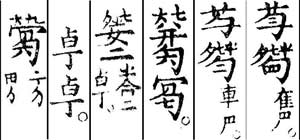 The five examples given here are all figures that appear more than once in this handbook, so it seems likely that they are not simpy copy errors. Starting from right:
- Two columns, each showing an open string followed by its octave. One is played 應聲 the other 連聲, but there is no explanation of the difference (IV/203)
- The figure meaning 分開 is usually applied to two right hand strokes: with sixth or seventh string? (IV/201 [first notes Section 5]; same in 1525 [first notes Section ])
- The right column under 女二 has 半輪 on 二 but other versions all have octaves played here (IV/205; see also next)
- The individual components of this figure (here repeated) would seem to be 綽打 (綽 chuo and 打 da), but although this figure appears numerous times (e.g., in the previous example here), there is never any confirmation that this is indeed what the symbols stand for, much less an indication of where or how to play it (IV/241)
- This shows 吟猱 followed by 細猱, with two right hand strokes above. Should one do 吟猱 on the first then 細猱 on the second? 吟猱 appears quite frequently: does it mean do both 吟 (fast vibrato) and 猱 (slow vibrato), or could it be copying some old tablature that says 吟 is a type of 猱? (IV/203)
Considering the lack of explanation for some fingerings it is perhaps ironic that right after the fingering explanations the editor has included (without attribution) a verse by Cao Rou about looking up fingerings that are not understood. (Before the verse is written, "法曰 The rules say:"). It seems that generally finger explanations are copies of earlier, supposedly authoritative, versions. In early Ming this does not seem to be a problem, but later on it seems likely that some players were using new techniques for which there was no existing tablature, but the scribes could not imagine inventing new terms to describe these techniques.
(Return)
8.
Commentary by Zha Fuxi
查阜西 Zha Fuxi apparently wrote the original version , then it was edited by 吳釗
Wu Zhao. The full text of his commentary is as follows:
上海圖書館藏,明刊本,二卷。明藩王朱珵(朱珵坦)輯。有萬曆七年己卯(公元一五七九)秋八月瀋國保定王德軒序。上卷爲宮調及商調曲,下卷爲商角曲及外調曲,凡三十六曲。
該序有云:「暇中因檢舊譜,粗加檃定,錄己所能者三十一曲為上、下卷;其不能則不敢有所是正。」既是他的自用譜本,就與其他各先期譜集兼收並蓄的體裁有所不同一,技巧統一。
Zha's introduction in his Guide says the volume he had belonged to 胡公玄 Hu Gongxuan. It has basically the same information as here, with no speculation as to whom the mames 朱珵 Zhu Cheng (朱珵坦 Zhu Chengtan), 德軒 (Zhu) Dexuan or 保定王 Baoding Wang might refer.
(Return)
9.
上海圖書館; still in the Shanghai Library?
(Return)
10.
Melodies using non-standard tunings
In the text (not the table of contents) above the title for Zhuangzhou Mengdie, which is in the shangjue mode, is the character 附 fu, meaning "appendix". The four following pieces are identified as "non-standard tuning": Ao Ai and Yang Guan use ruibin mode, but this is not mentioned, though the tuning method is given at the front of Ao Ai; Li Sao uses qiliang mode (this is mentioned in the table of contents); Feiming Yin uses guxian mode, but this is not mentioned, though its tuning method is given. Mode names are also mentioned in the central column which has the page numbers, but there are mistakes.
(Return)
11.
Zhu Chengtan Preface
The preface misprints this as "30". The handbook's own table of contents does indeed list 31 melodies. The one here has 36 because it includes the five modal preludes, which in the book's own text but not in its Table of Contents.
(Return)
12.
He adds, "I have sighed over this many times."
(Return)
Return to the annotated handbook list or to the Guqin ToC.