|
T of C
Home |
My Work |
Hand- books |
Qin as Object |
Qin in Art |
Poetry / Song |
Hear, Watch |
Play Qin |
Analysis | History |
Ideo- logy |
Miscel- lanea |
More Info |
Personal | email me search me |
| Qin bios / 琴史續 Qin Shi Xu #141 | 首頁 |
|
Zhang Dai
- Qin Shi Xu #141 |
張岱 1
琴史續 #141 Zhang Dai 2 |
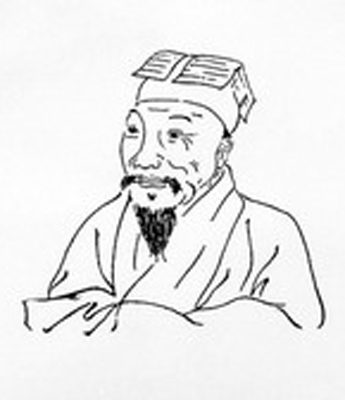 Zhang Dai (1597 - ca. 1684), a member of a wealthy family in Shaoxing that apparently lost its wealth after the fall of the Ming dynasty, wrote extensively about his life and family, in the process leaving a valuable record of life at the end of the Ming dynasty.3 Playing qin was just one of his many activities. Another was tea connoisseurship.4
Return to Dragon Mountain, a book by Jonathan Spence about Zhang Dai's life in Shaoxing, recounts many of Zhang's observations on Western society and its mechanical devices, including a keyboard instrument. Of Zhang's qin activities Spence writes,5
Not everyone was up to these lofty standards. Zhang Dai's cousin Yanke, who joined them for a while, was simply no good at music. Nor was their friend Fan Yulan, though Fan was at least interesting in his badness. For a while Fan would devote himself passionately to a particular teacher, striving to catch his every nuance, until another teacher caught his fancy. Then he would unlearn everything he had just learned and start all over again, repeating the pattern at intervals. "As for those pieces Fan had studied previously," wrote Zhang, "he worked so hard at forgetting them that he truly could recall nothing of them, and finally he could not play anything at all. At night he just cradled his qin and tuned the strings, that was it." Zhang Dai claimed that he himself did better, learning the techniques from his teachers until he had mastered them, at which point he was able to "move back to a more natural tone," deliberately cultivating a slightly roughened sound. With a favorite teacher and the two friends who played the best, Zhang Dai formed a quartet that gave performances from time to time: "Our four instruments sounded as if played by a single hand. Our audience was spellbound."
This ability to play in unison has led to suggestions that the group's practice was to use percussion to keep time, mentioned further below.
Zhang Dai's qin activities are further discussed in Xu Jian's Qinshi Chubian, Chapter 7.A., which also concerns Yin Ertao, a member of the group who later published the qin handbook Huiyan Mizhi. Elsewhere Zhang is quoted in connection with the expression cao man.
In 1623 Zhang Dai printed a collection of essays that includes what might be the earliest known reference to the expression "dapu" (play music from qin tablature). The collection was by a well-known "scholar in cotton clothes" from a previous generation, Xu Wei (Xu Wenchang; 1521-1593),6 one of which mentions the expression "dapu" as follows:7
"Dapu", playing/learning a melody directly from the qin tablature rather than from a teacher, has never been precisely defined. It could simply mean something like sight-reading: without a teacher, Xu Wei started playing directly from tablature but the fact that he did all this within a month suggests either these were quite simple - short songs perhaps - or he was playing them somewhat cursorily in order to experience a feeling for the melodies. Today, however, it is my understanding that the term usually means "realizing" a score through "recreating" the music (compare "reconstructing" it). A later version of the essay does not mention dapu.
The following biographical essay includes a statement about the organization of qin societies that has been much quoted elsewhere. Little is known about the origin of qin societies, but they seem to have become particularly popular at the end of the Ming dynasty. Another person beside Zhang Dai who was significant in the origin of such societies was Yan Cheng (Yan Tianchi, 1547-1625), whose handbook Songxianguan Qinpu is said to have laid the foundation for the very popular Yushan qin school.
With all his connections to Shaoxing, Zhang Dai is sometimes said to have belong to the "Shaoxing Qin School", but I have not yet found any early references to this term. 8
Zhang Dai biographical essay in Qinshi Xu 9
王侶鵝 Wang Lü'e (line 4)
王本吾 Wang Benwu (line 6)
何紫翔 He Zixiang (line 11)
張慎行 Zhang Shenxing (line 25)
何明台 He Mingtai (line 25)
Zhang Dai, style name 宗子 Zongzi and in old age nicknamed 陶庵老人 Old Man of Tao An, was from 山陰 Shanyin (Shaoxing, in Zhejiang). His family had been illustrious for generations, (so he had) beautiful and expensive food and clothing, and spent his days amongst wealthy people from all over. They arranged singers to perform melodies, and they could tell all sorts of jokes. Cock fights, bird fights, gambling, football and ruan lute music:11 he was accomplished at all such skills, but was especially good at qin.
In Shaoxing, people who followed Wang's Bright Spring School (of qin play)12 esteemed (its master?) Wang Lü'e,13 so Zhang Dai studied with him. He (then) could play such melodies as Yu Qiao Wenda, Liezi Yu Feng, Biyu Mode,14 Shui Long Yin, Dao Yi, and Huanpei Sheng.15
Shortly thereafter he studied qin for half a year with Wang Benwu,16 learning more than 20 melodies including Yan Luo Pingsha, Shan Ju Yin, Jing Guan Yin, Qingye Wen Zhong, Wu Ye Ti, Han Gong Qiu, Gao Shan, Liu Shui, Meihua Sannong, Chun Hua Yin,17 Cangjiang Yeyu, and Zhuang Zhou Meng Die, plus more than 10 short (versions of long?) melodies such as Hujia Shibapai 18 and Pu'an Zhou.
(Wang) Benwu's finger technique was round and calm, slightly carrying along a sort of slickness. Zhang Dai achieved his techniques (but) once he was fully proficient he deliberately returned to a raw state (sele) brought out through resisting over-smoothness; he was then praised for its compatibility.19
At one time he formed with his fellow students Fan Yulan, Yin Ertao, He Zixiang, Wang Tu, Mei Yan, Ke Pingzi and so forth a One Silk Strand Association.21 Each month they met three times. There was a short proclamation that read,
After this (Fan) Yulan, (Wang) Shimei, Yanke and Pingzi all failed to complete their studies (with Wang Benwu). He Zixiang attained eight or nine tenths of Wang Benwu’s level, though with some immaturity; Yin Ertao likewise reached eight or nine tenths, but with a certain stiffness. When Zhang Dai played together with Wang Benwu, He Zixiang, and Yin Ertao, the four qins would sound as though from a single hand; listeners were utterly convinced and subdued.
After Wang Benwu, those who came to Yue included Zhang Shenxing and He Mingtai; they were solid and well-grounded, though lacking ease and looseness. None surpassed Wang Benwu.
(Source:) Chunhu Manlu.
(See further comment on the translation.23)
See original text below. Much of this actually came from Zhang Dai's Dream Reminiscences of Tao'an (陶庵夢憶 Taoan Mengyi; original text also below.
Footnotes (Shorthand references are explained on a
separate page)
1.
Zhang Dai (1597 - after 1667), sources
10026.575/2 張岱 Zhang Dai says only that he was 劍州人,僑寓錢塘,字陶菴,自號蝶庵居士。著有西湖夢尋 from Jianzhou but made Hangzhou his residence; style name Tao'an (菴 not -庵), called himself Die'an Jushi (Master of the Butterfly Hut) and wrote a Xihu Mengxun. (Note that Zhuang Zhenfeng, author of Qinxue Xinsheng [1676], also had the nickname Die'an.)
Bio. 1217 says that Zhang Dai was from 浙江山陰 Shanyin in Zhejiang, had the style names 宗字 Zongzi and 石公 Shigong as well as the nickname 陶庵 Tao'an. He lived a long time in Hangzhou and after the Ming fled to 剡溪山 Yanxi Shan. It lists his writings as 琅嬛文集 Langhuan Wenji, 西湖夢尋 Xihu Mengxun, 陶庵夢憶 Tao'an Mengyi, 石匱書 Shikui Shu and 今存后集 Jincun Houji.
Two books on Zhang Dai were published in 2007:
Another useful work is Joseph S. C. Lam, Music and Masculinities in Late Ming China.
ICTCL pp.220-221 says Zhang Dai was a "romantic writer and historian of the late Ming period" whose poverty after the fall of the Ming "prompted him to produce two important works, Tao'an Mengyi 陶庵夢憶 (Recollections of Tao'an's Past Dreams), a series of nostalgic sketches of the grand and elegant life of the late Ming, and Shikui Shu 石匱書 (Book of the Stone Case), a history of the Ming dynasty".
Wu Zhao's preface to Huiyan Mizhi (QQJC X, p.1) refers to a chapter of Tao'an Mengyi called 紹興琴派 Shaoxing Qin School.
2.
Zhang Dai Image
3.
Writings by Zhang Dai
丙辰,學琴於王侶鵝。紹興存王明泉派者推侶鵝,學《漁樵回答》、《列子御風》、《碧玉調》、《水龍吟》、《搗衣》、《環珮聲》等曲。
戊午,學琴於王本吾,半年得二十餘曲:《雁落平沙》、《山居吟》、《靜觀吟》、《清夜坐鐘》、《烏夜詠》、《漢宮秋》、《高山》、《流水》、《梅花弄》、《淳化引》、《滄江夜雨》、《莊周夢》,又《胡笳十八拍》、《普庵咒》等小曲十餘種。王本吾指法圓靜,微帶油腔。余得其法,練熟還生,以澀勒出之,遂稱合作。同學者範與蘭、尹爾韜、何紫翔、王士美、燕客、平子。(范)與蘭、(王)士美、燕客、平子俱不成。紫翔得本吾之八九而微嫩,爾韜得本吾之八九而微迂。余曾與本吾、紫翔、爾韜取琴四張彈之,如出一手,聽者駴服。後本吾而來越者,有張慎行、何明台,結實有餘,而蕭散不足,無出本吾上者。
The Shaoxing Qin Lineage
In 1616 I studied the qin under Wang Lü’e. Within the Shaoxing tradition, those of the Mingquan lineage regarded Lü’e as its leading figure. Under him I studied such pieces as Dialogue of the Fisherman and the Woodcutter, Liezi Rides the Wind, Biyu Mode, Water Dragon Intonation, Pounding Clothes, and Sounds of Dangling Pendants, among others.
In 1618, I studied the qin under Wang Benwu. Within half a year I mastered more than twenty pieces, including Wild Geese Descending on the Sandbank, Mountain Dwelling Chant, Quiet Contemplation Chant, Sitting at Night Listening to the Bell, Ravens Cry at Night, Autumn in the Han Palace, High Mountains, Flowing Streams, Plum Blossom Melody, Chunhua Yin, Night Rain on the Cang River, and Zhuang Zhou’s Dream. In addition, I learned more than ten other small-form pieces, including Eighteen Songs of the Hujia and Pu’an Mantra.
Wang Benwu’s finger technique was rounded and tranquil, with a slight tendency toward slickness. I grasped his method; once it had become fully fluent, I deliberately returned it to rawness, bringing the sound out through se-le (澀勒). Thereupon we were praised as being well matched.
My fellow students were Fan Yulan, Yin Ertao, He Zixiang, Wang Shimei, Yanke, and Pingzi. Fan Yulan, Wang Shimei, Yanke, and Pingzi all failed to complete their studies. Zixiang attained eight or nine tenths of Benwu’s level, though with some immaturity; Ertao likewise reached eight or nine tenths, though with a certain stiffness.
I once took four qins together with Benwu, Zixiang, and Ertao and played with them; it was as though the sound came from a single hand, and the listeners were astonished and convinced.
After Benwu, those who came to Yue (Shaoxing) included Zhang Shenxing and He Mingtai. They were solid and substantial, yet lacked ease and natural looseness; none surpassed Benwu.
Much of this is in the biography here, but it cites Chunhu Manlu and has some differences.
4.
Zhang Dai and tea
5.
Return to Dragon Mountain, pp. 21-22.
6.
徐渭 Xu Wei (see also next footnote)
As for his being a "scholar in cotton clothes" (布衣文人 buyi wenren), the Wikipedia article says this was,
For more on Xu Wei see Duncan Campbell, "Madman or Genius: Yuan Hongdao's 'Biography of Xu Wei'", in Dov Bing, S. Lim & M. Lin, eds., Asia 2000: Modern China in Transition (Hamilton: Outrigger Publishers, 1993), 196-220. In addition, his four play cycle Four Cries of a Gibbon (四聲猿 Si Sheng Yuan) is translated and discussed in Shiamin Kwa, Strange Eventful Histories: Identity, Performance, and Xu Wei's Four Cries of a
Gibbon (Harvard Yenching, 2013).
7.
徐渭 Xu Wei (see above) and 打譜 dapu
Regarding Xu Wei and qin, another source says,
This indicates that Xu Wei studied with Chen Liangqi before studying with Wang Zheng. However, this latter (and later) article does not mention dapu.
Thanks to Amy Wang for help with the translation. No further information as yet on 王政(王廬山)Wang Zheng (Wang Lushan) or 陳良器 Chen Liangqi. The original essay mentioning dapu was copied from an article on dapu by 嚴曉星 Yan Xiaoxing. Yan says this is the earliest known mention of the term "dapu". Here, quite likely, it means learning a melody from tablature instead of from a teacher. He presumably was "recreating" his own versions rather than trying metiulously to "reconstruct" the versions he had found in tablature.
8. Shaoxing Qin School (紹興琴派 Shaoxing Qinpai)
9. Zhang Dai biographical essay in Qinshi Xu (#141)
(張岱,琴史續 #141, 26 lines)
紹興存王(侶鵝)「明泉派」者推王侶鵝。岱就學焉,能彈《漁樵問答》、《列子御風》、《碧玉調》、《水龍吟》、《搗衣》、《環珮聲》等曲。
既而學琴於王本吾,半年得《雁落平沙》、《山居吟》、《靜觀吟》、《清夜坐鐘》、《烏夜詠》、《漢宮秋》、《高山》、《流水》、《梅花弄》、《淳花引》、《滄江夜雨》、《莊周夢》等二十餘曲。又《胡笳十八拍》、《普庵咒》等小曲十餘種。
(王)本吾指法圓靜,微帶油腔。岱得其法,練熟還生,以澁勒出之,遂稱合作。
嘗與同學範與蘭、尹爾韜、何紫翔、王士美、燕客、平子等結「一絲社」。月必三會之。有小檄曰:
Only the former part of this original text has been translated above.
11.
擘院 bi ruan, lit: play the ruan lute.
(Return)
12.
明泉派 Mingquan School 14124.xxx.
(Return)
13.
王侶鵝 Wang Lü'e; Bio. xxx
(Return)
14.
碧玉調 Biyu Diao is the name of a mode, not a melody. Should it be
碧玉意 Biyu Yi?
(Return)
15.
環珮聲 Huanpei Sheng (Sound of Jade Pendants)
16.
王本吾 Wang Benwu
17.
淳花引 Chun Hua Yin (Singular Flowers Intonation)
18.
Hujia Shibapai 胡笳十八拍
19.
以澁勒出之,遂稱合作 Resisting over-smoothness (sèle) and praised for compatibility
However, as the translations below suggest, this argument is rather weak, and it is not clear whether this is the only source for comments that say Zhang Dai would sometimes accompany his qin play with bamboo sticks. Perhaps a better example on this is
this quote about
Liu Yun, but see also
ji qin.
As for dictionary definitions:
This suggests that in the musical context 澀勒 sèle does not mean a stick but something like "rough/harsh" and "restrain/engrave", based on the meaning of the two characters separately. The phrase might then have been used to describe a sort of roughness in playing, in contrast with the smoothness of the teacher.
21.
One Silk Strand Association (一絲社 Yi Si She)
23.
Further comment on the translation
Return to QSCB, 7.A.
or to the Guqin ToC.
"This absorbing book illuminates a culture’s transformation and reveals how China’s history affects its place in the world today." Further details online include a
Presidential Address by Prof. Spence to the 2005 meeting of the American Historical Society; his first footnote has a bibliography.
Focuses on Zhang Dai's Dream Reminiscences of Tao’an (Tao’an mengyi)
Asian Music, Vol. 42, No. 2 (SUMMER/FALL 2011), pp. 112-134 (23 pages)
Published By: University of Texas Press; also in JSTOR
(Return)
Copied from unattributed internet image.
(Return)
Of particular relevance would be the following section from Chapter 2 of his Dream Reminiscences of Tao'an (陶庵夢憶 Taoan Mengyi)
(Return)
Zhang Dai was particularly interested in the water used for making tea. In
Return to Dragon Mountain, pp. 17-20 and 36-38, Spence describes Zhang Dai's work on Snow Orchid Tea, made using water from a well at the local Speckled Bamboo Shrine (in Shaoxing; compare
Junshan). He then describes the commercialization.
(Return)
(Return)
Xu Wei (Wiki; style names 文清 Wenqing and then later 文長 Wenchang) was a well-known calligrapher, painter, poet and dramatist. He died four years before Zhang Dai was born.
(Return)
The source is Xu Wei's "徐文長先生佚稿"; the original of the text quoted above is as follows (see #140 from the full preface, in
ctext),
"十二三歲即作「賦雪詞」並與陳良器學古琴十五歲向王政學習琴曲能自譜古琴曲十六。
At 12 or 13 (I) wrote 'Lyrics Rhapsodizing Snow', and with Chen Liangqi studied guqin; at 15 from Wang Zheng I studied qin melodies and could myself "譜 pu" (put into tablature? play well enough that someone could put into tablature?) 16 qin melodies."
(Return)
This is the name of a segment in Zhang Dai's Dream Reminiscences of Tao'an
(陶庵夢憶 Taoan Mengyi), Section 2. To my knowledge it was not the name of an established style. Compare, e.g., 明泉派 Mingquan Pai, the school of Zhang Dai's first teacher.
(Return)
The source is identified only as 蓴湖漫錄 Chunhu Manlu. This is somewhat odd, as all other references to Chunhu Manlu are 14th century or earlier. The complete essay in Qinshi Xu, here tentatively divided into paragraphs, is as follows:
張岱,字宗子,晚號陶庵老師,山陰人。家世通顯,服食豪侈,日聚海內勝流,徵歌度曲,諧謔雜進。
凡「鬬雞」,「臂鷹」,「六博」,「蹴踘」,「擘阮」諸伎靡不為,而尤長於琴。
(Return).
No other mention found. As yet I have not found any references specifically connecting it to the melody Jade Pendants in a Heavenly Breeze
(天風環珮 Tianfeng Huanpei).
(Return)
Bio. xxx. Zhang Dai studying from Wang is also mentioned under
Pingsha Luo Yan.
(Return)
This title does not seem to occur elsewhere. It could be mistake, or it could be an example (one of many?) melodies that had an oral tradition for a while but were either never written down or only hand copied then lost.
17977.xxx. Also no 淳華, 27915. 純花, or 醇花.
淳 chun= singular, pure (純), fertile (醇); zhun= dampened; compare 純化、淳化: purify
(Return)
This presumably refers to the Hujia Shibapai that developed out of
Da Hujia rather than either the modern version that developed out of it or the qin song first published in
1597.
(Return)
This passage has also been interpreted as, "bamboo sticks [sele or se-le, suggesting they were used to bring out the rhythms]. This was then praised for "合作", interpreting that as "合奏" playing together".
(Further comment.)
"(廣東新語)笠竹,一名澀勒。勒,刺也。
廣東人以刺爲勒,故又曰勒竹,長芒密距,枝皆五出如雞刺也。...."
Sèle (New Discourses on Guangdong [17th c.])
The name of a type of bamboo; see "lizhu".
Lizhu (cone-hat bamboo) is also called sèle. Le means “thorn.”
In Guangdong, thorns are called le, hence it is also called le-bamboo.
It has long bristles and closely set spines; its branches all emerge five at a time, resembling a cock’s spur....
倦看澀勒暗蠻村,亂棘孤藤束瘴根。
Wearied of gazing at sèle bamboo darkening a southern village,
Tangled thorns and solitary vines bind fast the roots of miasma.
惟有長身六君子,依依猶得似淇園。
Only the tall-bodied Six Gentlemen remain —
Leaning together, they still resemble the garden of the Qi River.
(Return)
Was this a sort of club for people who wanted to play "as one string", i.e., in unison? Members mentioned here are:
范與蘭 Fan Yulan
尹爾韜 Yin Ertao
何紫翔 He Zixiang
王土 Wang Tu
美燕 Mei Yan
客平子 Ke Pingzi
(Return)
My translation currently ends on line 12 (of 26) from the original Qin Shi Xu entry. Lines 12 to 22 give Zhang Dai's ideas about establishing qin societies. This has been discussed elsewhere online in various places, but so far I have just copied the original here. Lines 22-26 have also not yet been translated elsewhere.
(Return)