|
T of C
Home |
My Work |
Hand- books |
Qin as Object |
Qin in Art |
Poetry / Song |
Hear, Watch |
Play Qin |
Analysis | History |
Ideo- logy |
Miscel- lanea |
More Info |
Personal | email me search me |
| Handbook List ToC (from Qinpu Hebi, TGYY and BYXF) Preface by Zha Fuxi .pdf copy | 首頁 |
|
Zhenchuan Zhengzong Qinpu
Authentically Transmitted Orthodox Qin Handbook 1 Combines Yang Lun's Taigu Yiyin and Boya Xinfa |
真傳正宗琴譜
楊掄太古遺音、伯牙心法 1589 and 1609 |
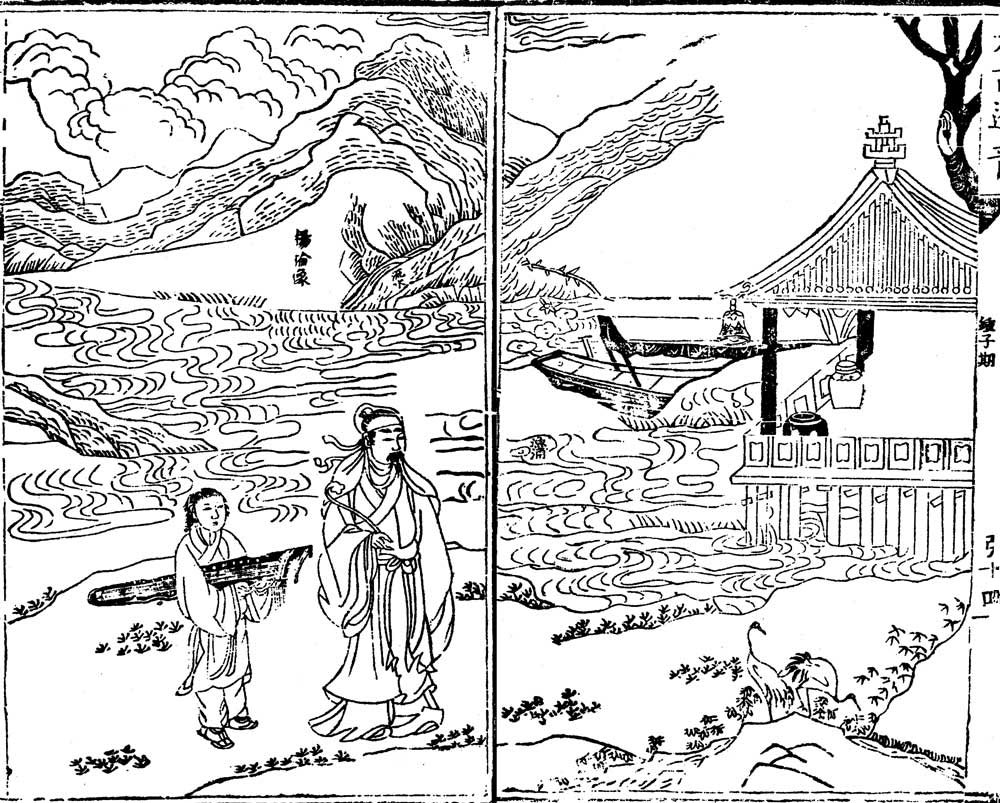
| Yang Lun,2 with Zhong Ziqi cut from the pavilion 3 |
 This significant handbook was compiled in Nanjing over a number of years by an important qin master about whom we seem to have very little personal information, Yang Lun. Detailing his life is complicated by the fact that around the same time there was a Yang Lun who was a prominent government official but who, although he does not seem to have any known specific connection to the qin, is sometimes treated as the same person.4 So until this can be established with certainty, they will be kept distinct in the following account.
Meanwhile, detailing the work of Yang Lun as the qin player is complicated by the handbook itself having two parts with different titles, as outlined below.
The most complete versions of Yang Lun's handbook have 63 melodies, of which thirteen seem to be new: seven with new titles and six with titles found in earlier existing handbooks. Melodies I have reconstructed and recorded from this handbook include the following (those without lyrics first):5
- Mozi Sings with Feeling (Mozi Bei Ge)
- Wild Geese on the Frontier (Saishang Hong; recording pending)
- Wine Mad (Jiu Kuang; song version of an old instrumental melody)
- A Phoenix Seeks his Mate (Feng Qiu Huang; new version of an older song)
- Intonation on Listening to a Qin (Ting Qin Yin)
- Pounding Cloth (Dao Yi; an instrumental melody with lyrics)
- Lament in a Lady's Chamber (Gui Yuan Cao)
- Qingshang Diao (prelude for Pounding Cloth?)
- Stanzas of Siddham (Shitan Zhang; a chant; recorded but not memorized)
In addition, I have transcribed but not recorded two further new melodies. Almost all of the melodies I reconstruct are the earliest versions to have survived, but the melodies of two of the above (Jiu Kuang and Shitan Zhang) are related to earlier versions.
Yang Lun apparently published his qin handbooks as a (relatively) young man )before the government official Yang Lun passed his civil service exams in 1613. Much has been written about the government official because of his subsequent career, culminating in his leading an imperial mission to the Ryukyu Islands in 1633. However, there is little information about where the melodies in the qin handbooks of Yang Lun originated. This is particularly true of those that survive first from his handbooks, which are the ones I myself have reconstructed and recorded, as just listed above.
Qinqu Jicheng includes two editions of Zhenchuan Zhengzong Qinpu: one published in 1589, apparently the earliest; and the "commonly seen edition" generally said to have been published in 1609.6 Their original publication in Nanjing suggests that they be considered representative of the late Ming Jiang School of qin play. The handbook consists of two parts: Yang Lun Taigu Yiyin, named after its compiler; and Boya Xinfa, meaning "Shared Teachings of Boya". This latter title, as well as the illustration at right, which originally depicted Yang Lun visiting Boya's friend Zhong Ziqi, was apparently considered by some to be an attempt to equate Yang Lun with Boya, the most famous qin player of antiquity, something for which Yang Lun was roundly criticized (though note that Zhong Ziqi was actually famous as a listener, not as a player).
The way both the 1589 and the 1609 Yanglun Taigu Yiyin and Boya Xinfa are included in Qinqu Jicheng means that Qinqu Jicheng has four separate entries for them (more detail in the outline below). These are in the following order (those from 1609 are referred to in the Table of Contents as "又本 extra volumes", referring to the fact that here only piece that were not in 1589 are included in this Qinqu Jicheng reprint of the 1609 edition):
| 1589 Yang Lun Taigu Yiyin7 | 31 of 34 pieces (missing three diaoyi kao), all with lyrics (VII/51) | |
| 1589 Boya Xinfa8 | 7 pieces; none with lyrics (VII/53) | |
| 1609 Yang Lun Taigu Yiyin | 1 (of the original 34) pieces (2 are missing?) (VII/175) | |
| 1609 Boya Xinfa | 22 of 29 pieces; 7 have lyrics (VII/179-227) |
The fact that Qinqu Jicheng omitted from its reprinting of the 1609 edition those melodies already included in 1589 suggests that the complete 1609 edition was a re-issue of the 1589 edition, with the same content for Yang Lun Taigu Yiyin, but adding 22 melodies to Boya Xinfa. (The three missing melodies from the 1589 Taigu Yiyin were likely in the original, but apparently the 1609 edition in Qinqu Jicheng had only one of these.)
In the 1950s several editions of this handbook were apparently still available in bookstores, and at least one other surviving edition has been reprinted, called Qinpu Hebi.9 Qinpu Hebi may have been published around the same time as the 1609 Qinpu Zhenchuan: as can be seen from its complete Table of Contents, it has the same melody content but adds some further commentary and illustrations. Apparently the whole book is also sometimes given the general name Yang Lun Taigu Yiyin. For example, Van Gulik states that Boya Xinfa is an appendix to Taigu Yiyin.10
Although Zha Fuxi's introduction to the editions in Qinqu Jicheng, Vol. VII, says that the two parts of this handbook originally had the name Zhenchuan Zhengzong Qinpu, Zha does not discuss the origin of this title, and makes no mention of the title Qinpu Hebi. QQJC seems to suggest that the 1589 edition it reprints first (QQJC VII/pp.49-168) was called Zhenchuan Zhengzong Qinpu,11 but it also seems possible that this name was added later. Likewise this overall title does not seem to appear in its reprint of the later "commonly seen edition", dated 1609,12 which has those parts of that were not in the 1589 Zhenchuan Zhengzong Qinpu.
Zhenchuan Zhengzong Qinpu begins (QQJC VII/49) with a preface by Li Wenfang, dated 1589.13 The title Taigu Yiyin is mentioned only in the margin that has the page numbers. After that is an image of Yang Lun (top right), framed in the original by a couplet written by Li Zhushi of Nanyang.14 There are then a number of essays, followed by 31 melodies, all with lyrics; at the end of Taigu Yiyin (VII/152) is an afterword by Lü Lan'gu.15 This is then followed by Boya Xinfa (VII/152-168; again the title is only in the margins); its 7 melodies each has a preface, but none has lyrics and there are no separate essays. For both sections, pagination is separate for each melody.
The 1609 edition in QQJC (VII/169-219), as mentioned above, includes only essays and melodies that were not already printed in the 1589 edition. Taigu Yiyin (VII/169-170) has some essays plus a different image (top right) of Yang Lun.16 The reader, looking at this together with this 1609 image can speculate as to whether they depict Yang Lun at different ages.17 Boya Xinfa (VII/171-219) begins with a new preface, dated 1609, by Yu Yan,18 of Maoshan.19
In his Guide, Section 3, Zha Fuxi has a short general introduction plus a table of contents (melodies only) for the 1609 edition.20 At that time Zha apparently had seen only this later edition. In addition to the preface by Yu Yan he mentions the preface by Li Wenfang (which he says is undated) and an afterword by Lü Lan'gu. Its table of contents includes 63 melodies: 34 for Taigu Yiyin and 29 for Boya Xinfa.21 The pagination for each section of the 1609 edition is continuous.22
A comparison of the contents of the 1589 Zhenchuan Zhengzong Qinpu with those of the 1609 edition (whether called Zhenchuan Zhengzong Qinpu or Qinpu Hebi) shows the following:
- The tablature for the first part (Taigu Yiyin) seems to have been the same for both the 1589 and 1609 editions, but the 1609 edition in QQJC changes the picture of Yang Lun and expands on the essays, while Qinpu Hebi has the larger illustration above (QQJC had only the left half) and adds considerably more illustrations and essays.23
- As for Boya Xinfa, the edition of 1589 has only seven melodies, none with lyrics, while the 1609 editions have 29 melodies, seven with lyrics.24
There are also a few other differences.25
The fact that in the 1589 edition of Taigu Yiyin the pagination is not continuous, but instead separate for each melody, perhaps explains why the melodies are in a somewhat different order from what they are in the book as printed in QQJC.26 However, it also leaves open the possibility that that the surviving 1589 edition is incomplete, and that it originally included more than seven melodies. The fact that Zha Fuxi makes no comment on this perhaps suggests that this was not the case. In that case the added melodies were presumably created or re-created by Yang Lun later in his career, or at least written down later.
As for new melodies, an examination of all the versions of Yang Lun's Zhenchuan Zhengzong Qinpu/Qinpu Hebi shows that they introduced seven new melodies with new titles27 plus at least six new melodies for older titles.28 The following outline mentions these plus several other melodies of particular note:29
- Yang Lun Taigu Yiyin (31 melodies [of 34], all w/lyrics; VII/49 - 152)
A reprint of Zhenchuan Zhengzong Qinpu, 1589, but missing several diaoyi kao. See especially:Ting Qin Yin (VII/73); new song, with lyrics by Han Yu
Qiu Sheng Fu (VII/85); new song, with lyrics by Ouyang Xiu
Feng Qiu Huang (VII/111); new melody for song of older title (see Wenjun Cao)
Qian Chibi Fu (VII/126ff); new melody for song of older title (compare 1511)
Dao Yi (VII/129ff); new melody and lyrics; qingshang mode (compare Dao Yi Qu)
Le Ji Yin (VII/134); compare 1552; ruibin mode; lyrics almost same as for Yu Ge Diao
He Wu Dongtian (VII/117ff); greatly expanded from 1525; the only one with lyrics
Han Gong Qiu Yue (VII/119ff); compare 1525: the earliest version with lyrics
Jiu Kuang (VII/61ff); a qin song (my recording is linked there) related to the 1425 melody
Su Wu Si Jun (VII/123ff); new or related to Li Ling Si Han (same tuning); for story see Han Jie Cao; for for recording: Zha Fuxi - Yang Lun Boya Xinfa (7 melodies, none w/lyrics; VII/153 - 168)
A reprint of the same 1589 Zhenchuan Zhengzong Qinpu; five are new versions of old titles:Gao Shan (VII/153-4; p.1 Gao Shan; Qinpu Hebi p.1 Gao Shan)
Liu Shui (VII/154-5; p.1 Liu Shui; Qinpu Hebi p.4 Liu Shui)
Chonghe Yin (VII/156; as above, new p.1 in QQJC; Qinpu Hebi p.7)
Shenhua Yin (VII/161-2; Qinpu Hebi p.97)
Zhuangzhou Meng Die (VII/163-5; Qinpu Hebi p.100)The other two melodies seem to survive first from this 1589 Boya Xinfa:
Jishan Qiu Yue (VII/157-161; Qinpu Hebi p. 39); new melody, from 1602 also called Xi Shan Qiu Yue (chart)
Saishang Hong (VII/165-8; Qinpu Hebi p.67); first of at least 33- Yang Lun Taigu Yiyin 又本 extra volume (includes only 1 [Gong Yi Kao] of the 34 melodies); VII/169 - 170)
A partial reprint from the 常見本 commonly seen edition published in 1609- Yang Lun Boya Xinfa 又本 extra volume (22 melodies w/out lyrics, 7 w/lyrics]; VII/171 - 219)
Includes 22 of the 29 melodies from the same 1609 edition, omitting the seven that are exactly the same as in the 1589 edition.
See especially the following (includes five new melodies):Mozi Bei Ge (VII/175ff); new melody
Shitan Zhang (VII/179); second setting, after 1592
Gui Yuan Cao (VII/190); new song; lyrics by Li Qingzhao (1084 - ca. 1151), slightly altered plus a coda
Lou Shi Ming (VII/191); a new setting of the Liu Yuxi lyrics first surviving from 1539
Canghai Long Yin (VII/205f); a revised version of Shui Long Yin
Gu Shen Hua Yin (VII/206ff); new melody: compare Shen Hua Yin
Ba Ji You (VII/206ff); new melody, unrelated to 1425: first in man gong mode
Feiming Yin (VII/217); greatly expanded from the 1425 version
Han Gong Qiu Yue (VII/202ff); from Yang Lun Taigu Yiyin (compare 1525, so lyrics added; see the ToC)
Shuilong Yin (VII/201); earlier in Yuwu Qinpu, but this is the 1st version with lyrics - Yang Lun Taigu Yiyin 又本 extra volume (includes only 1 [Gong Yi Kao] of the 34 melodies); VII/169 - 170)
Some of the titles Zha's Guide lists as new are in fact old melodies with new titles.30 Many of the pieces not listed here as having new lyrics have in fact lyrics that are quite modified from earlier handbooks. Details of this have not been fully studied.
Also noteworthy in this handbook are the attributions given to contemporary "qin friends" for revising or writing the tablature;31 the running commentary alongside some of the melodies;33 and the style of the tablature itself, which is quite uniform throughout but somewhat different from that of earlier handbooks.33
Footnotes (Shorthand references are explained on a
separate page)
| 1. Authentically Transmitted Orthodox Qin Handbook (真傳正宗琴譜 Zhenchuan Zhengzong Qinpu (VII/51) | Manchurian Edition (details) |
 (Note that the .pdf copy is of the old edition, so all page numbers referred to here are 4 numbers higher.)
As is discussed here and with the Table of Contents, there have been at least three modern reprints:
- QQJC, Volume VII, pp. 51-227, uses the title Zhenchuan Zhengzong Qinpu. It includes two editions, a complete version of the one published in 1589; plus those parts of a 1609 edition that were not previously included in the 1589 edition.
- A facsimile reprint called 琴譜合壁 Qinpu Hebi published by Zhongguo Shudian. Originally published in 1609, it seems to have had the same contents as the 1609 edition included in QQJC, though in perhaps a somewhat different order.
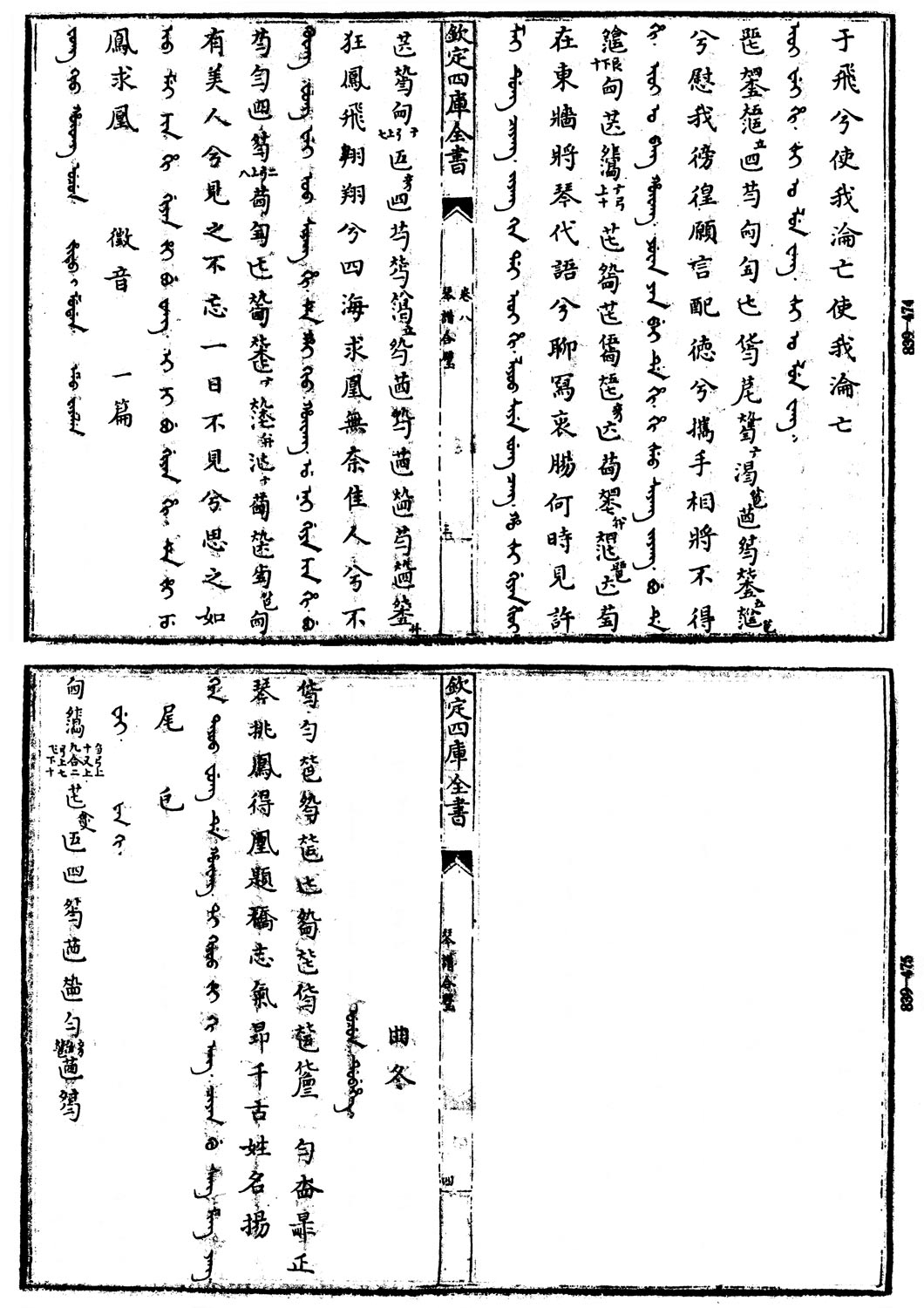
- The 1991 reprint of the 1802 edition of Qinpu Hebi in turn copied from a Qing dynasty translation into Manchurian by the bannerman He Su (1652-1718). According to www.chinaknowledge.de,
Hesu admitted that Yang Lun was a master in finger techniques..., but argued that Yang only interpreted music from the elitist viewpoint, and forgot that many of the popular pieces originated in the world of the common people. Hesu therefore included high-standing music pieces....while he decided to only transmit the melodies of popular pieces, without transmitting their song texts. As can be seen by expanding the tablature shown at right, because Manchu is written in the opposite direction as literary Chinese, the tablature goes from left to right instead of the reverse. The tablature here is for the 1689 version of Feng Qiu Huang.
"Commonly seen edition" (常見本 chang jian ben) is the expression Zha Fuxi uses for the 1609 edition in his QQJC preface. Furthermore, in his Guide, p. (105) 63, Zha says versions of this edition "書店常見 can often be seen in bookstores" (he wrote that in the 1950s). He makes no mention of the title Qinpu Hebi. Likewise the introduction to the Zhongguo Shudian edition makes no mention of the title Zhenchuan Zhongzong Qinpu. And a comment by Van Gulik suggests he had seen yet another edition with a different name, also dated to 1609.
(Return)
| 2. Yang Lun 楊掄 (ca. 1660?-1634?; see Appendix) | Source page (transl.) |
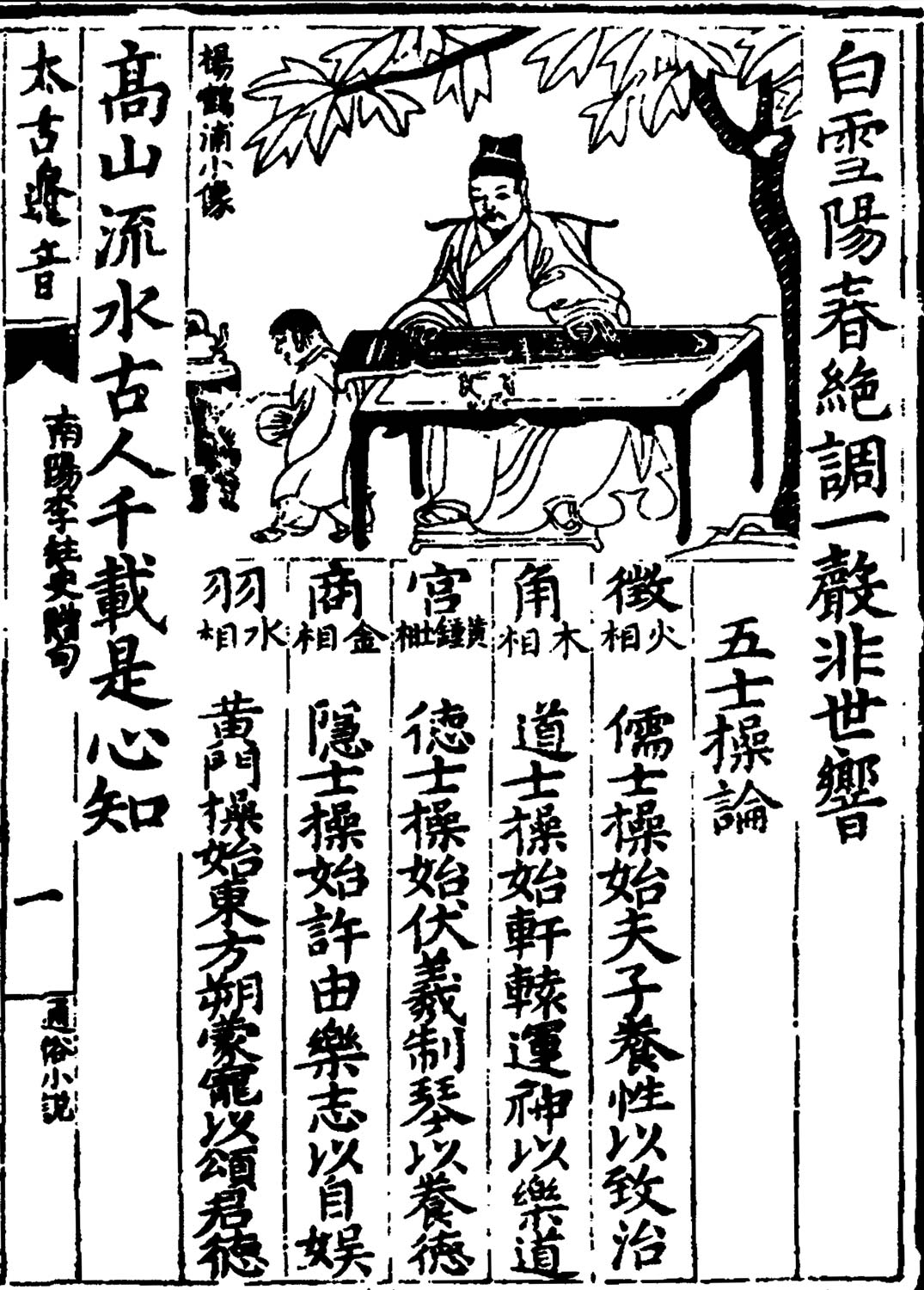
 The image at right, from QQJC VII/53, has the inscription "楊鶴浦小像 small image of Yang Hepu" (Yang Lun). He appears here to be a young man and indeed, if my understanding of the timeline is correct, his most notable qin accomplishments occurred while he was still young. His birth and death dates are unknown. If he is the same person as the government official, it seems likely that he was born in the 1560s and died in 1634. If born in 1560 then he was 29 when the first edition of his handbook was published: some would sat that is a rather young age to have completed such work, but it is not impossible.
There is very little personal information about the qin player Yang Lun, whether in his handbook(s) or elsewhere, that could help decide whether he was later a government official. So for the time being the commentary keeps the two roles separate, as though they concern two different people.
One might claim that qin publications related to Yang Lun make no mention of a possible government career because that came later than the first editions of the handbook, and so it is reasonable to consider the possibility that he was the same person as the government official of the same name. And in fact with a listing of the handbook included in Siku Quanshu there is commentary saying "楊掄號桐菴,又號鶴漵" (鶴淑?) Yang Lun had two nicknames, Tongan and Heshu.
Of the government official there is quite a bit of information available, but it mostly concerns official activities, without much personal information. Regarding his career, the online essay 明代揚掄於《真傳正宗琴譜》 by 張雅晶 Zhang Yajing (see appendix) says the qin player and government official were the same people, but does not give explicit details showing this.
As mentioned, the qin handbooks have virtually no personal information and nothing about his career. Does this support the suggestion that all the qin work was done before his career took off? Compare this, for example, to the speculation below as to whether some of the melodies might have been added to a handbook later.
In contrast to the above, the qin literature generally says that Yang Lun was from 江寧 Jiangning (apparently a district of Nanjing), either ignoring or unfamiliar with the possibility of his origins in Yunnan, and that he was a late Ming specialist on qin song. This should lead one to wonder whether he had any interaction with Yang Biaozheng, as discussed further below.
According to the preface by Zha Fuxi), Yang Lun's style name was 鶴浦 Hepu (elsewhere it is given as 鶴洲 Hezhou). However, the afterword by Lü Lan'gu (VII/156) says the style name was 文浦 Wenpu and that he was from 金陵 Jinling, once again Nanjing. The introduction to the facsimile edition of Qinpu Hebi does not mention a style name, saying he had the nicknames 桐庵 Tongan (Tong'an) and 鶴淑 Heshu. Qin Shi Xu does not include him and Xu Jian's Outline History only seems to mention him in passing, in connection with Yan Cheng's criticisms of qin songs in Chapter 7a2 (p. 127), not in its section on qin songs themselves.
Nevertheless, it is generally thought that Yang Lun was actively involved with the group of qin players living in Nanjing during the last century of the Ming dynasty who were noted for their fondness for qin melodies with lyrics. However, one can only speculate as to what connection he might have had with the overlapping qin master Yang Biaozheng, who was probably quite a bit older and apparently spent most of his time near his home in Fujian, but whose handbooks have several songs connected to Nanjing and were printed there only a few years earlier than those of Yang Lun. Van Gulik, Lore, p. 185, has some mistakes with both of these men (he may be reflecting a Chinese confusion). Thus he calls Yang Biaozheng's handbook 琴譜合壁大全 Qinpu Hebi Daquan, a title I have not yet found elsewhere, and dates it impossibly early (1503). He also has for Yang Lun 楊倫字桐庵, i.e., a different character for Lun (Bio/840: a different person) and gives Tongan as the style name instead of nickname. (See also the next footnote).
For a later mention of Yang Lun in old handbooks, 二香琴譜 Erxiang Qinpu (1833; XXIII/88, 杭弦,l.2), has, "楊鶴洲(楊掄)太古遺音則云琴弦非杭州者不可 Taigu Yiyin by Yang Hezhou (i.e., Yang Lun) says that if qin strings are not from Hangzhou they are useless." I have not located this yet in his Taigu Yiyin, suggesting perhaps that there was yet another edition not mentioned here.
(Return)
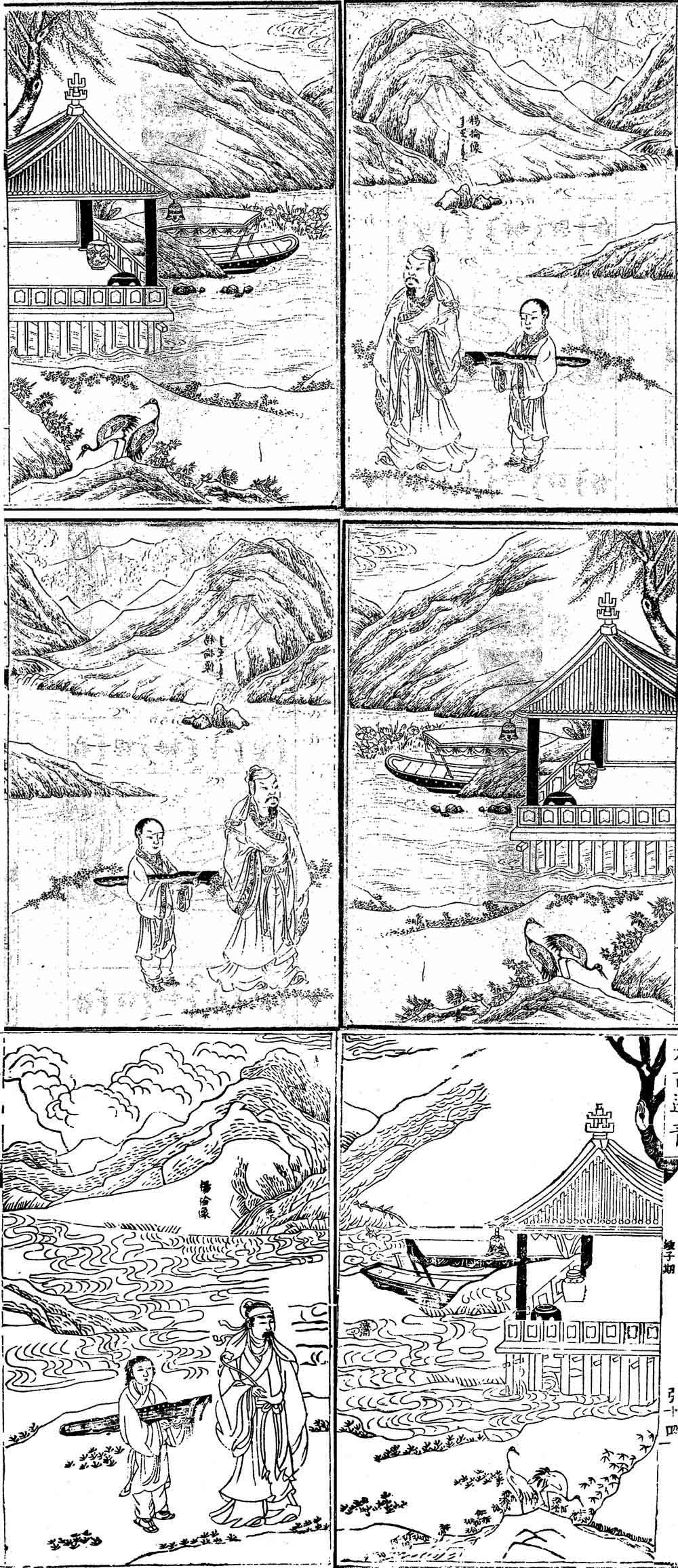
3.
Images of Yang Lun (see also previous)
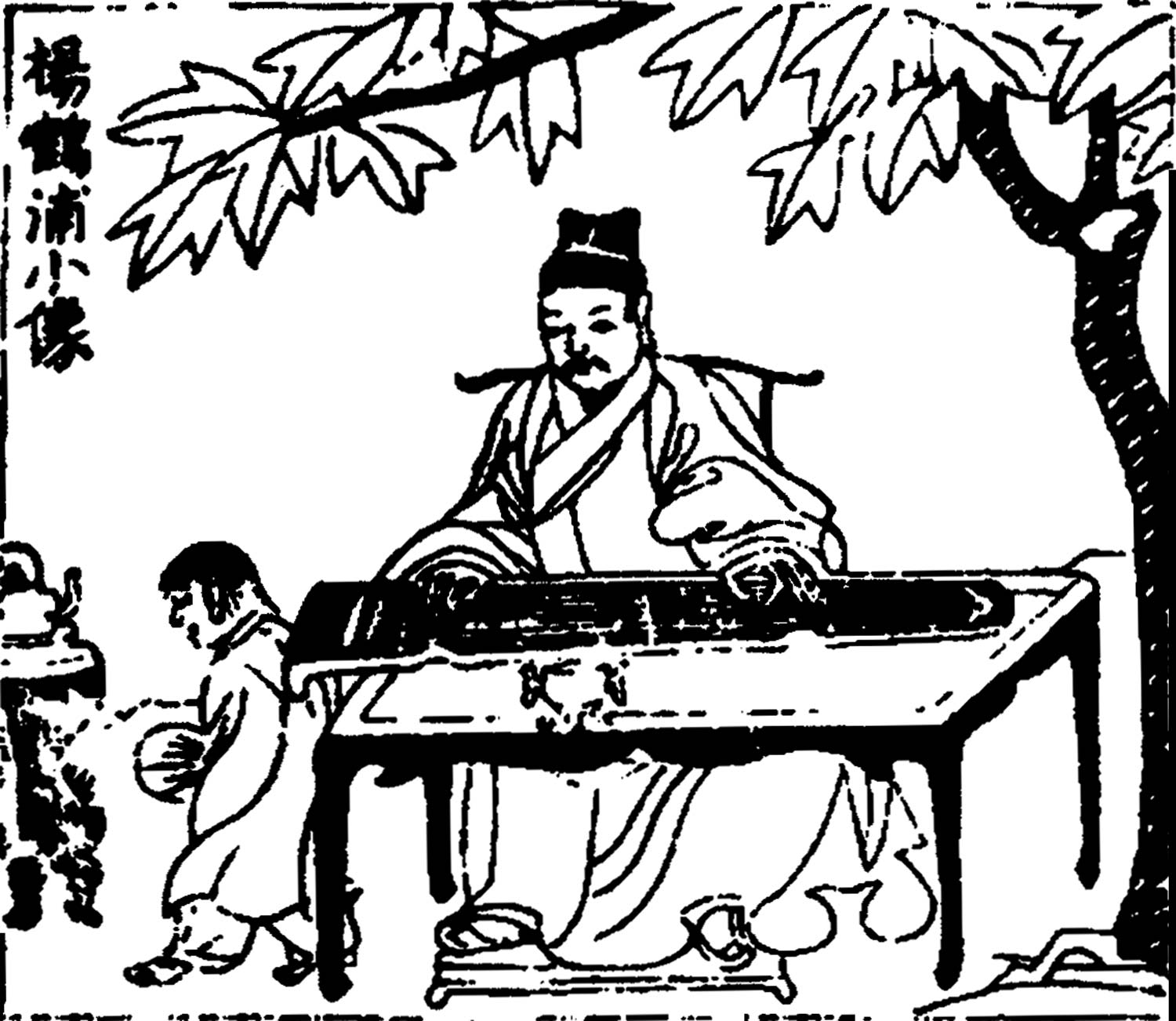
Compare the image above with the same scene as redone in the 1802 Qinpu Hebi, where the writing is reversed and Manchu script is added. This reveral can most clearly be seen by
expanding the tripled image at right. There the three images are:
- top: the image as in the 1802 Qinpu Hebi
- middle: image as in 1802, but reversed
- bottom: image from the ca. 1609 Qinpu Hebi above (Is Yang Lun being compared to Boya?)
As can be seen, the reversed 1802 Qinpu Hebi image in the middle directly corresponds with the earlier image just above it. How does this happen? Does it have to do with the mechanical process of making woodblock prints? (There is a similar phenomenon in this image of Xi Kang.)
In the illustration from the earlier Qinpu Hebi, Folio I/14-15, you can see "楊掄像 image of Yang Lun" written over the bearded figure in the middle. To the right, in the column outside the pavilion, can be seen the characters "鐘子期 Zhong Ziqi". For some this apparently took too far what they considered already too obvious attempts to equate Yang Lun with the great Boya himself (see footnote below). According to Van Gulik, Lore, p. 185, the Imperial Catalogue (四庫全書存目 ch. 114, leaf 8 recto. ”繪鍾子期像而而已像廁其後尤為妄誕“) was "much incensed at the fact that on the picture in the first volume the author is shown together with Zhong Ziqi." Van Gulik adds that this "arrogance" must have been recognized early, as "most copies which I have seen were printed from a revised block, where the image of Zhong Ziqi has been deleted from the unorthodox picture." However, this is somewhat puzzling, as one might argue that Yang Lun was actually associating himself with Ziqi, a great listener, not with Boya himself. In addition, there is a certain irony in this criticism in that this handbook seems to be one of the best at crediting the various people who helped compile it (see sample attributions under further comment).
The image from the version in QQJC VII is actually missing the whole right half of that picture (see VII/175-6); that edition is also missing many other illustrations.
(Return)
4.
Yang Lun the government official (楊掄號桐庵,又號鶴浦), style name Tong'an (not Hepu: see the qin player?)
According to the article below (and
Chinese Wikipedia), this Yang Lun was from the Bai nationality in Yunnan, passed the provincial examination in 1606, became a Jinshi 1613, then rose through the ranks to become the Director of the Court of Imperial Sacrifices. In 1633 he apparently went on a mission to the Ryukyu islands, died shortly after their return in 1634, then was buried in his family's ancestral tomb on 鶴慶城東南班登山 Bandeng Mountain southeast of his native city, Heqing, in what is today Yunnan province.
Because this Yang Lun had a significant government career, there is quite a bit of information available about him, but it is not clear whether the detail that Yang spent much of his life in Nanjing (Nanjing theme) also applies to the government official.
(Return)
5.
Melodies I have transcribed from Zhenchuan Zhengzong Qinpu but not recorded
In order to consider a reconstruction as "completed" I must have learned it well enough to play from memory. The following are melodies that I have transcribed but not learned well enough to be comfortable playing. These transcriptions include:
- Qiu Sheng Fu (song; VII/89)
- Baji You (VII/214)
In addition, although I have recorded the last melody listed above, Shitan Zhang, I have not memorized it. This puts it into a grey area: it is quite easy to play through in segments, but I find it too repetitive to play through without consistently referring to the tablature. This is not necessarily bad - quite possibily it was intended that it be played freely/improvised. That is not something I have tried yet, but if I could learn to do so while considering the tablature itself as a guideline, then perhaps I would consider the reconstruction to be "complete".
In further addition to the above, for my program Music from the Time of Matteo Ricci I have rearranged Mozi Bei Ge so that it can be sung with the lyrics for Ricci's Eight Songs for Western Keyboard.
As for recordings from this handbook by others they include,
Considering the importance and apparent popularity of this handbook there should be quite a few more.
6.
Dating the 常見本 "commonly seen edition(s)"
7.
Yang Lun's Music Bequeathed from Antiquity
(楊掄太古遺音 Yang Lun Taigu Yi Yin)
8.
Shared Teachings of Bo Ya
(伯牙心法 Boya Xinfa)
As for the title, the basic meaning of xinfa (10531.80; 7/378) is apparently "修心 xiu xin: cultivate the heart/mind". Practically the term is used to describe a teaching method in which the teacher explains things carefully so that the student doesn't simply memorize but can come to a full understanding. In Buddhism it suggests doing this teaching without the aid of scriptures. It is also a neo-Confucian term for nurturing the essence of one's thoughts while examining how these thoughts can be put to use. The significance of using the name of Bo Ya in the title is discussed in a previous footnote.
9.
Qin Handbook Matched Well
(琴譜合壁 Qinpu Hebi)
10.
Edition mentioned by Van Gulik
11.
Zhenchuan Zhengzong Qinpu in Qinqu Jicheng
12.
Commonly seen edition (常見本 Changjian ben)
13.
Li Wenfang 李文芳
This seems to begin with some old quotes (合天人之和 => 合天地之和?).
14.
Li Zhushi 李柱史
Compare 絕聲 jue sheng, 絕響 jue xiang, etc.
15.
Lü Lan'gu 呂蘭谷
This afterword (also in QQJC VII/156) goes as follows:
呂蘭谷譔
Afterword on Qin
The way of sound and tone is subtle indeed. Its harmonics follow from the nine notes in their spareness; its resonances pursue the eight winds. When the pitch-pipes respond, they return to flourishing harmony; in song they raise up White Snow. Looking back, we see how Master Ni examined sound, and thus recognize the sage whose understanding was as vast as the ocean. When Shi Kuang struck the pure zhi note, even the gate-towers were shaken; dark cranes came flying in response. How could this be a petty skill?
This handbook was revised and settled by grand scribe/astrologer of Zhedong (east Zhejiang), Master Yu (余 549.xxx; Bio/???). As for the supreme refinement of its finger techniques, these are based on Yang Hezhou and Li Siquan. Yang himself was moreover able to have them engraved on woodblocks, thereby widening their transmission. Yang may truly be said not to have turned his back on the source.
This Yang, whose personal name was Lun and style-name Wenfu, was a man of Jinling.
Written by Lü Langu.
As for "finger techniques based on those of Yang Hezhou and Li Siquan", there seems to be no further information on Li Siquan, and in 1609 the name is changed to 周桐庵 Zhou Tongan (see below). From this I might guess that the playing method of the songs came from Yang Lun, but that somebody else was writing down the actual tablature. Zha Fuxi's preface elaborates somewhat on this.
16.
New Yang Lun image
17.
Yang Lun at different ages?
18.
俞彥 Yu Yan
19.
Maoshan 茅山
20.
Zha Guide, pages 63 - 66 (105 - 108 overall). Zha writes that this book could be found in many bookstores.
21.
The re-print of the earlier edition had 31 instead of 34 melodies because it is missing three modal preludes, 宮意考 Gong Yi Kao, 徵意考 Zhi Yi Kao and 羽意考 Yu Yi Kao. QQJC includes only Gong Yi Kao from the later edition. No reason is given for this.
22.
1609 edition pagination
As for Boya Xinfa, in QQJC (VII/179-227) the numbering was continuous, apparently the same as in Qinpu Hebi.
23.
Comparing versions of Taigu Yiyin
24.
Comparing versions of Boya Xinfa
25.
Further differences between the 1589 and 1609 editions within QQJC
26.
The most notable difference is that the listing in Zha's guide puts the five 意考 modal preludes in front.
27.
New melodies (with new titles) in Yang Lun's handbooks
28.
Older titles having new melodies in Yang Lun's handbooks
29.
Perhaps most noteworthy of these is the song version of Jiu Kuang.
30.
Older melodies with new titles
31.
Attributions to "琴友 qin friends"
Here are some sample attributions:
For further attributions see the handbook's Table of Contents. It is perhaps significant that most of such attributions are to melodies without lyrics.
32.
Running commentary (compare attributions)
33.
Some notes on the tablature in Zhenchuan Zhengzong Qinpu
分開 Fenkai: traditionally this means to pluck a string twice with the left hand at the same marker, but adding a slide up in between. The two plucks are usually written together, with fenkai after, but fenkai might also be written between the plucks. Here the second pluck is often at a lower position, and sometimes it is not even written. Since some handbooks around that time suggest that fenkai is actually like zhuang (撞 written "立" one pluck with a slide up and down), this makes the intention of the tablature unclear. This seems to happen especially when fenkai is followed by a zhuang. (The first such instance in my Mozi Bei Ge
(Return)
In both QQJC (VII/179) and the facsimile Qinpu Hebi (Folio IV/2) the date 萬歷三十七年己酉 Wanli 37th year (1509) appears at the end of the preface by 俞彥
Yu Yan to Boya Xinfa. (Zha Fuxi does not mention this preface in his QQJC commentary but he does mention it in his Guide p.105 [63].) Although the versions of the preface in these two reprints seem to have come from the same original woodblock, some of the other contents of these two editions are quite different. On the other hand, the tablature for both editions seems to be identical. So although it cannot be stated as a fact that both were reprinted in 1609, and it seems likely that more of these "commonly seen editions" could have been republished later, it seems very unlikely that any of the tablature itself dates from after 1609.
(Return)
Compare the earlier Taigu Yiyin.
(Return)
The seven melodies in the 1589 version (compare the 29 of 1609) are:
(Return)
"Matched well" could be referring to the lyrics and music. On this see Van Gulik's comment in Lore, p. 185, with regard to Qinpu Hebi Daquan. The facsimile reprint published by Zhongguo Shudian, 2006, has five folios. The first three are Yang Lun Taigu Yiyin; the latter two are
Boya Xinfa. This reprint also has two introductory essays.
(Return)
Van Gulik, Lore, p. 185, gives Taigu Yiyin as the overall title, saying Boya Xinfa is a supplement (i.e., there is no mention of the titles Zhenchuan Zhengzong Qinpu or Qinpu Hebi). He says this book is "much better edited" than Yang Biaozheng's "Qinpu Hebi Daquan", another qin song handbook from Nanjing published only a few years earlier. (See also his comment on the illustration.)
(Return)
Zha says it is in the 文化部,文學藝術研究院,音樂研究所藏 collection of the Music Research Institute. Presumably this refers to both the 1589 and 1609 editions.
(Return)
Presumably the copy reprinted in QQJC is also now in the Music Research Institute. For its publication date see above.
(Return)
(Bio/xxx); 己丑 1589; QQJC VII/53. His preface begins,
(Return)
The couplet by Li Zhushi of 南陽 Nanyang (Bio/xxx) might be translated as:
Bai Xue and Yang Chun: never excelled melodies whose sound is other worldly
高山流水,古人千載是心知。
Gao Shan and Liu Shui: the ancients a thousand times expressed true meaning.
(Return)
The 跋 afterword by Lü Lan'gu (Bio/xxx; Lan'gu/Lanyu: 33297.68xxx) to the 1589 edition (QQJC VII/156) has no further information about Lü, but the same afterword in the 1609 edition (see facsimile edition Folio III, end) identifies Lü as a 長湖居士 retired scholar of Changhu (42022.522 says only that this means a "very long lake").
夫聲音之道微矣。徽從九寡。響追八風。律
應歸昌。歌楊白雪。溯觀尼父審音。爱識望
洋之聖。師曠鼓清徵。而即門之垝。玄鶴來
翔。此豈小技也與哉。是譜係浙東太史余
公刪定。至若指法之精絕。則本之楊鹤洲
李泗泉楊生。又能繡諸梓。以廣其傳。楊生
可謂不背本矣。楊生諱掄字文甫金陵人。
(Return)
The image at QQJC VII/176 (top right; see also next) is discussed by Van Gulik (Lore, p. 185).
(Return)
Compare the beard in the 1609 Taigu Yiyin image at VII/176 with the lack of one in the 1589 Taigu Yiyin image at VII/53.
(Return)
Yu Yan (Bio/1750), style names 仲茅 Zhongmao and 容自 Rongzi, was from 應天府上元 Shang Yuan in Yingtian (today's Nanjing). He became a metropolitan scholar in 1602, then later was a high military official in Nanjing. In his preface he refers to himself as Master of the Eighth Paradise (第八洞天主人 26496.63xxx); the name 茅山 Maoshan is written above the page number, and 洞天主人 Dongtian zhuren (17777.9xxx) seems to have been a rank used at Maoshan (see below). Yu adds that he wrote it at the Pass Away Summer Pavilion (銷夏亭 Xiaoxia Ting); 41354.34 銷夏灣 is a Xiaoxia Bay on the edge of Taihu lake.
(Return)
Maoshan was one of the most famous centers of Daoism. It is in Jiangsu province between Nanjing and Taihu lake (see Wikipedia,
Shangqing School). A number of people mentioned on this site at some time were connected to Maoshan.
(Return)
(Return)
(Return)
Regarding the Taigu Yiyin part, the 1609 edition in QQJC includes only two pages, so the total number and its numbering method is not certain. The 3 folios of the Taigu Yiyin in Qinpu Hebi begin with 27 引 prefatory pages, which include the five modal preludes; this is followed by the melodies on pages numbered continuously 1 to 191. The 1609 Boya Xinfa has 127 pages.
(Return)
Although I have looked at both Taigu Yiyin in QQJC as well as the one in the Qinpu Hebi facsimile reprint, I have not yet closely examined all the tablature itself. So I cannot say for certain that there were not changes within the melodies, as happened between the two available editions of Chongxiu Zhenchuan Qinpu. (But see next footnote.)
(Return)
Although QQJC tried to include from the 1609 edition only melodies that were not already printed in 1589, apparently by oversight it included in the 1609 edition the end of Jishan Qiu Yue (see QQJC, VII/195, and compare VII/165; perhaps the intention was to put here the first page of Jishan Qiu Yue, as there was a difference in the two prefaces). The latter looks as though it might have been traced from the former. (Perhaps also from oversight a folio page [93] is missing from the middle of the 1609 Gu Shenhua Yin [see QQJC VII/215].)
(Return)
Zha Fuxi's introduction in QQJC (q.v.) mentions two specific differences. These are outlined further under
Zhou Tongan
(here).
(Return)
(Return)
These include the following new melodies with new titles (compare next):
Intonation on Listening to a Qin; new song with lyrics by Han Yu
(listen)
Autumn Wind Rhapsody, a new song with lyrics by
Ouyang Xiu
(transcription only)
Autumn Moon at Jishan; 24 sections; jue mode
Wild Geese on the Frontier; Guide 29/232/--: first of 33 to 1914; zhi mode; transcription only)
Mozi Sings with Feeling; Guide 29/228/--: first of 32; ToC #39;
(listen)
Lament in a Lady's Chambers; Guide 29/232/442: only here, but see
further details;
listen)
Old Metamorphosis; Zha Guide 30/233/--: first of four (see under Shenhua Yin)
(Return)
These include the earliest versions of the following new melodies for titles surviving earlier but with different melodies:
(Return)
(Return)
Zha's Guide indicates that these volumes within Zhenchuan Zhengzong Qinpu include 12 new melodies. However, at least five of these are in fact versions of the same melody published earlier with different titles. The five are:
(Return)
In Yang Lun's handbook these attributions are normally made under the heading for Section 1 of the particular melody. However, in some cases there are comments like this within the preface itself (e.g., in
Jishan Qiuyue). In early handbooks it was not at all common to identify either who originally copied the tablature or who revised it, nor is it clear what either "revised by" or "tablature by" mean. Checking for minor copy errors? Playing old tablature many times, developing ones own version, then copying it down? From my preliminary examination of the 1589 and 1609 editions of Yang Lun Taigu Yiyin and Boya Xinfa it seems that very few were done by the same person.
"金陵鄭養居校傳 Revised by Zheng Yangju of Jinling (Nanjing) and transmitted"(1589; 1609 adds "from Korea"; transcription only)
"建業琴友高(龍)伯校 Revised by qin friend Gao Longbo of Jianye"
"句曲琴友孔行素譜 tablature by qin friend Kong Xingsu of Juqu"
"秣陵水雲逸史鄭道光譜 Tablature of the unofficial historian of water and clouds Zheng Daoguang of Moling"
"新安琴友汪善吾校 Revised by qin friend Wang Shanwu of Xin'an, near Huangshan
"關中琴友王龍泉校 revised by qin friend Wang Longquan of Guanzhong"
(Return)
In both Zhenchuan Zhengzong Qinpu and the later "commonly seen edition", some of the melodies with lyrics have added text as commentary or explanation. For example, 復聖操 Fusheng Cao, Section 1 (VII/68), has 音必 to explain the punctuation of 俾 bi; many other melodies have such explanations of pronunciation. Almost always "重 chong" is written where there are repeats in the music, presumably so that the player will keep singing during the repeat. 客窗新語 Kechuang Xinyu (VII/190ff) has a great many explanations of people and phrases. 閨怨操 Gui Yuan Cao adds "呼連 hu lian" in small print between "奩 lian" and "塵 chen" (line 2; VII/198); I am not sure of the significance of that.
(Return)
Regarding the tablature itself, my study has been mostly with earlier tablature, and I haven't studied carefully enough other handbooks from around 1600 to be able to state which of these characteristics found in Zhenchuan Zhenzong Qinpu are unique to it, or new with it. In addition, there are probably some inconsistencies due to the fact that a number of the melodies seem to have been edited by different people (). Some characteristics that I have noted include:
transcription can be seen in measure 29.)
度 Du: elsewhere this is the same as 歷 li, a right hand indication of a finger going over several strings; but at the beginning of the Mozi tablature (QQJC VII/183) there is a statement that du is like a fast 撞 zhuang (see above). However, zhuang is itself said to be fast (see 立 in QQJC VII/59), and some zhuang within the tablature are said to be "fast zhuang". How are these to be distinguished? (First occurrence in my transcription of Mozi is m. 73.)
急歷猱 Ji li nao: a fast (ji) run (li), with a vibrato (nao, also called rou) written at the side. See Mozi transcription measures 178, 182, 185 and 210: a vibrato would not seem actually fit with a fast li; at best I put in a very short one.
(Return)
Return to the top, to the annotated handbook list or to the Guqin ToC.
Appendix
Zhang Yajing: "The Ming dynasty's Yang Lun and his
'Authentically Transmitted Orthodox Qin Handbook'"
Compare Chinese Wikipedia, which seems to be a summary of this article)
Copied from
www.bjzx.gov.cn/zxqk/bjgc/201606/whc201606/201805/t20180502_12154.html
and converted into standard Chinese characters.
The original Chinese text is below
Ming Dynasty Yang Lun and the Zhenchuan Zhengzong Qinpu
Zhang Yajing Director of the Center for Taiwan Studies,
Beijing Academy of Social Sciences
Yang Lun edited the Zhenchuan Zhengzong Qinpu (also called Taigu Yiyin), and later added Boya Xinfa as a sequel. It is one of the three major handbooks of qin songs from the Ming dynasty, and possesses rather high artistic and scholarly value.
Yang Lun, style-name Tong’an, also known as Hepu, was a Bai from Baiyi in Heqing Prefecture, Yunnan in the Ming. According to the Index to the Stele Records of Ming and Qing Presented Scholars, Yang Lun placed 42nd in the provincial examination of the bingwu year of Wanli 34 (1606), and 121st in the third class of the metropolitan examination of the guichou year of Wanli 41 (1613). In juan 3, “Record of Investiture and Tribute Affairs,” of Zhou Huang’s Qing work Zhongshan Chuanxin Lu, his office and place of registration when he went on mission to Ryukyu (Wiki) are recorded: his office was Vice Envoy of the Bureau of Messengers, and his registration is given as “a Yunnan man registered in Shangyuan.”
Some books mistakenly record him as a native of Jiangning in Yingtian Prefecture (today under Jiangning District of Nanjing) or as a man of Jinling. There are two reasons for this. First, as with many descendants of Ming migrants, his ancestral registration may have been in Shangyuan County, Yingtian Prefecture. Second, this confusion also derives from his standing in the qin circles of Jinling. On the basis of these two points, some books therefore took Yang Lun to be a native of Jinling.
In the Ming writer Cheng Jiasui’s “Seeing Off Marquis Yang, Lord of Shangdang, on Entering Court,” it is recorded that Yang Lun first served in the Ministry of Punishments. As an official he was strict, upright, and fair, with few wrongful convictions, so that “in his court it was said there were no miscarriages of justice.” Later, as a gentleman of the Secretariat, he was sent out to govern Lu’an Prefecture (潞安府; around the time that Zhu Changfang was there?), in what is now Changzhi in Shanxi (ancient Shangdang), where he also won the hearts of the people. In the spring of Wanli 47 (1619), in accordance with court regulations, Yang Lun left office and went to the capital to undergo the “great reckoning,” the official evaluation of administrators. After this he served as Vice Director of the central Bureau of Messengers, in charge of transmitting edicts and proclamations, and was later promoted to Director. In Chongzhen 2 (1629) he was appointed vice envoy in the embassy sent to invest the king of Ryukyu (Wiki). According to the Kangxi-era Gazetteer of Heqing Prefecture, after Yang Lun’s death he was buried back in his native Heqing, in the Yang ancestral graveyard on Bandeng Mountain southeast of the city.
I
Historical materials concerning Yang Lun are rather scant, but the scattered information we do have allows us to form some understanding of the man.
According to Cheng Jiasui’s “Seeing Off Marquis Yang, Lord of Shangdang, on Entering Court,” before Yang Lun left for the capital to undergo the “great reckoning,” the gentry and literati of the eight counties under Lu’an Prefecture especially asked the unappointed scholar Cheng Jiasui to compose a valedictory essay for him. The essay praises him as “gentle yet upright in character; broad-minded yet quick in ability, skilled in classical learning and expert in legal judgments,” portraying him as a fine official of mild and responsive temperament who was thoroughly versed in the Classics and in law.
As we know, under Ming and Qing institutions the investiture of Ryukyu was a solemn diplomatic ceremony of state level. The government selected a principal and vice ambassador from among the Liuke Jishizhong and the Bureau of Messengers. They then supervised the building of the investiture ships in the coastal regions, and equipped them with the full complement of navigators, cultural attendants, military guards of honor, ritual gifts, objects, and daily necessities. When the Chongzhen emperor ascended the throne, Ryukyu came twice to offer congratulations and request investiture. In Chongzhen 2 (1629), the emperor formally issued an edict appointing Yang Lun, Director of the Bureau of Messengers, as vice envoy, and Du Sance, Supervising Secretary of the Revenue Office, as principal envoy, in the mission sent to invest the king of Ryukyu.
Regarding the various matters of this Ryukyu investiture mission, one of the mission’s attendants, Hu Jing, wrote a work based on his own experience called True Record of Du Sance’s Investiture of Ryukyu: A Marvelous Account, also known as Record of Ryukyu. In it there are detailed accounts of the mission and Yang Lun’s activities. After four years, the investiture ship for the Ryukyu mission was completed, and in Chongzhen 6 (1633) they departed for Ryukyu. “The total number of accompanying personnel was somewhat over five hundred,” and the ships carried textiles, porcelains, craft goods, medicinal materials, paper, and so forth. Setting out from Changle in Fujian and passing through Wuhumen into the sea, the ship followed the traditional sea route, and after four days gradually entered the waters of the Ryukyu kingdom. After landing, they lodged, according to precedent, in the Hall of the Heavenly Envoys; Yang Lun lived in the small western upper chamber of the residence, named the “Tower for Listening to the Sea.” Besides first paying respects at the Confucian temple, and together with Du Sance presiding over the sacrificial rites for the former Ryukyu king Shō Nei and the grand ceremony investing the new king Shō Hō, he also met the descendants of the “Thirty-Six Fujian Surnames” who had migrated to Ryukyu in the early Ming, and viewed paintings by the deaf-mute Ryukyuan court painter Qin Kesheng. Xu Baoguang’s Qing work Zhongshan Chuanxin Lu, juan 2, also records how Du Sance and Yang Lun interacted with various circles in Ryukyu and traveled about there. Du Sance and Yang Lun both left inscriptions and wrote texts in many places in Ryukyu, and by happy chance each celebrated his birthday there.
The mission stayed in Ryukyu for more than five months. The return voyage was less smooth than the outward journey: at sea they encountered storms, “the rudder teeth broke dozens of times in a single day, and all the lashings snapped,” and they nearly ended in the bellies of fish. This investiture was also the last such investiture carried out by the Ming. After returning to the court and reporting completion of the mission, “Lun was promoted to Vice Minister of the Court of Imperial Seals”; Yang Lun eventually rose as high as Vice Minister of the Court of Imperial Banquets.
II
Yang Lun’s contribution to qin studies is also plain to see.
Although Yang Lun’s registered origin was in Yunnan, he lived for a long time in Jinling, and so his connection with qin handbooks was only natural. Moreover, in the qin circles of Jinling during the Wanli period of the Ming, Yang Lun was also an important representative of the “qin-song school.”
If we survey the history of the qin, the printing of qin handbooks flourished greatly in the Ming. The first handbook compiled in the Ming was Shenqi Mipu (1425), and the final Ming handbook was Huiyan Mizhi (1652); altogether forty-two qin handbooks were printed. “Aside from the Song dynasty, no other dynasty can compare with the Ming in its emperors’ love for qin music. The Ming princely houses were leaders in setting the cultural fashion for publishing collected qin handbooks.” For example, Ning Prince Zhu Quan, the seventeenth son of the Ming founder, compiled Shenqi Mipu, which became the model for Ming and later handbook collections, and is also the earliest extant collected qin handbook.
Those who took part in compiling qin handbook collections in the Ming may be divided into several categories: princes and aristocrats, such as Ning Prince Zhu Quan, compiler of Shenqi Mipu; eunuchs, such as Huang Xian, compiler of Wugang Qinpu; scholar-officials, such as Jiang Keqian, compiler of Qinshu Daquan; and cultivated literati, such as Yang Lun, compiler of Taigu Yiyin, Boya Xinfa, and the like.
As for the school to which Yang Lun belonged, some scholars place him in the Jinling school of the qin.
In his article “Exploring the Historical Jinling School of the Qin,” Liu Chenghua explains: “The Jinling school discussed in this article refers to the community of qin players active in Nanjing during or before the Qing who shared similar styles and possessed comparatively high levels of qin artistry,” and he includes Yang Lun among them.
Liu Yingli makes the classification still more specific, placing Yang Lun in the “Jinling River School” or the Jiangzuo “qin-song school.” The “Jinling River School” refers to a group of qin musicians active in the Nanjing region from the middle to the end of the Ming, taking qin song as their principal mode of performance. They advocated the performance of qin songs, filling in lyrics to fit melodies and matching the main text to the tones. The literary atmosphere of this school was rather strong, and the handbooks of its players were often furnished with explanations and lyrics. They differed both from the Songjiang school represented by Liu Hong and Zhang Yongzhen, and from the Nanjing Baixia school represented by Zhuang Zhenfeng.
Zhao Chunting believes that the “qin-song school” of the Wanli period refers to certain qin players who supplied lyrics and fitted songs to melodies, such as Huang Longshan, Yang Biaozheng, Yang Lun, and others. These men were mostly active in the Jiangzuo and Nanjing region, hence the name. They published quite a few works, but their accomplishments were not high.
As to why some have said that they had “many publications, but achievements not high,” Ming and Qing qin players already clearly pointed out the reason: this school overemphasized “matching the main text to the tones.” In the matter of song lyrics, they confined themselves within the frame of “one character, one note,” thereby restricting the development of qin music. Qin players also went too far in fitting words syllable by syllable to notes, even supplying music to poems that lacked musicality, so that inferior handbooks came onto the market.
Even so, a small number of excellent works from the “qin-song school” were widely transmitted. Extant Wanli-period handbook collections of the “qin-song school” include Chongxiu Zhenchuan Qinpu, Zhenchuan Zhengzong Qinpu, Lixing Yuanya, Qinshi, Sanjiao Tongsheng, and Lüqi Xinsheng, six in all. Among them, Yang Biaozheng’s Chongxiu Zhenchuan Qinpu, Yang Lun’s Zhenchuan Zhengzong Qinpu, and Huang Longshan’s Xinkan Faming Qinpu stand like a tripod, representing the highest level of Ming qin-song handbooks, and possessing extremely high artistic and scholarly value.
It must be pointed out in particular that Yang Lun not only pursued “matching the main text to the tones”; he also appreciated purely instrumental pieces in which the text had been removed and only the gou-ti playing figures retained. In this respect he differed from the editorial principle of the “qin-song school” figure Yang Biaozheng, whose own handbook-compiling principle regarding “removing the words and preserving the gou-ti” was different.
Yang Lun’s editing of the Zhenchuan Zhengzong Qinpu (also called Taigu Yiyin) was his greatest achievement.
The present writer has not seen the copy of the Zhenchuan Zhengzong Qinpu held in the China National Academy of Arts. According to relevant historical materials, it contains a total of sixty qin pieces. Among these, the main collection Taigu Yiyin has 30 pieces, the continuation collection Boya Xinfa has 7, and the appendix to Boya Xinfa has 22, along with one additional piece in Taigu Yiyin. Among them, 11 pieces were published there for the first time. Their subjects include lyric expression, historical themes, praise of objects, religion, and more. The format is also comparatively complete, the book containing a preface, self-preface, qin discussions, song-handbook materials, and postfaces. The subjects of the qin songs it includes are varied, and their musical styles are rich, with both slow and fast pieces. One may say that the Zhenchuan Zhengzong Qinpu gathers together pieces in many modes, examines and corrects tones and words, indicates the finger techniques, and draws upon a rather broad range of sources.
As for the editions of Yang Lun’s Zhenchuan Zhengzong Qinpu (also called Taigu Yiyin), the situation is in fact rather confused.
First, one must distinguish it clearly from other Ming printed books that bear the same title Taigu Yiyin but are not by Yang Lun, namely Xie Lin’s three-juan Taigu Yiyin and Huang Shida’s edited three-juan Taigu Yiyin.
Second, taking the different extant versions of Yang Lun’s Taigu Yiyin and drawing on the results of earlier scholars, the author summarizes the records of five versions as follows.
Version one is the Zhenchuan Zhengzong Qinpu, an original Wanli printing on white cotton paper, divided into a main and a continuation collection. It is held by the China National Academy of Arts. The whole book is in fact divided into the main and continuation collections. The main collection is called Taigu Yiyin and has no fascicle numbering. At the beginning is a preface by the recent scholar Li Wenfang dated the jichou year (1589). After the preface are gift-verses from Li Zhushi of Nanyang and a portrait of Yang Lun; then follow qin discussions and the musical handbook proper, containing 34 qin songs, that is, qin pieces with lyrics. After the handbook there is again a postface by Lü Langu. The continuation collection is called Boya Xinfa, likewise without fascicle numbering, and includes seven pieces such as Gaoshan and Liushui, all of them wordless, purely instrumental qin pieces.
Version two consists of the two separate handbooks Yang Lun Taigu Yiyin and Boya Xinfa, the most commonly seen version. Compared with the main collection Taigu Yiyin in version one, Yang Lun Taigu Yiyin has ten additional items, including Shanggu Qinlun, Wuyin Tonglun, Liyue Xu, Fuqin Zhuanxian Ge, a diagram of the face of the qin, a portrait of Yang Lun, diagrams of the taboo-names of the fingers of the left and right hands, hand postures, an ancient-style qin model, and Gongyi Kao. Compared with version one’s continuation collection Boya Xinfa, this Boya Xinfa has an additional Xu Qin Xu and 22 more pieces, including Meihua San Nong.
Mr. Zha Fuxi, seeing that the explanatory notes included many transmitters and revisers of scores, all qin players of Yang Lun’s own time, and that it was not a work edited by Yang Lun alone as in version one, and also seeing that in version two “Zhou Tong’an” replaces “Li Siquan,” considered that this seems to have been a collected printed edition made in the late Ming by several qin players who brought together the pieces each had learned, revised and adapted them, and published them together; or perhaps it was formed in the Wanli era by a bookseller using the original blocks and adding supplementary carved matter.
Version three is Qinpu Hebi, a woodblock edition on bamboo paper with “gold-inlaid jade” printing from the yiyou year of Wanli. It states that it was edited by Yang Lun of Jinling and printed by Li Jiayu of Guwu. Taigu Yiyin is in four ce and contains 29 pieces; Boya Xinfa is in two ce and contains 28 pieces, making a total of 57 ancient qin scores, with or without lyrics. In the first booklet are a preface, an embroidered likeness of Yang Lun, Shanggu Qinlun, 40 qin diagrams, 9 fingering diagrams, Wuyin Yi Kao, and three qin pieces. The last booklet has a postface on the qin.
Version four is the 18-juan Qinpu Hebi included in the Imperially Commissioned Complete Library of the Four Treasuries, a Manchu-Chinese translation prepared in the Qing by Hesu, in which Taigu Yiyin and Boya Xinfa appear as separate books. In 2013 and 2016, China Bookstore reprinted, according to the original color and binding style, a boxed set of nine books in eighteen juan of Qinpu Hebi, based on the Qinpu Hebi in the Wenjinge and Wenyuange copies of the Complete Library of the Four Treasuries.
Some believe that version four was translated on the basis of version two, Yang Lun Taigu Yiyin and Boya Xinfa. Without proper bibliographical investigation, the Imperially Commissioned Complete Library of the Four Treasuries listed this qin handbook collection merely as an entry preserved in catalogue, thereby leading later generations mistakenly to think that Yang Lun’s Taigu Yiyin is the earliest extant qin handbook collection bearing the title Taigu Yiyin. This is precisely why the author found it necessary at the beginning to distinguish it clearly from other works of the same title.
Version five is a Qing-era bookseller’s or qin player’s printed copy of Qinpu Hebi. This version follows version three but omits the Manchu text; in the gutter it bears the phrase “popular fiction.”
From the above it is clear that Yang Lun edited one qin handbook, whose line of transmission runs from Zhenchuan Zhengzong Qinpu (also called Taigu Yiyin), to Yang Lun Taigu Yiyin and Boya Xinfa, and then on to the Qinpu Hebi version.
To speak of it, Yang Lun rose in office as far as Vice Minister of the Court of Imperial Banquets. Because of his mission to Ryukyu to invest the King of Zhongshan, local people called him “Yang the Investiture Envoy.” After Zheng He and Xiao Chong, he was the third historical figure from Yunnan to attain the rank of a grand diplomatic envoy. Yet Qing gazetteers of Yunnan and Heqing contain no biography of Yang Lun, and the newly compiled modern Gazetteer of Heqing County likewise has not established a biography for him.
As for Yang Lun’s contribution to ancient qin music: as a famous late-Ming qin master and a principal representative of the qin-song school, he inherited the tradition of qin song from the Spring and Autumn and Warring States periods, putting into practice a merging of refined and popular culture in qin music. Just as in modern and contemporary times masters such as Cheng Gongliang and Li Xiangting have combined inheritance of tradition with reform and innovation, so too his handbooks Taigu Yiyin and Boya Xinfa, still being printed more than 420 years later, are enough to demonstrate his contribution to qin studies. Yet Yang Lun’s name does not appear in several histories of Chinese music, and in some popular books on the qin he receives only a few brief lines. It is evident that the academic world’s knowledge of him remains quite shallow.
As Yang Lun himself wrote in his Hepu Zishu:
“I am simple and unadorned by nature, and take morality and rightness as my heart. I disdain what is unclean, though I have not been able to avoid faults. I let my feelings roam beyond things, and my elegant aspirations lie in hills and forests. Why should I care for fame and advancement? Favor and disgrace do not startle me. The work of my whole life lies entirely in silk and paulownia.”
Whether in his official career or in his qin playing and writings, he always upheld being “simple and unadorned by nature,” holding “morality and rightness as his heart.” “He disdained what was unclean, though solitary and with few supporters he could not fully succeed”; when disappointed in office, he cut off thoughts of rank and profit, turned instead to giving free rein to his feelings amid natural mountains and waters, and devoted himself among silk strings and paulownia wood. All his life he was addicted to the qin, immersed in writing, and obsessed with the instrument. Yang Lun and his deep feeling for the ancient qin embody the integrity and ideals of the literati of that age.
Zhang Yajing, the author, is Director of the Center for Taiwan Studies, Beijing Academy of Social Sciences
楊掄輯《真傳正宗琴譜》(又名《太古遺音》),後又加入《伯牙心法》作為後編,是明代三大琴歌曲譜之一,具有頗高的藝術價值和學術價值。
楊掄,號桐庵,又號鶴浦,明雲南鶴慶府(今鶴慶等縣)白族人。據《明清進士題名碑錄索引》載,楊掄是萬曆三十四年(1606年)「丙午科」舉人第42 名、萬曆四十一年(1613年)「癸醜科」三甲進士第121名。清人周煌所著《中山傳信錄》卷3《封貢事跡》中記載了楊掄出使琉球時的官職和籍貫,官職是「行人副使」,籍貫是雲南籍上元人。
一些書籍中,將他誤記為應天府江寧人(今屬南京市江寧區)、金陵人,其原因一是和許多明朝移民後裔一樣,其祖籍或為應天府上元縣;二是緣於他在金陵琴界的地位。基於這兩點,有些書籍中楊掄就被認為是金陵人了。
明人程嘉燧撰《送上黨郡侯楊公入覲》一文中曾有記述,楊掄曾先在刑部任職,為官嚴明清正,少有冤假錯案,乃至「庭中號無冤」。後又以「尚書郎出守潞安府」,外放今山西長治市(古稱「上黨」)任知府,於此地他也深得民心。萬曆四十七年(1619年)春天,楊掄按朝廷規定,離任到京參加考核官吏「大計」。之後,楊掄任中央「行人司」司副,主管宣旨頒詔,後升為「司正」,崇禎二年(1629年)任冊封琉球國王使節團的副使。據康熙《鶴慶府志》卷記載,楊掄故後,歸葬故鄉鶴慶城東南的班登山楊氏祖塋。
一
有關楊掄的史料較少,零星的資料中,讓我們對楊掄其人也有了一些瞭解。
據明程嘉燧《送上黨郡侯楊公入覲》一文載:在楊掄赴京參加「大計」前,潞安府所屬「八縣士紳」,特請布衣文人程嘉燧撰文為他壯行!文章贊楊他「為人溫厚而直;敦大而敏,擅經術,精法比」,是一位性格溫和敏捷、精通經學和法律的好官。
我們知道,按明清制度,冊封琉球是國家級隆重外交大典,政府要在「六科給事中」和「行人司」中選定正、副兩位冊封大使。後由他們在沿海地區監造出使「封舟」,並配備各種航海人員、文化隨從、軍衛儀仗、禮品器物和生活物資等。崇禎帝即位,琉球又兩次前來賀喜和請封。崇禎帝在二年(1629年)正式下詔,派遣「行人司」司正楊掄為副使,「戶科給事中」杜三策為正使,出使冊封琉球國王的使節團。關於這次赴琉球冊封諸事,有使節團的「從客」胡靖,根據親身經歷撰寫《杜三策冊封琉球真記奇觀》,又名《琉球記》一文,文中對使節團和楊掄活動均有詳細記載:經歷四年,建成使琉球冊封「封舟」,崇禎六年(1633年)出使琉球。「所有從行人員共約五百有奇」,隨船攜帶紡織品、瓷器、工藝品、藥材、紙張等。由福建長樂行起,從「五虎門」出海,封舟按以往的海路,四天之後,漸入琉球國洋面。登陸後,照例下塌「天使館」,楊掄住館後西邊小樓,名曰「聽海樓」。除了最先的參拜孔廟、和杜三策主持諭祭琉球國先王尚寧的儀式和冊封新王尚豐的大典外,還接見了明初移居琉球的「閩籍三十六姓」後裔、觀看琉球宮廷畫師聾啞人欽可聖的繪畫。清徐葆光所著《中山傳信錄》卷二也記載了杜三策和楊掄在琉球同各界人士交流和遊歷的情況,杜三策和楊掄在琉球多處題字、撰文,並巧在此地分別過了生日。
使團琉球停留五月又余,歸途不如來時順暢,海上遇風,「舵牙日折幾十次,勒索皆斷」,險入魚腹。此行冊封也是明朝的最後一次冊封,回國復命後,「掄升尚寶司少卿」,楊掄官至光祿寺少卿。
二
楊掄對琴學的貢獻也是顯而易見的。
楊掄籍貫雖是雲南,但是他長期生活在金陵,其與古琴譜之緣也就是很自然之事了。並且,在明代萬曆年間的金陵琴界,楊掄還是「琴歌派」的重要代表人物。
縱觀琴史,明代刊印琴譜十分盛行,明代編撰的第一部琴譜是《神奇秘譜》(1425年),至明代最後一部琴譜《徽言秘旨》(1652年),共刊印有42部琴譜。「除宋代之外,明代的皇帝對古琴音樂的喜愛是其他朝代所未能比及的。明代的藩王又是引領刊印琴譜集之文化風尚的領軍人。」如明太祖十七子寧王朱權編纂了成為明代及後來琴譜集典範的《神奇秘譜》,它也是現存最早的琴譜集。
明代參加編纂琴譜集的有這樣幾類人:王侯貴族,如寧王朱權編著《神奇秘譜》;太監,如黃獻編著《梧岡琴譜》;士大夫,如蔣克謙編著《琴書大全》;文人雅士,如楊掄編著《太古遺音》、《伯牙心法》等等。
就楊掄所屬琴派而言,部分學者將其歸於金陵琴派。
劉承華在《探尋歷史上的金陵琴派》一文中說明,「本文所論之金陵派,是指清代或清代以前活動於南京且具有相似風格和較高琴藝水平的琴人群體」,並將楊掄列入金陵派之列。
劉英麗更細化地把楊掄歸於「金陵江派」或江左「琴歌派」。「金陵江派」是指活躍於明朝中期到明朝末年的南京地區,以琴歌為主要表演形式的琴人群體。他們主張琴歌的表演形式,填詞配歌,正文對音。金陵江派的文人氣息較為濃厚,其琴人的琴譜多配有解題、歌詞。他們既有別於劉鴻、張用軫等為代表的松江派,也有別於莊臻鳳為代表的南京白下派。
趙春婷認為:明萬曆年間的「琴歌派」是指一些填詞配歌的琴人,如黃龍山、楊表正、楊掄等人,這些琴人多活動在江左、南京一帶,因以得名。他們的出版物不少,但成就不高。
之所以有「出版物不少,但成就不高」之說,明清的琴人已明確指出其原因:此派過分強調「正文對音」,在曲詞上,框於「一字一音」之中,束縛了古琴音樂的發展;琴人過分於逐音添配文辭,為無音樂性的詩詞也配音,致使劣質琴譜面市。
但「琴歌派」還是有少數優秀作品被廣泛流傳的。現存萬曆年間「琴歌派」琴譜集有《重修真傳琴譜》《真傳正宗琴譜》《理性元雅》《琴適》《三教同聲》《綠綺新聲》六種。其中,楊表正的《重修真傳琴譜》、楊掄的《真傳正宗琴譜》、黃龍山的《新刊發明琴譜》三足鼎立,代表了明代琴歌曲譜的最高水準,具有極高的藝術價值和學術價值。
特別要說明的是,楊掄不僅追求「正文對音」,對當時「去文以存勾剔」的純器樂曲也欣賞,這一點,與「琴歌派」楊表正的「去文以存勾剔」輯譜原則有所不同。
楊掄輯《真傳正宗琴譜》(又名《太古遺音》),也是他最大的成就。
筆者沒有見過藏於中國藝術研究院的《真傳正宗琴譜》版本,據相關史料記載其譜中共收錄琴曲60首。其中,正集「太古遺音」30首,續集「伯牙心法」 7首,附錄「伯牙心法」22首,「太古遺音」1首。其中,11首首次刊出的琴曲。其題材有抒情、詠史、贊物、宗教等內容。體例也較為完備,書中含有序、自敘、琴論、琴歌曲譜、跋等;其收錄琴歌題材多樣,曲風豐富,快慢曲兼有。可以說,《真傳正宗琴譜》匯錄諸調,考正音文,注明指法,搜採頗廣。
就楊掄《真傳正宗琴譜》(又名《太古遺音》)版本而言,實在是比較雜亂。
首先,要撇清與《太古遺音》同名,但非楊掄所作的明刻本,是為謝琳撰《太古遺音》三卷和黃士達編集《太古遺音》三卷。
其次,將現存楊掄《太古遺音》的不同版本,參考他人研究成果,把5個版本記錄歸納如下:
版本一為《真傳正宗琴譜》,明萬曆原刊白棉紙刻印本,分為正續兩集。中國藝術研究院收藏。全書實分正、續兩集。正集稱為「太古遺音」,不分卷數。卷首有己醜(1589年)近世李文芳序,序後有南陽李柱史贈句及楊掄小像,後為論琴及曲譜,共收34首琴歌(有詞之琴曲)。譜後又有呂蘭谷跋。續集稱為「伯牙心法」,不分卷數,共收《高山》、《流水》等7首,均為無詞的純器樂琴曲。
版本二為《楊掄太古遺音》和《伯牙心法》兩本琴譜集,此為最常見的一種版本。其中,《楊掄太古遺音》較《真傳正宗琴譜》的正集「太古遺音」多出「上古琴論」、「五音統論」、「禮樂序」、「撫琴轉弦歌」、「琴面圖」、「楊掄像」、「左右手指諱號圖」、「手勢」、「上古琴樣」、「宮意考」等10項內容,而《伯牙心法》則較版本一的續集「伯牙心法」多出《續琴序》及《梅花三弄》等22曲。
查阜西先生鑒於解題中出現多位傳譜者及校譜者,均為楊掄同時代的琴人,非版本一楊掄一人編輯而成;以及版本二中「周桐庵」替換了「李泗泉」。他認為,這似乎是明代晚期幾位琴人將其各所習琴曲,校正改編而合集之編印本,或為萬曆年間的書商利用原版剔刻增補而成。
版本三是《琴譜合璧》,萬曆乙酉年木刻竹紙金鑲玉印本。有金陵楊掄輯、古吳李嘉遇梓。《太古遺音》四冊,含29首;《伯牙心法》二冊,含28首,合計共57首有詞或無詞的古琴譜。首冊中寫有序言、楊掄繡像、上古琴論、40個琴圖、9個指法圖、五音意考及三首琴曲。末冊有琴跋。
版本四是《欽定四庫全書》中《琴譜合璧》十八卷,清代和素翻譯的滿漢文本,其中《太古遺音》和《伯牙心法》獨立成冊。2013年和2016年,中國書店據文津閣和文淵閣《四庫全書》中《琴譜合璧》,又按原版色彩、裝幀形式影印出版了一函九冊十八卷的《琴譜合璧》。
有人認為,版本四依據版本二《楊掄太古遺音》和《伯牙心法》翻譯而成。《欽定四庫全書》將此琴譜集的名稱未加考證就列入存目,使後世誤認楊掄《太古遺音》是現存最早的以「太古遺音」命名的琴譜集。這也就是筆者上文首先要交待撇清的原因。
版本五為《琴譜合璧》清代書商或琴人刻印本。此本參照版本三並刪除滿文,書縫有「通俗小說」一語。
由上可知,楊掄輯琴譜一部,是從《真傳正宗琴譜》(又名《太古遺音》),到《楊掄太古遺音》《伯牙心法》,再到《琴譜合璧》版本的流傳過程。
說起來,楊掄仕途官至光祿寺少卿,因出使琉球冊封中山王之事,被「里人稱之為‘楊封王’」,是雲南自鄭和、蕭崇後,第三位外交大使級歷史人物,然而,清代雲南及鶴慶地方誌均無《楊掄傳》,當代新編《鶴慶縣誌》中也未立《楊掄傳》。
論楊掄對古琴音樂的貢獻。作為晚明著名琴家,琴歌派主要代表人物,他繼承春秋戰國時期的琴歌傳統,實踐著琴樂雅俗文化的交融。如同現當代成公亮、李祥霆等琴學家的繼承傳統與改革創新。他的《太古遺音》《伯牙心法》琴譜,經過四百二十餘年還在刊印,足以說明他對琴學的貢獻,然而楊掄在幾本中國音樂史書中均書上無名,個別通俗古琴讀物上,也只是寥寥幾筆。可見,學界對他的認識還很膚淺。
正如楊掄在《鶴浦自述》中寫道:「愚樸為性,道義為心。不屑不潔,寡過未能。放情物外,雅志山林。何心聞達,寵辱無驚。一生事業,盡在絲桐。」
他仕途為官也好,操琴著述也罷,都秉持「愚樸為性」,懷有「道義為心」,「不屑不潔,孤寡未能」,為官失意,便斷念於功名利祿,轉身放情於自然山水,獻身於絲桐之間。其一生嗜琴,潛心著述,為琴而痴。楊掄與他的古琴情愫,體現著那個時代文人的氣節與理想。
張雅晶
Responsible editor: Liu Mofei
明代楊掄與《真傳正宗琴譜》 translation
張雅晶
北京市社科院台灣研究中心主任
時間:2018-05-02; 來源:2016年06期
作者系北京市社科院台灣研究中心主任
責任編輯:劉墨非