|
T of C
Home |
My Work |
Hand- books |
Qin as Object |
Qin in Art |
Poetry / Song |
Hear, Watch |
Play Qin |
Analysis | History |
Ideo- logy |
Miscel- lanea |
More Info |
Personal | email me search me |
| XLTQT ToC / Tracing chart (under Ao Ai) / Prelude: Jing Ji Yin / Yu Ge Scroll | 聽錄音 Recording and transcription / 首頁 |
| 82. Fisherman's Song | 漁歌 1 |
| - Zhi mode, standard tuning:2 5 6 1 2 3 5 6 played as 1 2 4 5 6 1 2 | Yu Ge |
| Yu Ge illustration, from Kuian Qinpu 3 |
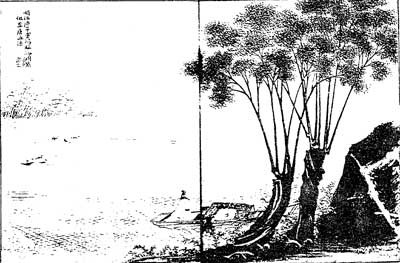 This is the earliest surviving version of a Yu Ge using zhi mode (standard tuning; cadences on sol and re); the first surviving printed version dates from 1546. In all, versions of this standard tuning melody survive in over 30 handbooks from 1525 to 1910; none has lyrics (see
chart).
4 Most versions have 18 sections, the main exception being the second surviving version (1547, repeated 1561); in 10 sections, it is "also called Green Landscape"5 and is said to have been "from the Meixuewo revision".6
This is the earliest surviving version of a Yu Ge using zhi mode (standard tuning; cadences on sol and re); the first surviving printed version dates from 1546. In all, versions of this standard tuning melody survive in over 30 handbooks from 1525 to 1910; none has lyrics (see
chart).
4 Most versions have 18 sections, the main exception being the second surviving version (1547, repeated 1561); in 10 sections, it is "also called Green Landscape"5 and is said to have been "from the Meixuewo revision".6
Xilutang Qintong attributes the standard tuning Yu Ge to the late Song dynasty qin master Mao Minzhong, but this attribution is generally not repeated in later handbooks.
A musically unrelated version of Yu Ge also generally having 18 sections but using ruibin (raised 5th) tuning can be found in about 40 handbooks from >1505 to 1876. Beginning with Xilutang Qintong, which calls the ruibin version Ao Ai, over 10 handbooks have two versions, one with each tuning.7 Eventually Ao Ai became the common name for the ruibin version in later handbooks. Note also that Ao Ai is often preceded by Yuge Diao, a short melody with lyrics by the famous Tang dynasty poet Liu Zongyuan. Based on this Xu Jian lists it as a Tang dynasty melody.8 Some handbooks also attribute Ao Ai itself to Liu, while a few later ones even attribute to him this standard tuning Yu Ge.
Melodies with one of the raised fifth tunings are often associated with the Chu region, generally considered to be southern; there is some comment about this under a section on melodies of the Chu region. It is thus somewhat puzzling that, at at least according to two accounts, at one time the raised fifth string Yu Ge now generally called Ao Ai came to be known as the "northern Yu Ge". There is some further discussion of that here.9 Furthermore,it is not clear whether this idea is related to the idea that northern melodies were more likely than southern ones (at least ones connected to the Chu region) to use a diatonic (7-tone scale). The earliest surviving versions of the raised fifth tuning Yu Ge do have numerous non-pentatonic notes, though these tended to disappear in later versions.
Supporting the idea that if one of the Yu Ge should be considered as "northern" it is the standard tuning one is the fact that the only geographical reference in the standard tuning Yu Ge is to the Songpu River, near lake Taihu (relatively northern),10 for the raised fifth version the introduction and section titles both have clear references to Hunan (considered "southern").
In addition, several prefaces to later versions of #77 Zuiyu Chang Wan, also connected to the Taihu region, suggest it has melodic relations to the standard tuning version of Yu Ge. By contrast, section titles of the ruibin version seem to connect it to Xiao Xiang Shui Yun, which also uses ruibin tuning and is also connected to Hunan province (see Chu).
There have been at least eight modern recordings of Yu Ge, perhaps the earliest being the one made by Zha Fuxi at the Library of Congress; all are related to descendants of the version in Xilutang Qintong.11
There are also at least 14 recordings of the unrelated Yu Ge now called Ao Ai; all are related to descendants of the one in Zheyin Shizi Qinpu.12
Music
18 Sections14 (see transcription; timings are from my recording 聽錄音 15 )
Section titles correspond with the 18 images in this Illustrated Yu Ge Scroll
00.30 2. Losing oneself in the misty waterscape
01.02 3. Washing out one's ears along the rushing streams
01.46 4. Rinsing one's cap in the whirling waters
02.18 5. Rowing gently up the stream
03.01 6. Loudly sing a fisherman's song (harmonics)
03.39 7. The melody fills the cliffs and clouds
04.03 8. The sounds spread to the Songpu (river)
04.36 9. Striking the oars on a misty river
05.25 10. Hitting the side of the boat by a cloudy islet
05.57 11. Turning the boat to stop and extend the fishing net
06.37 12. Casting a net at the bend in a river
07.19 13. Having caught fish, buying some wine
07.36 14. Burning bamboo to boil the fresh fish
08.10 15. Drunkenly leaning on a boat window
08.33 16. Snoozing under the willows by the shoreline
09.16 17. Gathering people of similar intentions
09.56 18. No interest in an official position
10.20 harmonics
10.40 end
Footnotes (Shorthand references are explained on a
separate page)
1.
Yu Ge references
Early references are as follows:
- 18588.87 漁歌 "song sung by a fisherman"; examples by 王勃 Wang Bo and 孟浩然 Meng Haoran
- 18589.88 漁歌子,Yu Gezi 詞牌名 name of a ci song poem pattern connected to poems by Tang poet 張志和 Zhang Zhihe (730-782).
Neither sheds any light on the origins of the present melody.
(Return)
2.
Zhi mode (徵調 zhi diao
Standard tuning can also be considered as 5 6 1 2 3 5 6 . For more information about 徵調 zhi mode see
Shenpin Zhi Yi. For modes in general see Modality in Early Ming Qin Tablature.
(Return)
3.
Kuian Qinpu illustration (QQJC XI/44)
The inscription in the upper left corner is not very clear. It begins, "順治庚子... Shunzhi (reign) 1660 (year)...."
More famous is the painting by Wu Zhen (1280-1354) called The Fisherman 吳鎮,漁父圖, though it is said that he painted it in the style of one by Jing Hao. The Illustrated Yu Ge Scroll on this website is an adaptation by Bai Yunli from the "original" in the Shanghai Museum. There is at least one other "original", in the Freer Gallery, Washington, D.C., where it is called 仿荊浩〈漁父圖〉Fishermen, after Jing Hao. The copy shown below (expand) of the full painting from the Shanghai Museum was copied from this webpage, which also had images from the painting in the Freer, adding commentary comparing the two, but that site has disappeared.

4.
Tracing Yu Ge and Ao Ai
In general there seem to be two different melodies, one using standard tuning and one using raised fifth (ruibin) tuning, but with a lot of variety within each. Generally speaking, people today refer to versions using standard tuning as "Yu Ge" and to those using ruibin tuning as "Ao Ai" (or Ai Nai). For details see this appendix is under the Ruibin Yu Ge. However, those details are somewhat tentative they are largely based on the two related charts by Zha Fuxi (11/117/200 "Yu Ge" and 21/190/376 "Ao Ai"). Zha's book has the prefaces, lyrics and and further information for almost all versions, however it does not always correctly distinguish between the two versions because early ruibin tuning versions were often called Yu Ge and Zha generally goes by title rather than by tuning: although he generally puts all pieces called Ao Ai under ruibin, those he lists under Yu Ge include some of the rui bin versions. I have straightened some of that out, but have not yet carefully examined all the versions in handbooks published after 1802.
(Return)
5.
Green Landscape (山水綠 Shanshui Lü; 8043.xxx)
Underneath the title "Yu Ge" the second and third surviving handbooks with only the standard tuning version of this melody
(Wugang Qinpu [I/436] and
Qinpu Zhengchuan [II/509]) write, "即山水綠 also called Shanshui Lü"; they have no separate commentary (but see next footnote). Identical to each other, these two identical versions have 10 titled sections but no preface or afterword. Their music is very similar to that of the 1525 standard tuning version, but some sections are combined. Most later versions have 18 sections, so one might suspect this 10 section version to be earlier, but its actual tablature seems to have more problems, making comparisons more difficult.
The words "山水綠 Shanshui Lü are in the fourth line of Liu Zongyuan's poem The Old Fishermen, where it says, "In the green landscape his paddles splash "Ao Ai". These lyrics (欸乃一聲山水[的那]綠) accompany the ruibin tuning melody Yu Ge Diao,
(Return)
6.
梅雪窩刪製 Meixuewo Shanzhi
15223.145 only 梅雪 Meixue. The full note under the title in the second and third surviving editions of the standard tuning 漁歌 Yu Ge (see previous footnote) says, "即山水綠,歲庚戊九日 (月?)梅學窩刪製 also called Shanshui Lü, gengwu 9th day (month?), Meixuewo revision." This is applied only to the two aforementioned handbooks, variously dated between 1546 and 1561 (?), and both handbooks clearly write the date in the "heavenly stem-earthly branch" 60-year cycle system
(more) as "庚戊 gengwu", so this must be a mistake: "戊" is a "heavenly stem", not an "earthly branch". This suggests that the year indication must be 庚戌 gengxu (1370/1430/1490/1550 etc), but this is also a problem as 1550 seems too late and 1490 rather early. As for Meixuewo and its connection to Xu Shen, see
QSCM, #163 and
QSCB, Chapter 7.A.1.
(Return)
7. The 1525 version of 欸乃 Ao Ai is actually quite different from the other Ao Ai; see in the chart. (Return)
8. Qinshi Chubian, p.75 (Return)
9.
"Northern Yu Ge"
See Zha p. 191 (435) and Erxiang Qinpu, facsimile edition, IV, p.28. See also the comments/footnote with the ruibin version of Yu Ge
(Return)
10.
Songpu River reference
See Section 8 聲分淞浦 as well as the
Zuiyu Chang Wan afterword. As yet I have not found any specific geographical references in other standard tuning versions of Fisherman's Song (Zha [361] 117ff and 190 [434] ff).
(Return)
11.
Modern recordings and transcription of Yu Ge
Guqin Quji has transcriptions of three versions of the standard tuning Yu Ge:
- Vol.I, p.104 (from 1722 Wuzhizhai Qinpu as played by Wu Zhaoji)
- Vol.I, p.115 (from 1802 Ziyuantang Qinpu as played by Zha Fuxi).
- Vol.II, p.78 (Wuzhizhai Qinpu as played by Wu Jinglu).
After the beginning, all are quite different from 1525; none of the recordings is clear about where or how the player learned them.
Notably, Chou Wen-chung (Wiki) captured the flavor of Yu Ge in a lovely composition called Yü Ko (1965;
listen). However, the program notes, apparently operating on the principal that great music must be "composed" like Western music, often state something like the piece was "composed by Mao Min chung (c.1280)." It seems quite possible that Mao Minzhong did
"zuo" something like this around the end of the Song dynasty, but the connection between what he may have played and what has survived in tablature is very much unknown. As for the connection between Chou Wen Chung's composition and an early qin melody version, this can best be heard at the beginning of the first section of the qin melody. After that I cannot comment as to whether he becomes more free in his interpretation or whether he is following one of the later versions (see the right side of this chart). Quite likely it was one of the versions then available in transcription
(Return)
12.
Yu Ge/Ao Ai recordings
For recordings and transcriptions of the ruibin tuning Yu Ge see under that page.
(Return)
13.
Original Chinese afterword from 1525
Regarding 奇握溫, 6013.156 says 奇渥溫:元代帝室之姓,清代改作欲特氏。
(Qiwowen: Yuan dynasty royal name; during the Qing dynasty changed to Yuteshi.)
The original Chinese here is:
(Return)
14.
Original Chinese titles
These are as follows:
2. 放情煙水
3. 洗耳清湍
4. 濯纓迴漵
5. 緩棹溯遊
6. 高歌欸乃
7. 響遏巖雲
8. 聲分淞浦
9. 擊遠疝江
10. 扣舷雲渚
11. 施罛橫渡
12. 撒網絕流
13. 得魚沽酒
14. 燃竹烹鮮
15. 醉倚蓬窗
16. 閒眠柳岸
17. 蠡和同志
18. 軒無軒冕
Compare the section titles from 1546, which has only 10 sections:
The latter are not yet translated.
15.
My recording
(Return)
The recording was somewhat rushed; if I record it again the phrasing will be quite different in places.
(Return)
Return to the annotated handbook list
or to the Guqin ToC.