|
T of C
Home |
My Work |
Hand- books |
Qin as Object |
Qin in Art |
Poetry / Song |
Hear, Watch |
Play Qin |
Analysis | History |
Ideo- logy |
Miscel- lanea |
More Info |
Personal | email me search me |
| XLTQT / ToC / Standard tuning Yu Ge | 首頁 |
|
81. Intoning in Absolute Repose
- zhi mode:2 standard tuning 5 6 1 2 3 5 6 played as 1 2 4 5 6 1 2 |
靜極吟
1
Jing Ji Yin |
| Original tablature from 1525 3 |
 This melody, Jing Ji Yin, is here used as a prelude to the earliest surviving version of a standard tuning version of Yu Ge. It survives only here and in Buxuxian Qinpu (1556), where it also precedes and seems to serve as a prelude to a standard tuning version of Yu Ge. However, there are many differences between the two versions of Jing Ji Yin.4
Neither version has a separate preface but the "absolute repose" in the title fits the Chinese literary image of fishermen as patient people who wait in stillness as they contemplate their natural surroundings - the water, the weather, the seasons - and who take action only when the conditions are right.5
This contrasts fishermen with woodcutters, who also live in nature but must strive to get what they need.
Later versions of this standard tuning Yu Ge no longer have this prelude. First, several other handbooks, such as Taiyin Chuanxi, do have a short melody before its standard tuning Yu Ge but instead of being a version of the present melody it is a version of Dongting Qiu Si called Xiang Jiang Yin.6 Still later the tradition of short preludes preceding longer melodies was no longer followed at all.
In contrast, early versions of the ruibin tuning Yu Ge not only often had a related melodic prelude (beginning with Yu Ge Diao but later usually called Le Ji Yin). Then, as the tradition of preludes disappeared, elements of this prelude became a new first section of the full melody.
This melody should be played before the standard tuning Yu Ge (Song of the Fisherman).7
Original Preface
None
Music (4 sections, ending with a harmonic coda; see
tentative transcription and
listen to my recording)
Footnotes (Shorthand references are explained on a
separate page)
1.
Intoning in Absolute Repose (Jing Ji Yin 靜極吟; QQJC III/164)
Another translation could be "Ultimate Stillness". For this theme 11/572 and 43533.217 have only jingji; short entry saying "靜寂之極也", with references to poems by 劉得仁 Liu Deren (9th c.; "對月寄雍陶") and 范成大 Fan Chengda (1126-1191 "寒夜觀雪").
However, these poems do not mention fishing. For one that does (or almost does), see this poem (the second from a set of two) by the Tang poet Xu Tang ,
Xu Tang (9th c. CE), Second of Two poems inscribed at Qian Lake (17744.2 汧水 in 隴縣 Long County, near 隴山 Longshan in western 陝西 Shanxi)
隴首時無事,湖邊日縱吟。
草平連遠岸,沙淺露寒心。
靜極亭長在,年深水更深。
無人見垂釣,暗起洞庭心。
At the ridge head there is nothing going on,
by the lakeside days are spent freely intoning.
Grass lies level all the way to the distant shore,
the sand is shallow and cold dew clears the heart.
The Pavilion of Absolute Repose has stood there forever,
as years go by the water has become deeper still.
No one notices whether there is cast fishing,
and quietly there arises a heart like that of Dongting (Lake: alive but vast and still).
城非宓賤邑,館亦號聞琴。
乃是前賢意,常留化俗心。
代公存綠綺,誰更寄清音。
此跡應無改,寥寥畢古今。
This city is not the town once governed by
Mi Jian,
yet the hall is likewise called “Hearing a Qin.”
Such was the intention of the worthy men of old:
to let a mind that transforms custom always remain.
A princely patron's Green Silk qin still abides here —
but who, now, will send forth its pure sound?
These traces should never be altered;
sparse and remote, they endure from antiquity to the present.
靜極 Jing Ji is also known as part of the expression "Jing Ji Si Dong 靜極思動", a phrase sometimes translated as "Movement in Stillness" but which can also be translated as "Stillness Leading up to Action".
The melody here has no connection to that of 靜觀吟
Jing Guan Yin.
(Return)
2.
徴調 Zhi mode
Standard tuning can also be considered as 5 6 1 2 3 5 6 . In zhi mode this same tuning also seems sometimes to be considered as 2 3 5 6 7 2 3 . My tentative understanding here, based on considering the relative tuning as 1 2 4 5 6 1 2 , is that the main tonal center is 5 (transcribed as G but still a relative pitch), secondary is 1 (a fifth above 5). The open third string is avoided, but not its relative pitch (4 or relative F). 2 (B, a major third above G) is quite common, but so also is 1 (C), though it is a fourth above the main tonal center. So far this is not unusual. However, there are three places in the first section where a note does not fit into this analyis. Two of these might work: the very first note (flatted 7, which is a minor third above the tonal center, something not uncommon); and a sharped 1 (C#) also in the first line. The third of them, occurs in the middle of the third column, where the "上十往來" seems very odd: more idiomatic would be "上九往來: 十 and 九 might easily be misread; but in this case the "合" that comes just before this, in a place that makes no sense, would logically come right after the "九").
For more information about 徵調 zhi mode see Shenpin Zhi Yi. For modes in general see Modality in Early Ming Qin Tablature. (Return)
| The tablature from 步虛僊琴譜 Buxuxian Qinpu (1556) |
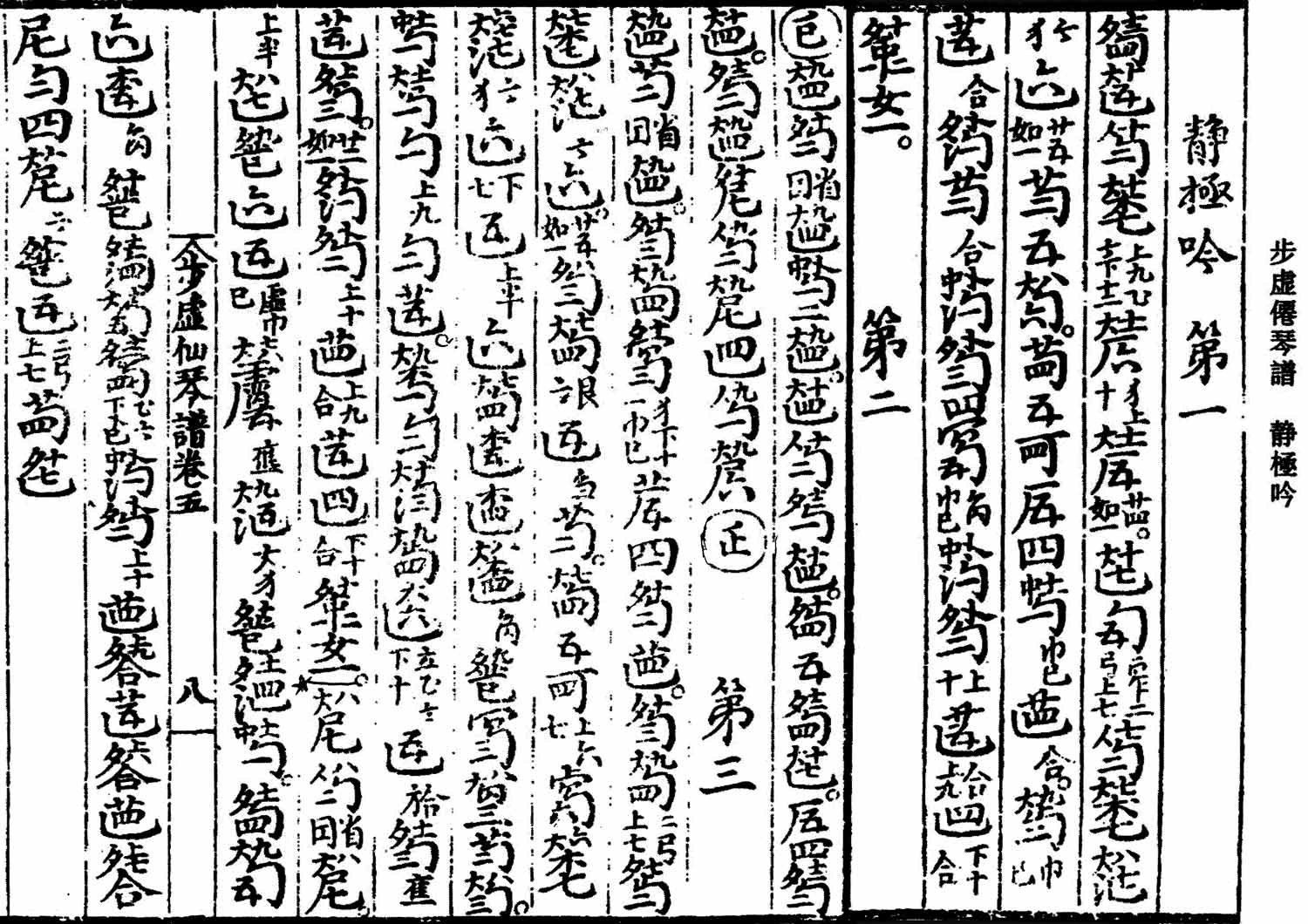 3.
Image: The original tablature
3.
Image: The original tablature
The example above, from 1525, is in QQJC III/164.
The example at right, from 1556, is in QQJC III/286.
(Return)
4.
Version in Buxuxian Qinpu (1556)
See Zha Guide 20/--/--. The 1556 version, shown at right, was copied from
QQJC III/286. Differences between that and the 1525 version can be found throughout the melody, but the most noticeable differences are that the 1556 version has only three sections, with the third sort of combining the 1525 sections 3 and 4, but the material of the 4th section (see * in the fourth column of tablature from the left) is in 1556 much condensed and there is no closing harmonic coda.
(Return)
5.
Reconstruction of the 1525 Jing Ji Yin
The tablature has a number of problematic details that have made reconstruction difficult. These are mainly finger positions that yield strange notes and so may be mistakes, but one is that, at the beginning of the third vertical line from the right in the middle panel (of three: see the image of the original tablature at top), there is a figure that looks something like 哥 but with the lower square missing: this is very puzzling.
As for what seem to be strange notes, these begin at the start of the piece (see the first two examples).
- If the open first string is tuned as C then the very first note (fourth string at 12th hui) is B♭ while the sixth note (sixth string at "outside" position is B♮ unless played at 13.5 instead of 13.1).
- The first note of the second phrase begins at the 11th position on the 5th string: C#.
- In the fourth line of the middle panel mentioned above, the third note has the position "on the third string between 7 and 8", usually 7.6, but this would be E♭ whereas 7.3 = E seems more likely.
- The fifth line has a sequence "up half" then "down half" that cannot be idiomatic as written; "down half" means "down to the half positon" so go "up helf" must mean go a half back down rather than "to the half position".
Of course, in my experience sometimes the most seemingly problematic tablatures yield the most interesting results if they can be worked out, but that takes extra time and patience.
(Return)
6.
Source of preludes
Sometimes the melodies used in handbooks such as 1525 included melodies specifically designed as preludes for the piece that followed. Other times they seem to take an existing melody and apply it as a prelude.
(Return)
7.
Dongting Qiu Si as prelude
Elsewhere Dongting Qiu Si is used as a prelude not to Yu Ge but to
Zui Yu Chang Wan, a melody associated with the region around Lake Taihu. The most famous Dongting is the lake into which the Xiangjiang flows. However, Taihu also has a Dongting island (with cave of same name). This relationship between Dongting Qiu Si and Xiang Jiang Yin is thus particularly interesting (see further comment under Dongting Qiu Si
(Return)
Return to the annotated handbook list or to the Guqin ToC.