|
T of C
Home |
My Work |
Hand- books |
Qin as Object |
Qin in Art |
Poetry / Song |
Hear, Watch |
Play Qin |
Analysis | History |
Ideo- logy |
Miscel- lanea |
More Info |
Personal | email me search me |
| Chinese glossary / HIP / dapu / rhythm / mode | 中文 首頁 |
| Website Glossary 1 | 網站詞彙解釋 |
This selected glossary, an ongoing project including lists, definitions and explanatory essays, is divided into three sections:
1. Some general terms used on this website
2. Music instrument categories and their Chinese translation
3. Music theory terminology
Here on this website I have tried to be consistent in using music terms as defined or described in this glossary. When reading other pages on this website it may be important to consult this page, since elsewhere many of these terms often have different definitions, descriptions or usages. One reason for this is that the meaning of many musical terms depends on the type of music to which they refer (see footnote). Some are here because either they are not common terms, or they are used here with a special meaning (e.g., rules of modality). Some have rarely been translated into Chinese (e.g., HIP) or into English (e.g., dapu). And some are here because, although they seem rather clear in one language, they can easily be ambiguous in translation (such as "notes" in English or "diao" in Chinese).
-
HIP
(復古風格演奏;
Historically Informed Performance)
A performance done in accordance with the historical and iconographic records of how it was performed at the prescribed time in the past. When possible, information can also be derived from relevant oral and written traditions. - Pu (譜)
This word used by itself can be confusing. Within the qin context it usually means either tablature as a concept (finger methods [指法 zhifa] as written down), or a collection of such tablature (usually translated as "handbook"). However, sometimes it seems to refer to the music itself (Jiangxi Pu or gepu). And at other times it seems to be used as a verb, in which case it may mean "compose" (with old qin melodies "create" might be better), "write down" or perhaps even "play from tablature" (compare 打譜 dapu). Examples include those in Qiujiang Yebo and Wuling Chun. -
Dapu (打譜: "Realization" of music from qin tablature)
A specifically Chinese term now used for learning music directly from qin tablature instead of from a teacher. Traditionally this might have meant something like "reading music" or "sight-reading" (sight reading), but today it seems generally to be used to mean "reconstructing", which requires some analysis of the tablature, in particular to determine appropriate note values. This then could be used either to try to play the melody as it might originally have been played (and originally expressed its "meaning"), or to use it more freely in order to create something new. - Note values (音值: length/time duration of notes; related to rhythm)
-
Written music (樂譜﹕音樂記譜法)
There is no special word for this in English. In actual practice often the word notation is used to refer to all written music, with tablature called "tablature notation". In fact very few writers consider it important even to consider the word or concept "tablature", presumably because it is so much less common than notation. Here, of course, the tablature is of prime importance and so these and related terms are used in a way that allows all three terms to be kept distinct. -
Notation (指音譜)
- This method of writing music directly indicates the note names through symbols, letters or numbers; when fully developed it also indicates note duration. Types of music notation include:
- Staff notation 五線譜
(see in Wikipedia)
The most common Western notation puts the symbols on a five-line music staff, and so it is called "staff notation".
Number notation 簡譜 (see in Wikipedia)
Today traditional Chinese music is often written in a type of "number notation".
Gongchepu 工尺譜 (see in Wikipedia)
The best known predecessor of Chinese number notation is gongche notation. In different parts of China and at different times there have been various forms of gongchepu. A system common in the Ming and Qing dynasties called the seven notes of the scale shàng, chě, gōng, fán, liù, wǔ, yǐ (上尺工凡六五乙). (Chinese Wiki compares this to 1 2 3 4 5 6 7, or do re mi fa sol la ti, adding that the most common variants had 合, 四, and/or 一 for 六, 五 and/or 乙). This system also often included indications of rhythm, note emphasis and ornamentation.
-
Tablature (指法譜)
(see in Wikipedia as well as under Qin tablature and playing technique)
- This method of writing music does not directly indicate note names or note values. Instead it gives such information as the finger positions and/or finger movements.
- Guitar tablature (吉它六線譜)
This is the best known Western tablature. It puts dots on a diagram of the guitar fingerboard in order to indicate finger positions for playing chords (see examples).
Qin tablature (琴譜 qinpu; see example)
This form of written music began as a longhand description (wenzipu) of how to play a qin melody. Since the Tang dynasty qinpu has been written as a "shorthand tablature" that uses suggestive strokes from Chinese characters to form clusters that give details of left hand finger positions and ornamentation, plus right hand stroke techniques. As such it might be called a kind of finger choreography. Although it does not directly indicate note values, I believe it often suggests them. The word "qinpu" can refer either to the tablature itself or to a collection of pieces written in tablature.
-
Common practice period (共曉時期, ca. 1600/1650 to 1900 CE; see in
Wikipedia)
This relatively new term might more precisely be called the "Common practice period of Western classical music". The most common Western terms for musical analysis were developed for analyzing Western classical music of this period. Some of these must be redefined when discussing Western music outside that period as well as music from Western oral traditions or from non-Western traditions. -
Classical music (古典音樂)
In English the word "classical" comes from "class" and suggests "top class"; it is specifically connected with antiquity in the form of Greek and Roman culture. In Chinese the word for classical is 古典 gudian; this is an ancient term literally meaning "following ancient canons", a positive term in traditional Chinese culture. Calling music "classical" suggests that there are established rules by which one can analyze it. In English the term is associated specifically with music composed during the period of about 1770 to 1830. More commonly it is applied either to music of the so-called "common practice period", just mentioned above, and even more broadly applied to any composed music from the past, or to any music that can be analyzed according to established rules. Indian music that follows a raga system of modality (see Wikipedia) comes from an oral tradition, but is called "Indian classical music" because it follows established rules of modality.
2. Music instrument categories and their Chinese translation (中文)- Musicologists have classified music instruments according to the way their sounds are produced. The system was originally developed by Erich von Hornbostel and Curt Sachs and published in 1914. The general public is often unfamiliar with this terminology, and so it is not used at all consistently in English. It is used even less consistently in Chinese. (Some translations here are from World Music Culture).
There are five basic categories (the fifth was added later):
- Chordophones (弦鳴樂器 see below)
- Membranophones (膜鳴樂器 such as drums)
- Idiophones (體鳴樂器 such as chimes)
- Aerophones (氣鳴樂器 such as organs and flutes)
- Mechanical and electrical instruments (機械樂器、電子樂器 such as musical clocks and synthesizers)
Stringed instruments (chordophones) were further divided into five sub-categories (the fifth was determined later):
- Zither (箏類): soundbox with strings across it; may also have a hollow fingerboard; includes 琴 qin (always?), 瑟 se, 箏 zheng
- Lute (魯特琴類): soundbox attached to a largely non-resonant fingerboard; strings go across both; includes 琵琶 pipa, 二胡 erhu, etc.
- Harp (豎琴類): two- or three-sided frame w/soundbox on one side; strings go obliquely from one side across the soundbox to the other side; includes 箜篌 konghou
- Lyre (抱琴類): four-sided frame with a soundbox on one side; strings attached perpendicularly from the soundbox (not across the soundbox) up to the frame
- Musical bow (弓琴類): strings extend across a bent one-sided frame; a resonator (soundbox) may be attached to the frame.
Stringed instruments can be further subdivided according to the method of play. Mostly this is plucked, bowed or struck, but there have also been examples of stringed instruments that resound when the wind blows on them. Again, there is not always a standard term for translating these terms.
- Plucked instruments (撥彈樂器 botan yueqi) include the guqin and Eastern European zithers (plucked zithers 撥彈箏類樂器), and the guitar (plucked lute 撥彈魯特琴類樂器). (I have not yet seen compound terms such as "plucked zither" in Chinese.)
- Bowed instruments (擦絃樂器 caxian yueqi), occasionally called 拉絃樂器 laxian yueqi) such as the violin and erhu (擦絃魯特琴類?), and bowed zithers such as the Korean ajaeng (擦弦箏類).
- Struck (hammered) stringed instruments (打擊弦鳴樂器 ?) include the yangqin (揚琴; originally 洋琴) and the piano (struck/hammered zithers 打擊箏類樂器). This assumes that 打擊 daji can be applied to stringed instruments, not just types of drums. In this regard, note that the character "鼓 gu" is often used to mean "play" a qin (the Chinese article 古琴「鼓」與「彈」的技藝源流演變 cites occurrences from the Chinese classics). This gu originally referred to a kind of drum and is used to mean "beat". Does this mean that perhaps the guqin was originally beat like a drum? Since there is no evidence that a stick was ever used to strike the qin, it is difficult to evaluate how "striking" a qin might be different from otherwise "playing" one. The same might be said for such words as kan and pi as applied to harp and pipa; note also that 49321 鼓 includes expressions such as 鼓舌 gushe (sweet talk, shoot off one's mouth) that do not actually require drumming.
- Aeolian harp (風鳴琴); although called a "harp" this is actually a wind-blown zither (風力鳴響的箏類樂器 ?)
Lutes and zithers can be further subdivided according to whether or not they have frets (絃枕). They almost always have one or more bridge (絃馬、琴馬), but these can be subdivided according to whether or not the bridges are fixed or movable.
- Frets are thin strips on the 指板 fingerboards (頸 necks) of some lutes and on the soundboxes of some zithers. While a string is plucked, a finger of the other hand presses the string down into the fingerboard or soundbox of the instrument on the opposite side of the fret from which it is plucked. Frets are used to determine pitch, and are usually fixed. Chinese have many traditional terms for frets, such as 品 pin for the frets on a pipa.
- Bridges raise a string high enough that it usually cannot be pressed down onto the soundbox. The main function of some, such as the single bridges on most lutes, is to help transmit the sound between the strings and sound box (on lutes the fingers are pressed onto fingerboard, not the soundbox). On zithers most bridges help determine the pitch, there is often one for each string, and it is often movable. In Chinese there is a variety of terms for bridges. Xianma (絃馬) seems to be a modern term. Movable guzheng bridges are 雁柱 yanzhu (Bao Rong ref.) and the fixed bridge on a violin is 絃馬 xianma. The 岳 yue (mountain) that supports the strings on a guqin could be considered a type of fixed bridge.
Most lutes have a single bridge, but they may or may not have frets. Zithers almost always have bridges, but most do not have frets.
3. Music theory terminology (Chinese version)- Relevant terms as used on this website include:
- Tones (音): sounds of definite pitch (in English these are often also called "notes")
- Notes (音符): symbols used to represent a pitch (compare "tones")
- Pitch names (音名): letters or numbers used for writing such a pitch
- Absolute pitch (絕對音高): often used to mean the ability to recognize frequencies ("perfect pitch") but also used defining notes in terms of fixed frequency (e.g., a'=440 Hz [i.e., vibrations per second]). Although "notes" usually represent absolute pitch, they don't do so in my transcriptions)
- Relative pitch (相對音高): used for sounds where the note name does not tell the pitch (e.g., do re mi sol la or 1 2 3 5 6); the note name is determined by its position in a scale
- Tuning (調諧 tiaoxie; also 定音法 dingyinfa "tuning method"?): these term are not always precisely used; in Chinese 調 diao by itself can refer to either tuning or mode
- Relative tuning (相對定音): used to express tunings that use relative pitch (e.g., standard tuning 1 2 3 5 6 1 2)
- Interval (音程): the distance between two pitches.
- Octave (八度、八度音、八音度、倍頻程): these terms describe various aspects of an octave. The first three reflect the fact that a diatonic scale (q.v.) has eight notes. The last is derived from the fact that the upper note note of an octave vibrates with twice the frequency of the lower note. Thus if a'=440Hz, a (i.e., one octave below a')=220hz.
- Scale (音階): a sequence of tones within an octave. In theory an octave (倍頻程) can be divided into any number of tones. The reason standard music theory identifies only 12 tones is related to the generation of notes through the "cycle of fifths method, discussed under Qin Tunings, Some Theoretical Concepts (see also sanfen sunyi compared to Pythogorean tuning). It should be noted that some music, such as that played on Indonesian 甘美朗 gamelans, completely ignores these mathematical relationships. See further below.
- Chromatic scale (半音階): a scale consisting of all 12 of the tones generated through the cycle of fifths mentioned above, organized within one octave (there are 13 notes, the 13th note being the octave note).
- Half tone, semitone (半音): a semitone interval is the distance between two tones in the chromatic scale
- Whole tone (全音): a whole tone interval is equivalent to two half-tone intervals
- Heptatonic scales (七聲音階): scales using seven tones (not counting the octave note)
- Diatonic scale (自然音階): heptatonic scale consisting of the first seven tones generated through the cycle of fifths mentioned above, arranged within an octave. There are seven such scales, as outlined below.
- Pentatonic scales (五聲音階): scales using five tones, not including the octave note.
- Major pentatonic scale (大調五聲音階): pentatonic scale consisting of the first five tones generated through the cycle of fifths mentioned above, arranged within an octave. This scale has sometimes been described as the "black keys on a piano". These can also be compared to C, D, E, G and A, but probably are better described using relative pitch: do-re-mi-so-la or in number notation 1-2-3-5-6 .
- Solfeggio (視唱): While singing, giving the names of each note sung, usually using do, re, mi, etc.); to practice singing in this way (Wiki; use with guqin).
- Glissando (滾、沸; "discrete glissando" is specific): on a guqin the term "滾 gun" means "挑 poking" a finger outward across some or all of the seven strings, while "沸 fu" means "勾 hooking" a finger inwards across some or all of the strings; one of the strings may be stopped (按音) but almost invariably the others are all open (散音). Translating gun and fu is actually somewhat complicated. On a harp running the fingers across the strings like this in either direction is called doing a "glissando", while "arpeggio" refers to playing strings not in order but in a rapid sequence that forms broken chords. However, because of their tuning, running a finger across several strings on a violin or a guitar can produce a broken chord, making it an arpeggio, not a glissando; there, playing a glissando means sliding from one note to another on the same string. Thus for playing qin a more precise translation of both gun and/or fu could be "harp-like glissando" or "discrete glissando".
- Chinese pentatonic scale (中國五聲音階): same as the major pentatonic scale
- Monophonic music (單音音樂): music consisting of only one melodic line (including octaves)
- "Multiple-phonic music" (多聲部音樂): music that has more than one note playing simultaneously. "Multiple-phonic music" is not an established term in English, but I don't know of a better term (sometimes "counterpoint" may be used). There are three basic types of multiple-phonic music: polyphony, homophony and heterophony. (One might also call this "multiphony", but that term also has another meaning (see Wiki.)
- Polyphony (複音音樂, polyphonic music): multivoice music in which each voice is considered as a separate line of music or separate melody (it might thus be called horizontal polyphony)
- Homophony (和聲音樂、主調音樂): music that has more than one note playing together, but instead of separate melodic lines the notes form chords (this might be called vertical polyphony); the Chinese terminology here does not seem to be consistent, but the latter Chinese term may specify the type of homophony that has been the main characteristic of classical Western music since about 1750 CE.
- Heterophony (支聲音樂; Wiki): two or more performers (or an instrumentalist while singing; see also here) play similar versions of the same melody, usually in an improvisatory manner, sometimes in unison, other times not. Although this was apparently a prominent characteristic of much traditional Chinese music, it was not common in Western classical music. (Other Chinese terms seem to include 支聲複音,異音式音樂,異聲音樂 and perhaps other terms).
- "Tonal center" (調中心音): a note (and its octaves) to which the melody keeps returning (sometimes also translated as 主音 or 中心音)
- "Main note" (調主要中心音; see mode table; also called main tonal center or primary tonal center): the primary tonal center in a piece of music. The main note is usually the concluding note of the whole melody and most of its sections.
- "Secondary note" (調次要中心音; also called secondary tonal center): the second (and sometimes third) most common tonal centers in a melody. A secondary note is usually the concluding note of many phrases and some sections.
- Third (三度; third note): this could refer to a third above any other note, but it usually means the third note of a diatonic scale or a third above a tonal center; there are two types, "flatted thirds" and "whole-tones thirds" (see next; compare 3 natural and natural third)
- "Flatted third" and "whole-tones third" (小三度、大三度): there do not seem to be any unequivocal terms to describe specifically these two types of third note above a base note, but such terms are necessary to explain an important characteristic of early qin music (e.g., in shang mode). This concerns whether a particular third note is two whole tones above the "main note", in which case it is called a "whole-tones third" (also 全三音; sometimes simply "third"), or one and a half whole tones above the main note, in which case it is called a "flatted third" (also 降三音).
- Third interval (三度音程; third): an interval between two notes separated by either two whole tones or one and a half whole tones; in English there does not seem to be a clear distinction made between an interval and a diad (see next)
- Diad (雙和絃): two notes played together; in English the word "chord" usually means three or more notes played together
- Third diad (三度和絃): a diad separated by either two whole tones (major diad) or one and a half whole tones (minor diad)
- Triad (三和絃、三音和絃): a chord consisting of three notes; since around 1600 Western music can largely be analyzed in terms of triad relations. For this the two most important triads are the "major triad" (usually called simply a "major chord": major third diad at bottom, minor third diad at top) and the "minor triad" (usually called simply a "minor third chord": minor third diad at bottom, major third diad at top).
- 3 natural (3♮[♮]; 3本位音). In notation this sign is only necessary if the previous occurrence of the note (in this case 3) was modified by an accidental (3# or 3b). It is mentioned here as a reminder that it can be either a whole tones third (e.g., when 1 = C and 3 natural = E) or a flatted third (e.g., when 1 is A and 3 natural = C).
- Natural third (純律三度): same as a just intonation third; the latter term is better because elsewhere "natural third" may have other meanings, such as what is here called 3 natural. The frequency a Pythagorean third (五度相生律的三度) above another note is higher by 81/64, that of a natural third is higher by 80/64 = 5/4 . Thus if 1 (do) = 64Hz, Pythagorean 3 = 81 Hz, just intonation 3 = 80 Hz.
- Tritone (全三音): an interval of three whole tones, also called an augmented fourth or diminished fifth. The Chinese translation apparently comes from Japanese.
- Rhythm (節拍): Wiki: "the timing of the musical sounds and silences." It also quotes the Oxford Dictionary, "movement marked by the regulated succession of strong and weak elements, or of opposite or different conditions." This rhythm may consist simply of a pulse, defined again in Wiki as consisting of beats, which are "a series of identical, yet distinct periodic (repeating) short-duration stimuli perceived as points in time." Or it may be organized into meter, defined in the same source as a "repetitive, regularly-accented pulse-group" (further in Wiki).
- Mode, modal, modality (調式 diaoshi): the diao in diaoshi is also used for key (see next) or tuning; in English "modal" is often applied only to music that follows rules other than Western classical music's rules of harmony (see below): early music, non-Western music, many forms of popular music. The page Modality in early Ming Qin tablature looks for modal rules in early Chinese music.
- Key (調子 diaozi): in English "key" (see further below) is used for modes that follow Western classical music's rules of harmony. In earlier usage 調子 diaozi had other meanings, including "melody" or short song.
- Related key (關係調): how closely two keys are related is measured by how many common tones they share. The most closely related keys are a major and its relative minor: they use exactly the same tones. The second most closely related keys are tonic and either its dominant or sub-dominant: they share six of seven tones.
- Modulation (轉調): Modulation in music of the Common practice period should be to a related key. The two most common such modulations are:
- From a tonic key up a fifth to its dominant (or perhaps more precisely from the tonic chord to the dominant chord)
Between a major key and its relative minor
- From a tonic key up a fifth to its dominant (or perhaps more precisely from the tonic chord to the dominant chord)
- Transposition (移調): generally defined as writing or performing a melody in a key other than the stated one; see further details.
- Rules of harmony (看中文): this is an idiom mainly used to refer to the specific harmonic rules that Western homophonic music was supposed to follow. The rules could be different for different periods.
- Rules of modality (看中文): this term is applied here as a parallel idiom to "rules of harmony". It can be used to refer to the specific modal rules that any music genre with its own system of such rules is supposed to follow. Thus the modal rules that govern one of the Indian classical raga systems (such as Hindustani classical music) might together be referred to as its "rules of modality". In the process of my work reconstructing music from Ming dynasty handbooks I have found some modal rules that characterize the guqin music therein, but these are not detailed or specific enough to be referred to as "rules of modality".
- The seven diatonic scales, analyzed with the piano keyboard as a reference (中文)
Today music analysis (in Chinese or English) often uses as its reference the 88 keys of the piano keyboard. These 88 keys together play 88 notes (音符) but only 12 of these have distinct names. The names of the 12 keys below "middle C" (for music analysis purposes usually written c') are as follows (also shown on the piano keyboard segment at right):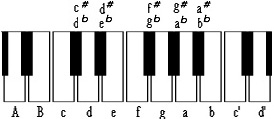
Seven white keys: c, d, e, f, g, a, b (then c'=middle C)
Five black keys: c# (=db), d# (=eb), f# (=gb), g# (=ab) and a# (=bb)Note that the names of the white keys of a piano are used here only as a convenient reference. A piano is usually tuned so that the key a' has a pitch of about 440Hz. This makes c' (middle C) have a pitch of about 260Hz. However, in this discussion (and in my transcriptions) c actually means do, a relative pitch.
Playing any 13 consecutive keys/notes gives the 12 semitone intervals of a chromatic scale (半音階). The first and last notes of this sequence form an octave. In Western classical music a one-octave scale is normally a diatonic scale, consisting of 8 notes separated by 7 intervals: five whole-tone intervals and two half-tone (semitone) intervals. Again using the piano as a reference, there are in theory seven different scales, one starting on each of the seven different white keys of the piano. These scales use only consecutive white keys, so each scale is differentiated by its sequence of whole tones (W) and semitones (H). Today each of these seven scales has a related mode name adapted from an early modal system called "church modes"; these names in turn were borrowed from ancient Greek music theory (the mode names come from Greek place names).
With this in mind the relevant sequences of intervals for all seven diatonic scales, with their respective mode names, can be stated as follows (中文):
|
Scale on c (do, Ionian mode) :
Scale on d (re, Dorian mode) : Scale on e (mi, Phrygian mode) : Scale on f (fa, Lydian mode) : Scale on g (sol, Mixolydian mode) : Scale on a (la, Aeolian mode) : Scale on b (ti, Locrian mode) : |
W - W - H - W - W - W - H ("major scale"/"major mode": compare
"do - sol mode")
W - H - W - W - W - H - W H - W - W - W - H - W - W W - W - W - H - W - W - H (Chinese 7-tone scale: gong-shang-jiao-bianzhi-zhi-yu-biangong) W - W - H - W - W - H - W W - H - W - W - H - W - W ("minor scale"/"minor mode": compare "la - mi mode) H - W - W - H - W - W - W |
Footnotes (Shorthand references are explained on a
separate page)
1.
Rationale for this glossary
I have written this webpage first to help me understand the relevant terminology,then to help me decide which terms to use and how to translate them. Should one use traditional Chinese terminology to explain traditional Chinese music to a modern reader? The first problem is that many basic terms, such as "interval", "scale" and "note" cannot be found in classical Chinese texts. Many such concepts were certainly discussed in old texts, but the terms they used are often used inconsistently today and can be very confusing. On the other hand, the most common Western terms were developed for analyzing Western classical music during what has been called the "Common practice period" (ca. 1600 - 1900 CE). These are not necessarily appropriate for discussing traditional Chinese music, or even early Western music.
Fortunately, the modern Western interest in early music and in non-Western music has led to the development of terminology that applies more broadly than either the traditional Chinese or traditional Western terms. Unfortunately, for many of these terms there are no generally accepted translations into Chinese: thus, for example, with such basic terms as historically informed performance (HIP) as well as with the terms used for describing music instruments of the world (English, Chinese).
Given these circumstances, the best I can do is explain here the terms as I use/translate them on this website, then try consistently to use them in this way.
(Return)
Appendix
五音 Wuyin,
律呂 Lülü, 工尺 gongche and 俗字 suzi 譜 note/pitch systems
Suzi symbols and some commentary copied from this page by Babelstone
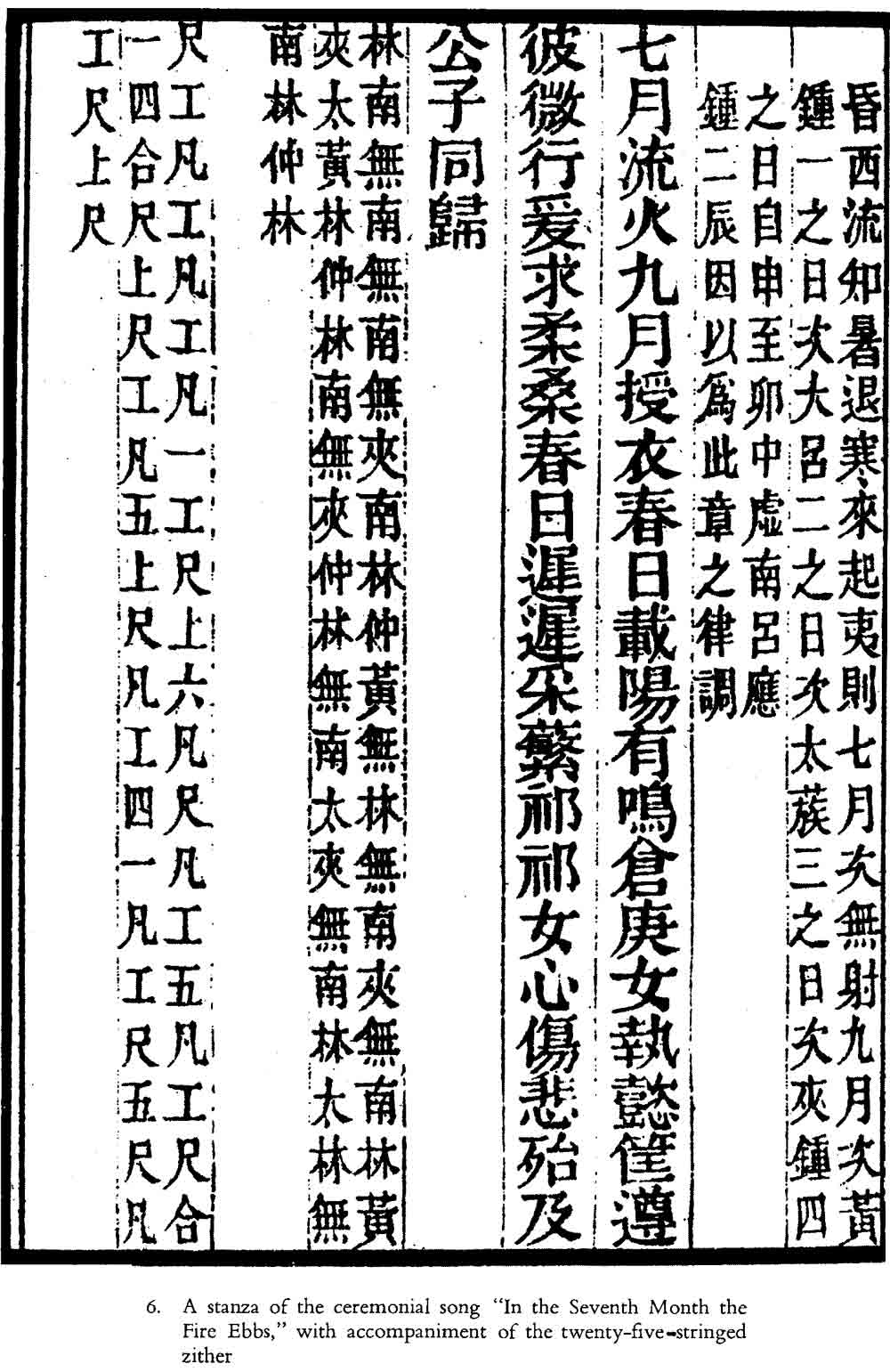
These note/notation systems have little to do with writing qin music, particularly when dealing with Ming sources. However, some Qing dynasty handbooks utilize one of these systems alongside the qin tablature; and some people have tried taking music originally written in another system and putting it into qin tablature. Examples include the music for 12 Shi Jing poems that Zhu Xi had transcribed into lülü notation; this was later written alongside their transcription into qin tablature in Lüyin Huikao (1835); qin music alongside gongche notation can be found in the 張鞠田琴譜 Zhang Jutian Qin Tablature (1844), much of it originally for opera songs; and modern examples such as music for qin songs that Jiang Kui apparently wrote for other instruments using a form of suzi notation (q.v.) but that people today are playing on qin.
The following chart is part of an imperfect attempt to try to begin to understand these other pitch/notation systems.
The four systems considered here are:
According to Pian (p. 93), "The twelve pitch names have had a long history. But it is in the Sonq (Song) period that we see, for the first time, the use of them for writing music. The method here is to use only the first syllable of each name for the basic octave, and a suiffix ching (jing) 清 is added for the notes and octave above...." (The 清 often seems to be omitted, especially when the system is used alongside gongche notation, as here [Pian, illus. 6].)
Throughout history many other systems of notation came to be used in China; the details below related to the four basic ones are included here because they are connected to matters covered elsewhere on this site. The chart has been modified from the referenced page by the addition of the seven figures added under "comments" (copied from Pian, p.59). They do not seem actually to occur in the Jiang Kui ci songs.
This system seems designed not so much for writing music as for analyzing notes within their relative position in a scale. Here it seems that gong is considered always to be used for the primary tonal center (主音 zhuyin), but this is not always easy to reconcile with my own understanding of how the music actually works (see
Modality in early Ming Qin tablature).
The 律呂 lülü are the 12 tones/pitches established very early for Chinese music. Further detail
here. They are (along with their relation to huangzhong):
This was apparently devised during the Tang dynasty, perhaps first as tablature but then as note names. There are variations in the system and it is not clear when in was adapted for 12 (relative) pitches.
This system first appeared somewhat later, perhaps early Song dynasty: it was mentioned by Zhu Xi (1130-1200) and used by Jiang Kui
(ca. 1155 - 1221), but first described in detail by 張炎 Zhang Yan (1248–c.1314) in his 詞源 Ci Yuan (Lyric Poetry Wellspring). It also apparently originated as tablature, indicating the fingerings used in playing the Chinese end-blown flute (簫 xiao). It is not certain when and where they came to be used as note names (e.g., when Jiang Kui wrote his songs in suzi pu was he specifying that they be played on xiao flute?). There was probably even more variety in system of suzi names/symbols than in the gongche ones.
| Number notation |
Scale- degree |
Pronun- ciation |
Lülü system |
Gongche system |
Pronun- ciation |
Gongche 16-name |
Suzi system |
Suzi (Zhu Xi?) |
Flute fingering |
Comments |
| 1 | 宮 | gōng | 黃(鐘) | 合 | hé | 合 |  |
厶 | ●●●●●● | |
| 1♯/2♭ | 大(呂) | 四下 |  |
マ下 | Pian p.59: circled suzi are half-step lower | |||||
| 2 | 商 | shāng | 太(簇) | 四 | sì | 四上 |  |
マ上 | ●●●●●○ | |
| 2♯/3♭ | 夾(鐘) | 一下 |  |
二下 | Not easy to write in the original gongche or suzi | |||||
| 3 | 角 | jué | 姑(洗) | 一 | yī | 一上 |  |
二上 | ●●●●○○ | |
| 4 | 變徵? | biànzhǐ? | 中(呂) | 上 | shàng | 上 |  |
マ | ●●●○○● | Shàng and gōu do not usually appear in the same piece: which is used depends on the mode (compare). |
| 4# | 變徵? | biànzhǐ? | 蕤(賓) | 勾 | gōu | 勾 |  |
△ | ●●○●●● | See previous comment |
| 5 | 徵 | zhǐ | 林(鐘) | 尺 | chě | 尺 |  |
△ | ●●○○●● | The gongche system may begin here instead of with 合 |
| 5♯/6♭ | 夷(則) | 工下 |  |
フ下 | ||||||
| 6 | 羽 | yǔ | 南(呂) | 工 | gōng | 工上 |  |
フ上 | ●○○●●● | |
| 6♯/7♭ | 變宮? | biàngōng? | 無(射) | 凡下 |  |
〢下 | Not easy to write in the original gongche or suzi | |||
| 7 | 變宮? | biàngōng? | 應(鐘) | 凡 | fán | 凡上 |  |
〢上 | ○●●○○● | |
| 1' | 宮 | gōng | 黃清 | 六 | liù | 六 |  |
六 | ○●●●●● | Same fingering as hé: blow harder |
| 1♯'/2♭' | 大清 | 五下 |  |
丌下 | ||||||
| 2' | 商 | shāng | 太清 | 五 | wǔ | 五上 |  |
丌上 | Same fingering as sì: blow harder | |
| 2♯'/3♭' | 夾清 | 緊五 |  |
丌緊 | Pian p.59: suzi has superscribed hook | |||||
| 3' | 角 | jué | 姑清 | 乙 | yĭ | Not part of the Song “12+4” (16-category) system; belongs to later expanded “qing” lists. |
These charts should not be considered as definitive: I am not a specialist in this area. Likewise the comments are also quite tentative.
Further regarding the 律呂 lülü see above as well as this chart from Wikipedia. The 16 names here include the 12 律呂 lülü plus four qing "clear" versions, meaning one octave higher. These have been said to refer to absolute pitch rather than relative pitch, but prior to the scientific discovery of sound waves the actual pitches were not documented.
One issue with this chart is that it suggests that the original forms of gongche and suzi symbols would have been problematic when it came to writing the names of non-pentatonic notes frequently heard on qin: although qin music published in the Ming dynasty primarily used the pentatonic scale 1 2 3 5 6, non-pentatonic notes were also quite commonly used, primarily 3♭, 4, 4♯, 7♭ and 7. As can be seen from the chart above, neither the gongche nor the suzi systems seems to include two of the most important of these notes, 3♭ and 7♭.
Further regarding the "16-name gongche" and "suzi (Zhu Xi?)" columns, the detail there (particularly regarding he suzi notation) is connected to what is written here about Zhu Xi's Discussion of Qin Tones. There is further discussion of this in Pian (pp.67-8), as follows:
Nevertheless, some reconstructions have tried to be scientific in their use of these secondary symbols, as though they are the only clues to note values. In my own transcriptions of Jiang Kui songs I have tried to keep them under consideration, but generally treat them as flexible guidelines rather than presciptions.
Additional comments
This should perhaps be integrated with the above.
- “姑清”: “姑清” is not part of the Song “four qing” (黃清、大清、太清、夾清). It belongs to later/other expanded “qing” lists (e.g., extending 清聲 to additional 律).
- The Song pitch-name forms (合、四下、四上…緊五) are a naming/encoding scheme used in 俗樂/燕樂 contexts to label 16 pitch-categories.
- Zhu Xi’s passage is recording a shorthand written layer (簡字) for those graphs; it is not “qin tablature.” These mappings are conventional equivalences within that system; they do not guarantee that a given performance pitch equals the court’s absolute 黃鐘 standard (later writers explicitly warn that “俗樂之黃鐘” is not necessarily 雅樂黃鐘).