|
T of C
Home |
My Work |
Hand- books |
Qin as Object |
Qin in Art |
Poetry / Song |
Hear, Watch |
Play Qin |
Analysis | History |
Ideo- logy |
Miscel- lanea |
More Info |
Personal | email me search me |
| Qin bios | 網站目錄 |
|
Zhu Xi
- Qin Shi Xu #10 |
朱熹 1
琴史續 #10 14th c. portrait of Zhu Xi2 |
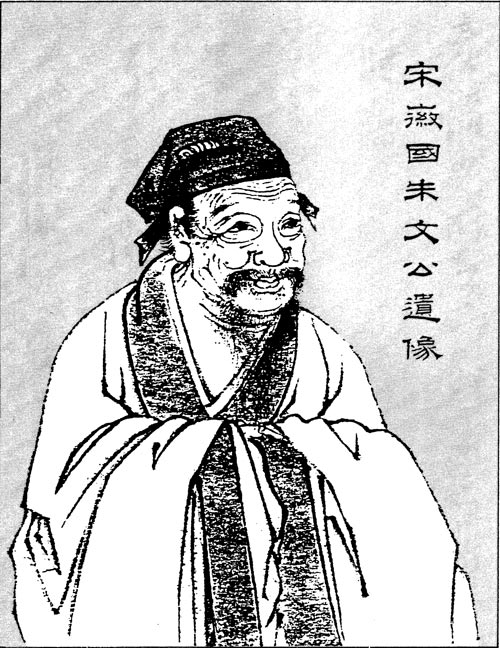 Zhu Xi (1130 - 1200), also known as Zhuzi,3 was a major Song dynasty philosopher and commentator, but at the time his ideas led to his being dismissed several times from official positions. His father Zhu Song4 (1097 - 1143), a scholar and high official, also had problems with the government, in his case due to his opposition to peace with the Jin, as a result of which he retired.
Zhu Xi was born in what is today Youxi County in Fujian province,5, where his father was serving as an official, but his home town is considered to be Wu Yuan, now in the northeast corner of Jiangxi province, but then part of Huizhou, a district just south of Huangshan.6 He spent many years teaching in the Wuyi Mountains on the modern Fujian/Jiangxi province border,7 and is also particularly associated with two Confucian academies, the Yuelu Academy in Changsha8 and one at his retreat by the White Deer Grotto in Lushan, northwest of Poyang Lake.9
Connections between Zhu Xi and specific guqin melodies are all tangential or after the fact. Examples include,
- His commentaries on the Book of Songs (ctext: 詩經:朱熹集傳詩經) are quoted amongst the lyrics attached to the >1505 setting of the melody Guan Ju.
- His commentary on the Da Xue is included with the qin melodies Mingde Yin and Kongsheng Jing.10
- Shuangqin Shuwu Qinqu Jicheng (1884), in its preface to Shishang Liu Quan, connects Zhu Xi to the melody Bijian Liu Quan (see also the Zha Guide).
Most or all of Zhu Xi's writings were collected into a compendium called Mr. Hui'an Zhu Wen'gong's Literary Collection.11 Works from this collection that concern guqin are discussed further below.
Speaking of Qin Music Standards (Qin Lü Shuo),12 also referred to as Zhu Xi's "Qin Book" (or perhaps part of his "Qin Books"?), is probably the most relevant of these writings. In it Zhu Xi seems to have taken details of the Pythagorean (sanfen sunyi) tuning system, previously applied to flutes and connected to gongs, and applied them to qin strings. This publication of the calculations in terms of their resulting positions on the qin, according to Prof. Rao Zongyi, influenced the Qin System of Xu Li, eventually incorporated into the Qin Tong of Xilutang Qintong. Zhu Xi's calculations perhaps thus provided a basis leading to the later decimal system for indicating finger positions.13
Tong Kin-woon's Qin Fu, pp.1690-1, has selections from four folios in the collected works of Zhu Xi, as follows:
- Folio 1: Qin Cao (Qin Compositions)14
This includes two melodies, Zhao Yin Cao and Fan Zhao Yin, plus a poem called Listening to Qin - Folio 4: another poem15
"Mr. Zhao Zexi Carries Qin and Wine on a Visit to Discuss Distinguishing Rhyme for the Character 'Qin'" (QQJC) - Folio 66: The titles only of two chapters from Qin Lü Shuo16
Dr. Tong says that this work, already mentioned above, is very abstruse and he invites the readers to consult the original! - Folio 85: Inscriptions
Writings on three different qins.17
Qinshu Daquan also has inscriptions and poems by Zhu Xi that mention qin.18 These include:
- Folio 18, #47-49, as in Qin Fu
- Folio 18, #74, and
- Folio 20B, #64 - 67.
There is an essay called Ziyang Qinshu perhaps by Zhu Xi: one of his nicknames was Ziyang.19
Zhu Xi apparently transcribed into Lülü notation 12 settings of Shi Jing poems in Zhao Yansu's Fengya Shiershi Pu (ca 1170).20 These were also copied in se tablature by Xiong Penglai (1246-1323).21 In the 19th century handbook Lüyin Huikao they were also set to qin tablature.22
The biography in Qinshi Xu seems largely to concern Zhu Xi's writings on qin tuning and intonation, saying that he took rules that previously had been applied to bells and applied them instead to qin strings. It begins,23
Zhu Xi, style names Yuanhui and Zhonghui, was from Wuyuan in Huizhou....
Not yet translated.
Footnotes (Shorthand references are explained on a
separate page)
1.
Zhu Xi references
(Wiki;
Stanford)
14779.803 朱熹 Zhu Xi, 字元晦 style name Yuánhuì, 號 晦庵 nickname Huì Àn, commonly known as 朱子 Zhuzi: Master Zhu.
H. Giles; ICTCL has many references but no separate entry
(Return)
2.
Surviving Portrait of Zhu Wen Gong, State Duke of Hui of the Song Dynasty (宋徽國朱文公遺像 Song Hui Guo Zhu Wen Gong Yixiang)
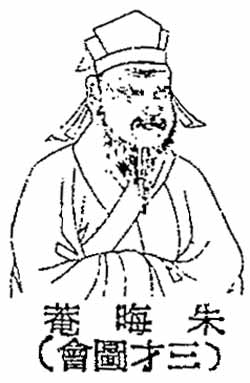
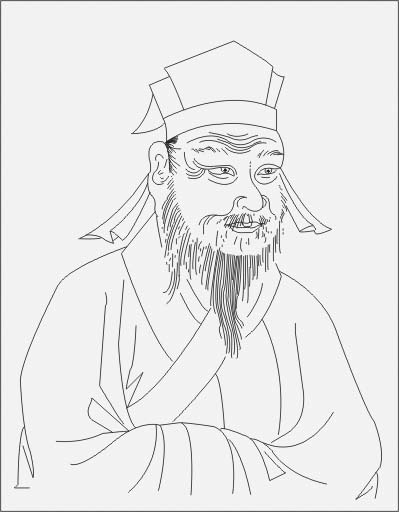
Copied from Wing-Tsit Chan: Chu Hsi, Life and Thought. Hong Kong, Chinese University Press, 1987, p.2. The accompanying comment says, "by an unknown artist, circa. 1330"; no publication is mentioned. (Compare
this image
[cleaned up] copied from 14778.803, which took it from 三才圖會 Sancai Tuhui)
(Return)
3.
朱子 Zhuzi
In addition to Zhuzi one can also find 朱夫子 Zhu Fuzi, as with Confucius. In fact Zhu Xi used many style names: 元晦 Yuanhui, 仲晦 Zhonghui; and nicknames: 晦庵 Hui'an, 沈郎 Shenlang, 季延 Jiyan, 晦翁 Huiweng, 遯翁 Dunweng, and 雲谷老人 Yun'gu Laoren. He was made a 公 duke and canonized 文 Wen, making another name Wen'gong
(Return)
4.
朱松 Zhu Song
Zhu Song (Giles, Bio/542), style name 喬年 Qiaonian, nickname 韋齋先生 Mr. Weizhai, wrote several poems connected to the qin. See
Folio 20B, #53
(Return)
5.
尤溪 Youxi, in central Fujian province.
(Return)
6.
婺源、徽州 Wu Yuan in Huizhou
(Return)
7.
Wuyi Shan 武夷山 has a number of buildings commemorating Zhu Xi, including his grave and a memorial hall.
(Return)
8.
Yuelu Academy (岳麓書院 Yuelu Shuyuan)
(Wiki)
Named after Yuelu Shan, a range of hills across the Xiang River from central Changsha. The current building marking the old academy is of much more recent construction
(Return)
9.
White Deer Grotto Academy (白鹿洞書院; Bailudong Shuyuan)
Wiki)
On Mount Lu (廬山 Lushan) in Jiangxi province. Today a landmark, there is apparently a plaque on 五老山 Wulao Shan (Five Elders Peak) commemorating the spot of the academy.
(Return)
10.
There is no suggestion that he had any connection with the music.
(Return)
11.
Mr. Hui'an Zhu Wen'gong's Literary Collection (晦庵先生朱文公文集 Huian Xiansheng Zhu Wengong Wenji)
This is the full title, e.g., as found in the
China Text Project, of the Collected Writings of Zhu Xi (14281.33 晦庵集 Hui'an Ji: 100 folios, with a continuation in 11 (5?) folios and extra essays 10 (7?) folios. The selections in Tong Kin-woon's Qin Fu, pp.1690-1, are from folios 1, 4, 66 and 85 (see following footnotes). His comments are on pp. 1738-9. I do not yet know of any available translations.
(Return)
12.
Discussion of Qin Tones (琴律說 Qin Lü Shuo)
21570.xxx. The complete text can be found at the end of Folio 66 of Zhu Xi's Complete Works (晦庵先生朱文公文集 Mr. Hui'an Zhu Wen'gong's Literary Collection: see below). Online it can be found in Volume 15 of the
China Text Project copy.
The complete text is organized into an opening plus two titled sections:
- Opening (CTP pp. 298-308)
Begins, "太史公五聲數曰...." (further below) - Determining the Tones (定律 Ding Lü, 308-10)
Begins, "沈氏《筆談》據唐人《琵琶録》,以為調琴之法...." - Tuning the Strings (調絃 Ding Xian, 310-16).
Begins, "調弦之法,散聲隔四而得二聲,(宮與少宮,商與少商。)....亦皆虛語矣。鳴呼,異哉。"
Qinshu Cunmu #108 has 28 lines discussing this work. It seems to consist mostly of a quote from the middle section, Ding Xian. See next footnote.
(Return)
13.
Zhu Xi's calculations in 琴律說 Qin Lü Shuo
These sorts of calculations are included in a segment of the work copied into
Qinshu Cunmu #108 (28 lines). There are a few differences in the text - corrected here from the standard version. Symbols such as 厶 and マ seem to be a shorthand for pitch names; none is in standard use for qin tablature.
The entire QSCM segment is as follows (some of Zhu Xi's music symbols are approximations):
宋朱熹選。熹字元晦,婺源人。紹興十八年進士,官 至華文閣待制諡文追封信國公從事孔子廟事 蹟具宋史道學傅攷宋史樂志載朱子與學者共 講「琴法」云以禮運正義推之則每律各為一宮各 有五調(案此朱子答吳元士書也)然朱子語類云如黃鐘為宮, 大呂為角。太簇為徵,應鐘為羽。自是四樂各舉其 一者而言之以大呂為角,則南呂為宮,太簇爲徵, 則林鐘為宮,應鐘爲羽,則太簇爲宮。此朱子說周 禮不言每律一宮每宮五調乃言大呂為羽則太 簇為宮云云則似近於劉几所議景靈舊宮法矣 豈朱子明於琴法而周禮則偶忘之歟
其「琴律說」云:
今俗樂之譜,
厶則合之為黃也。
マ則四下之為大也,マ則四上之為太也。
二則一下之為【夾】也,二則一上之為姑也。
マ則上之為中也。
△則勾之為㽔【蕤】也,△則尺之為林也。
フ則工下之為夷也,フ則工上之為南也。
〢則凡下之為無也,〢則凡上之為應也。
六則六之為黃清也。
丌則五下之為大清也,丌則五上之為太清也,丌則五緊之為夾清也。
此聲俗工皆能知之,但或未識古律之名,不能移彼以為此,故附見其說云。
故附見其說云。 陳澧聲律通考云十六字譜宋時俗工 所用以記每弦之十六聲也所以造此十六字譜 者當時每一絃之第一聲職聲(散聲也)皆謂之黃鐘其第 二聲(手按第一柱)皆謂之大宮名為律呂而實非律呂 故俗工別以十六字記十六聲每弦第一聲謂之 合聲第二聲謂之下四字也又從而減省趨便則 合作△四作マ不成字體傳寫易譌詞源刻本之 誤余已正之朱子「琴律說」刻本尤誤既訂正詞源 則琴說之誤不必改而自明矣
These calculations give precise positions in terms of the overall length of the qin strings. Later on, in an essay entitled "Qin Precision Measurements" (琴準異同 Qin Zhun Yi Tong; QQJC, p. 18), Xilutang Qintong had similar calculations, but giving the positions in terms of their distances from qin studs. However, both of these works give positions in terms of physical distances (e.g., the Chinese equivalent of inches), not decimal percentages (e.g., 7.6), and neither work seems to have suggested that these mathematical relationships could be used for indicating finger positions in qin tablature.
These calculations are also discussed by 李玫 in 《琴律說》文本解讀——兼及常見的校勘錯誤,音樂研究 2008, 第5期 (thanks to Tse Chun Yan for the references). There is also further comment on this under Origin of the modern decimal system for indicating finger positions.
(Return)
14.
Folio 1: Qin Compositions (琴操 Qin Cao)
The three entries are:
- Beckoning a Recluse (招隱操 Zhao Yin Cao; compare Zhao Yin)
- Against Beckoning a Recluse (反招隱 Fan Zhao Yin)
- Listening to Qin (聞琴 Wen Qin)
瑶琴清露後,寥亮發窗間。
韻逐回風遠,情隨玄夜闌。
端居獨無寐,林扉空掩關。
起望星河落,哀絃方罷彈。
Not clear whether the poem is associated with a particular melody.
(Return)
15.
Folio 4. Poem (詩 Shi)
趙君澤携琴載酒見訪分韻得琴字
王孫有高趣,挈榼來相尋。
喜兹煩抱舒,未覺杯酒深。
一爲塵外想,再撫丘中琴。
餘音殷雷動,爽籟悲龍吟。
寄謝筝笛耳,寧知山水音。
Not translated.
(Return)
16.
Discussion of Qin Tones (琴律說 Qin Lü Shuo)
Dr. Tong says, "內容深奧,而所論非詳解不能明白". It is one of the 雜著 Miscellaneous Writings; further details above.
(Return)
17.
Folio 85. Inscriptions (銘 Ming)
The inscriptions are:
黃子厚琴銘
紫陽琴銘 ("養君中和之正性,禁爾忿欲之邪心。乾坤無言物有則,我獨與子鈎其深。")
(Return)
18.
Selections from Qinshu Da Quan
There is no index for this book, so I may have missed some selections.
(Return)
19.
Ziyang Qinshu 紫陽琴書
See further information.
(Return)
20.
風雅十二詩譜 Fengya Shiershi Pu by 趙彥肅 Zhao Yansu
This includes Zhu Xi's
12 Shi Jing poem settings
("Picken: Twelve Ritual Melodies of the T'ang Dynasty"), of which Pian, p.10, writes (romanization revised),
(Return)
21.
瑟譜 Se Pu by 熊朋來 Xiong Penglai, ca. 1300
See further details here.
(Return)
22.
Lüyin Huikao: Extended settings of Zhu Xi's 12 Shi Jing lyrics
(1835; QQJC XXII/171-209;
facsimile edition)
By 邱之稑 Qiu Zhilu (1781–1839), who part edited and part created the content. (PDF of the lülü and qin settings [pp. 171-194; 2.1MB])
The earliest survival of these 12 songs is from their publication in 風雅十二詩譜 Fengya Shiershi Pu (ca. 1170, see above) by 趙彥肅 Zhao Yansu (QQJC XXII/171-8), but they are said actually to date from the Tang dynasty. Modern transcriptions into staff notation include those mentioned above by Pian and Picken. The handbook is included in Qinqu Jicheng because of the arrangements of these melodies for guqin, said to be by Qiu Zhilu himself.
Qiu Zhilu and these songs are mentioned in Stephen Jones: a blog, The Confucian ritual in Hunan (posted 28 March 2019) as follows:
Confucian sacrifices may have been performed in Liuyang since ancient times, but we only find firm evidence from 1829, when the local jiansheng 監生 official Qiu Zhilu 邱之稑 (1781–1839) was commissioned to begin a lengthy investigation of how to perform the rituals, with funding to establish a Bureau for Rites and Music (Liyue ju 禮樂局). His research was based not only on early compendia (including Han sources and the Qing Lülü zhengyi) but also on a visit to Qufu.
Qiu Zhilu then had to decide on the pitch standard (itself a thorny historical issue); choose the vast instrumentarium and repertoire (indeed, he is credited with incorporating folk elements, revising the system of one note per beat, and expanding the scale); and rehearse the singers, instrumentalists, and dancers. He documented the results of his research in a series of volumes.
Though Qiu Zhilu died in 1839, the rituals he had designed were first performed in the early 1840s. Every three years over sixty youths over the age of 12 sui within the town—“from decent families” shenjia qingbai 身家清白, an assessment that would have been abruptly reversed after the 1949 Liberation!) [3]—were recruited, training for a month before the 2nd- and 8th-moon rituals.
One can find historical recordings of this music by searching online for "瀏陽文廟祭孔音樂". If those examples are accurate, the music must have been played very slowly. In some videos you can see qin, but if it really was there in ancient times it must have been largely for ritual reasons as it cannot be heard. If played as a qin solo at that speed it might be lucky if the sound could continue to resonate from note to note.
The various transcriptions in Lüyin Huikao are included. in an appendix (pp.179-209). The transcriptions into qin tablature were based on the transcriptions Zhu Xi had himself done into lülü notation, though there seems to be some added ornamentation.
In addition to this publication in Lüyin Huikao these songs were apparently later published in Qinzhi Shen Qiu (1889; not in QQJC). As far as I can tell these latter were developed from/copying the Lüyin Huikao settings.
Details of the Lüyin Huikao settings
(listed) are as follows
(the above-mentioned pdf [2.1MB] has the first three items below; QQJC XXII/171-194):
- Fengya Shiershi Pu (XXII/171-4 and 175-8)
Two sets of 12 musical settings using the lülü notation - A further setting of the 12 songs in lülü notation (pp.179-182);
this seems to be the one attributed to Zhu Xi - Two further settings of the same melodies in qin tablature (pp.183-8 and 189-94)
- A setting for the same in se tablature (pp.195-200)
- Explanations of qin and se tablature (pp.200-1)
- A final setting of the 12, in "聲子譜 shengzipu" (pp.201-205)
- Commentary (pp. 205-8)
- Illustrations (pp.208-9)
There is also mention of 邱之稑 Qiu Zhilu's work in Pian (pp. 154-173 and search for "Chiou Jyluh"). After including (p.165) a transcription from Guan Ju with just one note for each character, all in quarter notes (very similar to the one by Picken), she has (p.166) the transcription said to be by Qiu himself of Guan Ju; it seems to have the same added notes as does the qin transcription in Lüyin Huikao. Unfortunately, her practice of not including the original notation made it difficult to know where these were in Lüyin Huikao; in fact the lülü version is at XXII/181 and the related qin setting at XXII/192 in the attached pdf.
My own understanding of this music is minimal. For example, the qin being such a quiet instrument, I don't know what musical value it (or even a group of them) could have added to a performance of these ensemble melodies, though their tablature could give some suggestion about rhythms/note values for the ensemble version. From looking at the original lülü notation (e.g. XXII/171-182) it seems there is no rhythmic indication and little or no ornamentation, just one note or occasionally two names for each character of the lyrics, and no apparent designation for any particular instrument, not to mention the question of whether a ritual melody would have been played heterophonically. In the case of Qiu Zhilu's version, Bian arranges each of the twenty 4-character phrases as a three-bar phrase: Guan Ju has 5 verses with each verse arranged as ([4+4] x 2). In Bian's transcription each phrase has the equivalent of a whole note for the first character and a half note for each of the other four characters.
Bian's arrangement (at least the note values) apparently came from Yang Yinliu's description (or transcription) of the Hunan performance combined with the qin tablature in Lüyin Huikao. Does the latter suggest some possible rhythmic arrangements? Just from looking at them does not describe any specific rhythms. Did Qiu Zhilu simply adapt for qin exactly what he heard?
The source of Bian's 3-bar arrangement is not explained and I have not seen the one by Yang, assuming he made one. Is it an accurate description of the rhythm from a living tradition such as the performances in Liuyang, Hunan? Or was it imposed on what actually was played?
Because the music and lyrics are not one word per note, one might speculate that words with more notes are held longer. However, here it would be useful to know why in Lüyin Huikao they did not follow the traditional pairing method, used in virtually all qin handbooks when pairing lyrics to qin melodies, of having one Chinese character for each right hand stroke but only for certain left hand plucks (not slides); here there are not infrequently right hand plucks with no related character. If this was a decision based on rhythm then that would be significant for the interpretation, but by itself would not necessarily reflect the original (i.e., Song dynasty or earlier) rhythm.
(Return)
23
Zhu Xi (Qin Shi Xu #10; 34 lines)
The original text begins,
The reference given is 宋史 the official Song dynasty history.
(Return)