| T of C Home |
My Work |
Hand- books |
Qin as Object |
Qin in Art |
Poetry / Song |
Hear, Watch |
Play Qin |
Analysis | History | Ideo- logy |
Miscel- lanea |
More Info |
Personal | email me search me |
| 1425 Melody; video; Images: 0 1 2 3 4 5 6 7 8 9 10 11 12 13 14 15 16 17 18 19 20 21 22 23 24 25 26 27 28 29 30 31 32 33 34 35 36 | 首頁 |
| Imperial images: Wild Geese in Autumn | 秋鴻圖譜冊 1 |
| The 36 images are arranged into four albums 2 |
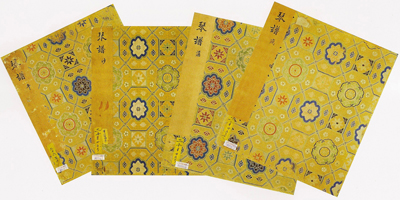
The Forbidden City included amongst its books the four volumes at right, an undated publication with illustrations of the 36 sections of the melody Qiu Hong (Wild Geese in Autumn), together with related qin tablature. These were arranged into four folios/books, apparently with each of the 36 sections of tablature following an illustration. These have now been reprinted in at least two publications, a facsimile edition and as part of a book entitled Zithers of the Forbidden City.3
The introduction in Zithers of the Forbidden City quotes the comment under the melody title Qiu Hong (see image one) that states that this is the tablature of Guo Chuwang (a well-known late Song dynasty qin master) as edited by his disciple Xu Tianmin and Xu's descendant Xu Xiaoshan. The introduction then quotes Xu Jian's Qinshi Chubian, Chapter 7A, in suggesting that Xu Xiaoshan may have given the tablature to Zhu Di at his feudatory court (fandi; does this mean it was in Nanjing before as Yongle, i.e., emperor Chengzu, 1403–1425, he moved the capital to Beijing?). It also suggests that the painting may have been done by an artist called Zhu Fu,4 who lived at that time and is known to have done a painting on a related theme.
The original publication apparently has only tablature and illustrations, no commentary other than the musical attribution under the general title with the first image, mentioned above. It is thus unfortunate that the modern introduction does not discuss some important aspects. Some issues that need further study include:
- What is the source of the tablature?
The modern introduction says that because the writing here was only qin tablature it was not included in the Shiqu Baoji (石渠寶笈), a Qing dynasty imperial catalogue of painting and calligraphy in the imperial collection. Perhaps this is by way of saying there is no official information as to when the documents came into the imperial collection. The above comments identifying known qin players from the 13th to early 15th centuries are not evidence that these are materials or exact copies of materials directly connected to them. There seems to be no consideration of the possibility that they were copied and/or edited later, within the palace. - What is the source of the music in the tablature?
At first glance it seems that from Section 8 through Section 27 the music is completely different from that in Shen Qi Mi Pu and other versions. Perhaps on this basis the modern introduction talks about the palace tablature being a 浙派 Zhejiang school version that is earlier than the tablature in either Shen Qi Mi Pu (1425) or Wugang Qinpu (1546). In fact, although Section 10 in the palace is different from that of the other versions (original tablature lost?), the other pages were more likely just placed out of order at some time.5 In particular, the contents of folios 2 and 3 apparently have been reversed. The arrangement here (see also below), putting them in the same order as in Shen Qi Mi Pu and other early editions, shows that only in Section 10 does the palace edition differ significantly from Shen Qi Mi Pu; the Wugang Qinpu version is also very similar to the palace edition, and there is no information available at present to show how two of its sections got lost. - What is the earliest known version of Qiu Hong tablature?
The tablature here most closely resembles that of Shen Qi Mi Pu (1425), but section titles are mostly as in Wugang Qinpu (1546). I have been able to play the Shen Qi Mi Pu almost exactly as written; the Wugang Qinpu version would seem to require more editing to play it. Perhaps this means that the 1546 version is a bad copy of 1425, but it could also be a copy of some earlier tablature. Perhaps the palace version is a copy of 1425, but from my reading I would say one must consider the possibility it was the other way around. - Could the images have been added later?
The modern introduction does not seem to consider the possibility that they were added after the reign of Zhu Di, as mentioned above. - Why is the melody used as a prelude—elsewhere called “Calling out in Flight” (飛鳴吟 Fei Ming Yin)—here called “Flying into the Distance” (飛冥吟 Fei Ming Yin)?
There is no discussion of this.
The books have the seal of the 乾隆 Qianlong emperor (r. 1736–96), but this simply means he owned them.
Footnotes (Shorthand references are explained on a separate page)
1. Qiu Hong illustrated tablature from "Zithers of the Forbidden City" (故宮古琴圖典:秋鴻圖譜冊)
I have seen a facsimile edition of this, but references here are to the version that comprises Section 3 of 故宮古琴圖典 Zithers of the Forbidden City. In addition to images of qin and associated materials from the collection of the 故宮博物院 Museum of the Forbidden City, the book has reprinted the tablature and paintings for Qiu Hong.
The introduction on page 198 says:
古琴曲「秋鴻」圖譜冊
明 /縱41.4厘米,橫71.9厘米
圖絹本/縱24.3厘米,橫62厘米
譜紙本/縱19.3厘米,橫58.1厘米。明宮舊藏浙派徐門所傳古琴曲《秋鴻》圖譜冊,圖先譜後,為繪圖與曲譜的合裝本。共分四冊,冊面裝五色仿宋錦,素絹簽,題楷書“琴譜”二字,並分別注序號為“平”、“沙”、“落”、“雁”四字於其下。因其為琴譜故未收入《石渠寶笈》之中。琴曲為紙本楷書,每段一開並有標題,圖為絹本水墨工筆畫,亦每段一開皆按標題內容繪制,無作者名款。每冊封面後一開與最後一開上方鈐“乾隆御覽之寶”大印。
第一開為“清商調”和“夾鐘清商意”兩首練習曲,第二開為序曲“飛冥吟”,其下進入“秋鴻”主題,圖先譜後依次排列,自“渡江”開始“聲斷楚雲”止,共36段。在主題“秋鴻”二字下,有兩行小字注明:“妙品夾鐘清商曲,世謂清商楚望譜,瓢翁、曉山翁累刪。”表明譜經二人刪節。按“瓢翁”乃南宋浙派名古琴家徐天民別號,其孫徐夢吉號曉山,夢吉子徐和仲,世為浙派大家。徐和仲系洪武元年“文華堂”名琴家之一。據《琴史初編》載:“明成祖朱棣在藩邸時,曾召見徐和仲,並給以賞賜。”此譜或系徐和仲當時所進,因此宮中藏有此譜。
本圖譜前端的兩首序曲為浙派徐門琴譜的特點,圖譜中的兩行小字注疑似徐和仲之所為。圖畫結合的琴譜僅此一件,據《明畫錄》稱:明初浙派畫家朱芾畫“蘆洲聚雁,極瀟湘煙水之致”。本圖是否為其所作,有待進一步的研究。
《秋鴻》一曲被明清許多古琴譜所收錄,雖起止基本相同,但一般從《飛冥吟》開始,沒有《清商調》與《夾鐘清商意》兩小曲,且中間各段次序多不一致。本圖譜與明初朱權的《神奇秘譜》和黃獻的《梧岡琴譜》相較,曲目順序也各有不同。明宮所遺的這部琴譜系原舊裝裱,冊頁未有重裝現象。因此,可信這部圖譜應為浙派徐門的傳譜,且圖譜早於《神奇秘譜》。那麼《秋鴻》一曲之作者確非朱權,實為南宋郭楚望可以明矣。
Guqin Piece “Autumn Geese”: Illustrated Tablature Album
Ming dynasty
Album (overall): height 41.4 cm, width 71.9 cm
Paintings: silk, height 24.3 cm, width 62 cm
Tablature: paper, height 19.3 cm, width 58.1 cmThis Illustrated Tablature Album of the Guqin Piece “Autumn Geese” is a former Ming palace collection item, transmitting the Zhejiang-school Xu lineage guqin piece Qiu Hong. It is a combined volume in which (on each leaf) the illustrations come first then the tablature (paired below it), thus integrating painted images with musical tablature-notation. The work consists of four volumes. The covers are mounted in five-colored imitation Song brocade, with plain silk title slips bearing the two regular-script characters “qinpu” ("qin tablature"), and beneath them the respective sequence designations: Ping, Sha, Luo, and Yan. Because it is qin tablature, it was not included in the Shiqu Baoji.
The melody is written on paper in standard script, with each sheet when unfolded showing the section (title and tablature). The illustrations are meticulous ink paintings on silk, likewise one per section, each when unfolded showing it was painted according to the meaning of the corresponding title. There is no artist’s signature or inscription. On the first unfolded leaf following each album's cover, and on the final unfolded leaf of each album, a large seal reading “Treasure of the Qianlong Emperor’s Viewing” is impressed at the top.
The first sheet (leaf?) when unfolded contains two warmup pieces, Qingshang Mode (a modal prelude) and Defining Jiazhong Qingshang. The second sheet when unfolded is the melodic prelude Feiming Yin. Thereafter begins the main Qiu Hong melody. The album is arranged with illustration first and tablature following. Beginning with Crossing the River and ending with Sound Fades among Chu Clouds, there is a total of thirty-six sections.
Beneath the two characters (at the beginning of the first section of tablature) “Qiu Hong” (Autumn Geese), two lines of small characters state:
“A marvelous piece in Jiazhong Qingshang Mode; over generations it has been called Qingshang Tablature of (Guo) Chuwang; the elders Piaoweng and Xiaoshan made successive amendations.”
This indicates that the tablature underwent editing by two individuals. “Piaoweng” is the sobriquet of Xu Tianmin, a renowned Southern Song Zhejiang-school qin master. His grandson Xu Mengji bore the sobriquet Xiaoshan, and Mengji’s son was Xu Hezhong — generation after generation major figures of the Zhejiang school. Xu Hezhong was among the celebrated “Wenhuatang” qin masters of the first year of the Hongwu reign. According to Introductory History of the Qin, “While the Ming Chengzu emperor Zhu Di (1360-1424) was still residing in his princely domain, he summoned Xu Hezhong for an audience and bestowed rewards upon him.” This tablature may have been presented by Xu Hezhong at that time, which would explain why it was preserved within the palace.
The two prelude pieces at the beginning of this album are a characteristic feature of the Zhejiang-school Xu-lineage tablatures, and the two lines of small characters in the album are suspected to have been written by Xu Hezhong himself. This is the only known instance of a qin tablature combined with paintings. According to the Record of Ming Paintings, the early-Ming Zhejiang-school painter Zhu Fu painted Geese Gathering on Reed Islets, which fully captured the misty waters of the Xiao and Xiang rivers. Whether the paintings in this album are his work remains a matter for further study.
The piece Qiu Hong appears in many Ming and Qing qin handbooks. Although their beginnings and endings are generally similar, most versions start with Feiming Yin and do not include the two short pieces Qingshang Mode and Defining Jiazhong Qingshang Mode, and the internal sequence of sections often differs. When this illustrated album is compared with the early-Ming Shen Qi Mi Pu compiled by Zhu Quan and the Wugang Qinpu compiled by Huang Xian, differences in the ordering of sections are likewise apparent.
This palace-preserved tablature retains its original mounting, and its folios show no signs of later remounting. It is therefore credible that this illustrated album represents a transmitted tablature of the Zhejiang-school Xu lineage, and that it predates the Shen Qi Mi Pu. Consequently, the authorship of Qiu Hong cannot belong to Zhu Quan; rather, it may clearly be attributed to Guo Chuwang of the Southern Song.
Notes on the translation
- 冊 Album: i.e., not a scroll. From my understanding of the measurements given above, the measurement 71.9 cm for the width of the album is a measure for the album when opened. Then, each of the 36 sections can be presented on a single leaf folded in half vertically (material unstated), ten leafs in the first album, nine in each of the others. Each leaf forms a paired unit consisting of (if presented as in the museum book) a sheet with a silk illustration mounted on top, and its corresponding tablature mounted on a paper sheet underneath (in the book the illustrations and tablature both show a fold in the middle).
- 石渠寶笈 Shiqu Baoji: "Stone Channel [pavilion-archive] Treasury of Book Caskets", the Imperial Catalogue of Paintings and Calligraphy. The people who did the categorizing were quite strict and qin tablature did not fit neatly into one of their categories.
- No serious scholar attributes this melody to Zhu Quan, but for the reasons given above the attibution to Guo Chuwang
Other parts are discussed further in my general commentary.
(Return)
2. Four Books/Folios
The four folios are entitled, in order, 平 Ping, 沙 Sha, 落 Luo and 雁 Yan. However, as mentioned above, many of the 36 individual sections are out of order when compared to the titles and tablature in Shen Qi Mi Pu and other early handbooks. Bringing them into the correct order is a four step process (see the content list below):
- Exchange the Folio "Luo" (and its 10 sections) with Folio "Sha" (and its 9 sections).
- Move the Section "Nan Si Dongting Shui" (Shen Qi Mi Pu Section 8, which now comes directly after the Folio Luo title page) so that it comes after Section 7; this puts nine sections in each folio.
- Exchange title page "Sha" with title page "Luo" so as to maintain the original order of section titles: Ping, Sha, Luo, Yan.
- Reverse Shen Qi Mi Pu Sections 22 and 23.
As arranged in Zithers of the Forbidden City the Qiu Hong tablature is as follows:
-  This video pans the 36 images, pairing them with the music from the 36 Sections in 1425.
- Meanhile the list below also shows the correct section number according to SQMP
197: 三:琴譜 Chapter 3: Qin tablature
198: 古琴曲「秋鴻」圖譜冊 Introduction to the guqin melody Qiu Hong, as above
Since Zithers of the Forbidden City does not discuss the discrepancies, further work on this needs to be done.
(Return)
3. Zithers of the Forbidden City
Subtitle: Classics of the Forbidden City; pp.198-239.
(Return)
4. 朱芾 Zhu Fu
朱芾 Bio/541 says Zhu Fu was active during the reign of the first Ming emperor. The above commentary in Zithers of the Forbidden City mentions a painting attributed to him entitled "蘆洲聚雁,極瀟湘煙水之致 Lu zhou ju yan, ji Xiao Xiang yanshui zhi zhi.
(Return)
5. Pairing the tablature and images
This is a particularly important issue in light of the apparent page mix up described above. In addition, my own impression is that some of the tablature and images could be changed, e.g., exchanging the images attached to sections 1 and 2 (q.v.).
(Return)
Return to Art Illustrating Guqin Melodies