|
T of C
Home |
My Work |
Hand- books |
Qin as Object |
Qin in Art |
Poetry / Song |
Hear, Watch |
Play Qin |
Analysis | History |
Ideo- logy |
Miscel- lanea |
More Info |
Personal | email me search me |
| CXZC in ToC | lyrics and transcription; 首頁 |
|
08. Universal Song
"Gong mode" (?:2 1 2 4 5 6 1 2) |
浩浩歌
1
Haohao Ge |
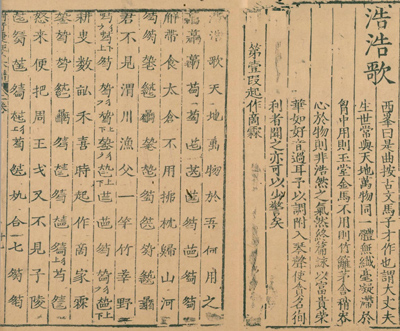
| The 1573 Haohao Ge preface begins, "Xifeng says"3 |
 The title of this melody might also be translated, "Song of the Universe" or "Grand Song" (suggesting a universal question). The preface attributes it to the neo-Confucian Song dynasty scholar official Ma Cun (1050-1096), here called Ma Zicai,4 but it is referring to the lyrics, not to the melody. The lyrics attributed to Ma Cun are included in the Guwen Zhenbao, which dates from the late Yuan/early Ming dynasty; as written there they are almost the same as the lyrics set for qin by Yang Biaozheng.5 These lyrics are also connected thematically and stylistically but not textually to the Hao Ge lyrics in the Yuefu Shiji.6
As for the source of the present melody, this is uncertain. It is found only here (the 1573 version is somewhat different from the one in 1585) and in 1618, which has similar music and almost the same lyrics.7 As in 1573 and 1585 the 1618 preface makes no mention of Yang Biaozheng having created the melody, suggesting that the melody might have already existed in an old document, and so claims have been made that the melody also originated with Ma Cun himself.8
As for these 1573 and 1585 versions, they look strikingly similar (especially when compared to differences in the two versions of Yu Xian Yin): the tablatures are lined up identically in terms of characters and clusters per line. However, quite a few of the actual clusters are different, usually changing the notes by one or two pitches. And, as with some other pieces in the two handbooks, the 1573 version is more likely to use ornaments such as fast and slow vibrato (吟 yin and 猱 nao/rou), while the 1585 version much more commonly ornaments with a simple "up down" (上下 shangxia) or "down up" (下上 xiashang).
About fifty years after Ma Cun, Wen Tianxiang wrote his own Haohao Ge lyrics. There, instead of "what does the universe have to do with me?", the universal song/question is, "what can one do about the fact that life is short?".
Preface9
The original preface (1573 difference is only in the opening bracket) begins,
This piece — according to ancient writings — was composed by Ma Zicai. It holds that a great man, living in the world, should take Heaven, Earth, and the myriad things as one body. When employed, he follows the undertakings of Yi and Zhou; when not employed, he follows the withdrawal of Chao and Xu. Thus the whole piece concludes that wealth, rank, glory, and splendor are like floating clouds passing across the Great Void, and one should harbor no attachment to them in the mind.
Therefore (these lyrics) have been set into qin music, so that those who greed after fame and pursue profit, upon hearing it, may also be somewhat awakened.
Music and lyrics (see
tentative transcription)
10
The setting is largely syllabic. The lines largely rhyme, and each consists of two phrases of equal length (except for the first line of each section). Musically the first half of each line usually ends on 2 (re) or 5 (sol) while the second half almost always ends on 1 (do).
The three available settings of the lyrics have a few inconsistencies with the original text. The complete Chinese lyrics in correct order (see Zha Guide 385 as well as separate copies of Ma Cun's poem) are as follows:
第一段 起作商霖
Di yi duan: Qǐ Zuò Shāng Lín;
Section 1: Rising as the Beneficent Rain of Shang
浩浩歌: 天地萬物如吾何。
Hào hào gē: Tiān dì wàn wù rú wú hé.
Song of Vastness:
Heaven, Earth, and the myriad things — what are they to me?
用之解帶食太倉,不用拂枕歸山河。
Yòng zhī jiě dài shí tài cāng, bù yòng fú zhěn guī shān hé.
When employed, I loosen my belt and eat from the imperial granary;
when not employed, I brush my pillow and return to the rivers and mountains.
君不見,渭川漁父一竿竹,莘野耕叟數畝禾。
Jūn bù jiàn, wèi chuān yú fù yī gān zhú, shēn yě gēng sǒu shù mǔ hé.
Do you not see—the fisherman of the Wei River, with but a single bamboo rod;
the old ploughman of Shen fields, with only a few acres of grain?
喜時起作商家霖,怒來便把周王戈。
Xǐ shí qǐ zuò shāng jiā lín, nù lái biàn bǎ zhōu wáng gē.
In times of joy, he rises to become the rain that blesses the House of Shang;
when anger comes, he takes up the halberd of the King of Zhou.
又不見,子陵橫足加帝腹,帝不敢動豈敢訶。
Yòu bù jiàn, zi líng héng zú jiā dì fù, dì bù gǎn dòng qǐ gǎn hē.
Again, do you not see — Ziling stretched his feet across the emperor’s belly;
the emperor dared not move — how could he dare to rebuke him?
皇天爲忙逼,星宿相擊摩。
Huáng tiān wèi máng bī, xīng sù xiāng jī mó.
August Heaven is driven on in urgent haste;
the constellations jostle and collide with one another.
可憐相府痴,邀請先經過。
Kě lián xiāng fǔ chī, yāo qǐng xiān jīng guò.
Pitiful, those fools of the ministerial mansions—
their invitations I pass by before they are even made。
第二段 觀聖賢心 (Guān Shèng Xián Xīn)
Section two: Contemplating the Minds of Sages and Worthies
浩浩歌:天地萬物如吾何。
Hào hào gē: Tiāndì wàn wù rú wú hé.
Song of Vastness: Heaven, Earth, and the myriad things—
what are they to me?
屈原枉死汨羅水,夷齊空餓西山坡。
Qū Yuán wǎng sǐ Mìluó shuǐ, Yí Qí kōng è xī shān pō.
Qu Yuan died unjustly in the waters of the Miluo;
Bo Yi and Shu Qi starved in vain upon the western hills.
丈夫犖犖不可覉,有身何用自滅磨。
Zhàng fū luò luò bù kě jī, yǒu shēn hé yòng zì miè mó.
A true man, outstanding, cannot be bound;
having this body, why should one wear it away and destroy oneself?
吾觀聖賢心,獨樂豈有他。
Wú guān shèng xián xīn, dú lè qǐ yǒu tā.
I contemplate the minds of sages and worthies—
their solitary joy—how could it be anything else?
蒼生如命窮,吾道成蹉跎。
Cāng shēng rú mìng qióng, wú dào chéng cuō tuó.
If the common people’s fate runs to exhaustion,
then my Way comes to be delayed and thwarted.
直須爲弔天下人,何必嫌恨傷丘軻。
Zhí xū wèi diào tiān xià rén, hé bì xián hèn shāng Qiū Kē.
One must simply mourn for all under Heaven;
why harbor resentment that wounds Confucius and Mencius?
第三段 仰天長嘯 (Yǎng Tiān Cháng Xiào) (...笑 xiao: laugh?)
Section three: Looking to heaven and uttering a long cry
浩浩歌:天地萬物如吾何。
Hào hào gē: Tiāndì wàn wù rú wú hé.
Song of Vastness: Heaven, Earth, and the myriad things—
what are they to me?
玉堂金馬在何處,雲山石室高嵯峨。
Yù táng jīn mǎ zài hé chù, yún shān shí shì gāo cuó é.
Where now are the Jade Halls and Golden Gates?
among clouded mountains, the stone chambers rise lofty and sheer.
低頭欲耕地雖少,仰面長嘯天何多。
Dī tóu yù gēng dì suī shǎo, yǎng miàn cháng xiào tiān hé duō.
Bowing my head, I would till — though the land be small;
raising my face, I give a long whistle — how vast the sky!
請君醉我一斗酒,紅光滿面春風和,
Qǐng jūn zuì wǒ yī dǒu jiǔ, hóng guāng mǎn miàn chūn fēng hé,
Pray make me drunk on a full measure of wine;
with ruddy glow filling the face, in the gentle spring breeze,
紅光滿面春風和。
Hóng guāng mǎn miàn chūn fēng hé.
With ruddy glow filling the face,
in the gentle spring breeze.
Translation tentative.
Footnotes (Shorthand references are explained on a
separate page)
1.
Song of the Universe (浩浩歌 Haohao Ge) (QQJC IV/316)
17932.19: 浩浩 vast, flood; .54 浩歌 1/sing loudly, a phrase in 楚辭,九歌,大司命;
also: 2/song name from 樂府,雜曲,李賀: Yue Fu lyrics
(q.v.) by
Li He (791 - 817) and
Bai Juyi (772 - 846). Those two poems can be translated as follows:
Hao Ge by Li He:
Li He: Singing out
This "overwhelmingly ecstatic poem" has also been translated as The Great Song, in Robert Payne et al.,
The White Pony: An Anthology of Chinese Poetry from the Earliest Times to the Present Day, Newly Translated, The John Day Company, New York, 313, 1947).
The other Hao Ge mentioned, by
Bai Juyi (772 - 846), is this Hao Ge Xing, as follows:
Bai Juyi: Ballad of a Vast Song
Heaven is long, Earth enduring — without final end;
Fifty years after Ma Cun wrote the lyrics that were later used for this qin song, Wen Tianxiang also wrote a Haohao Ge in three sections, but here each section began, “Sing out (or Universal Song): life is a waystation, but what can we do?...."
The whole poem is as follows:
浩浩歌,人生如寄可奈何?
浩浩歌,人生如寄可奈何。
浩浩歌,人生如寄可奈何。
Song of Vastness
Song of Vastness:
Song of Vastness:
Song of Vastness:
As with Ma Cun's setting, also in three sections, each section of Wen Tianxiang's version is introduced by the words "Haohao ge" with the question then becoming, "What can one do?" rather than, "What are these things to me?".
Where Li He's poem is ecstatic, Bai Juyi's is much more reflective. Later, Ma Cun's and Wen Tianxang's poems, as emphasized by changing Hao Ge to Haohao Ge and repeating the title with a related question, evoke vastness: the great flowing of Heaven and Earth.
Also, in the case of the song with Ma Cun's lyrics, the title of which could also be translated as "Grand Song" or "Sing out", the lyrics are built around a repeated question: "The universal song: the universe has myriad matters, but what does this have to do with me? In other words, he is espousing detachment from worldly affairs and the seeking of power and wealth: the universe will still continue its course.
However, with Wen Tianxiang the question has become, "What can one do about this?" This is not surprising, given Wen Tianxiang's desperate attempts to keep China from conceding to the Mongols who wished to take over the country.
2.
Gong mode (5 6 1 2 3 5 6)
3.
The 1573 Haohao Ge preface begins, "Xifeng says"
(expanded image)
4.
馬存 Ma Cun (1050-1096, Bio/59)
5.
古文真寶 Guwen Zhenbao (True Treasures of Ancient Prose)
南風吹山作平地,帝遣天吳移海水。
王母桃花千遍紅,彭祖巫咸幾回死?
青毛驄馬參差錢,嬌春楊柳含緗煙。
箏人勸我金屈卮,神血未凝身問誰?
不須浪飲丁都護,世上英雄本無主。
買絲綉作平原君,有酒唯澆趙州土。
漏催水咽玉蟾蜍,衛娘發薄不勝梳。
羞見秋眉換新綠,二十男兒那刺促?
South wind blows the mountains flat;
the Lord of Heaven sends Tianwu to shift the sea.
The Queen Mother’s peach blossoms have reddened a thousand times;
how many times have Pengzu and Wu Xian died?
My blue-dappled horse is mottled like strings of coins;
in tender spring the willows hold fine mist.
The zheng-zither player urges me to drink from a golden cup;
before the divine blood has congealed, who can ask what this body is?
No need to drink wildly to “Ding Duhu”;
heroes in this world have no fixed master.
Buy silk and embroider Lord Pingyuan;
if there is wine, pour it only on Zhaozhou’s earth.
The water-clock urges on; water chokes through the jade toad.
Lady Wei’s hair is too thin to bear the comb.
Ashamed to see autumn eyebrows changed to new green—
how can a man of twenty be so pressed and cramped?
天長地久無終畢,昨夜今朝又明日。
鬢髮蒼浪牙齒疎,不覺身年四十七。
前去五十有幾年,把鏡照面心茫然。
既無長繩繫白日,又無大藥駐朱顏。
朱顏日漸不如故,青史功名在何處?
欲留年少待富貴,富貴不來年少去。
去復去兮如長河,東流赴海無迴波。
賢愚貴賤同歸盡,北邙冢墓高嵯峨。
古來如此非獨我,未死有酒且高歌。
顏回短命伯夷餓,我今所得亦已多。
功名富貴須待命,命若不來知奈何。
last night becomes this morning, then yet another tomorrow.
My temples have turned pale and disordered, my teeth grown sparse;
before I knew it, my years had reached forty-seven.
Ahead, how many years remain before fifty?
I raise a mirror to my face, and my heart grows dim and lost.
I have no long rope to tie fast the white sun,
nor any great elixir to preserve this rosy face.
This rosy face daily becomes less than before;
where now are the achievements and fame written in blue annals?
One wishes to keep youth until wealth and honor arrive,
but wealth and honor do not come, while youth departs.
Gone and gone again, like the long river,
eastward flowing to the sea, with no returning wave.
Wise and foolish, noble and base — all alike come to their end;
on Beimang the tomb-mounds rise lofty and steep.
It has always been thus from ancient times, not for me alone;
while not yet dead, with wine at hand, let us sing aloud.
Yan Hui died young, Boyi starved in hunger;
what I myself have obtained is already much indeed.
Achievement, fame, wealth, and honor must await destiny;
if destiny does not come, what can one do about it?
春秋去來傳鴻雁,朝暮出沒奔羲娥。
青絲冉冉上霜雪,百年欻若彈指過。
封侯未必勝瓜圃,青門老子聊婆娑。
江湖流浪何不可,亦曾力士為脫靴。
清風明月不用買,何處不是安樂窩。
鶴脛豈長鳧豈短,夔足非少蚿非多。
不能高飛與遠舉,天荒地老懸網羅。
到頭北邙一抔土,萬事碌碌空奔波。
金張許史久寂寞,古來賢聖聞丘軻。
乃知世間為長物,惟有真我難滅磨。
春夢婆,春夢婆,拍手笑呵呵。
是亦一東坡,非亦一東坡。
(Preface by Wen Tianxiang himself): Chen Guandao took the phrase “Like a Lodging” from a poem by Dongpo and made it his own sobriquet. He is one who belongs among the truly enlightened; therefore I composed this “Song of Vastness” for him.
life is but a lodging — what can one do?
Spring and autumn come and go, borne by wild geese;
morning and evening rise and set, driven by Xi and E.
Black hair slowly takes on frost and snow;
a hundred years passes suddenly, like the snap of a finger.
Being enfeoffed as a marquis is not necessarily better than tending melon-fields;
the old man of Qingmen may simply wander at ease.
Why not drift among rivers and lakes?
Even once, a Strongman took off my boots.
Clear wind and bright moon need not be bought;
where is there not a nest of peace and joy?
Are crane legs really long, are duck legs really short?
Does Kui truly have too few feet, and the millipede too many?
life is but a lodging—what can one do?
Unable to fly high or journey far,
from heaven’s edge to earth’s old age the net is hung.
In the end, at Beimang, one handful of earth;
all affairs are mere bustling and running about.
The Jin, Zhang, Xu, and Shi houses have long been silent;
of ancient sages and worthies we hear only Confucius and Mencius.
Thus I know the things of this world are surplus things;
only the true self is hard to grind away.
life is but a lodging—what can one do?
Old woman of spring dreams, old woman of spring dreams,
clapping hands and laughing, ha ha!
This too is one Dongpo;
that too is one Dongpo.
(Return)
Gong is the name of the first string, and this was the tonal center for Yu Xian Yin, also said to be in gong mode. However, in Haohao Ge the relative tuning seems to be 5 6 1 2 3 5 6, and the main tonal center is the open third string (the note 宮 gong). For more on this see
Shenpin Gong Yi and
Modality in early Ming qin tablature.
(Return)
The 1585 preface omits this attribution but is otherwise almost the same.
(Return)
宋饒州樂平人,字子才。哲宗元祐三年進士。師事徐積,為文雄直。歷官鎮南節度推官,再調越州觀察推官。早卒。有文集。
A scholar-official from Leping in Raozhou (modern 德興 Dexing, north of 上饒 Shangrao in Jiangxi). Earned his Jinshi degree in Zhezong Yuanyou 3rd year (1088) but seems to have died only eight years later. Bibliographies suggest his collected writings amounted to over 20 volumes, but almost all of this is lost.
This was a very important collection, transmitted also to Korea and Japan, but I have not yet seen close details. Its Hao Hao Ge lyrics are in 前集 歌類 the first volume under the "Songs category". Its content is shown below left, with by comparison the 1585 lyrics shown below right:
|
(1)
浩浩歌,天地萬物如吾何? 用之解帶食太倉,不用拂枕歸山阿。 君不見渭川漁父一竿竹,莘野耕叟數畝禾。 喜來起作商家霖,怒後便把周王戈。 又不見,子陵橫足加帝腹,帝不敢動豈敢訶。 皇天爲忙逼星辰,相擊摩。 可憐相府擬邀請,先經過。 (2)
(3)
|
第一段 起作商霖
浩浩歌: 天地萬物如吾何。 用之解帶食太倉,不用拂枕歸山河。 君不見,渭川漁父一竿竹,莘野耕叟數畝禾。 喜時起作商家霖,怒來便把周王戈。 又不見,子陵橫足加帝腹,帝不敢動豈敢訶。 皇天爲忙逼,星宿相擊摩。 可憐相府痴,邀請先經過。 第二段 觀聖賢心
第三段 仰天長嘯
|
6.
Hao Ge in Yuefu Shiji
See 雜曲歌辭卷六十八,雜曲歌辭,八 Folio 68, III/p.975. There are there the poems by 李賀 Li He and 白居易 Bai Juyi translated in footnote 1 above.
(Return)
7.
Tracing Haohao Ge
Guide
25/212/385 lists it only
here and in 1618 (VIII/203), where the lyrics are almost same, the music is similar and its preface is also related.
(Return)
8.
Haohao Ge in 1618
The preface here begins, "此張子合正之曲。按古文馬子才作也....This is a song arranged by
Master Zhang; according to old texts Ma Zicai created it....". In other words, whereas the 1573 and 1585 versions only mention Ma Cun, the 1618 preface adds that "Master Zhang" edited its version. So either Yang Biaozheng was also an editor, or in 1618 they interpreted the lack of specifics in the earlier handbooks to suggest that this was the case.
(Return)
9.
Original Preface
The original preface is:
Translation above.
(Return)
10.
Transcription and lyrics
Note that in QQJC (IV/317 top) the song's second page has been switched with IV/322, top. The 1573 edition does not seem to have this pagination problem.
(Return)
Return to the Chongxiu Zhenchuan intro,
to the annotated handbook list
or to the Guqin ToC.