|
T of C
Home |
My Work |
Hand- books |
Qin as Object |
Qin in Art |
Poetry / Song |
Hear, Watch |
Play Qin |
Analysis | History |
Ideo- logy |
Miscel- lanea |
More Info |
Personal | email me search me |
| SQMP ToC / lyrics / "Grand Version" / 18 Songs: 1597 version / 18 Songs: Illustrations / North and Central Asia | My recording/transcription 首頁 |
|
15: Short Version of Nomad Reed Pipe
1
Or perhaps "Modest Version"; Huangzhong mode (1 3 5 6 1 2 3)3 |
小胡笳
2
Xiao Hujia |
| Cai Wenji in the desert with her qin4 |
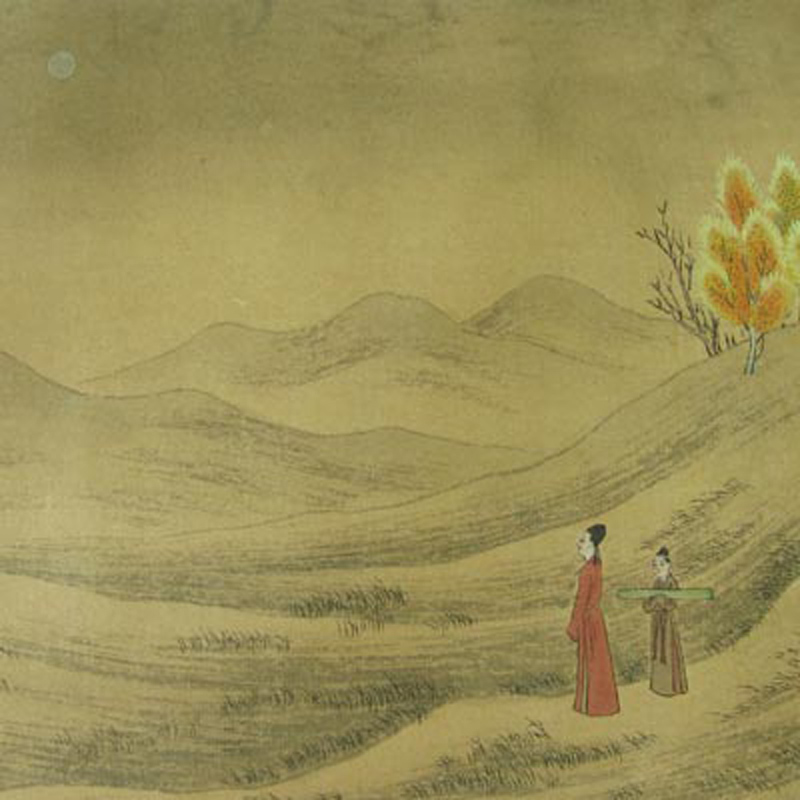 The story related here, and also with the surviving titles
Da Hujia and
Hujia Shibapai,
concerns the experience of Cai Wenji (Cai Yan), a beautiful and talented Han woman,5 after she was abducted by Xiongnu (Central Asian nomads) from her home in Chenliu, in today's Henan province; this took place in the year 190 CE, near the end of the Han dynasty. Cai Wenji was the daughter of the famous literatus Cai Yong (133-192), who died shortly thereafter.6 During her 12-year captivity in Central Asia Wenji was married to one of the Xiongnu chiefs and had two children by him. Thus, although she was terribly homesick living in the desert, when she was ransomed by the famous general Cao Cao (155-220), who had been a friend of her father, leaving her children was also a traumatic experience. Nevertheless, she returned to Chenliu and re-married.
The story related here, and also with the surviving titles
Da Hujia and
Hujia Shibapai,
concerns the experience of Cai Wenji (Cai Yan), a beautiful and talented Han woman,5 after she was abducted by Xiongnu (Central Asian nomads) from her home in Chenliu, in today's Henan province; this took place in the year 190 CE, near the end of the Han dynasty. Cai Wenji was the daughter of the famous literatus Cai Yong (133-192), who died shortly thereafter.6 During her 12-year captivity in Central Asia Wenji was married to one of the Xiongnu chiefs and had two children by him. Thus, although she was terribly homesick living in the desert, when she was ransomed by the famous general Cao Cao (155-220), who had been a friend of her father, leaving her children was also a traumatic experience. Nevertheless, she returned to Chenliu and re-married.
This story soon became quite widely spread, related in poetry and song, and finding its way into the repertoire of various musical instruments, as mentioned in several pre-Tang as well as Tang dynasty sources (drama came later).7 In this it competed in popularity with the story from two centuries earlier about Wang Zhaojun being married to a Xiongnu prince (see #46 Longshuo Cao, Folio Three).
All, or almost all, of the Cai Wenji stories and early melodies would have focused on the nomad reed pipe ("hujia", a term actually rather difficult to translate), but about the earliest melodies nothing is really known. The earliest information about such melodies seems to come from their mention in Song dynasty or earlier poetry, three poems in particular.
- In the Tang dynasty Liu Shang wrote the lyrics in 18 sections later connected to the qin melody Da Hujia
- In the Song dynasty Wang Anshi created another set.
- From even earlier Cai Wenji herself is credited with several poems about the experience, including (rather questionably) the one in 18 sections published in the Yuefu Shiji and set for qin in 1597.
Evidence from poetry does not clarify the ages of the Xiao Hujia and Da Hujia melodies as we know them. For example, one of the earliest references to Xiao Hujia is a poem by Yuan Zhen that connects it to a Tang dynasty qin player named Jiang Xuan.8 And later a qin player of the Southern Tang dynasty (937–976) named Cai Yi9 is also said to have played it. However, although this Xiao Hujia is clearly mentioned in Tang dynasty poetry, and this is not certain for Da Hujia, there is evidence that this Xiao Hujia actually refers to a Xiao Hujia Shibapai, which would presumably have been very different from the present melody, which has only seven sections.
In addition, the Hujia scroll (connected to the melody Da Hujia) reminds us that at least since the Song dynasty this Hujia theme has also been popular in fine art.
As for surviving surviving qin tablature for melodies on this theme, the earliest examples are the two found here from the Ming dynasty publication Shen Qi Mi Pu (1425): Xiao Hujia (four occurrences) and Da Hujia (Long Version of Nomad Reed Pipe; seven occurrences). Nevertheless, both melodies were certainly quite a bit older. Just how much older, however, is up to debate.
Shen Qi Mi Pu (1425) puts Xiao Hujia in Folio 1, which has pieces for which there was old tablature but no players; Da Hujia is in Folio 3, which has pieces that were still played. Although this may suggest that this specific version of Xiao Hujia is more ancient than this specific version of Da Hujia, it does not prove that either the title or the basic melody is older: neither title seems to occur in any of the surviving Tang dynasty melody lists.10
As for actual surviving Xiao Hujia tablatures, these can be found in four handbooks from 1425 to 1585, then once again in 1890 (seems to be unrelated).11 Of the first four, the version in Zheyin Shizi Qinpu (>1505) adds lyrics but is otherwise identical to 1425, as is Fengxuan Xuanpin (1539). Chongxiu Zhenchuan Qinpu (1585) had the same lyrics as Zheyin, but a somewhat different melody.12
Comparing this with Da Hujia, as this chart shows, until 1596 Xiao Hujia occurs in mostly the same handbooks as does Da Hujia, substituting only in inclusion in 1585 instead of 1525. Related Da Hujia then appear in 1596 and 1634 before being replaced in 1689 by a somewhat related but also very different melody called Hujia Shiba Pai; this then became the standard melody up until the present.13
At least one source says that Xiao Hujia had 19 parts, whereas Da Hujia had 18. Its creation or adaptation as a qin piece is generally attributed to Dong Tinglan14 (ca. 695 - 765), a qin master famous for playing several melodies in huangzhong (yellow bell) mode that have a strong non-standard Chinese modal feel.
Although the Ming dynasty versions of Xiao Hujia and Da Hujia have completely different melodies they are connected by this yellow bell mode. In addition they both have a structure whereby each has a phrase that it repeats at the beginning of most sections.
With regard to the mode, perhaps it is significant that Dong was from Longxi,15 a region in Gansu province not far from its current capital, Lanzhou, and about 500 km WNW of Chang An, the Tang capital. He studied qin from Chen Huai(gu),16 who was then serving in the army in Fengzhou, about 150 km upriver from Chang An. Presumably Dong later spent some time in the capital because he became well known in literary circles and was highly praised in several poems. He edited a qin handbook, now lost. Two of his students, Zheng You17 and Du Shanren,18 both also became well-known players.
Three of the four surviving qin handbooks from the 15th and 16th centuries that include Xiao Hujia also have Da Hujia, the latter having 18 sections.19 But after this the Hujia title survived basically as Hujia Shiba Pai (18 Beats of Nomad Reed Pipe), always in 18 sections, though several different new melodies were tried before settling on the version common in the 18th and 19th centuries. Melodically there is little relation between the short and long versions, except that they both use the same huangzhong tuning.
As for the nomad reed pipe itself, it developed into a curved horn with three fingerholes, but the early nomad versions were said to have been made by rolling up a local reed and blowing into it. The sound is commonly said to be mournful and elsewhere it is said that the sound reminded Wenji of her sorrow. Although its mention in Section 2 does not specify who is playing it, the preface does say that Wenji herself rolled up a reed and blew into it. Images alluding to music, however, almost always have her playing qin, not blowing into reed pipes. (Compare Wang Zhaojun, who is commonly depicted with a pipa.)
Besides my own, there are recordings of Xiao Hujia by Xu Jian (first half), Ding Yang and Yao Gongbai, as well as the recording with transcription in Bell Yung's Celestial Airs of Antiquity.
The Emaciated Immortal says
this piece was created by Dong Tinglan in the latter half of the Tang dynasty. It concerns (the following story:)
Music
(timings follow recording on my CD;
聽錄音 listen with
my transcription)
Six sections:21
(00.00) -- Prelude
(01.06) 1. The geese are returning, so she thinks of China
(02.01) 2. Blowing of a reed pipe expresses grief
(02.52) 3. No one to appeal to
(04.26) 4. Offering up a great sigh to heaven.
(07.22) -- Postlude
(10.22) -- Piece ends
None of the melodies in Shen Qi Mi Pu had lyrics, so there are none in my transcription of Xiao Hujia. However, Zheyin Shizi Qinpu added them (see the lyrics alone and also this comment about pairing them). Although the source of these lyrics is not known and they are not paired in a way that seems singable, they are added here out of interest. They are arranged line by line following the pairing of words and music in my transcription from Shen Qi Mi Pu, as linked here and above.
Prelude
東風暖佈陽和,
East winds bring warmth and spread the harmony of spring;
【二作】;夷、夏謳歌。
[Repeat]; the Yi (non-Han) and Xia (Han) are singing together.
兩國友,歡罷兵戈。
The two realms have become friendly, laying down their arms.
漢詔來恩波
A Han decree has arrived bestowing imperial grace.
千金贖妾兮歸鑾坡。
With a thousand in gold the captive lady has been redeemed and will be brought back under imperial escort.
生還那故國,意複嗟跎,分攜二子兮。
Now alive once more she will be in her former land; yet her will sinks back into long regret: she must part from her two sons.
Her tears pour down like rain, becoming a torrent.
第一段 雁歸忠漢
First Section: Returning Geese have made her think of Han
雁南飛,
The wild geese fly south;...;
西風朔漠使妾時思歸。雁飛高兮莫追,徒傷悲,
West winds over the northern desert always make me think of returning home.
When geese fly high I cannot chase them; it only deepens sorrow.
飛低兮身難隨。捲蘆葉兮也學胡人吹。傷悲。
When they fly low — my body still cannot follow them. Rolling up reed leaves, I too learn to blow as the nomads do. Sorrow!
心憤怨兮,腸斷聲淒。其十八拍兮,
My heart filled with anger and resentment, bowels cut up, sounds grievous. As for the "18 Beats" melody,
痛落胡人淚,風寒兮
The pain expressed draws tears from the nomads. The wind is cold.
(泛音起)草木離離。指天問地漢女胡人妻?與雁相期(泛音止)
(Harmonics begin) Grasses and trees are sparse and scattered. Pointing to heaven, questioning earth: am I a Han woman, or a nomad wife? I made an agreement with the geese: (Harmonics end)
Next year! I vow that mother and children will return together and rely on one another. Yet weapons block the roads, perilous;
胡虜煙塵迷。
Nomad smoke and dust obscure the way.
一笳一拍音。誰知。誰知。
One reed-pipe, one blast of sound. Who can understand? Who can understand?
第二段 吹笳訴怨
Second Section: Blowing reed pipes give voice to grievance
聽胡笳,(聽胡笳)
Listen to the nomad reed-pipe, (repeat)
笳聲(作飯哺聲)聲哽咽,風落寒梅花。聽胡笳霜葉兮,蕭蕭下。
With the reed-pipe sound (make rice pecking sounds) each note chokes and sobs; wind scatters fallen cold plum blossoms. Listen to the nomad reed-pipe — frosted leaves fall rustling.
(泛音起)聽胡笳愁絕天涯。(泛音止)
(Harmonics begin) Listen to the nomad reed-pipe — sorrow reaches the ends of the sky. (Harmonics end)
(胡) 聽胡笳,笳萬里歸心賒,心賒。 (笳) (二作)
(Nomad) Listen to the nomad reed-pipe — the heart that longs to return from ten thousand li is deferred, deferred. (Reed-pipe) (Play twice)
Among the Rong and Jie people I was forced into a household, defiled and humiliated, I could only sigh in vain.
(泛音起)疾風千里揚塵沙。(泛音止)
(Harmonics begin) Fierce winds carry dust and sand for a thousand li.(Harmonics end)
(從胡至笳再作,後作滾六至一)
(begin repeat from "nomad" to "reed-pipe")
....
(continue repeat from "nomad" to "reed-pipe", ending with a downward glissando)
第三段 無所控訴
Third Section: No One to Appeal To
無所訴,無所訴,
No one to appeal to, no one to appeal to,
月夜思鄉念土。
On moonlit nights I think of my homeland and long for native soil.
稟氣全生兮莫過吾苦,苦,
Allotted my vital breath, fully alive — nothing surpasses my suffering.
Suffering!
People are displaced and conscripts scattered with the realm in disorder; thus my body has no rightful protector.
於乎薄命薄命遭夷虜,
Alas — thin fate, thin fate, encountering nomadic captors.
無訴,心異俗殊,汲汲也身難處。
No appeal. My heart is different, my customs are alien;
嗜慾不同去取,於阿依誰語。
Anxious and driven, my body finds no place to dwell. To whom can I speak?
悽楚悽楚,日落兮你那悲風起,起。
Such anguish! Such anguish! As the sun sets, those sorrowful winds arise, arise.
失身望原野舊條,烽戍兮萬里。
Bitter, bitter — Dishonored, I gaze toward open plains and old paths; beacon towers stretch ten thousand li.
(泛音起)冰冷草枯,安居茸壘,
(harmonics begin) Ice-cold, grass withered; dwelling in felt ramparts,
牛羊滿野,聚散如蜂蟻,(再作),
Cattle and sheep fill the fields, gathering and scattering like ants and bees. (repeat)
(泛音止)吁嗟兮否安如此。君無義揖讓,臣無禮
(harmonics end) Ah — how can this be peace? The ruler has no righteousness or courtesy; the minister has no ritual.
捐身,無口
Casting away this life. I have no voice
非貪生也而惡死,
— not from craving life, but from loathing death.
胡寵阿兮二子,鞠育兮不羞恥,
The nomads cherish me — two sons; raising them brings no shame.
閔念兮
Pity and remembrance,
骨肉生邊鄙。
Flesh and bone born on the borderlands.
第四段 仰天長嘆
Fourth Section: Long Sighs Toward Heaven
仰天兮,淚雨
I look up to heaven; tears and rain:
交垂。殘生兮將其歸。
they fall together. My remnant life is about to return.
撫抱胡兒兮執袂牽衣,
I embrace the nomad children, clutch sleeves, tug garments;
(二作【從「交」再作】)
(begin repeat of the previous two lines)
(二作【從「交」再作】)
(complete the repeat those two lines)
勞漢使迎歸兮
the Han envoy is wearied, welcoming me home.
駟牡騑騑。攜兒號痛聽失聲兮、聲兮
— Four steeds prancing. Holding the children, wailing in pain, my voice lost, lost,
How fitting is such a sound? Mother and sons appoint tomorrow as the moment of living separation.
愁二子兮寒暑無依,仰天兮日月也無光輝。
I grieve for the two children — through cold and heat they will have no support. I look to heaven — sun and moon have lost their radiance.
(二作【從「愁」再作】)
(repeat the previous line)
顧兒兮生羽翼將同歸,生死兮同相依,相依。
Turning back toward the children — if they grow wings, we will return together; in life and death we have relied on each other, relied on each other.
(二作【從「生」再作】)
(repeat part of the previous line)
看一步一遠兮
Each step I look back, ever farther,
成翹企,魂消夢斷,意絕心達,
Stretching into yearning. Soul dissolves, dreams break; will cut off, heart laid bare;
Liver and bowels severed — no healer exists.
母歸漢兮兒莫之隨,使阿心懸
The mother returns to Han; the children cannot follow. My heart hangs suspended and,
懸兮長如二子飢。四時兮
Prolonged, as if the two children were starving. As for the four seasons -
物盛還有衰,惟我
Things flourish and then decline;
罹此愁兮痛苦心
only I endure this grief, my pain:
無移,砥柱兮萬古無移,移。
unshifting, Like a pillar set in midstream, enduring for ten thousand ages, unmoving, unmoving.
大兒兮,小兒兮,(入殺)更深那夜,
Elder son, younger son (begin ending) deep into the night:
Silently we meet face to face, clearly in dreamlike form.
裡形儀。鍾情細敘兮
Affection poured out in fine detail —
喜還悲。覺後痛心兮無休
Joy mingled with sorrow. After waking, the heart aches without rest,
無歇,何能為笳聲
or pause. How could I make the nomad reed-pipe sound,
拍拍兮成長吁,煥塵兮
Beat after beat, into such long sighing? Dust brightens my face;
滿面西風吹。(正聲畢)
Full upon my face the west wind blows. (The principal section ends)
後敘
Postlude
笳:欲歇兮調促,
The nomad reed-pipe: as it is about to fall silent the melody becomes more urgent.
Grief would stop, but the sound just pauses then continues. (Repeat)
氣填胸兮不成曲。處窮廬兮偶殊俗,
Breath fills the chest; no melody can be formed. Dwelling in poor felt tents, by chance among alien customs.
恩幸漢兮黃金將贖。
Fortune from Han — gold redeemed me.
老天可得從人欲,
Can old Heaven be made to follow human desire?
(泛起)生還漢國兮(再作)
Alive again I have returned to Han lands;
鄉土歡心足。(泛止)二子兮空鞠育,育,
Joy fills the homeland heart. (Harmonics end.) (But) two sons raised only in vain, in vain.
地遙隔兮無由縮,縮,
The lands are far apart; there is no way to shorten the distance.
Life or death — there is nowhere to divine it; tears stain the Xiao and Xiang bamboo.
(泛起)笳聲兮短長,心思兮茫茫,
(Harmonics ) The nomad reed-pipe’s sounds — short and long versions; the heart’s thoughts — vast, indistinct.
(二作) 我與兒兮,
(Repeat) I and my children
(泛止)天各一方,悲傷。日東月西,
(Harmonics end) are each at opposite ends of heaven — I grieve. The sun may rise in the east, the moon set in the west,
空照耀。於我兮雲樹心相望,望。
but it is empty illumination. As for me, clouds and trees seem to face each other longingly, longingly.
寸斷柔腸,
Inch by inch this cuts my soft intestines.
對那萱草兮憂不忘,不忘,
Facing those day-lilies, sorrow is not forgotten, not forgotten.
Resentment (become slow) unites with the qin — how deeply feeling is wounded, wounded.
(入殺)忍拋子兮那歸故鄉,
(Begin the closing) Enduring the casting off of children, I return to my old homeland.
攜手別河梁,(二作)
Hand in hand we part by the riverbank. (Repeat)
舊怨方平兮新怨長。(二作)
Old resentments just calmed; new resentments grow long. (Repeat)
泣血仰頭兮訴蒼蒼,
Weeping blood, raising my head, I appeal to the blue heavens:
胡為生我兮羈此殃?
Why give me life only to bind me in this calamity?
不堪悲喜相為將,
Unable to bear sorrow and joy contending together.
Unable to bear sorrow and joy mixed — the heart aches and nose stings. Mountain passes are steep and obstructed;
行路難中難,思去時兮
Roads are difficult beyond difficulty. Thinking of departure:
(泛起)心寒,(泛止)歸時別兒兮愁漫漫。
the heart turns cold; on returning, parting from children — grief spreads without end.
(泛起)援琴,(泛止)翻調兮難為彈流水高山,
Taking up my qin I must change the tuning: otherwise it is difficult to play tunes like "Flowing Streams" and "High Mountains".
胡漢風俗兮思多般,
As for nomad and Han customs — thoughts multiply.
割骨肉兮成凋殘。恨兮長,壓江山,
Torn from my own flesh and bone, I am left irreparably broken. Grief endures, weighing down mountains and rivers;
(泛起)流離地覆天翻。(泛止)
In such wandering exile, heaven and earth seem overturned.
(曲終)
(Melody ends)
The above translation is tentative, and in some places the pairing seems somewhat at odds with the meaning of the text.
Note that in some other pairings from Zheyin Shizi Qinpu, such as with the melody Guan Ju, it seems that the person or persons who wrote the transcription must have been quite clear as to how the melody should sound and thus the lyrics fit well with the music. Here, however, this is not so obvious: it was one of the melodies Zhu Quan placed in Shen Qi Mi Pu Folio 1, which had the "most ancient pieces", melodies for which he could find only tablature, no players. The style of the tablature makes it difficult to doing the pairing in the traditional manner. And since idiomatically it does not seem like it was intended to be a song, it takes careful listening to hear the logic of the pairing.
Return to the top
Footnotes (Shorthand references are explained on a
separate page)
1.
Translating "大 Da" and "小 Xiao" with regard to 胡笳 Hujia (for "hujia" itself see under
Da Hujia)
QSCB also discusses these titles. As can be seen, translating the two titles "Da Hujia" and "Xiao Hujia" is not as clear as it might initially seem. Specifically regarding "大 da" and "小 xiao", here are some considerations:
- With these two melodies, "Da" and "Xiao" are most commonly translated into English as "Long" and "Short", so perhaps it is simplest simply to follow this convention. This translation is supported by the fact that the the surviving Da Hujia has 18 sections while Xiao Hujia has only 6. However, the actual difference in playing time between the two is not necessarily so dramatic: on my Shen Qi Mi Pu CDs Xiao Hujia is 10.22 while Da Hujia is 12.04. In addition, as stated below (specifically here), at one time the "xiao" version may have had 19 sections compared to 18 for the "da" version. One explanation could be that the surviving "xiao" version is an abridgement of a piece of this title that originally had 19 sections. On the other hand, perhaps the "da" and "xiao" referred to function.
- Along this line, this source says these two melodies actually served different functions, one for arrivals, the other for departures. Was one more grand than the other?
- Looked at another way, with "Grand Version of Hujia" used here to translate Da Hujia perhaps the best translation for Xiao Hujia would be "Modest Version" or even "Personal Version" of "Hujia".
- Also in this context, "da" and "xiao" could actually refer to two versions of the instrument itself, so translating them as "big" and "small" could suggest the two melody titles refer to two specific versions of the reed pipe.
- One must also consider the possibility that the contrast between "da" and "xiao" was intended as "earlier" versus "later". Thus, the comment here suggests that the 18 section version was an earlier one played by the Shen family while the 19 section version was a later one played by the Zhu family. Is it then possible that during the Tang dynasty, when the two existed side by side, some people referred to the 19 section version as "xiao" because it came later?
- This latter brings up the possibility that the contrast between "da" and "xiao" was intended as "greater" versus "lesser": perhaps some people were denigrating one version, or perhaps it was that the xiao version was simply less popular. Based on my understanding, the xiao version is certainly less structured; it also has no known links to poetry and painting.
Here it should be kept in mind that in spite of their modal similarities the "da" and "xiao" melodies are very different. In other words, there is no particular reason to think they both came from the same source.
As yet, to my knowledge, there are no definitive answers to these questions.
(Return)
2.
References related to 小胡笳 Xiao Hujia
See in Xu Jian, QSCB, Chapter 5 as well as under Da Hujia,
18 Blasts and the
Hujia scroll.
Xiao Hujia-related references from ZWDCD include:
- 7632.411 小胡笳 Xiao Hujia says only "樂器名,參見十九拍,祝家聲條 name of a music instrument; see 'Zhu family sounds' under the '19 pai' entry (2741.155). (Calling it an instrument name instead of a melody name is probably a mistake.)
- 2741.155 十九拍 Shijiu Pai (19 pai [sections/beats])
"胡笳曲名,後漢蔡邕作。參見十八拍條。Name of a Hujia melody, by Cai Yan of the Latter Han dynasty. See "18 pai" (2741.174)
One reference: 樂府詩集,琴曲歌辭,胡笳十八拍 YFSJ, Qin Melody Lyrics, Hujia Shibapai. This reference quotes the YFSJ passage quoting Qin Ji and Cai Yi Qin Qu as given (and partially translated) here. - 2741.174 十八拍 Shiba pai (18 pai [sections/beats])
See under Da Hujia references
As for titles beginning "Hujia 胡笳", 30073.357-361 has these five entries:
There is no separate entry for 胡笳弄 Hujia Nong although this is mentioned in the YFSJ quote of Liu Shang's preface with .539 Hujia Shibapai above.
Further regarding Xiao Hujia, in addition to the
above references and their links, 41049.1228 金徽 Jin Hui (Golden Studs) quotes a Preface to Xiao Hujia (see below) by the Tang writer Yuan Zhen.
3.
Yellow Bell Mode (黃鐘調 Huangzhong Diao
4.
Cai Wenji and her qin
Says it is a musical instrument (see
image); references do not seem to mention a specific melody title
Reference is to a poem by 岑參 Cen Shen (715 - 770) called "酒泉太守席上醉後作"詩. It is the first of two with this title, the complete poem being,
酒泉太守能劍舞,高堂置酒夜擊鼓;
胡笳一曲断人肠,座上相看泪如雨。
Reference is as a qin melody title in
Yuefu Shiji; see in particular the Liu Shang preface
Reference is also as a qin melody title in
Yuefu Shiji
Reference, as a song accompanying the melody Hujia, is to another poem by 岑參 Cen Shen:
"胡笳歌送顏眞卿使赴河隴"詩.
(Return)
For Huangzhong (or Wuyi) mode, slacken 1st, tighten 5th strings each a half step. For more details on this mode see under Kai Zhi and in Shenpin Wuyi Yi. For more on modes in general see Modality in Early Ming Qin Tablature.
(Return)
The above image is from #4 in the scroll 18 Songs of the Nomad Flute. At least six of the 18 paintings in the set show a servant standing next to Cai Wenji holding her qin.
| Wenji with a nomad reed pipe (expand) |
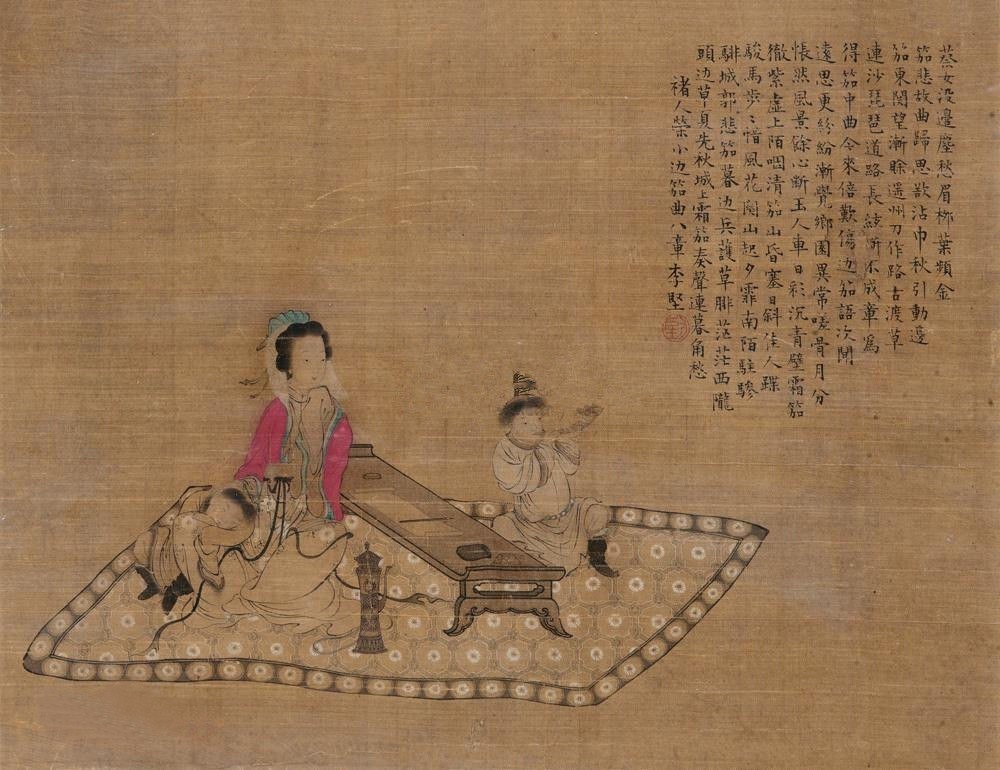 In contrast, paintings showing Cai Wenji with a 胡笳 nomad reed pipe are more rare. The one at right, copied from the internet, where it is sometimes titled "清李堅:文姬思漢圖 Wenji Thinks of Han, by Li Jian of the Qing dynasty", is one such example. It shows her with two children, perhaps her own; one is playing the pipe.
Regarding Li Jian, 14819.1082/d is "李堅,相符人,字敬堂,號琴浦,一作琴甫...乾隆進士" a Li Jian from Xiangfu (?) who achieved his jinshi during the Qianlong reign (1711-1799), then became an official. However, although I found the image in several places on the internet, none seems to give any further information about the artist or about the source/location of the painting, so at present I am not yet sure whether it is by the same person. I am also not clear where the apparent title comes from or the meaning of the last line, "褚人榮小邊笳曲八章李堅".
(Return)
5.
蔡琰 Cai Yan, also called 蔡文姬 Cai Wenji
Cai Yan has a biographical entry in in Qin Shi and there is further information under Shen Qi Mi Pu melody #47 Da Hujia. Giles gives much the same story under Ts'ai Yen, also mentioning her skill in music.
(Return)
6.
蔡邕 Cai Yong
Cai Yong is connected to a number of melodies, including #13 Qiuyue Zhao Maoting ;
(Return)
7.
Hujia theme in various media
In addition to the above there is considerable detail in Xu Jian, op. cit. For drama see under Cai Wenji.
(Return)
8.
Tang poetry specifically mentioning Xiao Hujia
The best known example seems to be 小胡笳引 Xiao Hujia Yin by 元稹
Yuan Zhen (779-831). "Xiao Hujia Yin" means "Prelude to Xiao Hujia", and although the lyrics seem generally to be attributed to Yuan Zhen, the poem is also sometimes referred to as "無名氏 Anonymous, 姜宣彈小胡笳引歌
Jiang Xuan plays a prelude song for Xiao Hujia", suggesting that Yuan Zhen wrote a separate preface.
The lyrics are as follows:
Yuan Zhen: Short Nomad Reed-pipe Prelude
雷氏金徽琴, 王君寶重輕千金。
(王君 Master Wang: 王建 Wang Jian? 767–830)
A Lei-family qin with golden inlay markers,
treasured by Master Wang more than a thousand in gold.
三峽流中將得來,明窗拂席幽匣開。
Brought back from amid the currents of the Three Gorges,
by a bright window the mat is brushed, the quiet case opened.
朱弦宛轉盤鳳足,驟擊數聲風雨迴。
Vermilion strings curve and coil about the phoenix feet;
a sudden striking of several notes—wind and rain return.
哀笳慢指董家本,姜宣得之妙思忖。
(See QSCB, p. 55)
The plaintive reed-pipe is fingered slowly, after the Dong-family version;
Jiang Xuan grasped it through subtle reflection and thought.
汎徽胡雁咽蕭蕭,繞指轆轤圓衮衮。
Harmonics drift—nomad geese choke and cry, desolate;
winding fingers turn and roll round and round.
吞恨含情乍輕激,故國關山心歷歷。
Swallowing grief, containing feeling, suddenly lightly strike it;
the old homeland’s passes and mountains stand out vividly in the heart.
潺湲疑是舞鸊鵜,砉騞如聞發鳴鏑。
The murmuring seems like mandarin ducks dancing on water;
the crack and snap is like hearing whistling arrows released.
流宮變徵漸幽咽,別鶴欲飛猨欲絕。
(流宮 17762.xxx)
Flowing gong shift to zhi, growing ever more dark and choked;
a parting crane longs to fly, gibbons seem about to die.
秋霜滿樹葉辭風,寒雛墜地烏啼血。
Autumn frost fills the trees, leaves bid farewell to the wind;
chilled chicks fall to the ground, crows cry tears of blood.
哀弦已罷春恨長,恨長何如懷我鄉。
When the sorrowful strings end, spring grief remains long;
how could that long grief compare with longing for my home?
我鄉安在長城窟,聞君膚奏心飄忽。
Where is my home? — at the caves by the Great Wall;
hearing your bare-handed playing, my heart drifts away.
何時窄袖短貂裘,臙脂山下彎明月。
(臙脂山 Yanzhi Shan: "Rouge mountain", in Gansu)
When will it be again: narrow sleeves, a short sable coat,
beneath Yanzhi Mountain, the bright moon curved?
Translation tentative.
(Return)
9.
Cai Yi 蔡翼
32581.xxx; Bio/2446xxx (Sui). Qin player of the Southern Tang dynasty. To my knowledge it is not clear from the references to Xiao Hujia in Qinshu Cunmu and
Qin Diao what exactly he played. The reference to him in Yuefu Shiji concerns only his comment on the melody, as follows:
According to Cai Yi's "Qin Melodies" there are Long and Short (versions of) Hujia Shibapai. Shen Liao's Collection (says) at that time it was common that Xiao Hujia also had a 契聲 (summary/outline sounds?), giving it 19 in all; this was called the Zhu family version. It is not clear to what period Mr. Zhu belonged.
契聲 qisheng 6038.xxx, but there are further references in connection to Guangling San, Li Liangfu and in Qinshu Daquan Folio 13 Melody Addenda.
(Return)
10.
Which is earlier, Da Hujia or Xiao Hujia?
Regarding the age of "Hu Jia" see above. Logic suggests that the title "Hujia" should occur before either "Xiao Hujia" or "Da Hujia", and indeed early melody lists mention only "Hujia". This, however, even if this is true it is not proof of the relative age of the actual melodies. For example, these could first have appeared under completely different titles.
(Return)
11.
Tracing Xiao Hujia
See Zha Fuxi's Guide, 3/35/42. More details are in the appendix.
(Return)
12.
Lyrics from >1505 and 1585
The complete Zheyin lyrics are above (also
here). At that time adding lyrics did not necessarily mean the melody was intended for singing. As described here, lyrics were paired to the music by a formula that was intended basically to assign one character to each right hand stroke and to certain left hand plucks (slides usually do not have characters paired). This method meant that characters could at times have been paired by someone who was simply looking at the tablature and may never have heard the music. Leaving aside the issue of singability, such pairing is relatively straightforward with simple right hand tablature, but old tablature sometimes uses multi-stroke right hand indications and unspecified repeat indications that defy this system. Thus the lyrics added to the prelude begin with two phrases of 6 then 4 characters, but the tablature it accompanies begins with a phrase having 9 right hand strokes repeated then a phrase of four right hand strokes. The complete lyrics of this prelude are as follows:
束風暖佈陽和,夷夏嘔歌,兩國友歡罷兵戈。漢詔來恩波,千金贖妾兮歸鑾坡。生還那故國,意復蹉跎。分攜二子兮,淚流如雨成滂沱。"
As for pairing these lyrics with the 1585 tablature I have not yet examined that aspect.
(Return)
13.
The survival of Xiao Hujia and Da Hujia
There is some discussion here of the general survival of melodies from Shen Qi Mi Pu Folio 1 (and some other apparently old melodies).
(Return)
14.
Xu Jian, Qinshi Chubian, p.55, discusses Dong Tinglan.
(Return)
15.
42837.8 隴西 Longxi; almost all references are to Gansu
(Return)
16.
Qinshu Cunmu Folio II #2 lists a "Qinpu 21 folios" under his name,
connecting it also with Zhao Yeli.
(Return)
17.
Zheng You 鄭宥 40513.xxx
(Return)
18.
Du Shanren 杜山人
The proper name of Du Shanren (Mountain Man Du) was apparently 杜陵 Du Ling.
(Return)
19.
See also Qinshu Daquan (1590, V. pp.222, 261-7 and 270. No music included but a great variety of commentary on different versions and sources of this piece.
(Return)
20.
For the original Chinese text see 小胡笳.
(Return)
21.
前敘; (一)鴈歸思漢; (二)吹笳訴怨; (三)無所控訴; (四)仰天長嘆;後敘。
(Return)
Return to the top
Appendix: Chart Tracing Xiao Hujia
(compare Da Hujia)
Based mainly on Zha Fuxi's Guide
3/35/44
|
琴譜
(year; QQJC Vol/page) |
Further information
(QQJC = 琴曲集成 Qinqu Jicheng; QF = 琴府 Qin Fu) |
|
1. 神奇秘譜
(1425; I/130) |
6T (1+4+1); no phrasing indicated
|
|
2. 浙音釋字琴譜
(>1505; I/249) |
6T (1+4+1); adds lyrics; otherwise same as 1425. However, the lyrics don't match very well and the melody does not easily lend itself to singing. |
|
3. 風宣玄品
(1539; II/368) |
6t (1+4+1); same as 1425 but with phrasing indicated
|
|
4. 重修真傳琴譜
(1585; IV/492) |
6T (1+4+1); lyrics as >1505; music related but different from above
(No Da Hujia) |
|
5. 希韶閣琴瑟合譜
(1890; XXVI/462) |
11T (1+9+1); lyrics; pairs the se zither part; melody is quite different from the above |
Return to the top, to the Shen Qi Mi Pu ToC, or to the Guqin ToC.