|
T of C
Home |
My Work |
Hand- books |
Qin as Object |
Qin in Art |
Poetry / Song |
Hear, Watch |
Play Qin |
Analysis | History |
Ideo- logy |
Miscel- lanea |
More Info |
Personal | email me search me |
| Taiyin Daquanji ToC Folio 3 Folio 4: ToC 1 / 2 / 3 / 4 / 5< /A> / 6 / 7-21 / Folio 5 ToC | 網站目錄 |
|
Taiyin Daquanji
1
Folio 4, Part 6: Qin Critique Chapter 琴議篇 Qin Yi Pian (QQJC I/83) 2 |
太音大全集
卷四,己:琴議篇 |
| Qin Yi Pian; QQJC I/83b-84a |
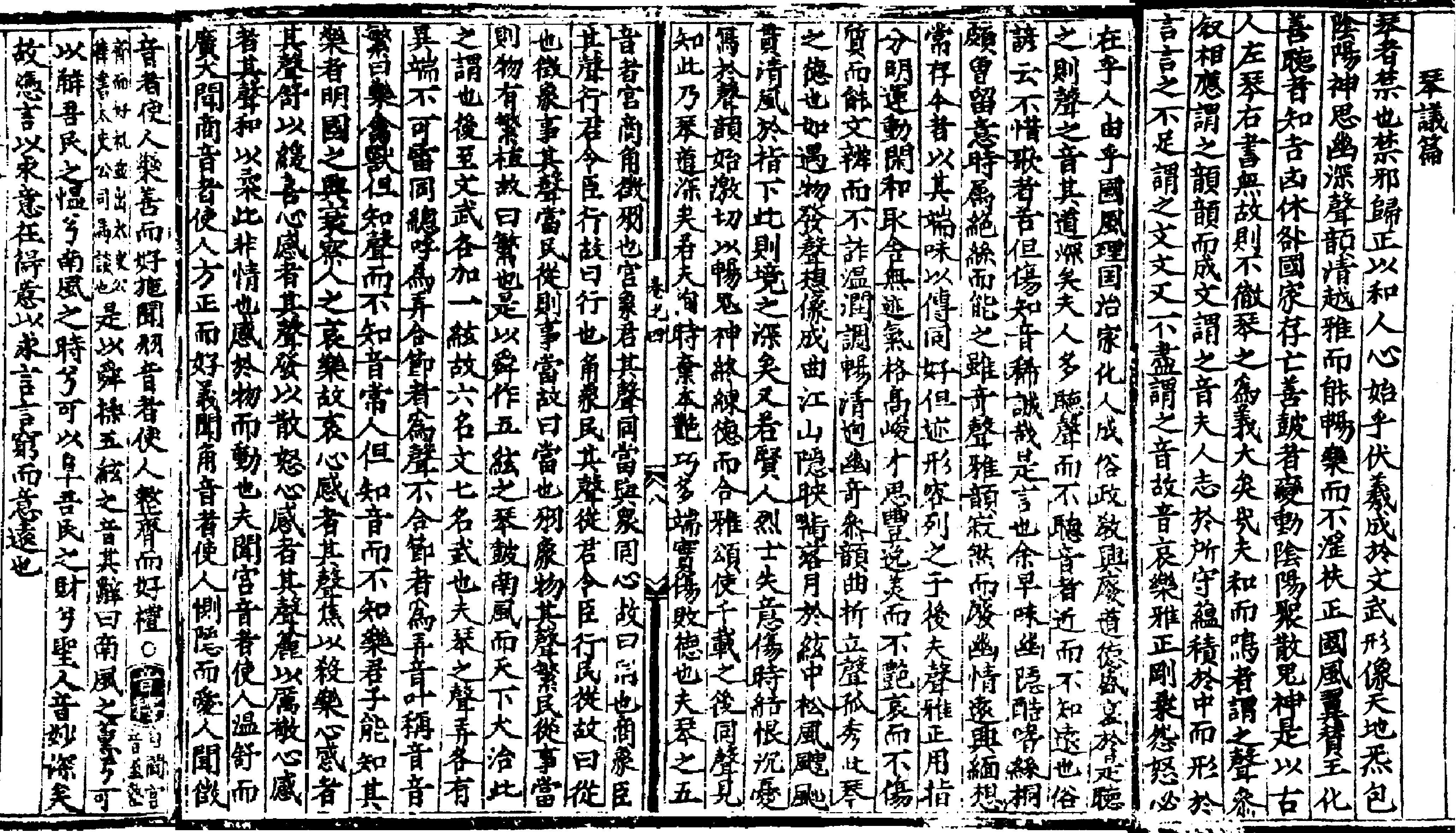 Part Six: Qin Critique Chapter
琴議篇 Qin Yi Pian
This essay, elsewhere attributed to Liu Ji, is discussed by Xu Jian in QSCB. (Corrections) here in the text come from other editions.
“Qin" signifies "restraint", meaning it restrains evil and returns one to propriety, harmonizing the human heart (see Huan Tan, Xin Lun.
始手伏羲,成於文、武。
It began at the hand of Fuxi then was perfected by Wen Wang and
Wu Wang.
形像天地。炁包陰陽。
Its form resembles Heaven and Earth; its vital energy encompasses yin and yang.
神思幽深。聲、韻清越。
Its spirit and thought are profound; its sound and sonority are clear and far-reaching.
雅而能暢,樂而不淫揺。
It is refined yet expressive, joyous but not indulgent or wavering.
扶正國風,翼贊王化。
It upholds the righteousness of national customs and assists in the transformation of the ruler’s virtue.
善聽者,知吉凶休咎。國家存亡。
One who listens well can discern fortune and misfortune, prosperity and calamity, as well as the survival or downfall of a nation.
善豉者,變動陰陽。聚散鬼神。
One who plays well can influence the movements of Yin and Yang and summon or disperse spirits and deities.
是以古人左琴、右書。無故則不徹。琴之為義大矣哉。
Therefore, in ancient times, scholars placed a qin to their left and books to their right, and they would not play it without purpose. How great is the significance of the qin!
夫和而鳴者謂之聲,參叙相應謂之韻,韻而成文謂(之)音。
夫人志於所守,蘊積於中而形於言。
言之不足謂之文,文又不盡謂之音。
故音哀樂雅正,剛柔怨怒,必在乎人。
由乎國風理國治家,化人成俗。
政教興廢,道德盛衰,於是聽之則聲之音。其道深矣。
夫人多聽聲而不聽音者,近而不知遠也。
俗諺云,不惜歌者,若但傷知音稀。誠哉是言也。
余早味幽隱,酷嗜絲桐。頗曾留意。
時屬絕絲,而能之。
雖奇聲雅韻,寂然而廢。
幽情遠興,緬想常存。
今者以其端味,以傳同好。
但跡形容,列之于後:
用指分明。 運動閑和。 取舍無跡。 氣格高峻。 才思豐逸。 美而不艷。 哀而不傷。 質而能文。 辨而不詐。 溫潤調暢。 清逈幽奇。 參韻曲折。 立聲孤芳。 此琴之德也。
如遇物發聲,想像成曲:
江山隱映,㘅落月于絃中。
松風颼飀,貫清風于指下。
此則境之深矣。
又若賢人烈士,失意傷時,結恨沉憂,寫于韻聲,
始激切以暢鬼神,終練德而和雅頌。
使千載之後,同聲見知。
此乃琴道深矣。
若夫徇時棄本,艷巧多端,實傷敗德也。
Whatever is concordant when resonating is called "sound" ("聲 sheng");
if (these sounds) mix in an organized manner as they resonate it is called "sonority" ("韻 "yun");
when sonority forms meaningful patterns it is called "music" ("音 yin").
A person’s will adheres to what they uphold; it accumulates within and manifests in words.
When words are insufficient, they become writing (文). When writing is still incomplete, it becomes sound (音).
Thus, sound contains sorrow and joy, refinement and righteousness, strength and gentleness, resentment and anger—all of these are found within human nature.
Through national customs, it governs the state and regulates the family, transforming people and establishing traditions.
The rise and fall of governance and education, the flourishing and decline of morality—all of these can be understood through listening to sound and tone. Its principle is profound indeed.
Many people listen only to ‘sound’ (聲) but do not perceive ‘tone’ (音); they focus on what is near and do not understand what is distant.
As the common saying goes: "One does not grieve for the singer, but rather laments how rare it is to find someone who understands the music." How true these words are!
Since my early years I have taken delight in seclusion, with an intense love for silk and tong wood. I have devoted considerable attention to it.
Yet at times, the tradition of silk strings (guqin playing) was severed, and still, I was able to carry it on.
Though its wondrous sounds and refined resonance fell into silence and neglect,
My deep sentiments and distant inspirations remained, lingering in thought.
Now, I wish to capture its essence and pass it on to those who share this passion.
I merely record its traces and descriptions, setting down (its virtues) here below:
夫聲雅正。Its sound is elegant and upright.
Its use of the fingers is clear and distinct.
Its movements are measured and harmonious.
Its execution leaves no trace of hesitation.
Its spirit and character are lofty and imposing.
Its talent and inspiration are abundant and free-flowing.
It is beautiful but not gaudy.
It is sorrowful but not distressing.
It is simple yet refined.
It is articulate but not deceitful.
It is warm, smooth, and well-balanced.
It is pure, distant, deep, and unique.
Its sonority is layered and intricate.
Its sound stands apart like a solitary fragrance.
Those are the virtues of the qin.
When encountering things, sounds emerge; imagining them, melodies take shape.
The rivers and mountains are veiled in mist, casting the setting moon into the strings.
The rustling of the pine winds flows through the fingers, carrying the essence of the pure breeze.
This is the depth of artistic conception.
Or when virtuous men and heroic scholars, having lost their way in troubled times, pour their grievances and deep sorrows into the sonority of sound,
At first, their tones are intense and stirring, moving even spirits and deities; in the end, they refine their virtue, harmonizing into elegance and praise.
Thus, across a thousand generations, those who share this sound will understand one another.
This is the profundity of the "way of the qin
And yet, if one conforms to worldly trends and abandons the fundamental essence, indulging in excessive ornamentation and artificial complexity, it truly harms and corrupts virtue.
Much of the information here is also elsewhere in early qin handbooks.
Go to text on next page.
Or return to the Folio 4 Table of Contents
Footnotes (Shorthand references are explained on a
separate page)
1.
太音大全集 Taiyin Daquanji Folio 4, Part 6 (QQJC 30 Volume edition I/83; QF/77-78)
See also the Comment on the different editions.
(Return)
2.
Explanations by translator
See comments concerning the structure of the original text.
(Return)
Return to Taiyin Daquanji